
The evolution of gear manufacturing is a testament to the relentless pursuit of precision and efficiency. My extensive involvement in this field has centered on a critical transition: moving from complex, dedicated mechanical machines to the flexible world of computer numerical control (CNC). This journey is particularly fascinating in the realm of spiral bevel and hypoid gear cutting, where the traditional methods, while ingenious, presented significant challenges in setup time, operator skill, and machine complexity. The advent of universal CNC gear cutting machines promised a revolution, but it necessitated a fundamental rethinking of the underlying kinematics. This article delves into the core principles of a universal kinematic transformation method, developed to seamlessly translate the intricate motions of conventional mechanical gear generators into the straightforward language of a five-axis CNC machining center.
Traditional Gleason-system mechanical gear cutting machines, designed for specific methods like the Fixed Setting, Modified Roll (or roll), and Tilt methods, rely on a labyrinth of gears, cams, and a critical component called the cradle. The cradle acts as a simulated generating gear. Its complex, machine-dependent kinematics made each machine a specialized tool, requiring elaborate setup calculations and skilled operators. The process was time-consuming and less adaptable. The modern paradigm, exemplified by machines like the PHOENIX series, strips away this mechanical complexity. A universal CNC gear cutting machine typically features three linear axes (X, Y, Z) and two rotational axes (A, B), with an optional sixth axis (C) for continuous cutter rotation control. This simple structure begs the question: how can we replicate decades of refined gear cutting science on this new, agile platform? The answer lies not in reinventing the wheel, but in a precise mathematical transformation—a kinematic bridge between the old and the new.
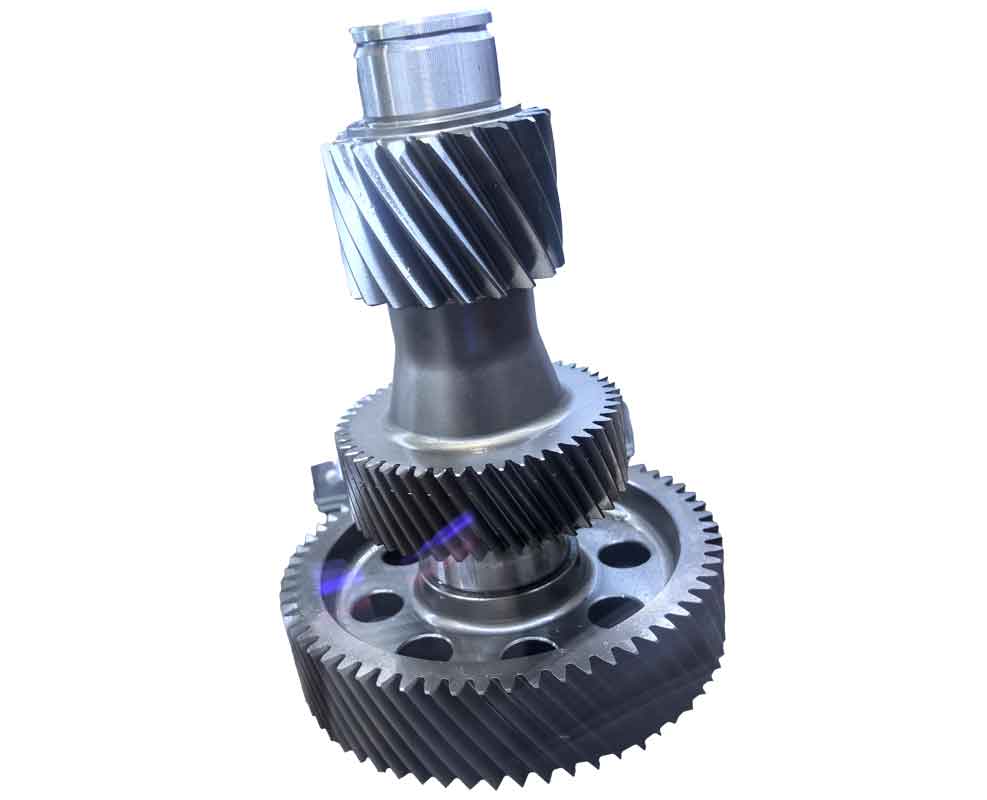
Fundamental Principle: From Machine Adjustments to Tool Path
The core task in enabling CNC gear cutting is to derive the precise position and orientation (the “tool pose”) of the cutter relative to the workpiece gear blank, based solely on the established machining parameters from traditional methods. This process is known as tool position calculation. We start by modeling the kinematic chain of a traditional cradle-type machine with a tilting head. The key is to define a series of coordinate systems that capture all relevant motions and adjustments.
Let us establish a machine-fixed coordinate system, $\Sigma_m = \{O; \mathbf{i}_m, \mathbf{j}_m, \mathbf{k}_m\}$, where $O$ is the cradle center and $\mathbf{k}_m$ is the cradle axis. A workpiece coordinate system, $\Sigma_w = \{O_o; \mathbf{i}_w, \mathbf{j}_w, \mathbf{k}_w\}$, is attached to the gear blank, with $O_o$ being the crossing point of the gear and pinion axes and $\mathbf{i}_w$ aligned with the workpiece axis. An intermediate coordinate system $\Sigma_t$ is also fixed to the machine bed, with its $\mathbf{i}_t$ axis aligned with the workpiece axis and $\mathbf{j}_t$ aligned with $\mathbf{j}_m$.
The traditional machine adjustments are: the machine root angle $\delta_m$, the sliding base (or “bed”) setting $x_b$, the work offset $E$, the axial work setting $x_p$, the radial tool setting $S$, the angular tool setting $q$, the cutter tilt angle $i$, and the cutter swivel angle $j$. During the gear cutting process, the cradle rotates through an angle $q$ while the workpiece rotates through a corresponding angle $\phi$, linked by a precise ratio (the generating roll ratio).
The homogeneous transformation matrix from $\Sigma_m$ to $\Sigma_t$ is derived from the geometric relationships:
$$
\mathbf{M}_{mt} =
\begin{bmatrix}
\cos\delta_m & 0 & \sin\delta_m & -x_p – x_b\sin\delta_m \\
0 & 1 & 0 & E \\
-\sin\delta_m & 0 & \cos\delta_m & -x_b\cos\delta_m \\
0 & 0 & 0 & 1
\end{bmatrix}
$$
The transformation from $\Sigma_t$ to $\Sigma_w$ accounts for the workpiece rotation $\phi$:
$$
\mathbf{M}_{tw} =
\begin{bmatrix}
1 & 0 & 0 & 0 \\
0 & \cos\phi & -\sin\phi & 0 \\
0 & \sin\phi & \cos\phi & 0 \\
0 & 0 & 0 & 1
\end{bmatrix}
$$
In the machine coordinate system $\Sigma_m$, the position vector of the cutter center $O_c$ and the direction vector of the cutter axis $\mathbf{c}$ are functions of the tool settings:
$$
\mathbf{R}_m = \begin{bmatrix} S\cos q \\ 0 \\ S\sin q \\ 1 \end{bmatrix}, \quad
\mathbf{c}_m = \begin{bmatrix} \sin i \cdot \sin(q – j) \\ \sin i \cdot \cos(q – j) \\ \cos i \\ 0 \end{bmatrix}
$$
Therefore, the fundamental tool pose in the workpiece coordinate system—the absolute cornerstone for accurate CNC gear cutting—is calculated by the following concatenated transformations:
$$
\mathbf{R}_w = \mathbf{M}_{tw} \mathbf{M}_{mt} \mathbf{R}_m
$$
$$
\mathbf{c}_w = \mathbf{M}_{tw} \mathbf{M}_{mt} \mathbf{c}_m
$$
These equations, $\mathbf{R}_w$ and $\mathbf{c}_w$, represent the universal description of the tool path for spiral bevel and hypoid gear generation. They encapsulate the essence of the traditional process, independent of any specific machine structure. The relationship between $q$ and $\phi$ is defined by the chosen generation law (e.g., uniform roll, modified roll for tooth profile correction), which is a separate but integral part of the gear cutting theory.
| Traditional Adjustment Parameter | Symbol | Description | Role in Kinematic Chain |
|---|---|---|---|
| Machine Root Angle | $\delta_m$ | Angle of workpiece axis relative to machine base. | Defines initial workpiece tilt in $\mathbf{M}_{mt}$. |
| Sliding Base / Bed | $x_b$ | Linear adjustment of workpiece along its axis. | Contributes to translational components in $\mathbf{M}_{mt}$. |
| Work Offset | $E$ | Perpendicular distance from cradle center to workpiece axis. | Directly sets the Y-offset in $\mathbf{M}_{mt}$. |
| Axial Work Setting | $x_p$ | Position of workpiece along its axis relative to crossing point. | Contributes to X-offset in $\mathbf{M}_{mt}$. |
| Radial Tool Setting | $S$ | Distance from cradle center to cutter center. | Magnitude of $\mathbf{R}_m$ vector. |
| Angular Tool Setting | $q$ | Cradle rotation angle (generating roll). | Primary motion parameter; defines $\mathbf{R}_m$ and $\mathbf{c}_m$. |
| Cutter Tilt Angle | $i$ | Inclination of cutter axis from vertical. | Defines the orientation vector $\mathbf{c}_m$. |
| Cutter Swivel Angle | $j$ | Rotation of cutter tilt plane. | Defines the orientation vector $\mathbf{c}_m$. |
| Workpiece Rotation | $\phi$ | Gear blank rotation, synchronized with $q$. | Defines the generating motion in $\mathbf{M}_{tw}$. |
Transformation to Universal CNC Machine Axes
Once the tool pose relative to the workpiece $(\mathbf{R}_w, \mathbf{c}_w)$ is known for every instant of the generation process, the next step is to command the universal CNC gear cutting machine to physically achieve this relative pose. This is the inverse kinematic problem for our specific machine topology. The goal is to decompose the complex relative motion into the simple, independent motions of the machine’s five axes: three linear coordinates for the cutter head position $(X, Y, Z)$ and two rotational coordinates for the workpiece orientation $(A, B)$.
We again define a machine coordinate system $\Sigma_m = \{O_o; \mathbf{i}_m, \mathbf{j}_m, \mathbf{k}_m\}$, now anchored at the gear axis crossing point $O_o$, with the $\mathbf{i}_m-\mathbf{j}_m$ plane representing the “machine plane” (often the plane of the B-axis rotary table). The workpiece coordinate system $\Sigma_w$ remains attached to the gear blank. For a given tool pose $(\mathbf{R}_w, \mathbf{c}_w)$ in $\Sigma_w$, we need to find the machine axis positions that will bring the workpiece into an orientation where its axis lies in a plane parallel to the cutter’s reference plane, and then position the cutter head accordingly.
Conceptually, we need to find two angles, $\alpha$ and $\beta$, such that:
- Rotating the workpiece by $\alpha$ about its own axis ($\mathbf{i}_w$) brings the tool center point onto a plane parallel to the machine’s $\mathbf{i}_m-\mathbf{j}_m$ plane.
- Tilting the workpiece axis by an angle $\beta$ around the $\mathbf{j}_m$ axis makes the workpiece axis parallel to the machine plane. This tilt angle $\beta$ corresponds directly to the B-axis rotation command.
- The angle $\alpha$ corresponds directly to the A-axis (workpiece spindle) rotation command.
- After these rotations, the coordinates of the tool center in the machine plane $\Sigma_m$ become the X, Y, Z commands.
To formalize this, we introduce an intermediate frame $\Sigma_t$ fixed to the machine, with $\mathbf{i}_t$ aligned with the workpiece axis after the B-axis tilt, and $\mathbf{j}_t$ aligned with $\mathbf{j}_m$. The transformation from the workpiece system $\Sigma_w$ (after it has been rotated by A) to $\Sigma_t$ is a rotation by $\alpha$ around the $\mathbf{i}$-axis:
$$
\mathbf{M}_{wt} =
\begin{bmatrix}
1 & 0 & 0 & 0 \\
0 & \cos\alpha & \sin\alpha & 0 \\
0 & -\sin\alpha & \cos\alpha & 0 \\
0 & 0 & 0 & 1
\end{bmatrix}
$$
The transformation from $\Sigma_t$ to the machine system $\Sigma_m$ is a rotation by $\beta$ around the $\mathbf{j}$-axis:
$$
\mathbf{M}_{tm} =
\begin{bmatrix}
\cos\beta & 0 & -\sin\beta & 0 \\
0 & 1 & 0 & 0 \\
\sin\beta & 0 & \cos\beta & 0 \\
0 & 0 & 0 & 1
\end{bmatrix}
$$
The complete transformation from the oriented workpiece to the machine system is therefore:
$$
\mathbf{M}_{wm} = \mathbf{M}_{tm} \mathbf{M}_{wt}
$$
The position of the tool center in the machine coordinate system, which gives the linear axis commands, is:
$$
\mathbf{R}_m = \mathbf{M}_{wm} \mathbf{R}_w
$$
However, $\alpha$ and $\beta$ are not given; they must be solved for. They are determined by imposing the condition that after the transformation, the cutter axis vector $\mathbf{c}_w$ (when expressed in $\Sigma_m$) should have no component along the machine’s $\mathbf{k}_m$ axis—meaning it is perpendicular to the machine plane, which is the condition for the cutter’s reference plane to be parallel to the machine plane. Simultaneously, the $\mathbf{k}_w$ component of the transformed tool center position $\mathbf{R}_m$ should be zero, placing it in the machine plane. Solving these conditions leads to the following key equations for the rotary axis commands:
$$
\beta = \arctan\left(\frac{c_{w,z}}{c_{w,x}}\right) \quad \text{(derived from orienting the cutter axis)}
$$
$$
\alpha = \arctan\left(\frac{R’_{w,z}}{R’_{w,y}}\right) \quad \text{(derived from placing the tool center in the machine plane)}
$$
Where $c_{w,x}, c_{w,z}$ are components of $\mathbf{c}_w$, and $R’_{w,y}, R’_{w,z}$ are components of a partially transformed tool position. The final linear axis commands $(X, Y, Z)$ are the components of the fully transformed $\mathbf{R}_m$ vector from the equation above:
$$
X = R_{m,x}, \quad Y = R_{m,y}, \quad Z = R_{m,z}
$$
This set of calculations—from traditional parameters to tool pose to machine axes—constitutes the complete universal kinematic transformation. It is executed for every point along the generating roll, producing a numerical control (NC) program that drives the universal CNC machine.
| CNC Machine Axis | Symbol | Derived From | Mathematical Determination |
|---|---|---|---|
| Workpiece Tilt (B-axis) | $B$ | Cutter Axis Orientation $\mathbf{c}_w$ | $B = \beta = \arctan(c_{w,z} / c_{w,x})$ |
| Workpiece Rotation (A-axis) | $A$ | Tool Center Position $\mathbf{R}_w$ and angle $\beta$ | $A = \alpha = \arctan(R’_{w,z} / R’_{w,y})$ |
| Linear X-axis | $X$ | Transformed Tool Center $\mathbf{R}_m$ | $X = (\mathbf{M}_{tm}\mathbf{M}_{wt}\mathbf{R}_w)_x$ |
| Linear Y-axis | $Y$ | Transformed Tool Center $\mathbf{R}_m$ | $Y = (\mathbf{M}_{tm}\mathbf{M}_{wt}\mathbf{R}_w)_y$ |
| Linear Z-axis | $Z$ | Transformed Tool Center $\mathbf{R}_m$ | $Z = (\mathbf{M}_{tm}\mathbf{M}_{wt}\mathbf{R}_w)_z$ |
Application in Modern Gear Cutting Strategies
The power of this universal transformation framework lies in its ability to host various classic and modern gear cutting methods on a single CNC platform. Let’s explore how it applies to the two primary generation philosophies: Single-Side Generation (often using a cutter with a single profile angle) and Formate/Completion (using a two-profile angle cutter to cut both flanks simultaneously in a non-generating, forming motion).
For Single-Side Generating, the process involves cutting one flank (convex or concave) of a tooth slot at a time. The traditional method uses a series of adjustments (tilt, swivel, modified roll) to control tooth geometry. In the CNC context, the kinematic transformation processes the corresponding set of parameters $(i, j, \text{roll graph})$ to produce a continuous, synchronized path for axes A, B, X, Y, Z. The cutter axis orientation changes dynamically throughout the roll, which is accurately rendered by the continuous interpolation of the B and A axes. This allows for the precise implementation of profile and lengthwise crowning directly through the tool path, a significant advantage of CNC gear cutting.
The Formate method is simpler kinematically but requires a precise cutter. Here, the workpiece does not rotate in coordination with the cutter during the cutting stroke ($\phi$ is constant for a given tooth index). The cutting is a form-cutting operation. The transformation still applies: the “cradle angle” $q$ may represent a simple feed motion, and the lack of generating roll simplifies the $\phi$ relationship. The CNC machine executes a linear or circular feed path (X,Y,Z) while holding B and A at fixed angles for each tooth slot, then indexes the A-axis to the next tooth. This highlights the flexibility of the approach—the same post-processor can handle both generating and non-generating cycles by interpreting different input data.
An advanced application is the so-called “6-axis” gear cutting, where the cutter spindle rotation (C-axis) is also under full CNC control. This allows for continuous indexing or specialized techniques like helical form milling. In this case, the transformation remains valid for positioning the cutter head (X,Y,Z,B,A). The C-axis rotation is superimposed as an independent function, often synchronized with the A-axis rotation for continuous differential indexing, freeing the process from the constraints of a mechanical index system and enabling true single-part, flexible production runs.
Practical Implementation and Workflow
Implementing this universal kinematic transformation in a real-world CNC gear cutting environment involves a defined software workflow. The process begins with the gear design and manufacturing data, which yields the classic machine settings (e.g., for a Gleason No. 116 or No. 463 machine). These settings become the input to a “Virtual Machine Model” or a dedicated post-processing software module.
- Input Processing: The software reads the traditional settings: $S$, $q$, $i$, $j$, $\delta_m$, $x_b$, $E$, $x_p$, and the roll relationship between $q$ and $\phi$.
- Tool Pose Calculation: For discrete increments of the generating roll angle $q$, the software calculates the corresponding workpiece angle $\phi$ and then computes the theoretical tool pose $(\mathbf{R}_w, \mathbf{c}_w)$ using the matrix equations $\mathbf{R}_w = \mathbf{M}_{tw} \mathbf{M}_{mt} \mathbf{R}_m$ and $\mathbf{c}_w = \mathbf{M}_{tw} \mathbf{M}_{mt} \mathbf{c}_m$.
- Axis Command Transformation: For each computed $(\mathbf{R}_w, \mathbf{c}_w)$, the software solves for the CNC machine axis positions $(X, Y, Z, A, B)$ using the inverse kinematic equations involving $\alpha$ and $\beta$.
- NC Code Generation: The sequence of axis positions is formatted into a standard G-code program, adding necessary auxiliary commands (spindle start, coolant, feedrates). This program is machine-specific only in its basic syntax, not in its kinematic logic.
- Machine Execution: The universal CNC gear cutting machine executes this program, accurately replicating the relative motion between cutter and workpiece that was once achieved by a complex mechanical train.
The benefits are profound. Setup time is drastically reduced as physical shims, gears, and cams are replaced by digital parameters. Changeover from one gear design to another involves loading a new program and possibly changing the cutter, not re-mechanizing the machine. The inherent accuracy of CNC servo drives improves consistency. Furthermore, this mathematical foundation enables advanced compensation techniques—for cutter deflection, machine thermal growth, or bed twist—by modifying the axis commands in software, pushing the limits of precision in gear cutting.
Conclusion and Future Perspectives
The development and adoption of a universal kinematic transformation for spiral bevel and hypoid gear cutting represent a paradigm shift in manufacturing technology. By decoupling the sophisticated logic of gear generation from the constraints of specialized mechanical hardware, it has unlocked unprecedented levels of flexibility, accuracy, and efficiency. The method detailed here, based on sequential homogeneous coordinate transformations, provides a robust and general-purpose bridge. It allows the vast body of knowledge encapsulated in traditional gear cutting settings to be faithfully and efficiently executed on modern, multi-axis CNC machining centers.
The future of gear cutting lies in further integrating this kinematic core with other digital technologies. Simulation and virtual machining can use the same transformation math to predict tooth contact patterns and manufacturing errors before metal is cut. Closed-loop adaptive control could use in-process measurements to dynamically adjust the transformed axis paths in real-time. The integration with additive manufacturing for hybrid gear production also becomes conceivable when the tool path generation is purely digital and flexible. As long as the demand for high-performance power transmission exists, the evolution of gear cutting methods, grounded in solid kinematic principles like those discussed, will continue to drive innovation in this foundational field of mechanical engineering.