
In modern mechanical design, particularly for applications in aerospace, automotive, and heavy-duty conveying systems, the demand for compact, lightweight, energy-efficient, and cost-effective power transmission components is paramount. The helical gear reducer stands out due to its superior performance characteristics, including high overlap ratio, smooth and quiet operation, and excellent meshing capabilities. Among these, the two-stage cylindrical helical gear reducer is a common and critical configuration for achieving substantial speed reduction with high torque capacity. This article presents a detailed study on the multi-factor optimization of such a reducer, with the primary objective of minimizing its overall volume.
The core challenge in optimizing a helical gear reducer lies in systematically adjusting its numerous interdependent design parameters to achieve a more compact design while strictly adhering to a set of performance and manufacturing constraints, such as gear strength, geometric limits, and operational requirements. Traditional design approaches often rely on sequential or local optimization, which may not yield a globally optimal solution, especially when considering parameters from both gear stages simultaneously. This research addresses this gap by formulating a comprehensive mathematical model that incorporates key variables from both the high-speed and low-speed stages of the helical gear train and applying an advanced optimization technique—the Mixed Penalty Function Method—to find the optimal configuration that minimizes the overall center distance, a direct driver of the reducer’s volume.
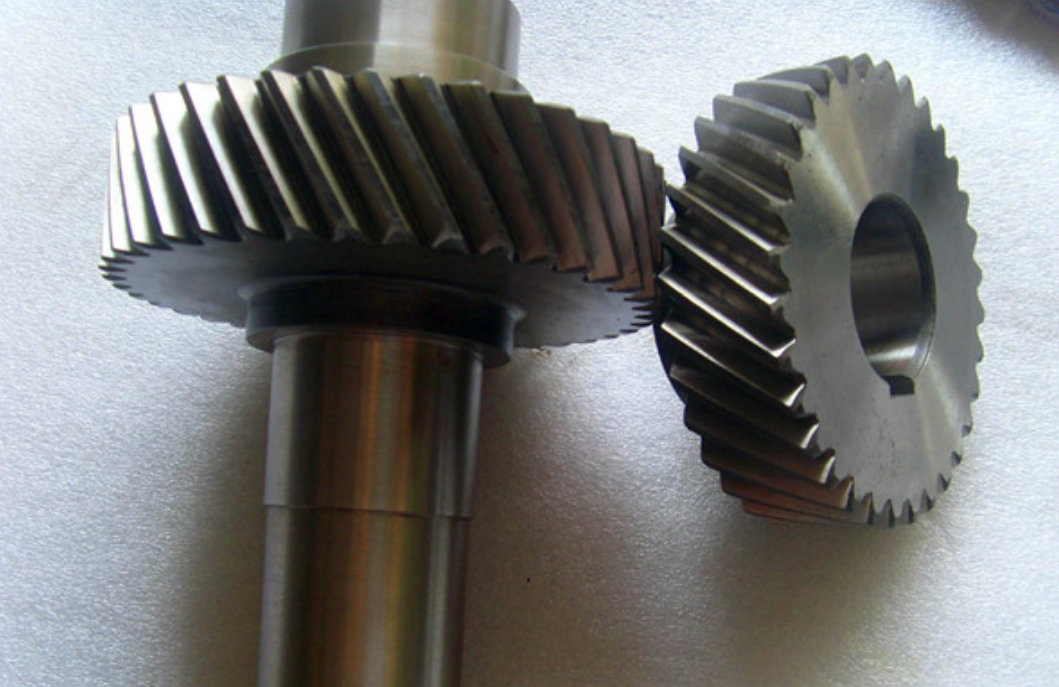
Problem Formulation and Mathematical Modeling
The optimization target is a heavy-duty two-stage cylindrical helical gear reducer with a specified input power of Pd = 15 kW and a total transmission ratio of i = 15. The operational profile assumes 8 hours per day, 300 days per year, over a 12-year lifespan, with unidirectional operation under relatively steady loading. Material selection is crucial for helical gear durability; the high-speed pinion and gear, along with the low-speed gear, are made of quenched and tempered 45 steel, while the low-speed pinion is made of higher-strength 40Cr quenched and tempered steel. All gears feature soft tooth faces with an accuracy grade of 8.
The schematic of the two-stage cylindrical helical gear transmission is shown in Figure 1 (implied by context). It consists of four gears with tooth counts Z1, Z2, Z3, and Z4. The stage transmission ratios are defined as i1 = Z2/Z1 and i2 = Z4/Z3, with i = i1 × i2. The normal module for each stage is mn1 and mn2, and the helix angles are β1 and β2 respectively. The initial design parameters are listed in the table below.
| Stage | Pinion/Gear Tooth Count | Normal Module mn (mm) | Helix Angle β (°) | Ratio u |
|---|---|---|---|---|
| High-Speed | 24 / 120 | 2.5 | 13.351 | i1 = 5.0 |
| Low-Speed | 24 / 72 | 3.7 | 13.953 | i2 = 3.0 |
For a comprehensive optimization, eight key design variables that significantly influence the size and performance of the helical gear reducer are selected. These variables form the design vector X:
$$ X = [x_1, x_2, x_3, x_4, x_5, x_6, x_7, x_8]^T = [m_{n1}, m_{n2}, Z_1, Z_3, \beta_1, \beta_2, i_1, i_2]^T $$
The total center distance (A = A1 + A2) of the two-stage helical gear reducer is the most direct factor determining its overall envelope size. Therefore, the primary objective function is formulated to minimize this center distance:
$$ \min f(X) = A_1 + A_2 = \frac{m_{n1} Z_1 (1 + i_1)}{2 \cos \beta_1} + \frac{m_{n2} Z_3 (1 + i_2)}{2 \cos \beta_2} $$
$$ \text{or} \quad \min f(X) = \frac{x_1 x_3 (1 + x_7)}{2 \cos x_5} + \frac{x_2 x_4 (1 + x_8)}{2 \cos x_6} $$
This objective is subject to a series of practical engineering constraints derived from gear design principles, material limits, and geometric considerations for helical gears.
Constraint Development
1. Normal Module Constraint: To ensure sufficient load capacity without excessive size, the normal module must be within a standard range. For heavy-duty helical gears, a lower bound is set.
$$ g_1(X) = 2 – m_{n1} \le 0 \quad \text{and} \quad g_2(X) = 2 – m_{n2} \le 0 $$
2. Helix Angle Constraint: The helix angle in a helical gear balances axial thrust and smoothness. A typical range is enforced.
$$ g_3(X) = 8^\circ – \beta_1 \le 0, \quad g_4(X) = \beta_1 – 20^\circ \le 0 $$
$$ g_5(X) = 8^\circ – \beta_2 \le 0, \quad g_6(X) = \beta_2 – 20^\circ \le 0 $$
3. Pinion Tooth Number Constraint: To prevent undercutting and ensure good manufacturability for the helical gear pinions.
$$ g_7(X) = 20 – Z_1 \le 0, \quad g_8(X) = Z_1 – 30 \le 0 $$
$$ g_9(X) = 20 – Z_3 \le 0, \quad g_{10}(X) = Z_3 – 30 \le 0 $$
4. Stage Ratio Constraint: The ratio for each helical gear stage should fall within an efficient range.
$$ g_{11}(X) = 2 – i_1 \le 0, \quad g_{12}(X) = i_1 – 5 \le 0 $$
$$ g_{13}(X) = 2 – i_2 \le 0, \quad g_{14}(X) = i_2 – 5 \le 0 $$
5. Contact Fatigue Strength Constraint: The calculated contact stress for each helical gear pair must be less than the allowable stress to prevent pitting. For a steel helical gear pair, the constraint for the high-speed stage is derived as:
$$ \sigma_{H1} = Z_E Z_H Z_{\epsilon} Z_{\beta} \sqrt{ \frac{2 K_{Ht} T_1 (i_1 + 1)}{\phi_d Z_1^3 m_{n1}^3 i_1} \cdot \frac{\cos^3 \beta_1}{\cos^2 \beta_b} } \le [\sigma_H] $$
Simplifying with known parameters (ZE, ZH, Zε, Zβ, KHt, T1, φd, [σH]) yields a nonlinear inequality constraint function g15(X) ≤ 0. A similar constraint g16(X) ≤ 0 is formulated for the low-speed helical gear pair.
6. Bending Fatigue Strength Constraint: The root bending stress in each helical gear tooth must be below the allowable limit. For the high-speed stage pinion:
$$ \sigma_{F1} = \frac{2 K_{Ft} T_1 Y_{Fa1} Y_{Sa1} Y_{\epsilon} Y_{\beta} \cos^2 \beta_1}{\phi_d Z_1^2 m_{n1}^3} \le [\sigma_{F1}] $$
Incorporating specific values for the form factor YFa, stress correction factor YSa, etc., leads to constraint g17(X) ≤ 0. Similar constraints g18(X), g19(X), g20(X) are developed for the other three helical gear wheels.
Thus, the complete nonlinear constrained optimization problem for the helical gear reducer is defined as:
Minimize f(X)
Subject to: gu(X) ≤ 0, for u = 1, 2, …, 20.
Optimization Strategy: The Mixed Penalty Function Method
To solve this complex, multi-variable, non-linear optimization problem, the Mixed Penalty Function Method is employed. This method is particularly effective for problems with inequality constraints, as it combines the advantages of both interior and exterior penalty function approaches. It transforms the constrained problem into a sequence of unconstrained minimization problems.
The core idea is to construct an augmented objective function, Φ(X, r), that adds a penalty term to the original objective f(X). This penalty term grows large as the design variables X approach or violate the constraint boundaries, effectively keeping the search within the feasible region. For a set of inequality constraints gu(X) ≤ 0, a common form of the mixed penalty function is:
$$ \Phi(X, r^{(k)}) = f(X) + r^{(k)} \sum_{u=1}^{L} \frac{1}{g_u(X)} $$
Here, r^(k) is a positive penalty parameter that is progressively reduced according to a schedule (e.g., r^(k+1) = c * r^(k), where 0 < c < 1) over a series of minimizations (k = 0, 1, 2, …). The term 1/gu(X) becomes very large as gu(X) approaches zero from the feasible side (gu(X) < 0), creating a “barrier” that prevents constraint violation. Starting from a strictly feasible initial point, the algorithm minimizes Φ(X, r^(k)) for a given r^(k), then reduces r^(k) and repeats the minimization, using the previous solution as the new starting point. As r^(k) approaches zero, the sequence of solutions {X*(r^(k))} converges to the true constrained optimum of the original helical gear reducer problem.
For the specific problem at hand with 20 inequality constraints, the function to be minimized at each iteration becomes:
$$ \Phi(X, r^{(k)}) = \left( \frac{x_1 x_3 (1 + x_7)}{2 \cos x_5} + \frac{x_2 x_4 (1 + x_8)}{2 \cos x_6} \right) + r^{(k)} \sum_{u=1}^{20} \frac{1}{g_u(X)} $$
This unconstrained minimization is performed using a robust algorithm suitable for non-linear functions. In this study, the programming and iterative numerical computation were executed within the MATLAB environment.
Optimization Results and Volume Comparison
Applying the Mixed Penalty Function Method through iterative computation in MATLAB yielded the following optimal set of design parameters for the helical gear reducer.
| Design Variable | Symbol | Optimal Value |
|---|---|---|
| Normal Module – Stage 1 | m_{n1} | 2.0 mm |
| Normal Module – Stage 2 | m_{n2} | 2.5 mm |
| Pinion Teeth – Stage 1 | Z_1 | 23 |
| Pinion Teeth – Stage 2 | Z_3 | 22 |
| Helix Angle – Stage 1 | β_1 | 15.5° |
| Helix Angle – Stage 2 | β_2 | 16.0° |
| Stage Ratio 1 | i_1 | 4.8 |
| Stage Ratio 2 | i_2 | 3.125 |
The corresponding minimized total center distance is f(X*) = A1* + A2* = 149.2 mm + 179.5 mm = 328.7 mm.
To evaluate the practical impact of this geometric optimization, the overall volume of the reducer housing is estimated. The housing can be approximated as a rectangular box with length (l), width (b), and height (h) determined by the gear centers, shaft lengths, and bearing placements. The key dimensions are primarily driven by the center distances and the gear face widths. The face width b for a helical gear is typically calculated as b = φ_d * a, where φ_d is the face width factor and ‘a’ is the operating center distance. Using φ_d = 1.3, the face widths for both stages are calculated.
The approximate housing dimensions can be derived as follows:
Length, l ≈ 2.5 * A2* + b2 + clearances
Width, b ≈ max(b1, b2) + bearing housing widths
Height, h ≈ A1* + A2* + gear outer radius allowances
Using these relationships and considering standard clearances and wall thickness (δ ≈ 8mm), the housing volume V is calculated as:
$$ V = (l + 2\delta)(b + 2\delta)(h + \delta) – (l)(b)(h – \delta) $$
Calculations for both the initial design and the optimized design yield the following comparative results:
| Parameter | Initial Design | Optimized Design |
|---|---|---|
| Total Center Distance (A1+A2) | 372.1 mm | 328.7 mm |
| Approximate Housing Volume (V) | 6,664,618 mm³ | 4,808,997 mm³ |
| Volume Reduction | 27.8% | |
Conclusion
This study successfully demonstrates a comprehensive multi-factor optimization framework for a heavy-duty two-stage cylindrical helical gear reducer. By systematically considering eight critical design variables encompassing both gear stages—including normal modules, pinion tooth numbers, helix angles, and stage ratios—a more holistic and effective optimization is achieved compared to methods focusing on a single stage.
The formulation of a mathematical model with the total center distance as the primary objective function, subjected to rigorous contact and bending fatigue strength constraints alongside standard geometric limits, accurately captures the essential design trade-offs. The application of the Mixed Penalty Function Method proved to be a robust and effective technique for solving this constrained non-linear optimization problem, navigating the complex design space to find an optimal configuration.
The significant outcome of a 27.8% reduction in the estimated housing volume underscores the practical value of this approach. This reduction directly translates to benefits in material usage, weight, and potentially lower manufacturing and operational costs, all of which are critical in competitive industrial applications. The methodology and results presented provide a valuable reference and a structured framework for the optimal design of compact and efficient helical gear reducers in various fields of mechanical engineering.