
Our research focuses on improving the transmission performance of helical gear systems by simultaneously reducing vibration and noise while achieving uniform load distribution on the tooth surfaces. We propose a multi-objective optimization design method based on loaded tooth contact analysis (LTCA) and dynamic modeling. Through experimental validation of transmission error amplitudes, we confirm the accuracy of our LTCA model. We then develop a method to evaluate tooth surface load distribution and a criterion for load uniformity. By combining the minimization of relative torsional velocity (representing vibration/noise) and the minimization of load difference between left and right tooth surfaces, we construct a multi-objective function and obtain optimal modification parameters using a genetic algorithm. A numerical example demonstrates that after optimization, the root-mean-square (RMS) of relative torsional velocity decreases by a factor of four, and the load imbalance between tooth surfaces is reduced by about 320 times, validating the effectiveness of our approach.
1. Introduction
Helical gears are widely used in power transmission systems due to their smooth engagement and high load capacity. However, vibration and noise generated during operation, together with uneven load distribution on the tooth surfaces, significantly degrade system performance and reliability. Gear modification—including profile modification, axial modification, and three-dimensional modification—has been recognized as an effective technique to reduce vibration and improve load distribution. In our study, we target both objectives: minimizing torsional vibration (closely related to radiated noise) and equalizing the load across the tooth width. We adopt a two‑step modification strategy where the pinion is first profile‑modified using a parabolic rack cutter, then axially modified along the helix direction. We verify our LTCA model by comparing computed transmission error amplitudes with experimental measurements. A multi‑body dynamic model of the helical gear pair is built, and its accuracy is confirmed through vibration acceleration tests. With these validated models, we formulate a multi‑objective optimization problem and solve it using a genetic algorithm. The results show substantial improvements in both dynamic performance and load distribution.
2. Modification of the Helical Gear Pinion
Our modification method focuses on the pinion for better manufacturing efficiency. The process consists of two stages:
- Profile modification is achieved by replacing the straight cutting edge of a rack cutter with a parabolic curve. The parabolic profile is defined in the rack cutter coordinate system \(O_b x_b y_b\) as:
\[
\mathbf{r}_b =
\begin{bmatrix}
x_b \\ y_b \\ 0 \\ 1
\end{bmatrix}
=
\begin{bmatrix}
u \\ a’ u^2 \\ 0 \\ 1
\end{bmatrix}
\]
where \(u\) is the rack parameter and \(a’\) is the profile modification coefficient. By applying coordinate transformations, we obtain the representation of the modified rack cutter in the pinion coordinate system. The resulting pinion tooth surface is generated through the usual generation process. Table 1 summarizes the transformation matrices used.
| Transformation | Matrix |
|---|---|
| \(M_{c1b}\) from rack to cutter coordinate | \(\begin{bmatrix} \cos\alpha_n & -\sin\alpha_n & 0 & -d_p\cos\alpha_n \\ \sin\alpha_n & \cos\alpha_n & 0 & a_m – d_p\sin\alpha_n \\ 0 & 0 & 1 & 0 \\ 0 & 0 & 0 & 1 \end{bmatrix}\) |
| \(M_{cc1}\) from cutter to intermediate frame | \(\begin{bmatrix} 1 & 0 & 0 & 0 \\ 0 & \cos\beta & \sin\beta & l\sin\beta \\ 0 & -\sin\beta & \cos\beta & l\cos\beta \\ 0 & 0 & 0 & 1 \end{bmatrix}\) |
| \(M_{1I}\) and \(M_{Ic}\) for generation | Standard rotation and translation matrices |
Here \(\alpha_n\) is the normal pressure angle, \(\beta\) the helix angle, \(d_p\) a distance parameter, \(a_m\) half the tooth thickness, and \(l\) a rack parameter.
- Axial modification is then applied along the helix direction. A parabolic curve in the plane containing the gear axis is defined as:
\[
y_i = -a (z_i – b)^2
\]
where \(a\) and \(b\) are the axial modification parameters. After rotating into the global pinion coordinate system, the modified tooth surface coordinates become:
\[
\mathbf{r}_1 =
\begin{bmatrix}
0 \\ z_i \sin\beta_i – a(z_i – b)^2\cos\beta_i \\ z_i \cos\beta_i + a(z_i – b)^2\sin\beta_i \\ 1
\end{bmatrix}
\]
The parameter \(z_i\) is solved from the geometry of the helical gear, ensuring that the midpoint of the gear width remains unchanged. The combination of profile and axial modifications yields the final pinion geometry. In practice, the interference due to modifications is negligible if the parameters are kept within reasonable bounds.
3. Tooth Surface Load Distribution Model
We perform loaded tooth contact analysis (LTCA) to compute the distribution of contact forces along the tooth surfaces. The LTCA problem is formulated as a linear programming problem:
\[
\min \sum_{j=1}^{2n+1} X_j
\]
subject to:
\[
[F]\{\mathbf{p}\} + \{\mathbf{Z}\} + \{\mathbf{d}\} + \{\mathbf{X}\} = \{\mathbf{w}\}
\]
\[
\{\mathbf{e}\}^T\{\mathbf{p}\} + X_{2n+1} = P
\]
\[
p_j, d_j, Z, X_j \geq 0
\]
\[
p_j = 0 \quad \text{or} \quad d_j = 0
\]
where \([F]\) is the flexibility matrix of the two tooth surfaces, \(\{\mathbf{p}\}\) is the vector of normal forces at discrete points on the contact lines, \(\{\mathbf{Z}\}\) are normal displacements under load, \(\{\mathbf{d}\}\) are the initial separations, \(\{\mathbf{w}\}\) are the initial clearances, \(\{\mathbf{e}\}\) is a unit vector, and \(P\) is the total normal load. The solution gives the force distribution at each meshing instant. We divide one meshing cycle into five positions and compute the loads on all contact lines, thereby obtaining the complete tooth surface load map.
3.1 Validation of the LTCA Model
We validate the LTCA model by comparing the transmission error amplitudes obtained from experiment and theory. Table 2 lists the measured and calculated peak-to-peak amplitudes. The excellent agreement (0.4517 vs. 0.4447 arcsec) confirms that our LTCA model accurately captures the elastic deformation and contact behavior of the helical gear pair.
| Measurement (arcsec) | Calculation (arcsec) |
|---|---|
| 0.451669 | 0.4447 |
3.2 Uniform Load Distribution Criterion
We divide the tooth surface into left and right halves along the width direction. Let \(k\) be the total number of contact lines on the tooth at a given meshing instant. If \(k\) is even, lines \(1,2,\dots,k/2\) belong to the left flank and lines \(k/2+1,\dots,k\) to the right flank. If \(k\) is odd, the middle line is considered neutral. The load imbalance is then defined as:
\[
f_1 = \left| \sum_{i=1}^{m} P_i – \sum_{i=m+1}^{k} P_i \right| \quad \text{with} \quad m = \begin{cases} k/2 & \text{if } k \text{ even}\\ (k-1)/2 & \text{if } k \text{ odd} \end{cases}
\]
In the odd case, the central line is excluded from the sums. Our objective is to minimize \(f_1\) to achieve an even distribution of load across the tooth width.
4. Vibration and Noise Reduction Model
4.1 Dynamic Model of Helical Gear Pair
We develop a 6‑degree‑of‑freedom dynamic model for the helical gear pair, including translational motions in the \(x\), \(y\), and \(z\) directions and rotational motions about the gear axes. The \(y\)-axis is aligned with the line of action. The equations of motion are:
\[
\begin{aligned}
m_p \ddot{x}_p + c_{px} \dot{x}_p + k_{px} f_{px}(x_p) &= \lambda \mu F_{py} \\
m_p \ddot{y}_p + c_{py} \dot{y}_p + k_{py} f_{py}(y_p) &= -F_{py} \\
m_p \ddot{z}_p + c_{pz} \dot{z}_p + k_{pz} f_{pz}(z_p) &= -F_z \\
I_p \ddot{\theta}_p + F_{py} r_p – S_p \lambda \mu F_{py} &= -T_p \\
m_q \ddot{x}_q + c_{qx} \dot{x}_q + k_{qx} f_{qx}(x_q) &= -\lambda \mu F_{py} \\
m_q \ddot{y}_q + c_{qy} \dot{y}_q + k_{qy} f_{qy}(y_q) &= F_{py} \\
m_q \ddot{z}_q + c_{qz} \dot{z}_q + k_{qz} f_{qz}(z_q) &= F_z \\
I_q \ddot{\theta}_q – F_{py} r_q + S_q \lambda \mu F_{py} &= -T_q
\end{aligned}
\]
Here subscripts \(p\) and \(q\) denote pinion and gear respectively; \(m\) is mass, \(I\) is mass moment of inertia, \(c\) and \(k\) are damping and stiffness coefficients, \(f\) are clearance functions, \(\lambda\) indicates the direction of friction (1 or -1), \(\mu\) is the sliding friction coefficient, \(S_p\) and \(S_q\) are friction moment arms, and \(F_{py}\) and \(F_z\) are the normal and axial components of the meshing force. The meshing force expressions are:
\[
\begin{aligned}
F_{py} &= \frac{\cos\beta}{\cos\beta_b} \left[ k \, f_{hy}(y_p + \theta_p R_p – y_q – \theta_q R_q – e_y) + c (\dot{y}_p + \dot{\theta}_p R_p – \dot{y}_q – \dot{\theta}_q R_q – \dot{e}_y) \right] \\
F_z &= \sin\beta \left\{ k \left[ z_p – z_q – (y_p + \theta_p R_p – y_q – \theta_q R_q)\tan\beta – e_z \right] + c \left[ \dot{z}_p – \dot{z}_q – (\dot{y}_p + \dot{\theta}_p R_p – \dot{y}_q – \dot{\theta}_q R_q)\tan\beta – \dot{e}_z \right] \right\}
\end{aligned}
\]
where \(\beta\) is the helix angle, \(\beta_b\) the base helix angle, \(R_p\), \(R_q\) the reference radii, and \(e_y\), \(e_z\) the static transmission error components. The dynamic model is solved using a fourth‑order Runge‑Kutta method with variable step size.
4.2 Dynamic Model Validation
We validate the dynamic model by comparing the frequency spectrum of the relative vibration acceleration in the \(y\)-direction with experimental measurements. The experimental setup details are given in reference [17] (omitted here). Table 3 lists the dominant frequencies and amplitudes from both the test and the simulation. The close match confirms that our dynamic model accurately captures the key dynamic characteristics of the helical gear pair.
| Frequency (Hz) – Experiment | Amplitude (m/s²) – Experiment | Frequency (Hz) – Simulation | Amplitude (m/s²) – Simulation |
|---|---|---|---|
| 2450 | 378 | 2432 | 357.8 |
| 4900 | 241 | 4864 | 214.1 |
4.3 Vibration/Noise Metric
We adopt the root‑mean‑square (RMS) value of the relative torsional velocity as a surrogate for vibration and noise level. The relative torsional velocity is defined as:
\[
v_{rel} = \dot{y}_p + \dot{\theta}_p r_p – \dot{y}_q – \dot{\theta}_q r_q – \dot{e}_y
\]
The objective function for vibration reduction is then:
\[
f_2 = \sqrt{ \frac{1}{N} \sum_{i=1}^{N} v_{rel,i}^2 }
\]
where \(N\) is the number of time steps in one steady‑state cycle. Minimizing \(f_2\) directly reduces the velocity fluctuations that cause radiated noise.
5. Multi‑Objective Optimization Formulation
5.1 Design Variables
The three design variables are the profile modification coefficient \(a’\) and the axial modification parameters \(a\) and \(b\):
\[
\mathbf{x} = \{ x_1, x_2, x_3 \} = \{ a’, a, b \}
\]
5.2 Objective Function
We combine the two objectives using a weighted sum approach. Because the magnitudes of \(f_1\) (load imbalance in Newtons) and \(f_2\) (relative velocity RMS in m/s) differ by several orders, we introduce a scale factor \(10^{-7}\) to balance them:
\[
\min f(\mathbf{x}) = w_1 \cdot f_1(\mathbf{x}) \times 10^{-7} + w_2 \cdot f_2(\mathbf{x})
\]
In our study we set both weights to 0.5, giving equal importance to load uniformity and vibration reduction. The factor \(10^{-7}\) is chosen so that both terms contribute similarly to the total cost.
5.3 Optimization Algorithm and Constraints
We employ the genetic algorithm (GA) toolbox in MATLAB for the optimization. No additional geometric constraints are imposed because the tooth design already respects strength and contact ratio requirements. However, the variable bounds must be defined based on practical limits. Table 4 lists the initial values, lower bounds, and upper bounds used in the optimization.
| Variable | Initial | Minimum | Maximum |
|---|---|---|---|
| \(a’\) | 0.001 | 0.001 | 0.01 |
| \(a\) | 1×10⁻⁴ | 1×10⁻⁶ | 1×10⁻² |
| \(b\) | 0 | -2 | 8 |
6. Numerical Example and Results
We apply the proposed method to a helical gear pair with the design specifications given in Table 5.
| Parameter | Value |
|---|---|
| Number of gear teeth | 40 |
| Number of pinion teeth | 20 |
| Normal module (mm) | 2.5 |
| Normal pressure angle (°) | 20 |
| Helix angle (°) | 20 |
| Face width (mm) | 30 |
| Applied torque on gear (N·m) | 200 |
| Assembly error δ_r (arcmin) | 2 |
| Pinion speed (rpm) | 1200 |
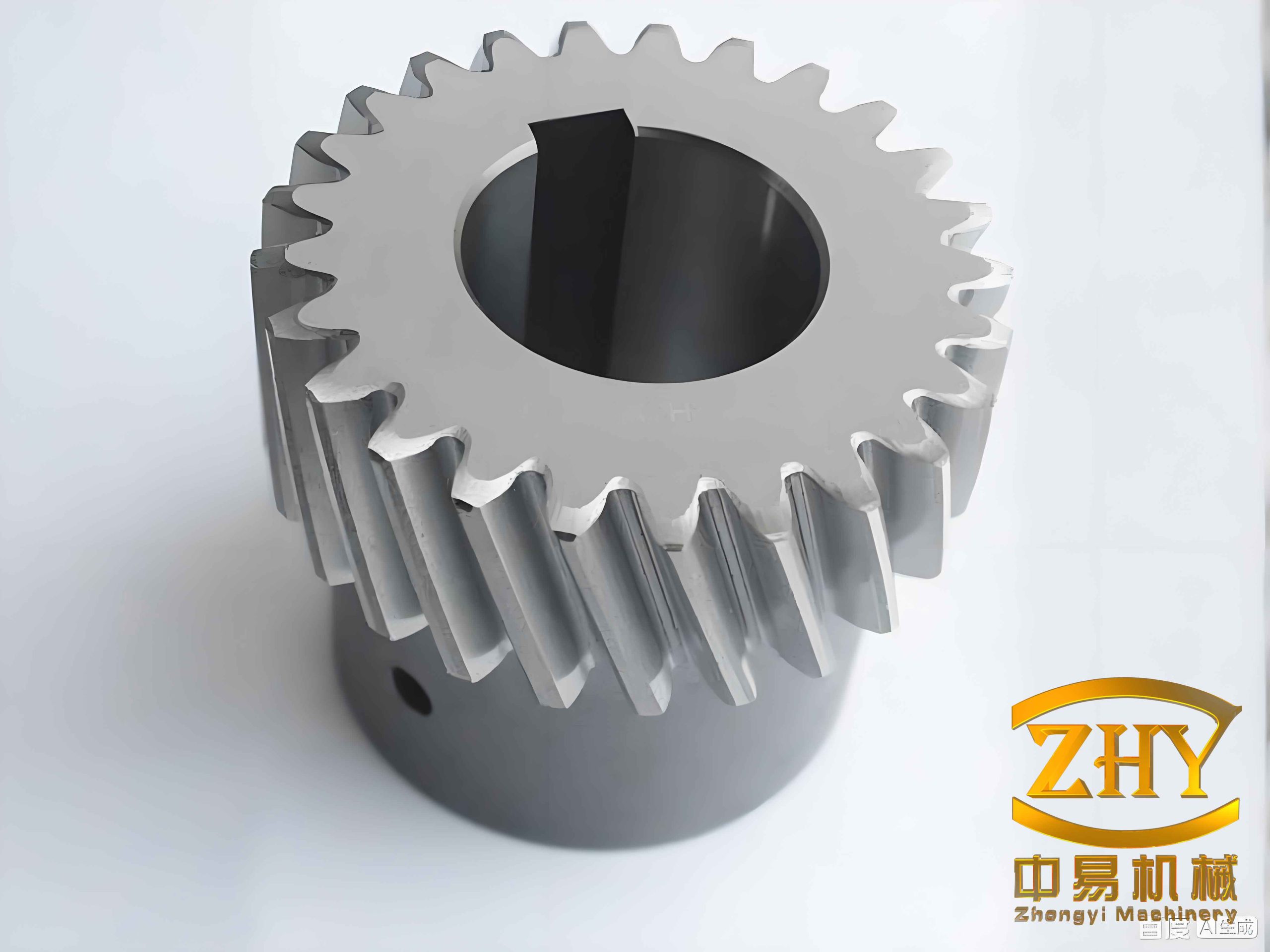
The optimization is run using the GA with default settings. Convergence is achieved after 110 generations. The optimal parameters are given in Table 6.
| Variable | Optimal value |
|---|---|
| \(a’\) | 5.71×10⁻³ |
| \(a\) | 7.29×10⁻⁶ |
| \(b\) | 1.451 |
6.1 Vibration Reduction Effect
Figures 10 and 11 (not shown; only the time‑domain plots are referenced) illustrate the relative torsional velocity before and after optimization. The RMS values are listed in Table 7. The optimized design reduces the RMS of the relative torsional velocity from \(1.28\times10^{-4}\) m/s to \(2.59\times10^{-5}\) m/s, a reduction factor of nearly 5. This demonstrates a significant improvement in vibration and noise performance.
| Condition | RMS (m/s) |
|---|---|
| Before optimization | 1.28×10⁻⁴ |
| After optimization | 2.59×10⁻⁵ |
6.2 Load Distribution Improvement
The tooth surface load distributions before and after optimization are shown schematically (Figures 12 and 13 omitted). The load imbalance metric \(f_1\) is computed based on the LTCA results. Table 8 compares the absolute load difference between left and right tooth surfaces. Before optimization, the difference is 15324 N; after optimization it drops to only 47.956 N—a reduction of about 320 times. This indicates an almost perfect uniform load distribution across the tooth width, which greatly reduces edge loading and contact stress concentration.
| Condition | Load difference (N) |
|---|---|
| Before optimization | 15324 |
| After optimization | 47.956 |
7. Conclusion
We have presented a comprehensive multi‑objective optimization method for helical gear modification that simultaneously targets vibration/noise reduction and uniform tooth surface load distribution. Our approach relies on a validated loaded tooth contact analysis model and a 6‑DOF dynamic model of the helical gear pair. The tooth load uniformity is quantified by the absolute difference between forces on the left and right halves of the tooth surface, while vibration is represented by the RMS of the relative torsional velocity. By using a genetic algorithm to optimize the profile and axial modification parameters, we achieve a substantial decrease in both objectives. In the example, the RMS relative velocity decreases by a factor of 4, and the load imbalance drops by a factor of 320. These results confirm that the proposed modification optimization can significantly enhance the transmission quality of helical gear drives, leading to quieter operation and more durable gear teeth.