
In the field of gear transmission, vibration and noise generated during the meshing process, as well as uneven load distribution on the tooth surface, severely degrade the performance of gear systems. To address these issues, I propose a multi-objective optimization design method for helical gears that simultaneously reduces vibration and noise and ensures uniform tooth surface load distribution. The proposed approach integrates tooth contact analysis, dynamics modeling, and optimization techniques to achieve improved transmission performance.
I begin by describing the modification methodology for helical gears. Both profile modification and axial modification are applied to the pinion to enhance meshing characteristics. The profile modification is realized by using a parabolic rack cutter, while axial modification follows a parabolic curve along the helix direction. The equations governing these modifications are derived as follows.
The rack cutter profile in its coordinate system \(o_b x_b y_b\) is given by:
\[
\mathbf{r}_b = \begin{bmatrix}
x_b \\
y_b \\
0 \\
1
\end{bmatrix} = \begin{bmatrix}
u \\
a’ u^2 \\
0 \\
1
\end{bmatrix}
\]
where \(u\) is the cutter parameter and \(a’\) is the modification parameter. After successive coordinate transformations, the rack cutter profile in the coordinate system \(o_c x_c y_c\) becomes:
\[
\mathbf{r}_c = \begin{bmatrix}
x_c \\
y_c \\
z_{c1}
\end{bmatrix} = \begin{bmatrix}
-a’ u^2 \sin \alpha_n + (u – d_p) \cos \alpha_n \\
a’ u^2 \cos \alpha_n \cos \beta + l \sin \beta + [(u – d_p) \sin \alpha_n + a_m] \cos \beta \\
-a’ u^2 \cos \alpha_n \sin \beta + l \cos \beta + [(u – d_p) \sin \alpha_n + a_m] \sin \beta
\end{bmatrix}
\]
The pinion tooth surface generated by the modified rack cutter is expressed as:
\[
\mathbf{r}_1 = \begin{bmatrix}
x_1 \\
y_1 \\
z_{11}
\end{bmatrix} = \begin{bmatrix}
(x_c – r_1) \cos \phi_1 + (y_c – s_1) \sin \phi_1 \\
(r_1 – x_c) \sin \phi_1 + (y_c – s_1) \cos \phi_1 \\
z_{c1}
\end{bmatrix}
\]
Axial modification is then applied along the helix direction. The parabolic curve in the coordinate system \(o_i y_i z_i\) is:
\[
\begin{bmatrix}
0 \\
y_i \\
z_i
\end{bmatrix} = \begin{bmatrix}
0 \\
-a (z_i – b)^2 \\
z_i
\end{bmatrix}
\]
After transforming to the pinion coordinate system, the modified tooth surface coordinate \(y_1’\) becomes \(y_1′ = y_1 + y\), where \(y\) is obtained from the axial modification parabola. The parameters \(a\) and \(b\) control the amount and location of the modification.
To validate the load tooth contact analysis (LTCA) model, I compare the transmission error amplitude obtained from experiments and theoretical calculations. The transmission error curves exhibit good agreement. The experimental amplitude is approximately 0.451669 arcsec, while the computed amplitude is 0.4447 arcsec, as summarized in Table 1.
| Source | Amplitude (arcsec) |
|---|---|
| Experimental | 0.451669 |
| Theoretical | 0.4447 |
This close match confirms the accuracy of the LTCA model for helical gears. Using this model, I compute the load distribution on the tooth surface. The tooth surface is divided into left and right halves along the face width. The load difference between left and right tooth surfaces is defined as follows. When the number of contact lines \(k\) is even:
\[
f_1 = \left| \sum_{i=1}^{k/2} P_i – \sum_{i=k/2+1}^{k} P_i \right|
\]
When \(k\) is odd:
\[
f_1 = \left| \sum_{i=1}^{(k-1)/2} P_i – \sum_{i=(k-1)/2+2}^{k} P_i \right|
\]
A smaller \(f_1\) indicates a more uniform load distribution. Next, I develop a dynamic model of a helical gear pair to evaluate vibration and noise. The model incorporates bending (x and y directions), torsional (rotation direction), and axial (z direction) degrees of freedom, as well as tooth friction and backlash. The equations of motion are:
\[
m_p \ddot{x}_p + c_{px} \dot{x}_p + k_{px} f_{px}(x_p) = \lambda \mu F_{py}
\]
\[
m_p \ddot{y}_p + c_{py} \dot{y}_p + k_{py} f_{py}(y_p) = -F_{py}
\]
\[
m_p \ddot{z}_p + c_{pz} \dot{z}_p + k_{p} f_{pz}(z_p) = -F_z
\]
\[
I_p \ddot{\theta}_p + F_{py} r_p – S_p \lambda \mu F_{py} = -T_p
\]
\[
m_q \ddot{x}_q + c_{qx} \dot{x}_q + k_{qx} f_{qx}(x_q) = -\lambda \mu F_{py}
\]
\[
m_q \ddot{y}_q + c_{qy} \dot{y}_q + k_{qy} f_{qy}(y_q) = F_{py}
\]
\[
m_q \ddot{z}_q + c_{qz} \dot{z}_q + k_{qz} f_{qz}(z_q) = F_z
\]
\[
I_q \ddot{\theta}_q – F_{py} r_q + S_q \lambda \mu F_{py} = -T_q
\]
where \(F_{py}\) and \(F_z\) are the meshing forces along the line of action and axial direction, defined by:
\[
F_{py} = k f_{hy}\left( y_p + \theta_p R_p – y_q – \theta_q R_q – e_y \right) + c \left( \dot{y}_p + \dot{\theta}_p R_p – \dot{y}_q – \dot{\theta}_q R_q – \dot{e}_y \right)
\]
\[
F_z = \sin \beta \left[ k \left( z_p – z_q – \frac{ y_p + \theta_p R_p – y_q – \theta_q R_q }{\tan \beta} – e_z \right) + c \left( \dot{z}_p – \dot{z}_q – \frac{ \dot{y}_p + \dot{\theta}_p R_p – \dot{y}_q – \dot{\theta}_q R_q }{\tan \beta} – \dot{e}_z \right) \right]
\]
The dynamic model is validated by comparing the relative vibration acceleration in the y-direction. Experimental data show dominant frequencies at 2450 Hz and 4900 Hz, while the theoretical simulation yields frequencies of 2432 Hz and 4864 Hz, closely matching the experiments. This confirms the dynamic model’s reliability for helical gears.
To quantify vibration and noise, I use the root mean square (RMS) of the relative velocity in the torsional direction:
\[
f_2 = \sqrt{ \frac{1}{n} \sum_{i=1}^{n} \left( \dot{y}_p + \dot{\theta}_p r_p – \dot{y}_q – \dot{\theta}_q r_q – \dot{e} \right)^2 }
\]
Lower \(f_2\) indicates reduced vibration and noise. The multi-objective optimization aims to minimize both the load difference \(f_1\) and the torsional velocity RMS \(f_2\). The design variables are the profile modification parameter \(a’\) and the axial modification parameters \(a\) and \(b\):
\[
\mathbf{x} = \{ x_1, x_2, x_3 \} = \{ a’, a, b \}
\]
The objective function is constructed using a linear weighted sum:
\[
\min f(\mathbf{x}) = w_1 \left( f_1(\mathbf{x}) \times 10^{-7} \right) + w_2 f_2(\mathbf{x})
\]
where \(w_1 = w_2 = 0.5\) and the factor \(10^{-7}\) accounts for magnitude difference. The optimization is performed using a genetic algorithm implemented in MATLAB. No additional constraints are needed beyond the ranges of the design variables, which are given in Table 2.
| Parameter | Initial | Minimum | Maximum |
|---|---|---|---|
| \(a’\) | 0.001 | 0.001 | 0.01 |
| \(a\) | \(10^{-4}\) | \(10^{-6}\) | \(10^{-2}\) |
| \(b\) | 0 | -2 | 8 |
An example is presented to demonstrate the method. The helical gear parameters are listed in Table 3.
| Parameter | Value |
|---|---|
| Number of gear teeth | 40 |
| Number of pinion teeth | 20 |
| Normal module (mm) | 2.5 |
| Normal pressure angle (°) | 20 |
| Helix angle (°) | 20 |
| Face width (mm) | 30 |
| Torque on gear (Nm) | 200 |
| Assembly error (°) | 1/30 |
| Pinion speed (rpm) | 1200 |
After 110 generations of the genetic algorithm, the optimal design variables are obtained and shown in Table 4.
| Design Variable | Optimal Value |
|---|---|
| \(a’\) | \(5.71 \times 10^{-3}\) |
| \(a\) | \(7.29 \times 10^{-6}\) |
| \(b\) | 1.451 |
The RMS torsional velocity before and after optimization is compared in Table 5. The RMS value is reduced from \(1.28 \times 10^{-4}\) m/s to \(2.59 \times 10^{-5}\) m/s, a reduction of approximately 80%.
| Condition | RMS (m/s) |
|---|---|
| Before optimization | \(1.28 \times 10^{-4}\) |
| After optimization | \(2.59 \times 10^{-5}\) |
The load difference between left and right tooth surfaces is also significantly reduced, as shown in Table 6.
| Condition | Load Difference (N) |
|---|---|
| Before optimization | 15324 |
| After optimization | 47.956 |
The load difference decreases by a factor of approximately 320, indicating a near-uniform load distribution on the tooth surface. The optimization thus yields substantial improvements in both vibration reduction and load uniformity for helical gears.
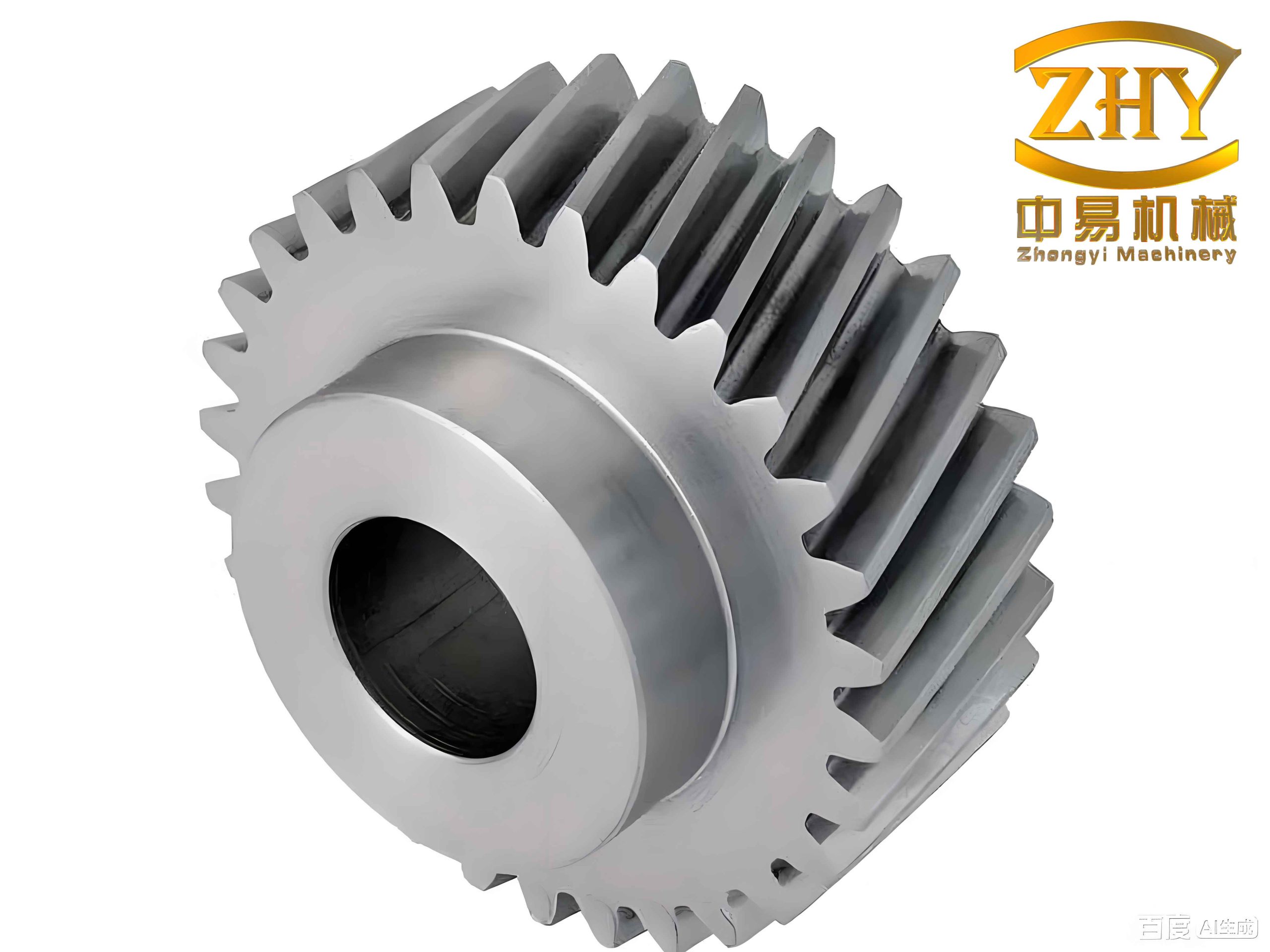
In conclusion, the proposed multi-objective optimization method achieves significant reductions in torsional vibration and tooth surface load imbalance for helical gears. The integration of profile and axial modifications, validated LTCA, and dynamic modeling provides a comprehensive framework for improving gear transmission performance. The method is directly applicable to the design of high-performance helical gear pairs in various industrial applications.