
In the field of gear manufacturing, the precise geometric design and gear cutting adjustment of hypoid gears are critical for achieving optimal performance in power transmission systems. Hypoid gears, known for their offset axes, are widely used in automotive and industrial applications due to their high load capacity and smooth operation. However, the complexity of their tooth surfaces, particularly in epicycloidal hypoid gears, poses significant challenges in gear cutting processes. Traditional methods for gear cutting adjustment often involve approximations that can lead to errors in tooth contact patterns and啮合对称性. In this study, I propose a novel approach to the geometric design and gear cutting adjustment of Klingelnberg-type epicycloidal hypoid gears, focusing on ensuring啮合对称条件 and improving contact zone control. This method integrates theoretical analysis with practical gear cutting parameters, aiming to enhance the accuracy and efficiency of gear production. The gear cutting process is central to this work, as it directly influences the final gear quality and performance. By refining the calculations for冠轮参数 and齿线曲率修正, this new method offers a systematic framework for gear designers and manufacturers to optimize hypoid gear systems. Throughout this article, I will elaborate on the mathematical derivations, provide computational examples, and discuss the implications for gear cutting practices. The integration of formulas and tables will help summarize key findings and facilitate implementation in real-world gear cutting applications.
The fundamental principle behind this new method is the establishment of啮合对称条件 for generated hypoid gears. In gear cutting, when a gear is generated using a产形轮, the tooth surfaces must meet specific symmetry requirements to ensure proper啮合 between the pinion and gear. For hypoid gears, this involves controlling the pressure angles and curvatures at the reference point. Let me begin by defining the pressure angles for the working and non-working tooth surfaces. For the pinion (gear 1) and gear (gear 2), the pressure angles for the working surfaces (denoted as “i” for the pinion concave side and gear convex side) are given by:
$$(\alpha_{ni})_1 = (\alpha_{ni})_2 = \alpha + \alpha_0$$
Here, $\alpha$ represents the average pressure angle, and $\alpha_0$ is the limit pressure angle for the gear pair “1-2”. Typically, $\alpha_0 < 0$. During the gear cutting process, the pressure angle of the generating gear (产形轮) must match that of the generated gear. Thus, for the generating gear $j$ (where $j=4$ for the pinion and $j=3$ for the gear), we have:
$$(\alpha_{ni})_j = (\alpha_{ni})_i = \alpha + \alpha_{0i} \quad (i=1,2; j=4,3)$$
where $\alpha_{0i}$ is the limit pressure angle for the cutting啮合 “j-i”. From the above equations, it follows that $\alpha_{01} = \alpha_{02} = \alpha_0$. This condition ensures that the limit pressure angles for both cutting processes equal that of the final gear pair, which is essential for啮合对称性. Similarly, for the non-working surfaces (“e” for the pinion convex side and gear concave side), the same relation holds. This symmetry in pressure angles is a cornerstone of effective gear cutting adjustment, as it directly affects tooth contact and load distribution.
Beyond pressure angles, the curvatures of the tooth surfaces play a vital role in啮合对称性. At the reference point M, the relative normal curvatures and geodesic torsions along the tooth line direction (v-direction) and tooth profile direction (G-direction) must satisfy specific conditions. For the gear pair “1-2”, the relative normal curvatures are expressed as:
$$-K_{12v} = -K_{41v} + -K_{43v} + K_{32v}$$
$$-K_{12G} = -K_{41G} + -K_{43G} + K_{32G}$$
and the relative geodesic torsion is:
$$-\tau_{12v} = -\tau_{41v} + -\tau_{43v} + \tau_{32v}$$
These equations apply to both the “i” and “e” surfaces. Here, $-K_{43v}$ and $-K_{43G}$ are the relative normal curvatures between the generating surfaces $\Sigma_4$ and $\Sigma_3$ at point M along the v- and G-directions, respectively, and $-\tau_{43v}$ is the relative geodesic torsion along the v-direction. The terms $K_{jiv}$ and $K_{jiG}$ (for $i=1,2$ and $j=4,3$) represent the induced normal curvatures during the cutting啮合 “j-i”, and $\tau_{jiv}$ is the induced geodesic torsion. The condition for啮合对称性 between the working and non-working surfaces is:
$$-K_{12vi} + -K_{12ve} = 0$$
$$-K_{12Gi} + -K_{12Ge} = 0$$
$$-\tau_{12vi} + -\tau_{12ve} = 0$$
Substituting the curvature parameters from the earlier equations, we derive that for直纹面 generating surfaces, the key condition simplifies to:
$$K_{4vi} + K_{4ve} = K_{3vi} + K_{3ve}$$
This indicates that the sum of the normal curvatures along the v-direction for the generating gears must be equal. Furthermore, for the cutting啮合 to be symmetric, three conditions must be met: (1) the pressure angles of the generating gear must be $\alpha_{ni} = \alpha + \alpha_{0i}$ and $\alpha_{ne} = -\alpha + \alpha_{0i}$, (2) the average normal curvature along the v-direction divided by $\cos \alpha$ must equal the limit normal curvature $K_{jpi}$ for the cutting啮合, and (3) the geodesic torsions must be zero. From these, we establish that the limit normal curvature for the gear pair, $K_{jv}$, should equal the average curvature of the generating gear tooth line, $K_0$. Thus, we have:
$$K_0 = \frac{0.5(K_{jvi} + K_{jve})}{\cos \alpha} = K_{jv}$$
This relation is fundamental for gear cutting adjustment, as it links the生成轮 geometry to the final gear啮合 properties. By ensuring these conditions, the gear cutting process can produce hypoid gears with symmetric tooth contacts, reducing wear and improving efficiency. The gear cutting parameters, such as tool settings and machine adjustments, must be calculated accordingly to achieve this symmetry.
In the context of Klingelnberg-type epicycloidal hypoid gears, the generating gear is a冠轮 (crown gear) with a pitch angle of $\delta_p = 90^\circ$. The冠轮 parameters, including its pitch radius $r_p$ and spiral angle $\beta_p$, are determined based on the啮合对称条件. From the earlier conditions $\alpha_{02} = \alpha_0$ and $K_{jp2} = K_{jv}$, we can derive formulas for $\beta_p$ and $r_p$ in terms of the gear parameters. For the gear (gear 2), with reference point pitch radius $r_{m2}$, spiral angle $\beta_{m2}$, and pitch angle $\delta_2$, we have:
$$\beta_p = \beta_{p2} + \beta_{m2}$$
$$r_p = r_{m2} \sin \beta_{m2} \tan \alpha_0 \cos \beta_{p2} \cos \delta_2 + \sin \beta_p \sin \delta_2$$
where:
$$\beta_{p2} = \arctan \left( \frac{-\tan \alpha_0 \cos^3 \beta_{m2}}{\tan \delta_2 – K_{jv} r_{m2} \sin \beta_{m2} \cos \alpha_0 \cos \delta_2 + \tan \alpha_0 \sin^2 \beta_{m2}} \right)$$
The values of $\alpha_0$ and $K_{jv}$ for the gear pair “1-2” can be obtained from established formulas in the literature. Similarly, using the conditions for the pinion (gear 1) yields the same $r_p$ and $\beta_p$, ensuring consistency in the冠轮 design. These parameters are crucial for setting up the gear cutting machine, as they define the position of the冠轮 center $O_p$ relative to the gear axes. Traditionally, methods assumed $O_p$ coincides with the gear pitch cone apex, but this new approach calculates $\beta_p$ and $r_p$ independently, leading to more accurate gear cutting adjustments. The冠轮 serves as the basis for generating both gears, and its geometry directly influences the tooth surfaces during gear cutting. Therefore, precise calculation of $r_p$ and $\beta_p$ is essential for achieving the desired啮合对称性 and contact patterns.
To compute the pitch cone parameters of the hypoid gears, we need to integrate the冠轮 parameters with the gear geometry. The冠轮 tooth line average curvature $K_0$ is determined using the tool settings. Given the tool名义半径 $r_0$, number of blade groups $z$, reference point normal module $m_n$, and冠轮 parameters $r_p$ and $\beta_p$, we can calculate $K_0$ as follows:
$$K_0 = \frac{1}{r_b} \left(1 + \frac{E_b \sin \Delta_p}{r_b (1 + i_{p0})} \right)$$
where:
- $i_{p0} = z_0 / z_p$
- $z_p = 2 r_p \cos \beta_p / m_n$
- $E_p = E \times i_{p0} / (1 + i_{p0})$
- $E_x = \sqrt{r_p^2 + r_0^2 – 2 r_p r_0 \sin(\beta_p – \delta_0)}$
- $\delta_0 = \arcsin(0.5 m_n z_0 / r_0)$
- $\Delta_p = \arcsin[(r_0 \cos \delta_0 – r_p \sin \beta_p) / E_x]$
- $r_b = r_0 \cos \delta_0 – E_b \sin \Delta_p$
- $q_p = \beta_p + \Delta_p$
Here, $E_x$ and $q_p$ represent the tool position and angle, respectively, which are key parameters in the gear cutting setup. The冠轮 parameters $r_p$, $\beta_p$, along with $E_x$ and $q_p$, are considered process parameters for gear generation, but they also affect $K_0$ and thus the啮合对称性. Therefore, they must be determined during the geometric design phase. The calculation of the gear pitch cone parameters involves an iterative process to find $r_{m1}$, $r_{m2}$, $\beta_{m1}$, $\beta_{m2}$, $\delta_1$, and $\delta_2$. The steps include: (a) initial estimates for the轴交角 $\Sigma$, offset distance $E$, transmission ratio $i_{12}$, gear大端直径 $d_{e2}$, gear width $b_2$, spiral angle $\beta_{m20}$, pitch angle $\delta_{20}$, and offset angle $\epsilon_0$; (b) setting $\delta_2 = \delta_{20}$ and computing $r_{m2} = 0.5(d_{e2} – b_2 \sin \delta_2)$; (c) using $\epsilon = \epsilon_0$ to find $\delta_1$, $\beta_{m1}$, and $r_{m1}$ through iteration until the offset error $\Delta E \leq 10^{-4}$; (d) calculating $\alpha_0$ and $K_{jv}$, then solving for $\beta_p$, $r_p$, and $K_0$ until the curvature error $\Delta \rho = |1/K_0 – 1/K_{jv}| \leq 10^{-3}$. This iterative approach ensures that the gear geometry aligns with the冠轮 parameters for effective gear cutting. The following table summarizes the key formulas used in this computation:
| Parameter | Formula | Description |
|---|---|---|
| Gear Pitch Radius | $r_{m2} = 0.5(d_{e2} – b_2 \sin \delta_2)$ | Reference point pitch radius for gear |
| Pinion Pitch Angle | $\delta_1 = f(\epsilon, \Sigma, E)$ | Derived from offset angle and geometry |
| Limit Pressure Angle | $\alpha_0 = g(\delta_2, \beta_{m2}, i_{12})$ | Function of gear parameters |
| Limit Normal Curvature | $K_{jv} = h(\alpha_0, r_{m2}, \beta_{m2})$ | Based on啮合 theory |
| 冠轮 Spiral Angle | $\beta_p = \beta_{p2} + \beta_{m2}$ | Sum of components from gear |
| 冠轮 Pitch Radius | $r_p = r_{m2} \sin \beta_{m2} \tan \alpha_0 \cos \beta_{p2} \cos \delta_2 + \sin \beta_p \sin \delta_2$ | Complex function of multiple parameters |
This table highlights the interdependence of geometric parameters in hypoid gear design, emphasizing the need for precise calculations in gear cutting adjustment. The gear cutting process relies on these parameters to set the machine tools correctly, ensuring that the generated tooth surfaces meet the desired specifications.
One of the critical aspects of hypoid gear design is the control of the contact zone between the pinion and gear. To achieve a favorable contact pattern, the curvature of the冠轮 tooth line may need correction during gear cutting. This correction, denoted as $\Delta K_i$ for gear $i$ (where $i=1$ for pinion and $i=2$ for gear), adjusts the tooth line curvature formed by the outer blades in the gear cutting process. The relationship between the relative principal curvatures and the curvature parameters along the tooth line and profile directions is derived from differential geometry. At the contact point M, let $\alpha_{v1}$ and $\alpha_{G1}$ be the tooth line and profile directions for the pinion, and $\alpha_{v2}$ and $\alpha_{G2}$ for the gear, with an angle $\nu$ from $\alpha_{v1}$ to $\alpha_{v2}$. The relative principal curvatures $-K_1$ and $-K_2$, and the angle $\theta_0$ from $\alpha_{v1}$ to the relative principal direction $g_1$, are given by:
$$\tan 2\theta_0 = \frac{-R_2 \sin 2\nu + \tau_{1v} – \tau_{2v} \cos 2\nu}{R_1 – R_2 \cos 2\nu + \tau_{2v} \sin 2\nu}$$
$$-K_1 = H + R$$
$$-K_2 = H – R$$
where $H = H_1 – H_2$, $R = R_1 \cos \theta_0 + \tau_{1v} \sin \theta_0 – R_2 \cos 2(\theta_0 – \nu) – \tau_{2v} \sin 2(\theta_0 – \nu)$, $H_i = \frac{1}{2}(K_{iv} + K_{iG})$, and $R_i = \frac{1}{2}(K_{iv} – K_{iG})$ for $i=1,2$. If $\alpha_{v1}$ and $\alpha_{v2}$ are aligned with the tooth line directions, then $\nu=0$, simplifying to:
$$\tan 2\theta_0 = \frac{-\tau_{12v}}{R_1 – R_2}$$
$$R = (R_1 – R_2) \cos 2\theta_0 + -\tau_{12v} \sin 2\theta_0$$
Eliminating $\theta_0$ yields a key relation:
$$(-K_1 – -K_{12v})(-K_1 – -K_{12G}) = -\tau_{12v}^2$$
This equation connects the relative principal curvature $-K_1$ to the relative normal curvatures $-K_{12v}$ and $-K_{12G}$ and the relative geodesic torsion $-\tau_{12v}$. It is essential for evaluating the contact ellipse parameters. For the generated gear surfaces, the curvature parameters at point M can be expressed in terms of the冠轮 parameters and the correction $\Delta K_i$. For gear $i$, we have:
$$K_{iv} = K_{pv} – K_{piG} \tan^2 \theta_{pi}$$
$$K_{iG} = -K_{piG}$$
$$\tau_{iv} = -K_{piG} \tan \theta_{pi}$$
where:
- $K_{pv} = (K_0 – \Delta K_i) \cos \alpha_n$
- $K_{piG} = \frac{W_{pi}}{(E_i \cos \delta_i)^2} \left( K_{pv} – Q_{pi} \pm W_{pi} e_{pi} \sin(\alpha_n – \alpha_0) \right)$
- $\theta_{pi} = \arctan \left( \frac{K_{pv} – Q_{pi}}{W_{pi} |E_i| \cos \delta_i} \right)$
- $W_{pi} = \frac{\cos \beta_{mi} \cos \beta_p}{r_{mi} r_p \sin^2(\beta_p – \beta_{mi})}$
- $e_{pi} = \pm r_p \cos \delta_i \tan \beta_{mi} \sin(\beta_{mi} – \beta_p)$
- $Q_{pi} = \frac{1}{\cos \alpha_0} \left( K_{jv} \cos \alpha_n – W_{pi} e_{pi} \sin(\alpha_n – \alpha_0) \right)$
- $a_{pi} = \mp (r_{mi} \sin \beta_{mi} – r_p \sin \beta_p \sin \delta_i)$
- $b_{pi} = r_p \cos \delta_i \cos(\beta_{mi} – \beta_p)$
- $c_{pi} = \sqrt{a_{pi}^2 + b_{pi}^2}$
The double signs are chosen as: upper for pinion (i=1) and lower for gear (i=2). For the working surface “i”, $\alpha_n = \alpha_{ni}$, and for the non-working surface “e”, $\alpha_n = \alpha_{ne}$. The cutting offset distance $E_i = r_p \sin(\beta_{mi} – \beta_p)$. To correct the冠轮 tooth line curvature, we specify a contact zone length coefficient $C_t$ for the gear, which gives the relative principal curvature along the instantaneous contact ellipse major axis:
$$-K_1 = \mp \frac{8 \Delta \zeta \cos \beta_{m2}}{(C_t b_2)^2}$$
where $\Delta \zeta = 0.0064$ to $0.011$ mm, and the sign is negative for the pinion concave surface (“i”) and positive for the gear concave surface (“e”). In the Klingelnberg gear cutting method, the inner blades (used for cutting convex surfaces) typically have no curvature correction ($\Delta K_i = 0$), while the outer blades (for concave surfaces) require correction $\Delta K_i$. By iteratively solving the above equations, we can find $\Delta K_i$ such that the啮合 conditions are satisfied. The iteration uses the errors:
$$\Delta F_1 = \frac{-\tau_{12vi}}{-K_1 – -K_{12vi}} – \frac{-K_1 – -K_{12Gi}}{-\tau_{12vi}}$$
$$\Delta F_2 = \frac{-\tau_{12ve}}{-K_1 – -K_{12ve}} – \frac{-K_1 – -K_{12Ge}}{-\tau_{12ve}}$$
with convergence criteria $|\Delta F_i| \leq 10^{-4}$ for $i=1,2$. Once $\Delta K_i$ is determined, other gear cutting adjustment parameters, such as the outer blade center offset $E_{XB}$, can be calculated using standard formulas. This curvature correction process is vital for optimizing the contact pattern in hypoid gears, ensuring even load distribution and minimizing stress concentrations. The gear cutting adjustments must be precise to implement these corrections effectively.
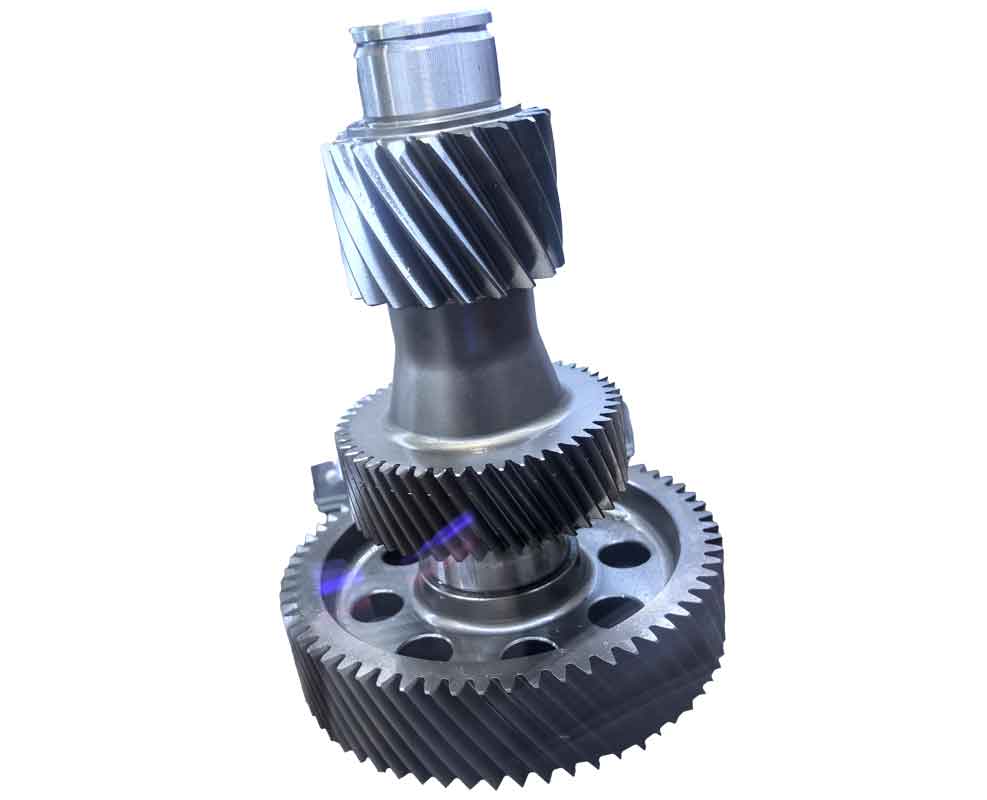
To illustrate the application of this new method, I provide a computational example based on typical Klingelnberg epicycloidal hypoid gear parameters. The input data are:轴交角 $\Sigma = 90^\circ$, offset distance $E = 40$ mm, transmission ratio $i_{12} = 49/12$, gear大端直径 $d_{e2} = 400$ mm, gear width $b_2 = 60$ mm, gear reference point spiral angle $\beta_{m2} = 30^\circ$, average pressure angle $\alpha = 20^\circ$, tool名义半径 $r_0 = 135$ mm, and number of blade groups $z_0 = 5$. Using the proposed geometric design and gear cutting adjustment method, we compute the following results:
- Reference point normal module: $m_n = 6.064819$ mm.
- Pitch cone parameters: $r_{m1} = 49.692377$ mm, $r_{m2} = 171.574715$ mm, $\delta_1 = 18.205761^\circ$, $\delta_2 = 71.353548^\circ$, $\beta_{m1} = 49.921820^\circ$.
- Limit pressure angle: $\alpha_0 = -1.728632^\circ$; thus, working surface pressure angles $\alpha_{ni} = 18.271368^\circ$ and $\alpha_{ne} = -21.728632^\circ$; limit normal curvature $K_{jv} = 7.874948 \times 10^{-3}$ mm$^{-1}$.
- 冠轮 parameters: $r_p = 177.616055$ mm, $\beta_p = 31.327645^\circ$,冠轮齿数 $z_p = 50.033173$, pinion cutting offset $E_1 = 35.696977$ mm, gear cutting offset $E_2 = -4.115315$ mm.
- 冠轮 tooth line average curvature: $K_0 = 7.874948 \times 10^{-3}$ mm$^{-1}$.
- Tool position: $E_x = 172.037850$ mm, tool angle $q_p = 45.388745^\circ$.
For contact zone control, we set $C_t = 0.4$ and $\Delta \zeta = 0.0064$ mm, and consider two scenarios for the blade pressure angles: Scheme I with $\alpha_i = \alpha_{ni}$ and $\alpha_e = |\alpha_{ne}|$, and Scheme II with $\alpha_i = 19^\circ$ and $\alpha_e = 21^\circ$. The calculated冠轮外刀齿线曲率修正量 $\Delta K$, relative curvature parameters, and instantaneous contact ellipse parameters are summarized in the table below. This table demonstrates the impact of blade pressure angles on the gear cutting outcomes and啮合对称性.
| Parameter | Symbol / Unit | Scheme I | Scheme II | ||
|---|---|---|---|---|---|
| Pinion Concave | Gear Concave | Pinion Concave | Gear Concave | ||
| Mating Surface | — | Gear Convex | Pinion Convex | Gear Convex | Pinion Convex |
| Blade Pressure Angle | $\alpha_i, \alpha_e / (^\circ)$ | 18.271368 | 21.728632 | 19 | 21 |
| Relative Principal Curvature | $-K_1 / \text{mm}^{-1}$ | $-6.666667 \times 10^{-5}$ | $6.666667 \times 10^{-5}$ | $-6.666667 \times 10^{-5}$ | $6.666667 \times 10^{-5}$ |
| 冠轮 Outer Blade Curvature Correction | $\Delta K / \text{mm}^{-1}$ | $2.189173 \times 10^{-5}$ | $2.239803 \times 10^{-5}$ | $2.049911 \times 10^{-5}$ | $2.381870 \times 10^{-5}$ |
| Relative Normal Curvature (v-direction) | $-K_{12v} / \text{mm}^{-1}$ | $-3.206519 \times 10^{-3}$ | $3.215401 \times 10^{-3}$ | $-3.316832 \times 10^{-3}$ | $3.105059 \times 10^{-3}$ |
| Relative Normal Curvature (G-direction) | $-K_{12G} / \text{mm}^{-1}$ | $-3.404883 \times 10^{-2}$ | $3.404198 \times 10^{-2}$ | $-3.290140 \times 10^{-2}$ | $3.527736 \times 10^{-2}$ |
| Relative Geodesic Torsion (v-direction) | $-\tau_{12v} / \text{mm}^{-1}$ | $-1.032952 \times 10^{-2}$ | $-1.034308 \times 10^{-2}$ | $-1.033405 \times 10^{-2}$ | $-1.034330 \times 10^{-2}$ |
| Angle to Ellipse Major Axis | $\theta_0 / (^\circ)$ | $-16.907639$ | $16.931777$ | $-17.464602$ | $16.370389$ |
| Contact Ellipse Semi-major Axis | $a_e / \text{mm}$ | $13.856380$ | $13.856410$ | $13.856308$ | $13.856282$ |
| Contact Ellipse Semi-minor Axis | $b_e / \text{mm}$ | $0.586678$ | $0.586662$ | $0.595034$ | $0.577985$ |
The results show that in both schemes, the contact ellipse parameters are similar, indicating that neglecting the outer blade curvature correction has minimal impact on啮合对称性. However, in Scheme II, where the blade pressure angles deviate from the theoretical values by $\Delta \alpha = 0.7286^\circ$, the absolute angle difference $|\Delta \theta_0| = 1.0942^\circ$, suggesting some asymmetry in啮合. This highlights the importance of using accurate blade pressure angles in gear cutting to maintain symmetry. For mass production, it is recommended to set $\alpha_i = \alpha_{ni}$ and $\alpha_e = |\alpha_{ne}|$ to ensure optimal gear performance. The gear cutting process must therefore carefully control these angles to achieve the desired tooth contact patterns.
In conclusion, this study presents a comprehensive new method for the geometric design and gear cutting adjustment of Klingelnberg-type epicycloidal hypoid gears. The key contributions are: (1) Establishing the conditions for啮合对称性 in generated hypoid gears, specifically that $\alpha_{01} = \alpha_{02} = \alpha_0$ and $K_{jp1} = K_{jp2} = K_{jv} = K_0$, which ensure symmetric tooth contacts. These conditions lead to precise formulas for determining the冠轮 parameters $r_p$ and $\beta_p$, as well as the tool position $E_x$ and angle $q_p$. (2) Deriving the relationship between relative principal curvatures and the curvature parameters along the tooth line and profile directions, enabling the calculation of冠轮 tooth line curvature corrections $\Delta K_i$ based on a specified contact zone length coefficient $C_t$. This correction is essential for optimizing the contact pattern during gear cutting. (3) Demonstrating through a computational example that the method effectively computes all necessary geometric and gear cutting parameters, with results showing that slight deviations in blade pressure angles can affect啮合 symmetry. The gear cutting process is integral to this method, as it translates the theoretical design into physical gears. By adhering to the proposed calculations, manufacturers can improve the accuracy and performance of hypoid gears. Future work could explore the application of this method to other gear types or integrate it with advanced manufacturing technologies. Overall, this new approach provides a robust framework for hypoid gear design and gear cutting adjustment, contributing to advancements in gear technology and industrial applications.