
As a key component in rolling mills for motion and power transmission, large module heavy-duty herringbone gear shafts must exhibit high contact strength and bending resistance. The tooth surface hardness is typically required to be 58–62 HRC, often achieved through carburizing and quenching of 17CrNiMo6 steel. Traditionally, fast quenching oil has been widely used as the cooling medium for these herringbone gear shafts. However, oil presents several drawbacks in terms of cooling performance, cost, stability, and environmental impact. In contrast, nitrate salt baths offer numerous advantages, including adjustable cooling capacity, lower cost, and better environmental friendliness. This study focuses on investigating the nitrate salt quenching process for large module heavy-duty herringbone gear shafts, aiming to optimize the heat treatment to meet stringent technical requirements while overcoming challenges associated with deep case hardening, large cross-sections, and microstructural control.
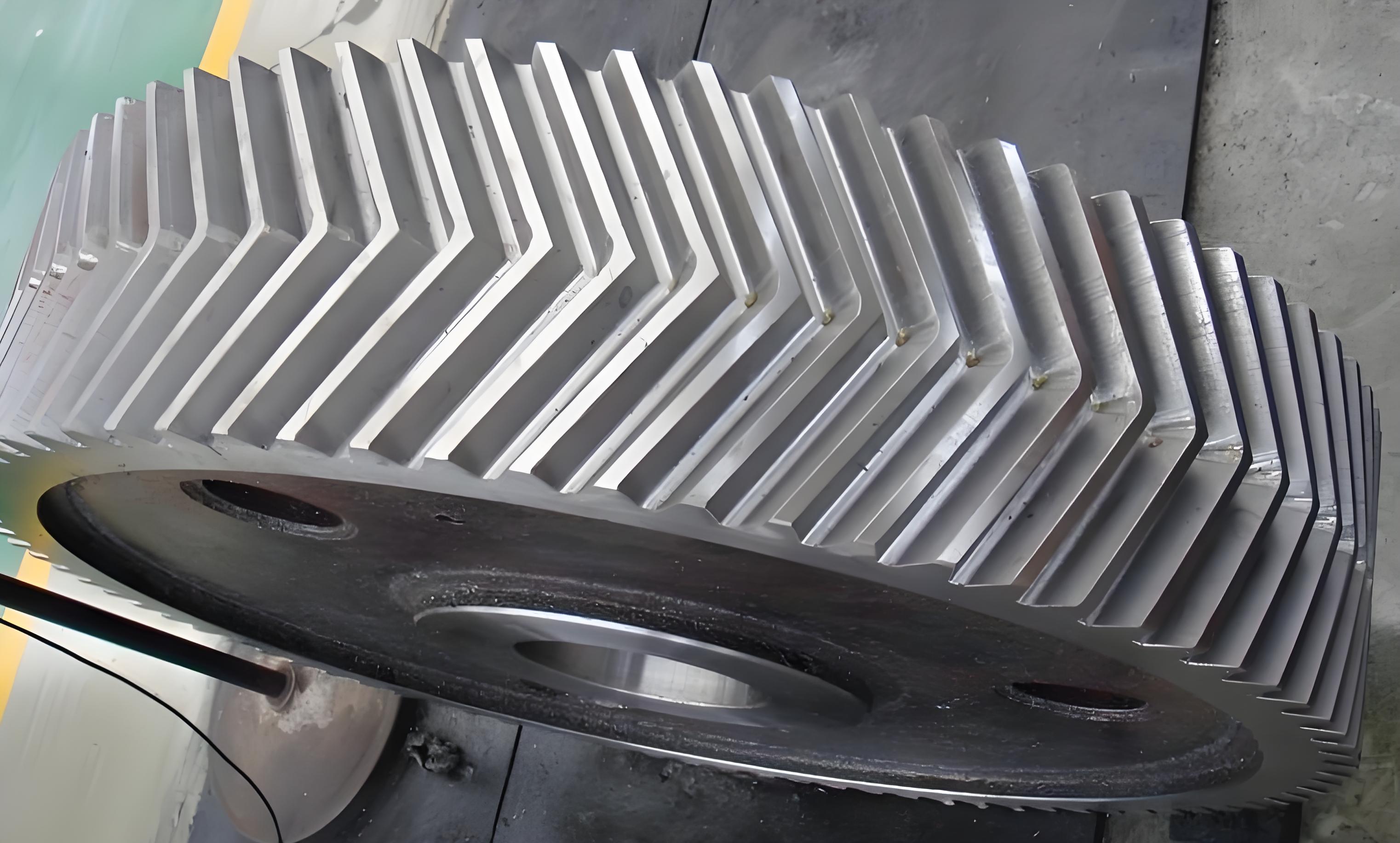
The herringbone gear shaft discussed here is a critical element in heavy-duty industrial machinery, where failure can lead to significant downtime and costs. The unique design of the herringbone gear, with its opposing helices, minimizes axial thrust and ensures smooth operation under high loads. However, this complexity also imposes demanding heat treatment specifications to achieve uniform hardness and microstructure throughout the gear teeth and core. The shift from oil to nitrate salt quenching represents an innovative approach to enhance the performance and sustainability of herringbone gear manufacturing. In this research, we delve into the technical nuances of the process, from material characteristics to quenching kinetics, and present a comprehensive analysis of the trials and optimizations conducted.
Heat Treatment Technical Requirements
The heavy-duty herringbone gear shaft must satisfy specific mechanical and metallurgical criteria to ensure reliability in service. The primary requirements include a surface hardness of 58–62 HRC, core hardness of 35–45 HRC, and an effective case depth of 4.5–5.0 mm, with a drawing specification mandating a minimum hardened layer depth of 2.75 mm. Microstructurally, the surface should consist of martensite within grade 3, core structure within grade 3, retained austenite within grade 2, and carbides within grade 2, as per the JB/T 6141.3–1992 standard for heavy-duty gear carburizing metallographic inspection. The herringbone gear shaft, made from 17CrNiMo6 steel, presents challenges due to its large module and substantial cross-section, which influence carbon diffusion during carburizing and cooling rates during quenching.
The material properties and chemical composition play a pivotal role in determining the heat treatment response. Below, Table 1 summarizes the key parameters of the herringbone gear shaft, while Table 2 lists the critical transformation temperatures, and Table 3 details the chemical composition of 17CrNiMo6 steel. Understanding these factors is essential for designing an effective quenching process, especially when transitioning to nitrate salt baths.
| Parameter | Value |
|---|---|
| Material | 17CrNiMo6 |
| Number of Teeth | 34 |
| Normal Module (mm) | 23 |
| Pressure Angle (°) | 20 |
| Whole Depth (mm) | 54.5 |
| Helix Angle (°) | 28 |
Table 1: Parameters of the heavy-duty herringbone gear shaft.
| Critical Point | Temperature (°C) |
|---|---|
| Ms (Martensite Start) | 400 |
| Ac1 (Austenite Start) | 730 |
| Ac3 (Austenite Finish) | 820 |
Table 2: Critical transformation temperatures for 17CrNiMo6 steel.
| Element | Content (wt%) |
|---|---|
| C | 0.19 |
| Si | 0.25 |
| Mn | 0.62 |
| P | 0.0024 |
| S | 0.005 |
| Cr | 1.60 |
| Ni | 1.52 |
| Mo | 0.28 |
Table 3: Chemical composition of the herringbone gear shaft material.
The technical challenges are multifaceted. First, achieving a case depth exceeding 4.5 mm requires prolonged carburizing times, which can lead to excessive carbide formation if not controlled precisely. Second, the large effective cross-section of approximately φ945 mm demands a cooling medium with high cooling capacity in the high-temperature range to avoid soft spots and microstructural inhomogeneities. Nitrate salt baths, through adjustments in bath temperature and water content, can provide superior cooling performance compared to oil in this regime. Third, the slow cooling in the salt bath and subsequent air cooling may result in higher retained austenite levels, necessitating careful process design to transform it while maintaining acceptable surface and core structures. These issues underscore the need for a tailored nitrate salt quenching strategy for herringbone gear shafts.
Experimental Process Design
To address the challenges, we conducted experiments using a φ1300 mm carburizing furnace, ensuring uniform heating and cooling by positioning the herringbone gear shaft at the center with equal distance from radiation tubes. This setup minimizes thermal stress and distortion. The heat treatment process employed a reheat quenching approach, where carburizing is followed by a separate quenching step. The nitrate salt bath composition was 50% KNO3 + 50% NaNO2, with a melting point of 140°C. We adopted a martempering (graded quenching) process, wherein the core transformation occurs in the salt bath and the surface transformation in air, reducing stresses and distortion. This method was evaluated for its feasibility in terms of microstructural quality and cost-effectiveness.
The carburizing process, illustrated in Figure 2, involves multiple stages with controlled carbon potential to achieve the desired case depth without excessive carbon enrichment. The carbon potential ($C_p$) is regulated using the following relationship, which is critical for surface carbon concentration control:
$$ C_p = k \cdot \exp\left(-\frac{E_a}{RT}\right) \cdot \sqrt{P_{CO}} $$
where $k$ is a constant, $E_a$ is the activation energy, $R$ is the gas constant, $T$ is the temperature, and $P_{CO}$ is the partial pressure of carbon monoxide. In our trials, we used a four-stage carburizing method with a boost-diffusion ratio of 1.2–1.5, setting the carbon potential to 0.65% to prevent carbide network formation. After carburizing, the herringbone gear shaft was subjected to a high-temperature tempering process (Figure 3) to reduce retained austenite, spheroidize any carbides, and relieve stresses. However, this step was later optimized to reduce cycle time and cost.
The quenching and tempering process (Figure 4) involved austenitizing at 820°C, followed by quenching in the nitrate salt bath at 190°C with 0.5% water content, and then tempering at 210–220°C for 5 hours plus 170–180°C for 20 hours. The salt bath temperature and water content were key variables influencing cooling performance. The cooling rate ($v_c$) in the high-temperature region can be approximated by:
$$ v_c = \frac{\Delta T}{\Delta t} = f(T_{bath}, w) $$
where $T_{bath}$ is the salt bath temperature and $w$ is the water content. Higher water content increases the vaporization heat, enhancing cooling capacity, while lower bath temperature reduces austenite stabilization. For the herringbone gear shaft, we aimed to achieve a cooling rate above the critical cooling rate for martensite formation in the core, which is influenced by the hardenability of 17CrNiMo6 steel. The hardenability can be estimated using the ideal critical diameter ($D_I$) formula:
$$ D_I = \sum (k_i \cdot X_i) $$
where $k_i$ are coefficients and $X_i$ are the alloying element percentages. Given the composition in Table 3, $D_I$ is sufficiently high, but the large section size requires aggressive cooling to avoid ferrite formation.
Experimental Results and Analysis
After implementing the initial process, we obtained the results summarized in Table 4 and Table 5. The herringbone gear shaft exhibited several issues: core hardness of 31–33 HRC, below the required 35–45 HRC; surface hardness of 58–58.5 HRC on φ45 mm × 90 mm test specimens, at the lower limit of specification; and core microstructure with grade 5 free ferrite, appearing as blocky and lath-like formations. These outcomes necessitated a detailed analysis to identify root causes and guide optimizations.
| Metric | Result |
|---|---|
| Carbides (Grade) | 1 |
| Martensite & Retained Austenite (Grade) | 1 |
| Core Ferrite (Grade) | 5 |
| Core Grain Size (Grade) | 7 |
| Tooth Surface Hardness (HRC) | 60–62 |
| Internal Oxidation Depth (mm) | 0.016 |
| Decarburization Depth (mm) | 0.026 |
| Effective Case Depth at 550 HV1 (mm) | 4.50 |
| Core Hardness (HRC) | 31–33 |
Table 4: Heat treatment trial results for the herringbone gear shaft.
| Distance from Surface (mm) | Hardness (HV1) |
|---|---|
| 0.1 | 661 |
| 0.2 | 673 |
| 0.3 | 667 |
| 0.4 | 663 |
| 0.5 | 668 |
| 1.0 | 669 |
| 2.0 | 649 |
| 3.0 | 624 |
| 4.0 | 571 |
| 4.3 | 560 |
| 4.9 | 530 |
Table 5: Hardness distribution in test specimens of the herringbone gear shaft.
The core hardness deficiency and excessive ferrite were attributed to multiple factors. First, the raw material exhibited grade 3 banding, leading to alternating zones of martensite and free ferrite after quenching due to micro-segregation of elements like C, Mn, Cr, and Mo. In alloy-depleted regions, the Ac3 temperature rises above 820°C, causing incomplete austenitization at 820°C and resulting in undissolved ferrite that persists after quenching. Additionally, reduced hardenability in these zones lowers the critical cooling rate, allowing ferrite precipitation during cooling. Second, the nitrate salt bath at 190°C with 0.5% water content provided insufficient cooling capacity in the high-temperature range. The cooling performance of nitrate salts is highly dependent on water content; unwatered baths have poor cooling, but adding water significantly improves it. The relationship between cooling rate ($v_c$), bath temperature ($T_{bath}$), and water content ($w$) can be expressed as:
$$ v_c = A \cdot w^B \cdot \exp\left(-\frac{C}{T_{bath}}\right) $$
where $A$, $B$, and $C$ are constants. For typical carburized herringbone gear shafts, water content should be 0.4–1.5%; our initial parameters were suboptimal, leading to slow cooling and ferrite formation.
The low surface hardness on test specimens was primarily due to over-tempering. The tempering temperature of 210–220°C, combined with prolonged time, caused softening of high-carbon martensite. For 17CrNiMo6 steel, tempering above 200°C induces noticeable softening, whereas at 170–180°C, extended times have minimal effect. The process was designed for the large herringbone gear shaft, which requires high tempering temperatures to transform retained austenite from nitrate salt quenching. However, small specimens like φ45 mm × 90 mm reach tempering completion much faster, and the extended cycle led to excessive softening. This discrepancy highlights the need for tailored tempering schedules to ensure test specimens accurately represent the actual herringbone gear shaft.
Regarding surface microstructure, the initial process included a high-temperature tempering after carburizing to address retained austenite and carbide spheroidization. However, our results showed no visible carbides after quenching, indicating that carburizing with a carbon potential of 0.65% and a boost-diffusion ratio of 1.2–1.5 effectively controlled surface carbon concentration. The carburizing exit temperature of 760°C, within the two-phase region of 17CrNiMo6, caused surface martensite or bainite formation upon air cooling. This led to structural inheritance during reheating, producing coarse martensite. To avoid this, high-temperature tempering was used, but it increased costs and cycle time. Alternatively, lowering the exit temperature to 650°C allows furnace cooling to produce equilibrium structures, enhancing nucleation during reheating and refining austenite grains. This approach can eliminate structural inheritance and potentially replace high-temperature tempering for herringbone gear shafts.
Process Optimization
Based on the analysis, we optimized the heat treatment process for the heavy-duty herringbone gear shaft. The key changes included eliminating the post-carburizing high-temperature tempering, adjusting quenching parameters, and refining the tempering schedule. These optimizations aimed to improve core hardness, surface hardness consistency, and microstructural quality while reducing production time and costs.
First, we omitted the high-temperature tempering after carburizing. Instead, the herringbone gear shaft was furnace-cooled to 650°C after carburizing and held to achieve equilibrium structures. This step refines surface grains and eliminates structural inheritance, serving the same purpose as high-temperature tempering but more efficiently. The carburizing process remained similar, with careful carbon potential control to prevent carbide formation.
Second, the quenching process was revised as shown in Figure 5. We implemented a two-step austenitizing approach: holding at 840°C to dissolve free ferrite and reduce austenitizing temperature in segregated zones, followed by rapid cooling to 820°C for quenching. This enhances hardenability and promotes finer martensite with reduced retained austenite. The nitrate salt bath temperature was lowered to 160°C, and water content increased to 1.0%. These adjustments significantly boost high-temperature cooling capacity, as described by the modified cooling rate equation:
$$ v_c = 5.2 \cdot w^{0.8} \cdot \exp\left(-\frac{1200}{T_{bath} + 273}\right) \, \text{°C/s} $$
where $w$ is in percentage and $T_{bath}$ in °C. At 160°C and 1.0% water, $v_c$ increases sufficiently to suppress ferrite formation in the core of the herringbone gear shaft. Lower bath temperature also reduces austenite stabilization, decreasing retained austenite levels.
Third, the tempering schedule was optimized to a two-stage递减式 (decremental) process: (210–220)°C × 5 h + (170–180)°C × 20 h. The first stage at higher temperature transforms retained austenite, while the second stage at lower temperature relieves stresses without over-softening. This approach ensures that test specimens, with smaller cross-sections, do not experience excessive tempering and their hardness values better match those of the actual herringbone gear shaft. The tempering effect on hardness can be modeled using the Hollomon-Jaffe equation:
$$ H = H_0 – k \cdot \log(t) \cdot \exp\left(-\frac{Q}{RT}\right) $$
where $H$ is hardness, $H_0$ is initial hardness, $k$ is a constant, $t$ is time, $Q$ is activation energy, $R$ is the gas constant, and $T$ is tempering temperature. By optimizing $T$ and $t$, we achieve balanced properties for both specimens and full-scale herringbone gear components.
After implementing these optimizations, the results improved markedly, as summarized in Table 6 and Table 7. Core hardness increased to 38–40 HRC, meeting specifications, and core ferrite was reduced to grade 1–2. Surface hardness on test specimens aligned with gear tooth hardness, ensuring that specimen data accurately reflect the herringbone gear shaft’s condition. Microstructurally, surface retained austenite was below 5% by volume, martensite was fine or hidden needle-like, and no carbides were visible, satisfying all requirements. These outcomes validate the feasibility of replacing high-temperature tempering with controlled cooling and optimized quenching for herringbone gear shafts.
| Metric | Result |
|---|---|
| Carbides (Grade) | 1 |
| Martensite & Retained Austenite (Grade) | 1 |
| Core Ferrite (Grade) | 1–2 |
| Core Grain Size (Grade) | 7 |
| Tooth Surface Hardness (HRC) | 60–61.5 |
| Internal Oxidation Depth (mm) | 0.015 |
| Decarburization Depth (mm) | 0.020 |
| Effective Case Depth at 550 HV1 (mm) | 4.62 |
| Core Hardness (HRC) | 38–40 |
Table 6: Optimized heat treatment results for the herringbone gear shaft.
| Distance from Surface (mm) | Hardness (HV1) |
|---|---|
| 0.1 | 687 |
| 0.2 | 700 |
| 0.3 | 710 |
| 0.4 | 705 |
| 0.5 | 714 |
| 1.0 | 685 |
| 2.0 | 658 |
| 3.0 | 630 |
| 4.0 | 586 |
| 4.3 | 565 |
| 4.9 | 538 |
Table 7: Hardness distribution after optimization for the herringbone gear shaft.
The optimized process was applied to over ten large module herringbone gear shafts, all of which met technical specifications. This success demonstrates the robustness of nitrate salt quenching for heavy-duty herringbone gear applications, offering a sustainable and cost-effective alternative to oil quenching. The ability to fine-tune cooling performance through bath temperature and water content makes it particularly suitable for complex components like herringbone gears, where uniformity and precision are paramount.
Conclusion
In this study, we explored the nitrate salt quenching process for large module heavy-duty herringbone gear shafts, addressing key challenges in deep case hardening, large cross-section cooling, and microstructural control. Our findings highlight several critical insights for manufacturing high-performance herringbone gear components.
First, by cooling the herringbone gear shaft to 650°C after carburizing and holding to achieve equilibrium structures, we eliminated the need for post-carburizing high-temperature tempering. This approach refines grain structure and prevents structural inheritance, reducing production costs and cycle times while meeting all microstructural requirements for herringbone gear shafts.
Second, the optimal quenching process for 17CrNiMo6 steel herringbone gear shafts involves austenitizing at 840°C followed by rapid cooling to 820°C before nitrate salt quenching. This two-step method enhances core hardenability, minimizes free ferrite, and promotes fine martensite with reduced retained austenite, ensuring superior mechanical properties in herringbone gear applications.
Third, adjusting the nitrate salt bath to 160°C with 1.0% water content significantly improves high-temperature cooling capacity, effectively suppressing ferrite formation in the core. The tunable cooling performance of nitrate salt baths allows precise control over quenching outcomes, making them ideal for large cross-section herringbone gear shafts where oil quenching falls short.
Fourth, implementing a decremental tempering schedule—starting at higher temperatures to transform retained austenite and then lowering to stabilize microstructure—prevents over-tempering in test specimens. This ensures that laboratory data accurately represent the actual herringbone gear shaft, facilitating reliable quality assessment and process validation.
Overall, nitrate salt quenching proves to be a viable and advantageous technique for heavy-duty herringbone gear shafts, offering enhanced cooling performance, environmental benefits, and cost savings. The optimizations developed here can be extended to other large module gear systems, contributing to advancements in industrial gear manufacturing. Future work could focus on further refining water content dynamics or exploring additive effects in salt baths to push the limits of herringbone gear performance in extreme operating conditions.