
Helical gears are fundamental power transmission elements in modern machinery, prized for their smooth operation, high load capacity, and reduced noise compared to spur gears. These advantages stem from their gradual tooth engagement. However, this very characteristic, combined with inherent manufacturing imperfections and operational loads, introduces complex nonlinear dynamic behavior. This behavior is governed by internal excitations such as time-varying mesh stiffness, transmission errors, and external factors like fluctuating loads. Furthermore, clearances in meshing teeth and supporting bearings, essential for assembly and lubrication, introduce strong nonlinearities that can lead to subharmonic resonance, bifurcations, and chaotic motion, significantly impacting vibration, noise, and fatigue life. Therefore, a comprehensive nonlinear dynamic analysis is crucial for the optimal design and reliable operation of helical gear systems.
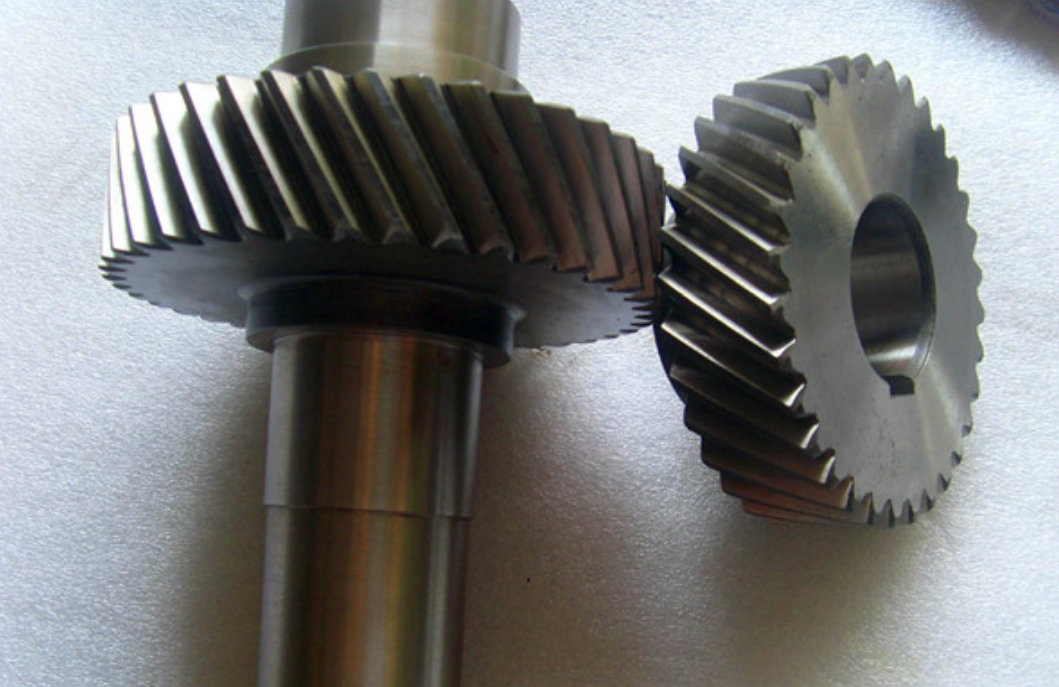
This study establishes a refined, nonlinear dynamic model for a parallel-axis helical gear pair. The model accounts for the key physical factors influencing system behavior: time-varying mesh stiffness, static transmission error, tooth separation due to backlash, clearance in radial and axial bearings, and viscous damping in both mesh and supports. The equations of motion are derived, nondimensionalized, and solved numerically to investigate the complex interplay between system parameters and dynamic response.
1. Mathematical Modeling of the Helical Gear System
The system comprises two helical gears, Gear 1 (driving, left-hand helix) and Gear 2 (driven, right-hand helix), mounted on flexible shafts supported by bearings. A lumped-parameter model with twelve degrees of freedom (DOF) is adopted: three translational (x, y, z) and one rotational (θ) for each gear body. Key assumptions include rigid gear wheels and shafts (with flexibility concentrated at bearings and mesh), symmetric installation, and the inclusion of assembly errors within the composite static transmission error.
The relative displacement along the line of action (LOA) is the fundamental coordinate for calculating the mesh force. For helical gears, the LOA is not parallel to any principal axis. The relative displacement \(\delta(t)\) along the LOA, considering gear center motions and rotations, is given by:
$$ \delta(t) = -a(x_1 – x_2) – b(y_1 – y_2) – c(z_1 – z_2) + c(R_1\theta_1 – R_2\theta_2) – e(t) $$
where \(x_i, y_i, z_i\) are the translational displacements of gear \(i\) (\(i=1,2\)), \(R_i\) is the base circle radius, \(\theta_i\) is the angular displacement, and \(e(t)\) is the static transmission error (STE). The directional coefficients \(a, b, c\) are determined by the pressure angle \(\alpha\) and helix angle \(\beta\) of the helical gears:
$$
a = \sin(\alpha), \quad b = \cos(\alpha)\sin(\beta), \quad c = \cos(\alpha)\cos(\beta)
$$
The nonlinear mesh force \(F_m\) acting along the LOA includes a nonlinear stiffness function \(f(\delta, b_m)\) accounting for tooth separation (backlash \(b_m\)) and linear mesh damping:
$$ F_m = k_m(t) \cdot f(\delta, b_m) + c_m \dot{\delta} $$
The piecewise linear backlash function is defined as:
$$
f(\delta, b_m) =
\begin{cases}
\delta – b_m, & \delta > b_m \\
0, & |\delta| \le b_m \\
\delta + b_m, & \delta < -b_m
\end{cases}
$$
The time-varying mesh stiffness \(k_m(t)\) for helical gears is periodic and can be approximated by a Fourier series. A common single-term approximation is:
$$ k_m(t) = k_{avg} \left[ 1 + \epsilon_k \cos(\omega_m t + \phi_k) \right] $$
where \(k_{avg}\) is the average mesh stiffness, \(\epsilon_k\) is the stiffness fluctuation amplitude, \(\omega_m\) is the mesh frequency (\(\omega_m = Z_1 \Omega_1 = Z_2 \Omega_2\), with \(Z\) as tooth count and \(\Omega\) as rotational speed), and \(\phi_k\) is a phase angle. Similarly, the STE is modeled as: \(e(t) = e_a \cos(\omega_m t + \phi_e)\).
The mesh force components on Gear 1 in the x, y, z directions are:
$$
F_{1x} = a F_m, \quad F_{1y} = b F_m, \quad F_{1z} = c F_m
$$
The supporting forces from bearings are also modeled with clearance nonlinearity and linear damping. For a bearing in the x-direction with clearance \(b_x\), the restoring force \(F_{bx}\) is:
$$
F_{bx} = k_x \cdot g(x, b_x) + c_x \dot{x}, \quad \text{where } g(x, b_x) =
\begin{cases}
x – b_x, & x > b_x \\
0, & |x| \le b_x \\
x + b_x, & x < -b_x
\end{cases}
$$
Applying Newton’s second law, the 12-DOF equations of motion are:
$$
\begin{aligned}
m_1 \ddot{x}_1 + c_{1x}\dot{x}_1 + k_{1x} g(x_1, b_{1x}) &= F_{1x} \\
m_1 \ddot{y}_1 + c_{1y}\dot{y}_1 + k_{1y} g(y_1, b_{1y}) &= F_{1y} \\
m_1 \ddot{z}_1 + c_{1z}\dot{z}_1 + k_{1z} g(z_1, b_{1z}) &= F_{1z} \\
I_1 \ddot{\theta}_1 + F_{1z} R_1 &= T_{in} \\
m_2 \ddot{x}_2 + c_{2x}\dot{x}_2 + k_{2x} g(x_2, b_{2x}) &= -F_{1x} \\
m_2 \ddot{y}_2 + c_{2y}\dot{y}_2 + k_{2y} g(y_2, b_{2y}) &= -F_{1y} \\
m_2 \ddot{z}_2 + c_{2z}\dot{z}_2 + k_{2z} g(z_2, b_{2z}) &= -F_{1z} \\
I_2 \ddot{\theta}_2 – F_{1z} R_2 &= -T_{out}
\end{aligned}
$$
Where \(m_i\) and \(I_i\) are mass and moment of inertia, \(c_{ij}, k_{ij}, b_{ij}\) are bearing damping, stiffness, and clearance, and \(T_{in}, T_{out}\) are input/output torques.
To generalize the analysis, the equations are nondimensionalized. Defining a characteristic displacement \(D_c\) (often the nominal static deflection or backlash) and a characteristic frequency \(\omega_n = \sqrt{k_{avg}/m_e}\) (where \(m_e\) is the equivalent mass \(\frac{m_1 m_2}{m_1+m_2}\)), we introduce:
$$
\tau = \omega_n t, \quad X_i = \frac{x_i}{D_c}, \quad \delta^* = \frac{\delta}{D_c}, \quad \Omega^* = \frac{\omega_m}{\omega_n}, \quad P = \frac{T_{in}}{m_e \omega_n^2 D_c R_1}
$$
The resulting nondimensional system, after substitution and manipulation, takes the form:
$$
\begin{aligned}
\ddot{X}_1 + 2\xi_{1x}\dot{X}_1 + \kappa_{1x} G(X_1) – 2a\zeta_m \dot{\delta^*} – a\kappa_m(\tau) F(\delta^*) &= 0 \\
… \quad &\text{(Similar equations for other DOFs)} … \\
\ddot{\delta^*} + a(\ddot{X}_1-\ddot{X}_2) + … + 2\zeta_m \dot{\delta^*} + \kappa_m(\tau) F(\delta^*) &= \bar{P} – \ddot{E}(\tau)
\end{aligned}
$$
Where \(\xi\) are dimensionless damping ratios, \(\kappa\) are dimensionless stiffnesses, \(\zeta_m\) is the dimensionless mesh damping ratio, \(\kappa_m(\tau)=1+\epsilon_k \cos(\Omega^* \tau)\) is the dimensionless mesh stiffness, \(F(\cdot)\) and \(G(\cdot)\) are the dimensionless piecewise linear functions, and \(\bar{P}\) is the dimensionless load parameter.
2. Numerical Analysis Methodology and System Parameters
The set of strongly nonlinear, coupled ordinary differential equations is solved using the fourth-order Runge-Kutta numerical integration scheme. To analyze the long-term dynamic behavior, the system is simulated over a long time span, discarding the initial transient response. The primary tool for investigating the system’s evolution with a control parameter (like mesh frequency \(\Omega^*\) or load \(\bar{P}\)) is the bifurcation diagram. This is constructed by plotting the local maxima of the dimensionless relative displacement \(\delta^*\) (or another state variable) at discrete, equally spaced values of the control parameter.
To distinguish between periodic, quasi-periodic, and chaotic motion, Poincaré maps are employed. For a system under periodic excitation with period \(T = 2\pi/\Omega^*\), the Poincaré section is defined by sampling the state-space trajectory at intervals of the excitation period:
$$
\Sigma = \{ (\mathbf{X}, \dot{\mathbf{X}}) \in \mathbb{R}^{12} \ | \ \phi = \omega_m t \mod 2\pi = 0 \}
$$
A finite number of points on this map indicates periodic motion (e.g., 1 point for period-1, n points for period-n), a closed curve indicates quasi-periodic motion, and a cloud of scattered points suggests chaotic motion. Phase portraits (e.g., \(\delta^*\) vs. \(\dot{\delta^*}\)) provide complementary visual insight.
The baseline parameters for the studied helical gears system are summarized in the table below.
| Parameter | Symbol | Value | Dimension |
|---|---|---|---|
| Number of Teeth (Gear 1 / Gear 2) | \(Z_1 / Z_2\) | 35 / 67 | – |
| Module | \(m_n\) | 3 mm | Length |
| Pressure Angle | \(\alpha\) | 20° | Degree |
| Helix Angle | \(\beta\) | 18° | Degree |
| Characteristic Displacement (Backlash) | \(D_c\) | 30 μm | Length |
| Avg. Mesh Stiffness | \(k_{avg}\) | 1.0e8 N/m | Force/Length |
| Stiffness Fluctuation Amplitude | \(\epsilon_k\) | 0.2 | – |
| Static Transmission Error Amplitude | \(e_a\) | 5 μm | Length |
| Dimensionless Backlash | \(b^*\) | 1.0 | – |
| Bearing Clearance (Radial/Axial) | \(b_{ij}^*\) | 0.5 | – |
| Bearing Damping Ratio | \(\xi_{ij}\) | 0.02 | – |
3. Influence of Mesh Damping Ratio on System Dynamics
The mesh damping ratio \(\zeta_m\) is a critical parameter representing the energy dissipation in the gear mesh interface, influenced by lubrication and material properties. Its effect on the global dynamics of the helical gears system is profound.
For a low mesh damping ratio (\(\zeta_m = 0.01\)), the system exhibits rich and complex dynamic behavior across a wide range of dimensionless mesh frequencies \(\Omega^*\). At high frequencies (\(\Omega^* > 2.45\)), the system responds with a stable period-1 motion, synchronous with the mesh frequency. As \(\Omega^*\) decreases, a period-doubling bifurcation occurs near \(\Omega^* \approx 2.45\), leading to period-2 motion. This is followed by a broad region of chaotic motion interspersed with periodic windows (e.g., period-3) for \(1.45 < \Omega^* < 2.29\). Further decrease in frequency reveals a complex sequence involving period-8 motion, a reverse period-doubling cascade (period-8 → period-4 → period-2), and transitions back into chaos before finally settling into a stable period-1 motion via a jump phenomenon at very low frequencies. The presence of multiple chaotic zones and high-periodic orbits indicates severe nonlinear responses and potential for high vibration levels.
Increasing the mesh damping ratio to \(\zeta_m = 0.03\) has a stabilizing effect. The chaotic regions are reduced in size and magnitude. While the period-doubling route to chaos still exists, the subsequent chaotic region is interrupted by a periodic window (e.g., period-24, evolving through reverse bifurcations to period-3). The low-frequency region becomes more dominated by periodic motions following the chaotic zone. The sequence simplifies to a period-8 → period-4 → period-2 → period-1 progression after the system exits chaos.
With a higher mesh damping ratio (\(\zeta_m = 0.05\)), the stabilizing effect is more pronounced. The chaotic region, while still present, becomes a single, contiguous band without embedded high-period windows. The transition out of chaos leads directly into a period-8 orbit, followed by a clean reverse period-doubling cascade back to period-1 motion. The amplitude of oscillations within the chaotic region is also reduced compared to lower damping cases. This demonstrates that adequate mesh damping in helical gears is highly effective in suppressing complex nonlinear phenomena, narrowing the parameter ranges where undesirable chaotic vibrations occur, and promoting simpler, more predictable periodic responses.
| Mesh Damping Ratio \(\zeta_m\) | Primary Dynamic Characteristics | Relative Size of Chaotic Zones | Typical Post-Chaotic Sequence |
|---|---|---|---|
| Low (0.01) | Complex bifurcation sequences, multiple chaotic bands, high-period orbits, jump phenomena. | Large and fragmented | Complex, with intermittent chaos |
| Medium (0.03) | Reduced chaos, clearer periodic windows within chaos, simpler low-frequency behavior. | Medium | Period-8 → P-4 → P-2 → P-1 |
| High (0.05) | Single chaotic band, clean period-doubling/reverse-doubling cascades, lower vibration amplitudes. | Smaller and consolidated | Period-8 → P-4 → P-2 → P-1 |
4. Influence of Input Load on System Dynamics
The dimensionless input load parameter \(\bar{P}\) directly relates to the transmitted torque. Its variation significantly alters the system’s equilibrium position within the backlash zone and the effective nonlinearity experienced during vibration.
Under light load conditions (\(\bar{P} = 0.027\)), the system spends a significant portion of its cycle near or within the backlash region, experiencing strong nonlinear effects from repeated tooth separations and impacts. This results in extensive chaotic response regions across medium and low frequencies. The bifurcation diagram shows that stable period-1 motion is limited to very high \(\Omega^*\). As frequency decreases, the system quickly becomes chaotic, with only very narrow periodic windows. The low-frequency region (\(0.5 < \Omega^* < 1.3\)) is particularly complex, featuring transitions between period-8, period-4, period-2, and period-1 motions, indicating high sensitivity to parameter changes.
Increasing the load to a nominal value (\(\bar{P} = 0.048\)) pushes the mean operating point further into the contact region, reducing the likelihood of tooth separation for a given vibration amplitude. This attenuates the severity of nonlinearity. Consequently, the chaotic regions become more confined. A prominent period-3 window emerges within the main chaotic band. The post-chaotic behavior becomes more orderly, typically following a reverse period-doubling cascade from period-8 down to period-1.
At a heavy load (\(\bar{P} = 0.063\)), the system is biased deep into the meshing state, minimizing the influence of backlash except during large-amplitude vibrations. The global dynamics simplify further. The route to chaos still follows a period-doubling sequence, but the subsequent chaotic region is more uniform. The transition out of chaos is abrupt, leading directly to a period-8 orbit, followed by a clean cascade to period-1 motion. The range of \(\Omega^*\) exhibiting chaotic motion is reduced compared to lighter loads.
This analysis underscores a critical design insight for helical gears: operating under sufficiently high load factors can be beneficial for dynamic stability. It suppresses the severe nonlinear effects of backlash, leading to a more predictable and less vibratory response. However, this must be balanced against increased contact stresses and wear.
| Dimensionless Load \(\bar{P}\) | Operating Point & Nonlinearity Severity | Chaotic Response Prevalence | Remarks on Dynamic Order |
|---|---|---|---|
| Light (0.027) | Near/inside backlash; Strong nonlinearity from impacts. | Very High (Broad chaotic zones) | Highly complex, sensitive behavior. |
| Nominal (0.048) | Engaged; Moderate nonlinearity. | Medium (Confined chaos with periodic windows) | More ordered post-chaotic cascades. |
| Heavy (0.063) | Deeply engaged; Weak nonlinearity. | Lower (Smaller, uniform chaos band) | Simplified, predictable bifurcation structure. |
5. Dynamics Under Progressive Tooth Wear
Tooth wear is a common failure mode in helical gears, gradually altering tooth profiles and effectively increasing the operational backlash. This can be modeled by modifying the backlash function \(f(\delta, b_m)\) to have an increased effective clearance \(b_{eff} = b_m + w\), where \(w\) represents the uniform wear depth across all teeth.
For a system with nominal damping (\(\zeta_m=0.03\)) and load (\(\bar{P}=0.048\)), introducing mild wear (\(w = 0.1 \cdot D_c\)) causes noticeable changes. The bifurcation structure remains broadly similar, but key differences emerge. The periodic windows embedded within the main chaotic region (e.g., the period-6 and period-3 motions) shrink or disappear. More significantly, the low-frequency region that was previously stable (period-1) becomes destabilized, transitioning into a chaotic zone for \(1.0 < \Omega^* < 1.13\). This indicates that wear can induce chaotic vibrations in operating speed ranges that were previously stable.
Under severe wear conditions (\(w = 0.3 \cdot D_c\)), the dynamic landscape deteriorates drastically. The period-doubling route is replaced at certain frequencies by a direct Hopf bifurcation from period-1 motion into quasi-periodic or chaotic motion. The chaotic region expands significantly, covering almost the entire medium-frequency range (\(0.7 < \Omega^* < 1.88\)). Stable periodic operation is only found at very high and very low frequencies. This demonstrates that excessive wear fundamentally alters the nonlinear characteristics of the helical gears system, promoting highly irregular and potentially damaging vibrations across a wide operational spectrum. Monitoring dynamic response changes can thus serve as a precursor for wear detection.
6. Conclusion
This comprehensive nonlinear dynamic analysis of a multi-degree-of-freedom helical gears system reveals the intricate relationship between design/operational parameters and system behavior. The model incorporating time-varying mesh stiffness, transmission error, bearing clearance, and tooth backlash successfully captures complex phenomena such as period-doubling bifurcations, chaotic motion, and jump discontinuities.
The key findings are: (1) The mesh damping ratio \(\zeta_m\) is a powerful stabilizing factor. Increasing damping suppresses chaos, reduces vibration amplitudes, and simplifies the bifurcation structure, guiding the system towards predictable periodic responses. (2) The input load \(\bar{P}\) significantly influences dynamic stability. Operating under sufficiently high load minimizes the destabilizing effect of backlash, reducing chaotic zones and simplifying post-chaotic behavior. (3) Progressive tooth wear, modeled as increased backlash, has a profoundly detrimental effect on system dynamics. It can destabilize previously stable speed ranges, eliminate beneficial periodic windows, and expand chaotic regions, serving as a dynamic indicator of component degradation.
For engineers designing helical gears transmissions, these insights emphasize the importance of optimizing damping (e.g., through lubricant selection or composite materials) and avoiding excessively light load operations to ensure dynamic stability. Furthermore, the analysis provides a framework for condition monitoring, where shifts in vibration signatures (e.g., the emergence of chaos at specific frequencies) could be linked to parameter changes like wear or lubrication loss, enabling predictive maintenance.