
As an engineer specializing in gear manufacturing and metrology, I have long been fascinated by the challenges associated with inspecting the tooth profiles of miter gears. These gears, a specific type of bevel gear with a 1:1 ratio and typically 90-degree shaft axes, are critical components in differentials, steering systems, and various power transmission applications. Their complex geometry, particularly the evolving tooth form from the heel to the toe, makes direct measurement of the full tooth profile at the large end exceedingly difficult. Traditional methods often rely on checking only the chordal tooth thickness and chordal addendum at the large end, leaving the complete involute profile unverified. This gap in inspection can lead to quality issues in downstream processes, such as in the production of electrodes for electrical discharge machining (EDM) used to create forging dies for precision gears. In this article, I will detail a method I developed that leverages computational power to overcome this hurdle, ensuring high accuracy in miter gear inspection without significant capital investment.
The core of the problem lies in the geometry of the miter gear tooth. On the back-cone development, the tooth profile at the large end can be represented as an involute curve. However, manually calculating and drawing this profile to a magnified scale for comparison purposes is prone to error, especially when dealing with high-precision gears. My approach involves programming a microcomputer to calculate the coordinates of the involute profile accurately, plotting a magnified drawing, and then using this drawing as a master template for inspection on an optical projector. This method transforms a subjective, skill-dependent task into a repeatable, quantitative process.
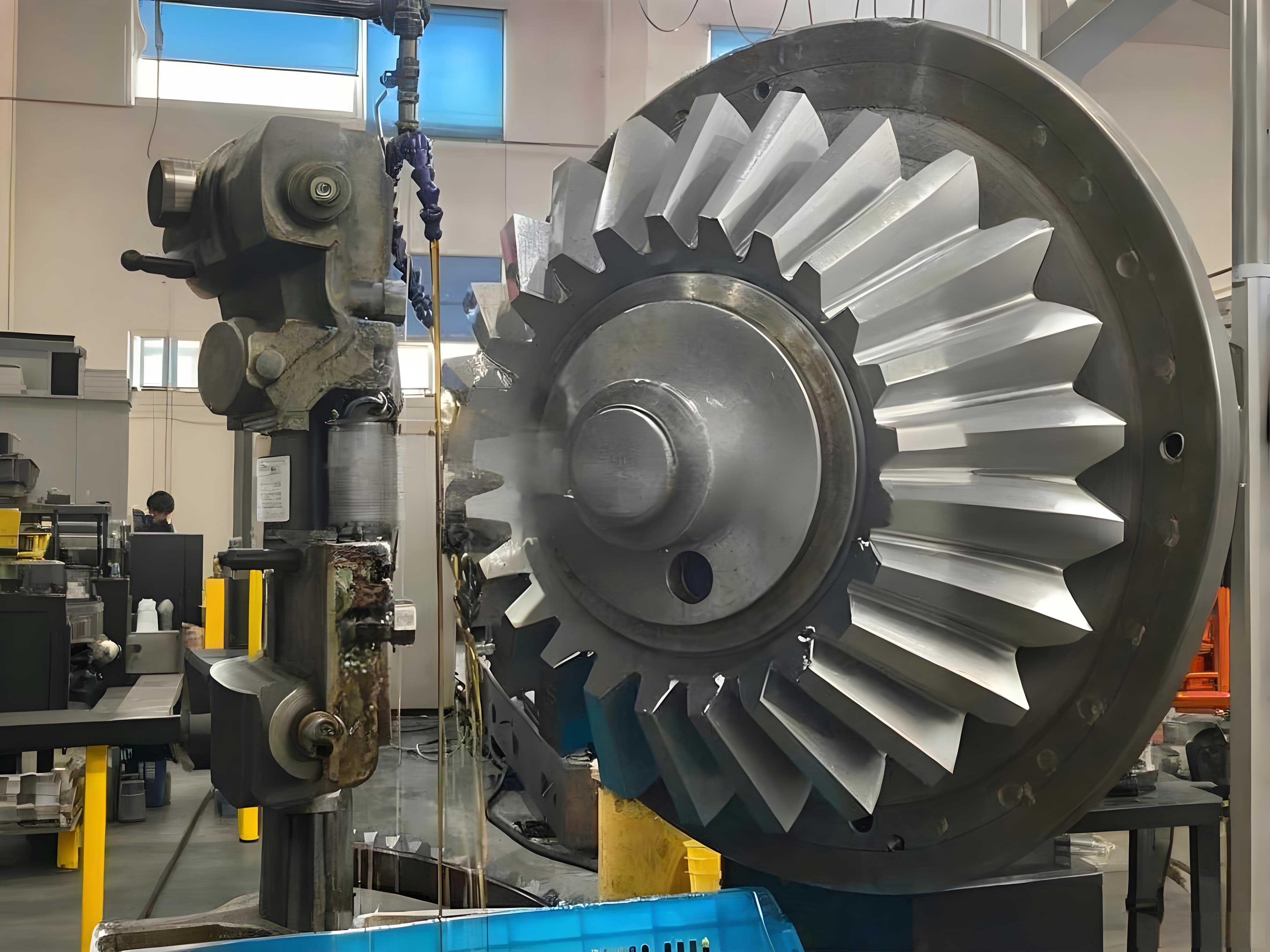
To understand the inspection of a miter gear, one must first grasp its fundamental parameters. For a straight bevel gear, which includes the miter gear as a subset, the tooth dimensions are defined at the large end of the tooth. The following table summarizes the key geometric parameters required for the profile calculation of a typical miter gear electrode used in our case.
| Parameter Symbol | Parameter Description | Typical Value (Example) | Role in Profile Calculation |
|---|---|---|---|
| z | Number of teeth | 16 | Determines the angular spacing and equivalent gear geometry. |
| m | Module at large end | 6.5 mm | The fundamental size scaling factor for all linear dimensions. |
| α | Pressure angle | 20° | Defines the slope of the involute curve at the pitch circle. |
| ha* | Addendum coefficient | 1.0 | Scales the addendum height relative to the module. |
| x | Radial modification (shift) coefficient | +0.3 | Modifies the tooth thickness and profile to avoid undercut or adjust center distance. |
| c* | Dedendum clearance coefficient | 0.25 | Determines the depth of the dedendum relative to the addendum. |
| δ | Pitch cone angle | 45° (for miter gear) | For a miter gear, this is 45° for equal tooth numbers on mating gears. It is used to find the back-cone geometry. |
The inspection process begins with the computational derivation of the tooth profile. On the back-cone development, the large-end section of the miter gear tooth transforms into a spur gear tooth with an equivalent number of teeth, zv. This is a crucial step in simplifying the problem. The equivalent spur gear parameters are calculated as follows:
The equivalent number of teeth for the back-cone development is given by:
$$ z_v = \frac{z}{\cos \delta} $$
For a standard miter gear with δ = 45°, this becomes $$ z_v = \frac{z}{\cos 45°} = \sqrt{2} z $$.
The pitch radius of this equivalent spur gear (at the large end) is:
$$ r_v = \frac{m z_v}{2} $$
The base circle radius, from which the involute emanates, is:
$$ r_{bv} = r_v \cos \alpha = \frac{m z_v}{2} \cos \alpha $$
The addendum and dedendum for the equivalent gear are:
$$ h_{av} = m (h_a^* + x) $$
$$ h_{fv} = m (h_a^* + c^* – x) $$
The tip radius $$ r_{av} = r_v + h_{av} $$ and the root radius $$ r_{fv} = r_v – h_{fv} $$.
The heart of the calculation is generating the coordinates of the involute curve. The involute function is defined parametrically. Let ry be the radius to any point on the involute between the base circle (rbv) and the tip circle (rav). The involute angle θy at this radius is:
$$ \theta_y = \tan(\arccos(\frac{r_{bv}}{r_y})) – \arccos(\frac{r_{bv}}{r_y}) $$
This is often expressed in terms of the involute function: $$ \text{inv}(\alpha_y) = \tan \alpha_y – \alpha_y $$, where $$ \alpha_y = \arccos(r_{bv} / r_y) $$.
The tooth thickness at any radius ry is critical for plotting. The tooth thickness sy on an arbitrary circle of radius ry is derived from the thickness on the pitch circle sv. For the equivalent gear, the pitch circle tooth thickness sv accounts for the modification:
$$ s_v = m \left( \frac{\pi}{2} + 2x \tan \alpha \right) $$
Then, the thickness at radius ry is:
$$ s_y = r_y \left( \frac{s_v}{r_v} + 2(\text{inv}(\alpha) – \text{inv}(\alpha_y)) \right) $$
where α is the pressure angle at the pitch circle (e.g., 20°).
For plotting in Cartesian coordinates, we need the (x, y) coordinates of points on the tooth centerline and the two flanks. We set up a coordinate system with the origin at the center of the equivalent gear, the Y-axis passing through the center of the tooth. The half-thickness at radius ry is sy/2. The coordinates for a point on the left flank (for example) are:
$$ x = -\frac{s_y}{2} $$
$$ y = r_y \sin(\phi_y) $$
where φy is the angle from the tooth centerline to the point. More precisely, φy = (sv/(2rv) + inv(α) – inv(αy)). For plotting a magnified profile, we calculate these coordinates for a series of radii from rbv to rav. Below the base circle, the profile is typically a radial line or a trochoid, but for inspection purposes, it is often approximated by a straight line tangent to the involute at the base circle and extending to the root circle.
The following table outlines the step-by-step computational algorithm implemented in a high-level language like Python or BASIC.
| Step | Action | Formula / Calculation | Output |
|---|---|---|---|
| 1 | Input basic miter gear parameters. | z, m, α, ha*, x, c*, δ. | Stored variables. |
| 2 | Calculate equivalent spur gear parameters. | $$ z_v = z / \cos \delta $$, $$ r_v = m z_v / 2 $$, $$ r_{bv} = r_v \cos \alpha $$. | zv, rv, rbv. |
| 3 | Calculate critical radii. | $$ r_{av} = r_v + m(h_a^* + x) $$, $$ r_{fv} = r_v – m(h_a^* + c^* – x) $$. | rav, rfv. |
| 4 | Define number of points N for involute. | N = 50 (for smooth curve). | N. |
| 5 | Loop: For i = 0 to N, calculate radius ry[i]. | $$ r_y[i] = r_{bv} + (i/N) * (r_{av} – r_{bv}) $$. | Array ry[i]. |
| 6 | For each ry[i], calculate pressure angle αy[i]. | $$ \alpha_y[i] = \arccos(r_{bv} / r_y[i]) $$. | αy[i]. |
| 7 | Calculate involute function values. | $$ \text{inv}(\alpha) = \tan \alpha – \alpha $$, $$ \text{inv}(\alpha_y[i]) = \tan \alpha_y[i] – \alpha_y[i] $$. | inv(α), inv(αy[i]). |
| 8 | Calculate tooth thickness sy[i] at ry[i]. | $$ s_v = m (\pi/2 + 2x \tan \alpha) $$, $$ s_y[i] = r_y[i] ( s_v / r_v + 2(\text{inv}(\alpha) – \text{inv}(\alpha_y[i])) ) $$. | sy[i]. |
| 9 | Calculate angle from tooth center φy[i]. | $$ \phi_y[i] = s_v / (2 r_v) + \text{inv}(\alpha) – \text{inv}(\alpha_y[i]) $$ (in radians). | φy[i]. |
| 10 | Compute Cartesian coordinates for left and right flanks. | Left: xL[i] = – sy[i]/2, yL[i] = ry[i] sin(φy[i]). Right: xR[i] = sy[i]/2, yR[i] = ry[i] sin(φy[i]). | (xL[i], yL[i]), (xR[i], yR[i]). |
| 11 | Output coordinate arrays for plotting. | Format for printer or plotter. | Data file or direct print. |
With the coordinate data generated, the next phase is creating the magnified inspection chart. I use a dimensionally stable, transparent drafting film or high-quality tracing paper. The calculated coordinates are scaled up by a factor, say 50:1 or 100:1, to make minute deviations visible. The plotting is done meticulously. The Y-axis represents the radial direction from the gear center (or the vertical direction on the back-cone development), and the X-axis represents the chordal thickness direction.
The plotting procedure is systematic:
1. On the film, establish the coordinate axes. The Y-axis is the tooth centerline.
2. For each calculated point from the involute (from the base circle to the tip), plot the left and right flank points using their scaled (X, Y) coordinates.
3. Connect these points with a smooth curve to form the involute portion of the tooth profile. A French curve or spline ensures accuracy.
4. The tip land is represented by a horizontal line connecting the two tip points (at rav). This line is perpendicular to the tooth centerline.
5. For the profile between the base circle and the root circle, a simplified approximation is used. A straight line is drawn from the point where the involute meets the base circle, tangent to the involute at that point, down to the root circle. The root circle itself is not drawn as an arc but the line terminates at the calculated root chord height.
6. The root fillet is crucial for stress concentration. Its form in the magnified drawing is an arc. The fillet radius ρf is given by:
$$ \rho_f = c^* m $$
where c* is the clearance coefficient. In our example, with m=6.5 and c*=0.25, ρf = 1.625 mm. This radius is scaled and drawn tangent to the root line and the flank line below the base circle.
7. Finally, to account for manufacturing tolerances, a tolerance band is drawn. The tooth thickness tolerance, often specified by gear accuracy grade (e.g., AGMA or DIN standards), is used. The nominal profile line is offset inward by half the tooth thickness tolerance (on each side) to create the lower limit profile. The area between the nominal line and this lower limit line forms the acceptance zone. Any profile falling within this band is acceptable.
The following formula summarizes the key dimensions checked on the chart, derived from the computed data and gear standards.
Chordal tooth thickness at the large end, $$ \bar{s} $$, and chordal addendum, $$ \bar{h_a} $$, for the miter gear (not the equivalent gear) are also calculated for reference during inspection:
$$ \bar{s} = m z \sin\left(\frac{90^\circ}{z} + \frac{2x \tan \alpha}{z}\right) $$ (approximation for bevel gears, more accurate calculation involves spherical trigonometry).
$$ \bar{h_a} = h_a + \frac{m z}{4} \left[1 – \cos\left(\frac{90^\circ}{z} + \frac{2x \tan \alpha}{z}\right)\right] $$
where ha = m(ha* + x). These values are often provided in gear data sheets and can be cross-verified.
The completed magnified drawing, now a precise template of the ideal miter gear tooth profile with its tolerance band, becomes the master for inspection. The physical inspection is performed using an optical projector, such as a profile projector with 20x or 50x magnification. The setup is critical. The miter gear, typically the electrode gear for EDM, is mounted on a precision mandrel. This mandrel is then placed on the projector’s stage. Since the tooth flank of a bevel gear is inclined, direct transmission lighting may not illuminate the entire profile clearly, especially near the root due to the root angle being smaller than the pitch angle. To overcome this, I use reflected light. The large-end back-cone surface of the miter gear is polished to a high shine to improve reflectivity. The gear is rotated so that the optical axis of the projector is aligned with the pitch cone element—essentially, the theoretical line from the apex of the pitch cone through the large end of the tooth. This alignment ensures the projected image corresponds to the back-cone development we calculated.
The magnified drawing is placed on the projector’s viewing screen, carefully aligned. The drawing’s coordinate axes (the tooth centerline and the tip line) are aligned with the crosshairs or grid on the projector screen. The projected shadow of the actual miter gear tooth is then superimposed over the drawn profile. The inspection involves several checks, as outlined below.
| Inspection Item | Method | Acceptance Criterion | Common Faults Indicated |
|---|---|---|---|
| Involute Profile Form | Visual comparison of the projected tooth flank with the nominal involute curve on the chart. | The projected profile must lie within the drawn tolerance band along its entire length from tip to root fillet start. The curve should be smooth with no waves or discontinuities. | Profile deviation due to tool wear, machine tool inaccuracies, or incorrect tool setting. |
| Pressure Angle (α) | Assessed by the slope of the involute profile at the pitch point. The chart’s involute has the correct slope for the specified α. | The projected profile’s tangent at the pitch circle region must match the chart’s slope. Misalignment indicates pressure angle error. | Incorrect cutting tool angle or improper machine setup. |
| Total Tooth Height (h) | Measure the vertical distance from the tip line to the root line on the projection, using the chart’s scale. | Must equal the calculated full depth: $$ h = m(2h_a^* + c^*) $$, within drawing tolerance. | Incorrect depth of cut during gear generation. |
| Chordal Addendum (ħa) and Chordal Thickness (š) | Measure using the projector’s micrometer stage or chart grid at the large-end diameter. | Must match the design values within specified limits. | Errors in tooth thickness due to feed or tool positioning errors. |
| Root Fillet Form and Radius | Compare the shape and size of the projected fillet with the drawn circular arc. | The fillet must be smooth and match the radius ρf. Sharp corners or incorrect radius indicate tool issues. | Worn or incorrect hob/cutter tip radius. |
| Composite Error (Total Profile Deviation) | Observe the entire profile simultaneously against the tolerance band. | The entire tooth profile must fall inside the tolerance zone. Any systematic bulge or undercut across the flank is rejected. | Comprehensive gear cutting machine error. |
The accuracy of this method is remarkably high. By deriving the profile coordinates mathematically, we eliminate human error in drafting. The primary sources of uncertainty become the precision of the plotter (if used), the alignment on the projector, and the resolution of the projector’s optics. In practice, the overall limiting error of this inspection method for a miter gear can be within ±0.01 mm on the actual tooth scale when using a 50:1 magnification and a high-quality projector. This corresponds to an accuracy sufficient for gears with AGMA quality 10 or better (DIN 6-7 grade).
Let’s delve deeper into the mathematical robustness. The involute function is transcendental, and its accurate computation is key. Using a computer ensures high precision. The error in chordal thickness calculation, for instance, can be analyzed. The nominal chordal thickness š is an approximation. A more exact formula for a bevel gear involves the spherical involute. However, for inspection of the large-end profile on the back-cone, the planar equivalent spur gear approximation is valid, especially for miter gears with a 90-degree shaft angle. The error introduced by this approximation, Eapprox, is negligible for most engineering purposes and is far smaller than typical manufacturing tolerances. It can be estimated as:
$$ E_{approx} \propto \frac{m}{R} $$
where R is the pitch cone distance. For a miter gear, R is relatively large compared to m, keeping the error minimal.
The benefits of this computerized inspection method are multifaceted. First, it provides a complete picture of the tooth form, not just discrete measurements. Second, it is cost-effective; it requires only a standard microcomputer, a printer or plotter, and an existing optical projector, avoiding the need for expensive dedicated gear inspection machines like coordinate measuring machines (CMMs) with special gear software. Third, it offers flexibility. The same program can be easily adapted for different miter gear designs by changing input parameters. The magnified drawing serves as a permanent record for quality control. Finally, it empowers operators to make immediate corrections. If a tooth is out of tolerance, the nature of the deviation (e.g., pressure angle error, profile curvature error) points directly to the likely machine or tool adjustment needed.
In application, this method has proven invaluable for inspecting miter gear electrodes used in EDM for producing precision forging dies. These electrodes must be extremely accurate, as any flaw is replicated in the die and subsequently in the forged gears. Traditional methods that only checked chordal thickness were inadequate to prevent downstream defects. Implementing this full-profile inspection dramatically reduced rejection rates of forged gears due to tooth form inaccuracies. The ability to inspect the root fillet is particularly important, as this area is critical for fatigue strength in dynamically loaded miter gears.
To further illustrate the computational process, consider a concrete example. Suppose we have a miter gear with the parameters from Table 1: z=16, m=6.5 mm, α=20°, ha*=1.0, x=+0.3, c*=0.25, δ=45°. The equivalent number of teeth is zv = 16 / cos(45°) ≈ 22.627. The equivalent pitch radius rv = (6.5 * 22.627) / 2 ≈ 73.538 mm. The base radius rbv = 73.538 * cos(20°) ≈ 73.538 * 0.93969 ≈ 69.097 mm. The addendum on the equivalent gear hav = 6.5*(1.0+0.3) = 8.45 mm, so tip radius rav = 73.538 + 8.45 = 81.988 mm. The dedendum hfv = 6.5*(1.0+0.25-0.3) = 6.5*0.95 = 6.175 mm, so root radius rfv = 73.538 – 6.175 = 67.363 mm. The pitch tooth thickness sv = 6.5*(π/2 + 2*0.3*tan(20°)) ≈ 6.5*(1.5708 + 2*0.3*0.36397) ≈ 6.5*(1.5708 + 0.21838) ≈ 6.5*1.78918 ≈ 11.630 mm. Using the algorithm, we compute points. For instance, at a radius ry = 75 mm (between rv and rav), αy = arccos(69.097/75) = arccos(0.92129) ≈ 0.3997 rad (22.9°). inv(α) = tan(20°)-20° in radians = 0.36397 – 0.34907 = 0.01490. inv(αy) = tan(0.3997) – 0.3997 = 0.42447 – 0.3997 = 0.02477. Then sy = 75 * (11.630/73.538 + 2*(0.01490 – 0.02477)) = 75*(0.15815 + 2*(-0.00987)) = 75*(0.15815 – 0.01974) = 75*0.13841 ≈ 10.381 mm. The angle φy = (11.630/(2*73.538)) + 0.01490 – 0.02477 = (0.07908) + 0.01490 – 0.02477 = 0.06921 rad. So coordinates for left flank: xL = -10.381/2 = -5.1905 mm, yL = 75 * sin(0.06921) ≈ 75 * 0.06918 ≈ 5.1885 mm. Repeating this for many points generates the profile.
In conclusion, the integration of computational geometry with conventional optical metrology presents a powerful solution for the precise inspection of miter gear tooth profiles. This method, which I have successfully applied, addresses the long-standing challenge of verifying the full involute form at the large end of a straight bevel or miter gear. By generating an accurate magnified template, we enable a comprehensive check of profile form, pressure angle, tooth dimensions, and root fillet geometry against specified tolerances. The approach is not only accurate, with a demonstrated limiting error around ±0.01 mm, but also economical and adaptable. It underscores the principle that intelligent application of readily available technology can significantly enhance quality assurance in precision gear manufacturing, ensuring that every miter gear performs reliably in its demanding mechanical role.