
In modern mechanical transmission systems, miter gears play a critical role, especially in applications requiring right-angle power transfer with high efficiency and reliability. As a specific type of straight bevel gear with a shaft angle of 90 degrees, miter gears are widely used in industries such as automotive, aerospace, marine, and heavy machinery. However, the manufacturing of large-scale miter gears presents significant challenges, including difficulties in machining, high dependency on specialized equipment, and transportation issues due to their substantial size. To address these challenges, the split-structure miter gear has been proposed, where the gear is divided into segments for easier processing and assembly. This approach necessitates advanced numerical control (NC) machining techniques to ensure precision and efficiency. In this article, I will explore the motion solution for NC machining of split miter gears using a universal five-axis machine tool, with a focus on coordinate transformation, motion trajectory derivation, simulation verification, and experimental validation. The goal is to demonstrate a cost-effective method that leverages standard end mills for flank milling, reducing reliance on large-scale dedicated gear cutting machines.
The core of NC machining for miter gears lies in accurately converting the cutter location data into machine tool movements. This process involves post-processing, where the tool path generated in the workpiece coordinate system is transformed into the machine coordinate system. For split miter gears, the machining setup requires careful consideration of coordinate systems due to the offset between the split segment’s installation center and the gear’s theoretical rotation center. I will begin by establishing the coordinate systems essential for this transformation. Let the workpiece coordinate system be denoted as $S_o(O_o – X_oY_oZ_o)$, where the miter gear model is defined based on tooth surface equations. To facilitate orientation adjustments, I introduce transition coordinate systems $S_i(O_i – X_iY_iZ_i)$ and $S_j(O_j – X_jY_jZ_j)$. The installation coordinate system $S_w(O_w – X_wY_wZ_w)$ accounts for the offset of the split miter gear segment on the machine tool. Finally, the machine coordinate system $S_m(O_m – X_mY_mZ_m)$ describes the linear and rotary motions of the five-axis NC machine, typically of the XYZAB type, where X, Y, Z are linear axes and A, B are rotary axes.
The transformation between these coordinate systems is achieved through homogeneous transformation matrices. From $S_o$ to $S_i$, the rotation matrix about the Z-axis by an angle $\alpha$ is given by:
$$M_{io} = \begin{bmatrix}
\cos\alpha & -\sin\alpha & 0 & 0 \\
\sin\alpha & \cos\alpha & 0 & 0 \\
0 & 0 & 1 & 0 \\
0 & 0 & 0 & 1
\end{bmatrix}$$
This rotation aligns the miter gear segment for further processing. Next, from $S_i$ to $S_j$, a rotation about the X-axis by an angle $\gamma$ is applied:
$$M_{ji} = \begin{bmatrix}
1 & 0 & 0 & 0 \\
0 & \cos\gamma & -\sin\gamma & 0 \\
0 & \sin\gamma & \cos\gamma & 0 \\
0 & 0 & 0 & 1
\end{bmatrix}$$
Subsequently, the translation to the installation coordinate system $S_w$ involves offsets $(a_0, b_0, c_0)$:
$$M_{wj} = \begin{bmatrix}
1 & 0 & 0 & a_0 \\
0 & 1 & 0 & b_0 \\
0 & 0 & 1 & c_0 \\
0 & 0 & 0 & 1
\end{bmatrix}$$
Finally, the installation to machine coordinate system transformation includes additional offsets $(a_1, b_1, c_1)$ for machine setup:
$$M_{mw} = \begin{bmatrix}
1 & 0 & 0 & a_1 \\
0 & 1 & 0 & b_1 \\
0 & 0 & 1 & c_1 \\
0 & 0 & 0 & 1
\end{bmatrix}$$
The overall transformation from workpiece to machine coordinates is then $M_{mo} = M_{mw} M_{wj} M_{ji} M_{io}$. For a cutter center point $\mathbf{P}_o = [X’_o, Y’_o, Z’_o, 1]^T$ in $S_o$, the corresponding point in $S_m$ is $\mathbf{P}_m = M_{mo} \mathbf{P}_o$. Expanding this, the linear motion coordinates for the machine tool are derived as:
$$X’_m = X’_o \cos\alpha – Z’_o \sin\alpha + a_0 + a_1$$
$$Y’_m = X’_o \sin\alpha \cos\gamma + Y’_o \cos\alpha \cos\gamma – Z’_o \cos\gamma + b_0 + b_1$$
$$Z’_m = X’_o \sin\alpha \sin\gamma + Y’_o \cos\alpha \sin\gamma + Z’_o \cos\gamma + c_0 + c_1$$
These equations provide the explicit functions for the X, Y, and Z linear movements during NC machining of the split miter gear. Similarly, the tool axis vector $\mathbf{p}_o = [p_X, p_Y, p_Z]^T$ in $S_o$ is transformed to $\mathbf{p}_m$ in $S_m$ by applying the rotational components of the transformation matrices. Since vectors are invariant under translation, $\mathbf{p}_m = R_{mo} \mathbf{p}_o$, where $R_{mo}$ is the rotation submatrix of $M_{mo}$. The components are:
$$p_{mX} = p_X \cos\alpha – p_Z \sin\alpha$$
$$p_{mY} = p_X \sin\alpha \cos\gamma + p_Y \cos\alpha \cos\gamma – p_Z \cos\gamma$$
$$p_{mZ} = p_X \sin\alpha \sin\gamma + p_Y \cos\alpha \sin\gamma + p_Z \cos\gamma$$
These tool axis vector components are crucial for determining the rotary motions of the five-axis machine. For an XYZAB-type machine, where A rotates about the X-axis and B about the Y-axis, the tool orientation relative to the workpiece must be converted into A and B angles. Given the tool axis vector $\mathbf{p} = (p_X, p_Y, p_Z)$ in the installation coordinate system (after rotation transformations), the swing angles A and B can be computed based on geometric projections. The angle A, representing rotation about the X-axis, depends on the sign of $p_Y$:
$$A = \begin{cases}
360^\circ – \arctan\left(\frac{p_Y}{\sqrt{p_X^2 + p_Z^2}}\right) & \text{if } p_Y > 0 \\
0 & \text{if } p_Y = 0 \\
-\arctan\left(\frac{p_Y}{\sqrt{p_X^2 + p_Z^2}}\right) & \text{if } p_Y < 0
\end{cases}$$
The angle B, representing rotation about the Y-axis, is determined by the quadrant of the vector projection on the XZ-plane:
$$B = \begin{cases}
\arctan\left(\frac{p_X}{p_Z}\right) & \text{if } p_X \geq 0, p_Z \geq 0 \\
180^\circ – \arctan\left(\frac{p_X}{p_Z}\right) & \text{if } p_X \geq 0, p_Z \leq 0 \\
180^\circ + \arctan\left(\frac{p_X}{p_Z}\right) & \text{if } p_X \leq 0, p_Z \leq 0 \\
360^\circ – \arctan\left(\frac{p_X}{p_Z}\right) & \text{if } p_X \leq 0, p_Z \geq 0
\end{cases}$$
with the special case where $p_Z = 0$ implying $\arctan(p_X/p_Z) = 90^\circ$. These formulas enable the generation of NC code by converting each cutter location point into machine-specific linear and rotary commands. The post-processing algorithm iterates through the tool path data, applying these transformations to produce the final G-code for machining the split miter gear segment.
To illustrate the practical application, I consider a specific miter gear with parameters typical for heavy-duty applications. The geometric parameters are summarized in Table 1, which defines the gear specifications essential for tool path calculation and simulation.
| Parameter | Symbol | Value | Unit |
|---|---|---|---|
| Normal Module | $m_n$ | 20 | mm |
| Number of Teeth | $z$ | 72 | – |
| Pressure Angle | $\alpha_n$ | 20 | ° |
| Face Width | $b$ | 100 | mm |
| Profile Shift Coefficient | $x_n$ | 0 | – |
| Pitch Diameter at Large End | $D$ | 1440 | mm |
| Shaft Angle | $\Sigma$ | 90 | ° |
This miter gear, due to its large size, is designed as a split segment to facilitate machining. The NC machining process involves two stages: rough slotting and finish flank milling. Rough slotting is performed using a form cutter on a three-axis machine to remove bulk material, while finish machining employs a standard cylindrical end mill with a diameter of 10 mm for flank milling on a five-axis machine. The tool path for flank milling is generated based on the tooth surface geometry of the miter gear, ensuring accurate profile generation. The use of an end mill, rather than specialized gear cutters, reduces costs and increases flexibility, making it suitable for small-batch production of large miter gears.
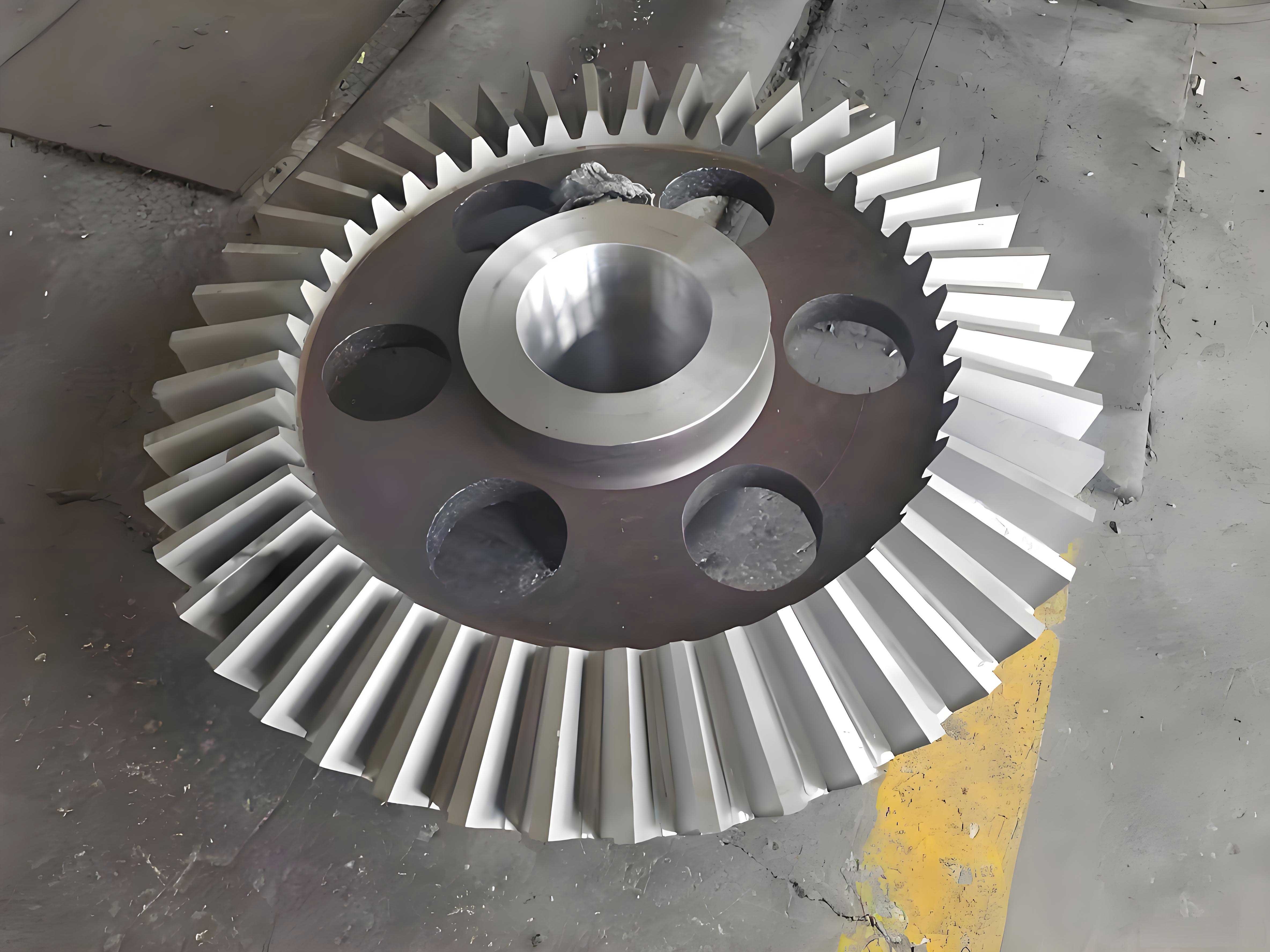
The validity of the motion solution is first verified through simulation using VERICUT software. A virtual model of a five-axis CNC machine tool, configured as an XYZAB type, is constructed. The machine parameters, including axis limits and kinematic chain, are defined to match real-world equipment. The cutter location data, derived from the post-processing algorithm, is imported as NC code. The simulation process replicates the roughing and finishing stages, with material removal visualized in real-time. Table 2 summarizes the simulation setup parameters, highlighting key aspects of the virtual machining environment.
| Component | Parameter | Value |
|---|---|---|
| Machine Tool | Type | Five-Axis (XYZAB) |
| Workpiece | Material | Steel AISI 1045 |
| Roughing Tool | Type | Form Cutter (Indexable) |
| Finishing Tool | Type | Cylindrical End Mill |
| Finishing Tool | Diameter | 10 mm |
| Simulation Tolerance | Overcut/Undercut | 0.05 mm |
During simulation, the tool moves along the calculated paths, cutting the split miter gear segment from a blank. The finishing process, using flank milling with the end mill, demonstrates the ability to generate precise tooth surfaces. After simulation, the automatic comparison function in VERICUT is used to assess accuracy. The machined part is compared against the design model of the miter gear, with tolerances set to 0.05 mm for both overcut and undercut. The result shows minimal deviations: slight undercut in localized areas due to residual material and minor overcut at the gear toe, but overall conformance to the theoretical tooth surface. This confirms that the motion solution correctly translates the tool path into machine movements, enabling accurate NC machining of the split miter gear.
Beyond simulation, actual machining experiments are conducted to validate the motion solution on a physical five-axis CNC machining center, specifically a DMU100 model. The split miter gear segment is fabricated from a steel blank, following the same two-stage process. Rough slotting is performed using a three-axis machine to create initial tooth spaces, after which the workpiece is transferred to the five-axis machine for finish flank milling. The NC code, generated from the post-processor, controls the machine’s linear and rotary axes. The machining parameters are optimized for surface finish and tool life, as detailed in Table 3, which provides insights into the practical cutting conditions.
| Parameter | Roughing | Finishing |
|---|---|---|
| Spindle Speed | 800 rpm | 3000 rpm |
| Feed Rate | 200 mm/min | 500 mm/min |
| Depth of Cut | 5 mm per pass | 0.5 mm |
| Coolant | Flood | Mist |
After machining, the tooth surface quality of the miter gear segment is evaluated using a coordinate measuring machine (CMM). The measurement process involves scanning multiple points on the tooth flank to determine deviations from the ideal geometry. Key gear accuracy parameters, such as pitch error, profile error, and runout, are computed. The results are compared against international standards, such as ISO 1328 (equivalent to GB/T 10095.1-2022), to assess the machining precision. Table 4 presents the measured errors for the split miter gear, demonstrating compliance with gear accuracy grades.
| Accuracy Parameter | Symbol | Measured Value | ISO Grade Achieved |
|---|---|---|---|
| Single Pitch Deviation | $f_{pt}$ | 25.3 μm | 7 |
| Cumulative Pitch Deviation | $F_p$ | 21.8 μm | 7 |
| Radial Runout | $F_r$ | 38.3 μm | 7 |
| Total Profile Deviation | $F_\alpha$ | 5.6 μm | 7 |
| Profile Form Deviation | $f_{f\alpha}$ | 2.6 μm | 7 |
The data indicates that all measured parameters fall within the tolerance limits for ISO grade 7, which is considered acceptable for large miter gears used in industrial applications. This validates the effectiveness of the NC machining motion solution, as the split miter gear segment meets required precision standards. The use of a standard end mill for flank milling proves feasible, offering a cost-efficient alternative to traditional gear cutting methods. Moreover, the ability to machine large miter gears on a relatively small five-axis CNC machine reduces capital investment and increases manufacturing flexibility.
From a theoretical perspective, the motion solution relies heavily on coordinate transformations and kinematic modeling. The derivation of transformation matrices can be generalized for any miter gear geometry by adjusting parameters such as shaft angle and tooth dimensions. For instance, the rotation angles $\alpha$ and $\gamma$ in the transition matrices depend on the orientation of the split segment relative to the machine axes. In practice, these angles are determined based on the fixture design and gear mounting. The mathematical framework ensures that the tool axis vector and cutter center points are correctly mapped, enabling precise control of the five-axis machine. To further optimize the process, one can incorporate error compensation techniques, such as volumetric error modeling, to enhance accuracy. The equations for linear and rotary motions form the basis of the post-processor, which can be implemented in software like MATLAB or custom NC code generators.
In addition to the motion solution, the machining strategy for split miter gears must consider factors like tool wear, cutting forces, and thermal deformation. Since miter gears have a 90-degree shaft angle, the tooth flanks are generated via conjugate surfaces, requiring accurate tool positioning. The flank milling process with an end mill involves swept envelope calculations to ensure the tool surface contacts the gear tooth along a continuous path. This can be modeled using differential geometry, where the tool surface is represented as a cylinder of radius $R_t$:
$$\mathbf{S}_t(u,v) = \mathbf{C}(u) + R_t (\cos v \mathbf{N}(u) + \sin v \mathbf{B}(u))$$
where $\mathbf{C}(u)$ is the tool axis curve, and $\mathbf{N}(u)$ and $\mathbf{B}(u)$ are the normal and binormal vectors of the Frenet-Serret frame. By solving for contact conditions between the tool surface and the gear tooth surface, optimal tool paths can be derived. However, for practical NC machining, the discrete cutter location points from the post-processor suffice, as demonstrated in the simulation and experiment.
The advantages of this approach extend beyond cost savings. By using split segments, large miter gears can be transported and assembled on-site, reducing logistical challenges. The NC machining method allows for rapid prototyping and customization, enabling manufacturers to produce miter gears with non-standard dimensions or materials. Furthermore, the integration of simulation tools like VERICUT minimizes trial-and-error, reducing scrap and improving time-to-market. As industries demand higher efficiency and sustainability, such advanced manufacturing techniques for miter gears become increasingly important.
To summarize, the motion solution for NC machining of split miter gears involves a systematic approach to coordinate transformation and post-processing. The derivation of linear and rotary motion equations enables accurate control of five-axis machine tools, while simulation and experimental validation confirm the practicality of the method. The successful machining of a split miter gear segment to ISO grade 7 accuracy demonstrates that standard end mills can be effectively used for flank milling, offering a viable alternative to dedicated gear cutting machines. This methodology not only lowers manufacturing costs but also enhances flexibility in producing large miter gears for critical applications. Future work could focus on optimizing tool paths for reduced cycle time, integrating real-time monitoring for adaptive control, and extending the approach to other gear types such as spiral bevel or hypoid gears. Nonetheless, the present study establishes a solid foundation for advanced NC machining of miter gears, contributing to the evolution of gear manufacturing technology.