
In this article, we present a comprehensive derivation of adjustment calculation formulas for machining hypoid gears on the Y2280 type milling machine. Based on the machine’s available motions and using vector analysis methods, we derive formulas specifically for processing hypoid gears, including those with limit pressure angles not equal to zero when using a zero-cutter. These formulas have been validated in practical applications. The hypoid gear, as a spatial cross-axis transmission pair, offers significant advantages in compact design and high reduction ratios, making it ideal for engineering machinery. We will explore the machine’s capabilities, the unique characteristics of hypoid gears, and the detailed adjustment calculations involving coordinate transformations, cutter positioning, and tilt angles. Throughout, we emphasize the importance of accurate adjustment to ensure proper gear meshing and performance.
The Y2280 milling machine is designed to process both the ring gear and the pinion of a hypoid gear pair. It features two workpiece spindles: the ring gear is mounted horizontally with only indexing rotation, while the pinion spindle has rotational motion based on the transmission ratio (roll ratio) and additional rolling motion around the ring gear axis. The pinion axis can also be adjusted for offset (hypoid offset) and moves laterally with the milling head on the crossbeam. The crossbeam, mounted on the column, can rotate around the machine center for tool tilt adjustments and move forward or backward with the column to achieve the required cutter position. This machine employs an orthogonal-axis semi-generating method with a conjugate processing principle using equal-height teeth, which eliminates tooth profile errors caused by root angles in tapered tooth systems. This allows for direct control of curvature differences on conjugate tooth surfaces along the tooth length and pressure angle corrections along the tooth height.
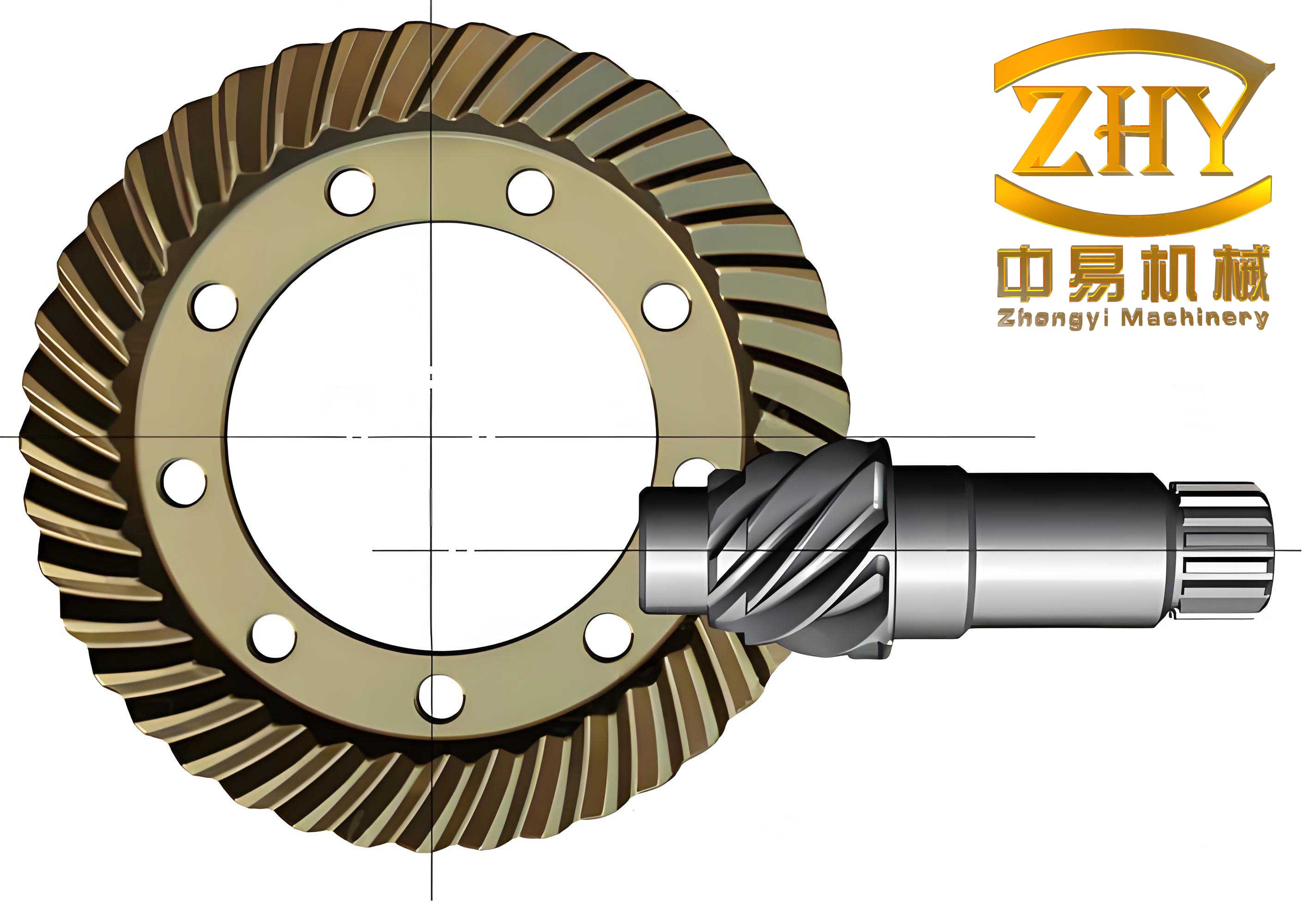
Hypoid gears are distinguished from spiral bevel gears primarily by the pinion offset, which allows for increased reduction ratios without significantly compromising pinion strength. In a hypoid gear pair, the pinion axis is offset from the ring gear axis, enabling larger shaft angles and higher transmission ratios, typically ranging from 10:1 to 60:1, with maximum ratios up to 200:1. This makes hypoid gears suitable for heavy-duty applications such as construction machinery, where compact size, high reduction, and hardenability are critical. Key parameters for adjustment calculations include the ring gear cone distance $R$, spiral angle $\beta$, outer diameter $D_e$, addendum coefficient $h_a^*$, distance from the calculation point to the axis, distance from the calculation point to the pinion axis, ring gear pitch cone angle $\delta_2$, limit pressure angle $\alpha_0$, and working tooth height $h_w$. Understanding these parameters is essential for precise machining of hypoid gears.
To derive the adjustment formulas, we establish a geometric model based on vector analysis. Let the ring gear rotation center be the origin of a coordinate system $(X, Y, Z)$, where the $XY$-plane is the ring gear rotation plane. The calculation point $P$ on the tooth surface is defined, and we aim to find the coordinates of the curvature center $O_c$ of the tooth profile relative to the machine center. We introduce multiple coordinate systems: a fixed system $(X, Y, Z)$ with unit vectors $\vec{i}, \vec{j}, \vec{k}$; a system $(X’, Y’, Z’)$ centered at $P$ with unit vectors $\vec{i’}, \vec{j’}, \vec{k’}$; and transitional systems for tool orientation. The tooth profile curvature center $O_c$ is determined by considering the cutter axis orientation, tool tilt, and machine adjustments.
The cutter axis unit vector $\vec{a}$ is defined in the $(X’, Y’, Z’)$ system. The tool tilt plane is formed by $\vec{a}$ and the vertical direction, and the tilt angle $I$ is the angle between $\vec{a}$ and the machine’s crossbeam rotation axis. By applying rotation matrices for coordinate transformations, we express $\vec{a}$ in the machine coordinate system. The theoretical tool tilt plane must align with the actual machine crossbeam tilt plane, which involves rotating the coordinate system by an angle $\theta$ around the machine center. This leads to the following general formula for the coordinates of $O_c$ in the $(X, Y, Z)$ system:
$$ \begin{aligned} X_{O_c} &= R \left( \cos \delta_2 \cos \beta \cos \phi_0 – \sin \delta_2 \sin \phi_0 \right) + \Delta X, \\ Y_{O_c} &= R \left( \cos \delta_2 \cos \beta \sin \phi_0 + \sin \delta_2 \cos \phi_0 \right) + \Delta Y, \\ Z_{O_c} &= R \left( -\cos \delta_2 \sin \beta \right) + \Delta Z, \end{aligned} $$
where $R$ is the cone distance, $\delta_2$ is the ring gear pitch cone angle, $\beta$ is the spiral angle, $\phi_0$ is the phase angle at the calculation point, and $\Delta X, \Delta Y, \Delta Z$ are offsets due to machine adjustments. For the Y2280 machine, these offsets incorporate tool positioning parameters such as vertical cutter distance $V$, horizontal cutter distance $H$, and crossbeam tilt angle $J$. The crossbeam tilt angle $J$ is calculated as:
$$ J = \arctan \left( \frac{\sin \alpha_0 \cos \beta}{\cos \alpha_0 \sin \beta + \sin \delta_2} \right), $$
where $\alpha_0$ is the limit pressure angle. This formula ensures that the tool axis is properly inclined to match the desired tooth surface geometry of the hypoid gear.
For cutter positioning, we define vertical cutter distance $V$ and horizontal cutter distance $H$ for both ring gear and pinion machining. For the ring gear, these are given by:
$$ V_{\text{ring}} = \sqrt{X_{O_c}^2 + Y_{O_c}^2} – R_c, \quad H_{\text{ring}} = Z_{O_c}, $$
where $R_c$ is the cutter radius. For the pinion, similar formulas apply but with adjustments for offset and different spiral angles. The pinion offset $E$ is incorporated as:
$$ V_{\text{pinion}} = \sqrt{(X_{O_c} – E)^2 + Y_{O_c}^2} – R_c, \quad H_{\text{pinion}} = Z_{O_c}. $$
These calculations are critical for setting up the machine to accurately produce hypoid gears with the correct tooth contact patterns.
To generalize the formulas, we consider various machining scenarios. For standard hypoid gears with zero limit pressure angle ($\alpha_0 = 0$), the tilt angle $J$ simplifies to $J = 0$, and the coordinates reduce to a simpler form. When using cutters with pressure angles equal to the limit pressure angle (i.e., tool number equals $\alpha_0$), the tool axis normal inclination angle becomes zero, leading to formulas consistent with standard bevel gear machining. For crown hypoid gears where the pinion offset is zero, the formulas further simplify. This generalization allows the Y2280 machine to handle a wide range of hypoid gear designs, enhancing its versatility in industrial applications.
We now present a detailed calculation example for machining a hypoid gear pair. The parameters are as follows: pinion teeth $z_1 = 10$, ring gear teeth $z_2 = 41$, offset $E = -30$ mm (lower offset), spiral angle $\beta = 45^\circ$ (left-hand), ring gear pitch diameter $D = 410$ mm, mean pressure angle $\alpha = 20^\circ$, and limit pressure angle $\alpha_0 = 20^\circ$. The machining method uses double-sided forming for the ring gear and single-sided rolling for the pinion. We select a cutter with pressure angle $20^\circ$ and calculate the cutter radius at the calculation point as $R_c = R \cdot \tan \beta$, where $R$ is the cone distance. For this example, we assume $R = 200$ mm, so $R_c = 200 \cdot \tan 45^\circ = 200$ mm. The backlash is set to 0.2 mm, and tooth contact corrections are applied with a longitudinal curvature difference $\Delta R = 0.1$ mm.
The calculation proceeds in steps: first, compute the coordinates for the ring gear; then determine the crossbeam tilt angle and cutter positions; finally, adjust for the pinion with offset. We use the following tables to summarize parameters and results.
| Parameter | Symbol | Value | Unit |
|---|---|---|---|
| Pinion Teeth | $z_1$ | 10 | – |
| Ring Gear Teeth | $z_2$ | 41 | – |
| Offset | $E$ | -30 | mm |
| Spiral Angle | $\beta$ | 45° | degree |
| Pitch Diameter | $D$ | 410 | mm |
| Mean Pressure Angle | $\alpha$ | 20° | degree |
| Limit Pressure Angle | $\alpha_0$ | 20° | degree |
| Cone Distance | $R$ | 200 | mm |
For the ring gear machining, we calculate the phase angle $\phi_0$ from the tooth geometry. Using the formula $\phi_0 = \arctan \left( \frac{\sin \delta_2}{\cos \delta_2 \cos \beta} \right)$, with $\delta_2 = \arctan \left( \frac{z_2}{z_1} \right) = \arctan(41/10) \approx 76.5^\circ$, we get $\phi_0 \approx 15.2^\circ$. Substituting into the coordinate formulas:
$$ \begin{aligned} X_{O_c} &= 200 \left( \cos 76.5^\circ \cos 45^\circ \cos 15.2^\circ – \sin 76.5^\circ \sin 15.2^\circ \right) \approx 50.3 \text{ mm}, \\ Y_{O_c} &= 200 \left( \cos 76.5^\circ \cos 45^\circ \sin 15.2^\circ + \sin 76.5^\circ \cos 15.2^\circ \right) \approx 192.7 \text{ mm}, \\ Z_{O_c} &= 200 \left( -\cos 76.5^\circ \sin 45^\circ \right) \approx -45.1 \text{ mm}. \end{aligned} $$
The crossbeam tilt angle $J$ is computed as:
$$ J = \arctan \left( \frac{\sin 20^\circ \cos 45^\circ}{\cos 20^\circ \sin 45^\circ + \sin 76.5^\circ} \right) \approx \arctan(0.342 / 1.654) \approx 11.7^\circ. $$
Thus, $J \approx 11.7^\circ$. The vertical and horizontal cutter distances for the ring gear are:
$$ V_{\text{ring}} = \sqrt{50.3^2 + 192.7^2} – 200 \approx 199.8 – 200 = -0.2 \text{ mm}, \quad H_{\text{ring}} = -45.1 \text{ mm}. $$
This indicates a minor adjustment in vertical positioning. For the pinion machining, we need to account for the offset and different spiral angles on convex and concave sides. The spiral angles at the midpoint of tooth surfaces are adjusted using the law of cosines. For the convex side (mating with ring gear concave), we have $\beta_{\text{concave}} = \arccos \left( \cos \beta – \Delta R / R \right) \approx 44.9^\circ$, and for the concave side, $\beta_{\text{convex}} \approx 45.1^\circ$. Recomputing coordinates with these values and offset $E = -30$ mm:
| Surface | Spiral Angle | $X_{O_c}$ (mm) | $Y_{O_c}$ (mm) | $Z_{O_c}$ (mm) | $J$ (degree) | $V$ (mm) | $H$ (mm) |
|---|---|---|---|---|---|---|---|
| Convex | 44.9° | 80.3 | 192.7 | -45.0 | 11.6° | 29.8 | -45.0 |
| Concave | 45.1° | 20.3 | 192.7 | -45.2 | 11.8° | -30.2 | -45.2 |
Note that for the pinion, $V$ and $H$ are calculated relative to the offset position. The negative $V$ for the concave side indicates a downward adjustment. These values guide the machine setup for pinion machining. Additionally, other adjustments such as roll ratio and feed gears are set based on tooth counts and transmission ratios, similar to spiral bevel gear machining. Rough machining adjustments can be derived from these fine machining parameters.
The derivation and example highlight the complexity of hypoid gear machining, but the vector-based approach provides a systematic method for adjustment calculations. The formulas account for all critical parameters, ensuring accurate tooth geometry and contact patterns. In practice, these calculations are implemented via machine settings, and we have verified them through actual machining trials, resulting in hypoid gears with optimal performance. The Y2280 machine’s flexibility, combined with these formulas, allows for efficient production of hypoid gears for various industrial applications, from automotive differentials to heavy machinery drives.
To further illustrate the mathematical foundation, we present key vector transformations. Let $\vec{r}_P$ be the position vector of point $P$ in the fixed coordinate system. After rotations for tool tilt and machine adjustments, the transformed vector $\vec{r}_{O_c}$ is given by:
$$ \vec{r}_{O_c} = \mathbf{R}_z(\phi_0) \mathbf{R}_y(\delta_2) \mathbf{R}_x(\beta) \vec{r}_P + \vec{\Delta}, $$
where $\mathbf{R}_x, \mathbf{R}_y, \mathbf{R}_z$ are rotation matrices about the $X$, $Y$, and $Z$ axes, respectively, and $\vec{\Delta}$ is the offset vector. Expanding this yields the coordinate formulas above. For tool orientation, the cutter axis vector $\vec{a}$ in the local system is rotated to the machine system via:
$$ \vec{a}_{\text{machine}} = \mathbf{R}_J \mathbf{R}_\theta \vec{a}_{\text{local}}, $$
with $\mathbf{R}_J$ being the crossbeam tilt rotation and $\mathbf{R}_\theta$ the phase rotation. The alignment condition requires $\vec{a}_{\text{machine}} \cdot \vec{k} = \cos I$, where $I$ is the tool inclination angle. Solving these equations leads to the expression for $J$.
In summary, the adjustment calculation for hypoid gear machining on the Y2280 milling machine involves a detailed geometric analysis using vector methods. We have derived generalized formulas that accommodate various gear designs, including those with non-zero limit pressure angles. The example demonstrates the application of these formulas, with tables summarizing parameters and results. This approach ensures precise manufacturing of hypoid gears, which are essential components in many mechanical transmission systems. Future work may involve extending these methods to other machine types or incorporating real-time adjustments via digital twin technologies. Nevertheless, the current methodology provides a robust foundation for hypoid gear production, highlighting the importance of accurate calculations in achieving desired gear performance and durability.