
In the realm of small-power transmission between non-parallel, non-intersecting shafts, spiral gears are a prevalent choice. Their primary advantages lie in the relative simplicity of manufacturing and consequent lower cost compared to other types of crossed-axis gears, such as hypoid or worm gears. Consequently, spiral gear pairs find extensive application in machinery for textiles, light industry, printing, and food processing.
However, the design of spiral gears has historically been approached predominantly from a kinematic and geometric perspective. The primary goal was often merely to satisfy the required velocity ratio and center distance, without a rigorous optimization of performance parameters. This article aims to shift that paradigm by conducting a comprehensive analysis of the key design parameter—the helix angle $\beta$. Specifically, we will investigate its optimal selection to achieve the highest possible meshing efficiency, minimize wear, reduce the overall weight of the gear pair, and mitigate the impact on bearing size. The synthesis of these factors is crucial for achieving superior and durable spiral gear drives.
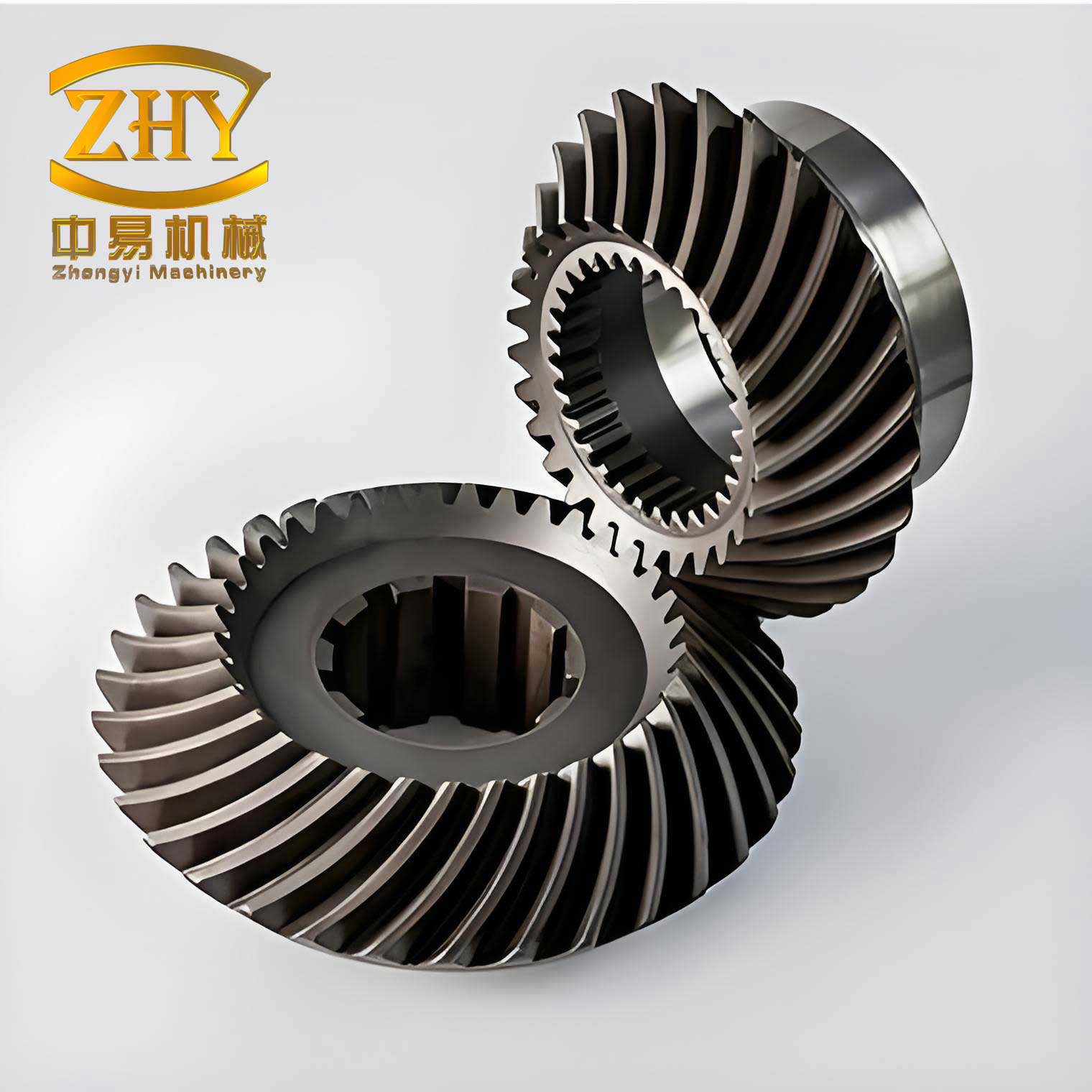
The fundamental geometry of a pair of spiral gears is defined by the shaft angle $\Sigma$ and the individual helix angles, $\beta_1$ and $\beta_2$, for the pinion and gear respectively. The relationship between these angles depends on the hand of the helices. The four possible configurations are: $\Sigma = \beta_1 + \beta_2$ (both gears of the same hand), $\Sigma = \beta_1 – \beta_2$ (opposite hands, $\beta_1 > \beta_2$), $\Sigma = \beta_2 – \beta_1$ (opposite hands, $\beta_2 > \beta_1$), and $\Sigma = -\beta_1 – \beta_2$ (a theoretical case with negative shaft angle). The choice among these configurations, along with the magnitudes of $\beta_1$ and $\beta_2$, is not arbitrary but has profound implications for the drive’s performance.
Influence of the Helix Angle on Meshing Efficiency
The meshing efficiency of spiral gears is significantly lower than that of parallel-axis gears due to the predominant sliding motion at the tooth contact. To analyze this, we can model the engagement at the pitch point as equivalent to that between a spiral gear and an inclined rack. Let $v_1$ be the velocity of the driving gear (pinion) at the pitch point, and $v_2$ be the velocity of the driven gear (modeled as the rack segment). The relative sliding velocity $v_s$ along the tooth is the vector difference.
If $F_t$ is the tangential driving force, the useful output power is $P_{out} = F_t \cdot v_2$. The power loss due to sliding friction along the tooth helix is approximately $P_{loss} = f_v \cdot F_n \cdot v_s$, where $f_v$ is an equivalent coefficient of friction that accounts for the sliding conditions. For the approximate efficiency $\eta_h$, neglecting minor losses in the profile direction, we derive:
$$ \eta_h = \frac{P_{out}}{P_{in}} = \frac{P_{out}}{P_{out} + P_{loss}} = \frac{1}{1 + f_v \frac{v_s}{v_2}} $$
From the velocity geometry at the pitch point, the relationship between $v_s$ and $v_2$ depends on the shaft angle and helix angles. For the common configuration where $\Sigma = \beta_1 + \beta_2$, it can be shown that $\frac{v_s}{v_2} = \frac{\sin \Sigma}{\cos \beta_1 \cos \beta_2}$. Substituting this into the efficiency formula yields:
$$ \eta_h = \frac{1}{1 + f_v \frac{\sin \Sigma}{\cos \beta_1 \cos \beta_2}} $$
A similar analysis for other configurations leads to forms where the denominator term involves $\sin(\beta_1 \pm \beta_2)$ or $\sin \Sigma$ divided by the product of the cosines of the helix angles.
To find the condition for maximum efficiency for a given shaft angle $\Sigma$, we treat $\eta_h$ as a function of $\beta_1$ and $\beta_2$ under the constraint $\Sigma = \beta_1 + \beta_2$. By setting the partial derivative with respect to $\beta_1$ (or $\beta_2$) to zero, we find that the maximum efficiency occurs when:
$$ \beta_1 = \beta_2 = \frac{\Sigma}{2} $$
At this point, the term $\frac{\sin \Sigma}{\cos \beta_1 \cos \beta_2}$ is minimized for the $\Sigma = \beta_1 + \beta_2$ configuration, leading to the maximum value of $\eta_h$. For the other configurations ($\Sigma = |\beta_1 – \beta_2|$), no such clear maximum exists within practical bounds; the efficiency tends to decrease as the helix angles diverge. Therefore, from a pure efficiency standpoint, the optimal design uses two spiral gears of the same hand with equal helix angles, each half of the shaft angle.
| Configuration | Condition for Max $\eta_h$ | Efficiency Characteristic |
|---|---|---|
| $\Sigma = \beta_1 + \beta_2$ | $\beta_1 = \beta_2 = \Sigma/2$ | Clear global maximum exists. |
| $\Sigma = \beta_1 – \beta_2$ | No internal maximum. | Efficiency generally decreases as $\beta_1$ increases. |
| $\Sigma = \beta_2 – \beta_1$ | No internal maximum. | Efficiency generally decreases as $\beta_2$ increases. |
Influence of the Helix Angle on Wear
Wear in spiral gears is a direct consequence of the sliding action. The key metric is the specific sliding velocity or the relative sliding speed $v_s$. Higher sliding velocities lead to greater frictional work, higher localized temperatures, accelerated wear, and a higher risk of scuffing. Unlike worm gears, where high sliding speeds can promote elastohydrodynamic lubrication, the point contact in spiral gears offers poor conditions for forming a protective fluid film. Therefore, the friction coefficient $f_v$ often increases with $v_s$, exacerbating wear.
The expression for $v_s$ relative to the pinion pitch line velocity $v_1$ is instructive:
$$ v_s = v_1 \frac{\sin \Sigma}{\cos \beta_2} $$
For a fixed input speed and shaft angle, $v_s$ is inversely proportional to $\cos \beta_2$. This means that for the configuration $\Sigma = \beta_1 + \beta_2$, a smaller $\beta_2$ (and consequently a larger $\beta_1$ to maintain $\Sigma$) results in a larger $v_s$ and thus higher wear. Conversely, the choice $\beta_1 = \beta_2$ gives a moderate and balanced value. For configurations with opposite hands ($\Sigma = |\beta_1 – \beta_2|$), the sliding velocity can become extremely high if one helix angle is small and the other is large to satisfy the shaft angle. This is particularly detrimental.
A common but ill-advised practice is to reverse the rotation of the driven gear by using spiral gears of opposite hand instead of an idler. This forces the use of the $\Sigma = |\beta_1 – \beta_2|$ configuration. Unless the shaft angle $\Sigma$ itself is very small, this leads to one very large helix angle, resulting in prohibitively high sliding velocities, low efficiency, and severe wear. This method should be avoided in favor of other mechanical solutions for direction reversal.
The following table summarizes the wear tendency based on the ratio $v_s / v_1$ for the $\Sigma = \beta_1 + \beta_2$ configuration with varying $\beta_1$ and fixed $\Sigma$:
| Shaft Angle $\Sigma$ | Pinion Helix $\beta_1$ | Gear Helix $\beta_2$ | Relative Sliding $v_s/v_1$ | Wear Tendency |
|---|---|---|---|---|
| 90° | 10° | 80° | 1.00 | Very High |
| 30° | 60° | 1.15 | High | |
| 45° | 45° | 1.00 | Moderate (Optimal Zone) | |
| 60° | 30° | 0.58 | Lower | |
| 80° | 10° | 0.17 | Low | |
| 45° | 10° | 35° | 0.53 | Moderate-High |
| 22.5° | 22.5° | 0.38 | Moderate (Optimal) | |
| 35° | 10° | 0.26 | Low |
The data shows that for a given $\Sigma$, choosing helix angles significantly different from $\Sigma/2$ (especially when one is very small) leads to a high sliding ratio. The region around $\beta_1 = \beta_2 = \Sigma/2$ offers a good compromise, and as $\beta_1$ increases beyond this point, $v_s/v_1$ decreases, entering a low-wear region.
Influence of the Helix Angle on Total Gear Weight
Minimizing the weight and material cost of spiral gears is another important design objective. The size of the gears is primarily governed by the pitch diameters, which are related to the number of teeth and the normal module. For a required center distance $a$ and velocity ratio $i$, the relationship is:
$$ a = \frac{m_n}{2} \left( \frac{z_1}{\cos \beta_1} + \frac{z_2}{\cos \beta_2} \right) $$
where $m_n$ is the normal module, and $z_1$, $z_2$ are the tooth numbers. The velocity ratio is $i = z_2 / z_1$. The total volume $V$ of the two gears (assuming equal facewidth proportional to a module) can be expressed as a function of the helix angles. For the configuration $\Sigma = \beta_1 + \beta_2$, we can express $\beta_2 = \Sigma – \beta_1$. Substituting into the center distance formula and formulating a volume function $V(\beta_1)$, we can find the minimum by taking the derivative $dV/d\beta_1 = 0$.
The resulting condition for minimum weight is found to be:
$$ \tan \beta_1 = \tan \beta_2 $$
which, under the constraint $\Sigma = \beta_1 + \beta_2$, again leads to:
$$ \beta_1 = \beta_2 = \frac{\Sigma}{2} $$
This remarkable result indicates that for the $\Sigma = \beta_1 + \beta_2$ configuration, the choice that maximizes efficiency also minimizes the total weight of the spiral gear pair. For the other configurations ($\Sigma = |\beta_1 – \beta_2|$), no such neat minimum exists within the physical domain. The volume function tends to decrease monotonically as one helix angle increases and the other decreases, but this leads to highly disparate gear sizes and poor performance in other aspects. The configuration with $\Sigma = -\beta_1 – \beta_2$ is impractical.
Therefore, weight optimization strongly reinforces the selection rule derived from efficiency analysis for the most common and desirable spiral gear setup.
Influence of the Helix Angle on Bearing Load and Size
Spiral gears generate substantial axial forces due to their helix angles. These axial forces must be supported by bearings, typically angular contact ball bearings or tapered roller bearings. The magnitude of the axial force $F_a$ on a gear is related to its tangential force $F_t$ and its helix angle $\beta$: $F_a = F_t \tan \beta$.
Larger axial forces require bearings with higher axial load capacity, which generally translates to larger size or a more expensive bearing type for a given life requirement. To quantify this, consider a typical shaft supported by a pair of angular contact ball bearings (e.g., 7000C series). The equivalent dynamic load $P$ on a bearing is calculated based on the radial and axial loads it supports, which are statically determinate from the gear forces. The required basic dynamic load rating $C$ for a desired life $L_{10}$ is given by:
$$ C = P \left( \frac{L_{10}}{10^6} \right)^{1/3} \quad \text{(for ball bearings)} $$
where $P = XF_r + YF_a$. $X$ and $Y$ are factors from bearing tables, $F_r$ is the radial load, and $F_a$ is the axial load on the bearing.
Since $F_a$ is proportional to $\tan \beta$, increasing the helix angle $\beta$ increases $F_a$, which increases the equivalent load $P$, and thus increases the required load rating $C$. This leads to the selection of a physically larger bearing. The relationship is not linear but monotonic. For the configuration $\Sigma = \beta_1 + \beta_2$, if we fix $\Sigma$ and vary $\beta_1$, the bearing on the pinion shaft sees an axial force proportional to $\tan \beta_1$, while the bearing on the gear shaft sees an axial force proportional to $\tan(\Sigma – \beta_1)$. The sum of the required bearing sizes on both shafts often has a minimum in the region where $\beta_1$ and $\beta_2$ are balanced, avoiding excessively large angles on either gear.
The following table illustrates a simplified scenario showing the trend of the required bearing rating factor (proportional to $C$) for the pinion shaft bearing as $\beta_1$ changes, assuming fixed transmitted power, speed, and shaft layout.
| Pinion Helix $\beta_1$ (deg) | Gear Helix $\beta_2$ (deg) for $\Sigma=90^\circ$ | Pinion Axial Force $F_{a1} / F_{t1}$ | Relative Bearing Rating Factor Trend |
|---|---|---|---|
| 10 | 80 | 0.176 | Low-Moderate |
| 30 | 60 | 0.577 | Moderate-High |
| 45 | 45 | 1.000 | High (Peak) |
| 60 | 30 | 1.732 | Very High |
| 80 | 10 | 5.671 | Extremely High |
Interestingly, while very small helix angles give low axial force, they correspond to very large angles on the mating gear (e.g., $\beta_1=10^\circ, \beta_2=80^\circ$), which would impose an extreme load on the gear shaft bearings. The balanced design $\beta_1=\beta_2=45^\circ$, although giving a significant axial force, avoids an extreme condition on either shaft. Often, a slightly asymmetric split (e.g., $\beta_1=50^\circ, \beta_2=40^\circ$) can slightly reduce the maximum bearing load compared to the perfectly symmetric case, while still maintaining good efficiency and low wear.
Synthesis and Guidelines for Optimal Helix Angle Selection
Based on the multifaceted analysis of efficiency, wear, weight, and bearing loads, we can synthesize a coherent set of guidelines for the optimal selection of helix angles in spiral gear design. The overarching principle is to prioritize the configuration where the shaft angle is the sum of the two helix angles ($\Sigma = \beta_1 + \beta_2$). Within this framework, the following specific recommendations are made:
- Primary Optimal Point: For a given shaft angle $\Sigma$, the theoretically optimal choice is $\beta_1 = \beta_2 = \Sigma/2$. This point delivers the maximum meshing efficiency, the minimum total gear weight, and avoids extreme sliding velocities or axial forces on either shaft. It also simplifies manufacturing and setup (e.g., using the same machine settings for both gears).
- Practical Deviation from Symmetry: If the exact equality $\beta_1 = \beta_2$ is not feasible due to integer tooth numbers or a need to fine-tune the center distance, a small deviation is acceptable. A slight increase of the pinion helix angle $\beta_1$ above $\Sigma/2$ (with a corresponding decrease in $\beta_2$) can be beneficial. It moves the design into the region of lower specific sliding velocity ($v_s/v_1$) for the pinion, further reducing its wear tendency, while only causing a minor sacrifice in efficiency and weight. For example, for $\Sigma = 90^\circ$, choosing $\beta_1 = 50^\circ$ and $\beta_2 = 40^\circ$ is often an excellent practical compromise.
- Avoidance of Opposed-Hand Configurations: The configurations $\Sigma = |\beta_1 – \beta_2|$ should generally be avoided unless the shaft angle $\Sigma$ itself is very small (e.g., less than $10^\circ$). Using opposed hands to reverse output direction is strongly discouraged, as it leads to poor efficiency, high wear, and potentially extreme bearing loads. An idler gear or other mechanical means should be used for direction reversal.
- Design Procedure Integration: The selection of helix angles should not be an afterthought. Given a target velocity ratio $i$ and center distance $a$, the designer should first use the optimal helix angle rule ($\beta_1 \approx \beta_2 \approx \Sigma/2$) to establish the basic geometry. The normal module $m_n$ and tooth numbers $z_1, z_2$ are then adjusted to satisfy the center distance equation precisely. The helix angles can be fine-tuned last to accommodate standard modules or preferred numbers of teeth.
The table below summarizes the qualitative impact of helix angle choices for the preferred $\Sigma = \beta_1 + \beta_2$ configuration:
| Design Choice ($\beta_1$ relative to $\Sigma/2$) | Efficiency | Wear (Sliding) | Weight | Bearing Loads | Recommendation |
|---|---|---|---|---|---|
| $\beta_1 << \Sigma/2$ (e.g., $\beta_1=10^\circ$, $\Sigma=90^\circ$) | Lower | Very High on Gear | Higher | Extreme on Gear Shaft | Avoid |
| $\beta_1 = \beta_2 = \Sigma/2$ | Maximum | Moderate/Balanced | Minimum | High but Balanced | Theoretical Optimum |
| $\beta_1 > \Sigma/2$ (e.g., $\beta_1=60^\circ$, $\Sigma=90^\circ$) | Slightly Lower | Lower on Pinion | Slightly Higher | High on Pinion Shaft | Good Practical Compromise |
In conclusion, the design of spiral gears transcends simple geometric calculation. A deliberate and informed selection of the helix angle, guided by the principles of maximizing efficiency, minimizing wear, reducing weight, and managing bearing loads, is fundamental to creating high-performance, durable, and cost-effective drives. The analysis conclusively demonstrates that the symmetric design within the same-hand configuration serves as the cornerstone for optimal spiral gear performance.