
In modern mechanical transmission systems, spur and pinion gears are fundamental components, and their dynamic behavior significantly impacts efficiency, noise, and durability. As systems evolve towards higher speeds and power densities, addressing vibration and noise reduction becomes paramount. However, inherent uncertainties from manufacturing, assembly, and operational conditions introduce random characteristics in gear transmission error and tooth surface topography, leading to complex dynamic responses. This randomness affects tooth surface friction parameters, which are critical in gear dynamics. While previous studies have explored deterministic models of gear vibrations with error or friction, the combined effects of random error and stochastic tooth surface friction parameters remain unclear. Therefore, this study aims to numerically investigate the vibration characteristics of spur and pinion gears by integrating statistical methods and lumped-mass modeling, focusing on the randomness of error and friction parameters. We establish a bending-torsional coupled vibration model, solve it numerically, and analyze the influences on dynamic responses. The results provide theoretical insights for dynamic design and optimization of gear transmissions, emphasizing the role of randomness in enhancing system instability.
The dynamic behavior of spur and pinion gears is influenced by multiple factors, including time-varying mesh stiffness, transmission error, and tooth surface friction. Traditional models often treat these parameters deterministically, but in practice, they exhibit random variations due to tolerances and surface roughness. For instance, gear errors from machining and assembly can be modeled as random variables, while tooth surface roughness affects friction coefficients and contact conditions. This study bridges this gap by considering both error and friction parameters as stochastic elements. We use probability statistics to characterize their randomness, such as representing gear error as a sinusoidal function with Gaussian white noise and modeling friction coefficients based on surface roughness distributions. By doing so, we can more accurately simulate real-world conditions and assess their impact on vibration responses. The spur and pinion gear system is analyzed under typical operating conditions, with parameters derived from standard gear designs, to ensure practical relevance.
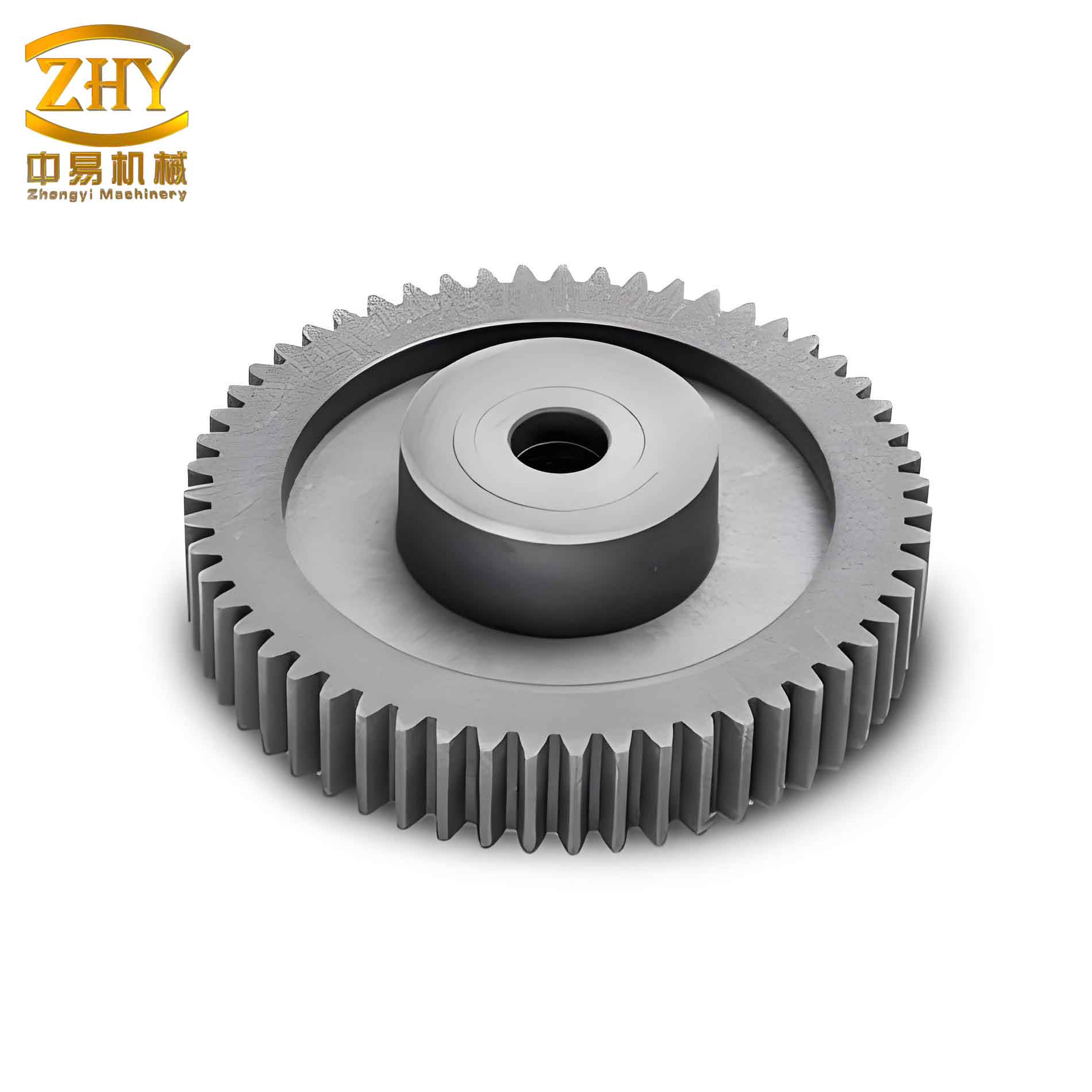
To model the dynamics of spur and pinion gears, we adopt a lumped-mass approach with three degrees of freedom (DOF) per gear: translations in the x and y directions and rotation about the gear axis. The displacement vector for the gear pair is defined as:
$$ \mathbf{q} = [x_p, y_p, \theta_p, x_g, y_g, \theta_g]^T $$
where subscripts \( p \) and \( g \) denote the pinion (driver) and gear (driven), respectively. The equations of motion for the bending-torsional coupled vibration are derived considering time-varying mesh stiffness \( k_m(t) \), random transmission error \( e(t) \), and tooth surface friction force \( F_f(t) \). The system is subject to external torques \( T_p(t) \) and \( T_g(t) \), and the equations are:
$$ \begin{aligned}
m_p \ddot{x}_p + k_{xp} x_p + \sin \alpha \, k_m(t) \delta(t) &= F_f(t) \sin \alpha \\
m_p \ddot{y}_p + k_{yp} y_p + \cos \alpha \, k_m(t) \delta(t) &= -F_f(t) \cos \alpha \\
I_p \ddot{\theta}_p + R_p(t) k_m(t) \delta(t) &= T_p(t) \\
m_g \ddot{x}_g + k_{xg} x_g – \sin \alpha \, k_m(t) \delta(t) &= -F_f(t) \sin \alpha \\
m_g \ddot{y}_g + k_{yg} y_g – \cos \alpha \, k_m(t) \delta(t) &= F_f(t) \cos \alpha \\
I_g \ddot{\theta}_g – R_g(t) k_m(t) \delta(t) &= -T_g(t)
\end{aligned} $$
with the relative displacement along the line of action given by:
$$ \delta(t) = \sin \alpha (x_p – x_g) + \cos \alpha (y_p – y_g) + R_p(t) \theta_p – R_g(t) \theta_g + e(t) $$
Here, \( m_i \) and \( I_i \) are the mass and moment of inertia, \( k_{xi} \) and \( k_{yi} \) are support stiffnesses, \( \alpha \) is the pressure angle, and \( R_i(t) \) are time-varying curvature radii along the contact line. The friction force is expressed as \( F_f(t) = \mu(t) k_m(t) \delta(t) \), where \( \mu(t) \) is the stochastic friction coefficient. This model captures the essential dynamics of spur and pinion gears, incorporating randomness in both error and friction parameters.
The gear parameters used in this analysis are based on a typical spur and pinion gear pair from a transmission system, as summarized in the table below. These values ensure the model represents real-world applications, with gears of precision grade 6GJ and standard modules.
| Parameter | Pinion (Driver) | Gear (Driven) |
|---|---|---|
| Number of Teeth | 33 | 26 |
| Precision Grade | 6GJ | 6GJ |
| Mass (kg) | 10.6 | 7.43 |
| Module (mm) | 7 | 7 |
| Moment of Inertia (kg·mm²) | 147,670 | 61,426 |
| Pressure Angle (°) | 20 | 20 |
| Face Width (mm) | 69 | 69 |
| Input Speed (r/min) | 2,000 | – |
| Input Torque (N·m) | 2,340.7 | – |
The time-varying mesh stiffness \( k_m(t) \) is computed using the Weber energy method, which accounts for gear tooth deflection under load. The stiffness varies periodically with the gear mesh frequency, and its curve exhibits peaks corresponding to the engagement of tooth pairs. For the spur and pinion gear pair, the mesh frequency \( f_m \) is calculated as:
$$ f_m = \frac{N_p \cdot n_p}{60} $$
where \( N_p \) is the number of teeth on the pinion and \( n_p \) is the rotational speed in rpm. With \( N_p = 33 \) and \( n_p = 2000 \) rpm, \( f_m = 1100 \) Hz. The stiffness profile shows harmonics at multiples of \( f_m \), influencing the dynamic response. The random error \( e(t) \) is synthesized from base pitch error and profile error, which are independent and normally distributed within tolerance limits. According to gear standards, for a 6GJ precision grade, the errors can be modeled as:
$$ e(t) = e_m + E \sin(\omega t + \phi) + \xi(t) $$
where \( e_m \) is the mean error, \( E \) is the amplitude, \( \omega = 2\pi f_m \), \( \phi \) is the phase, and \( \xi(t) \) is Gaussian white noise with zero mean and variance 0.0005. This representation captures the deterministic periodic component and stochastic variations. The friction coefficient \( \mu(t) \) is also treated as a random variable, dependent on tooth surface roughness, which follows a Gaussian distribution:
$$ \mu(t) = \mu_0 + \sigma_\mu \zeta(t) $$
where \( \mu_0 = 0.109 \) is the mean friction coefficient, \( \sigma_\mu = 0.05 \) is the standard deviation, and \( \zeta(t) \) is a Gaussian random process. The curvature radii \( R_i(t) \) vary along the line of action due to the changing contact point, and their randomness is influenced by error. Using geometric relations for involute spur and pinion gears, \( R_i(t) \) can be expressed as:
$$ R_p(t) = r_{p1} \sin \alpha + s(t), \quad R_g(t) = r_{g2} \sin \alpha + s(t) $$
with \( s(t) = s_\mu + \eta(t) \), where \( s_\mu \) is the mean distance from the pitch point to the instantaneous contact point, and \( \eta(t) \) is a random component. This formulation integrates randomness into the dynamic model, allowing for a comprehensive analysis of spur and pinion gear vibrations.
To solve the equations of motion, we employ the fourth-order Runge-Kutta method with a fixed step size of 0.00015 s, ensuring numerical stability and accuracy. The simulation runs for multiple mesh cycles to capture steady-state responses. The dynamic outputs include accelerations in the x, y, and rotational directions for both gears, which are analyzed in time and frequency domains. Statistical measures such as mean square values and power spectral density (PSD) are computed to quantify randomness. Below, we summarize the statistical characteristics of acceleration responses under random error and friction conditions.
| Gear Component | Direction | Standard Deviation (mm/s² or rad/s²) | Peak Frequency (Hz) |
|---|---|---|---|
| Pinion | x-direction | 5.5127 | 1100, 2200 |
| y-direction | 15.1342 | 1100, 2200 | |
| Torsional | 0.1254 | 1100, 2200 | |
| Gear | x-direction | 7.8657 | 1100, 2200 |
| y-direction | 21.5914 | 1100, 2200 | |
| Torsional | 0.2375 | 1100, 2200 |
The results indicate that the driven gear exhibits higher vibration amplitudes, particularly in the y-direction, due to its lower mass and inertia. The torsional responses are comparable between gears, but randomness amplifies the variations. The PSD plots reveal that vibration energy concentrates at the mesh frequency \( f_m = 1100 \) Hz and its second harmonic \( 2f_m = 2200 \) Hz, with sidebands arising from modulation between stiffness, error, and friction frequencies. This demonstrates how randomness in spur and pinion gears leads to complex spectral characteristics, increasing dynamic instability.
We further investigate the individual effects of random error and stochastic friction parameters on vibration responses. For this, we compare scenarios: (1) with random error but deterministic friction parameters, and (2) with both random error and stochastic friction. The analysis focuses on the pinion’s accelerations, as trends are similar for the gear. The time-domain responses show that random error causes significant fluctuations, while adding friction randomness exacerbates these variations. The standard deviations increase by approximately 26-27% when friction parameters are stochastic, as shown in the table below.
| Condition | x-direction (mm/s²) | y-direction (mm/s²) | Torsional (rad/s²) |
|---|---|---|---|
| With Random Error Only | 5.5127 | 15.1342 | 0.1254 |
| With Random Error and Stochastic Friction | 6.9896 | 19.2008 | 0.1591 |
| Percentage Increase | 26.79% | 26.87% | 26.84% |
In the frequency domain, the PSD amplitudes at peak frequencies rise substantially under combined randomness. For example, at \( f_m = 1100 \) Hz, the amplitude increases by about 40-41% for stochastic friction, and at \( 2f_m = 2200 \) Hz, the increase is around 53%. These enhancements highlight the synergistic effect of error and friction randomness in spur and pinion gears. Phase plots, which depict displacement versus velocity, transition from smooth closed curves under deterministic conditions to chaotic trajectories under randomness, indicating loss of periodicity and increased dynamic complexity. The mathematical representation of these effects can be summarized using key equations. The overall dynamic response \( \mathbf{R}(t) \) can be expressed as a function of input parameters:
$$ \mathbf{R}(t) = f(k_m(t), e(t), \mu(t), R_i(t)) $$
where each parameter has deterministic and stochastic components. For instance, the error term is decomposed as \( e(t) = e_d(t) + e_s(t) \), with \( e_d(t) = e_m + E \sin(\omega t + \phi) \) and \( e_s(t) = \xi(t) \). Similarly, friction coefficient is \( \mu(t) = \mu_d + \mu_s(t) \), with \( \mu_d = \mu_0 \) and \( \mu_s(t) = \sigma_\mu \zeta(t) \). The curvature radii include random variations: \( R_i(t) = R_{i,d}(t) + R_{i,s}(t) \). The interaction of these terms in the equations of motion leads to the observed random vibrations.
To quantify the randomness, we compute statistical moments such as variance and kurtosis. For acceleration \( a(t) \), the variance \( \sigma_a^2 \) is given by:
$$ \sigma_a^2 = \frac{1}{T} \int_0^T (a(t) – \bar{a})^2 dt $$
where \( \bar{a} \) is the mean acceleration over time \( T \). In our simulations, \( \sigma_a^2 \) values are higher for the gear than the pinion, reflecting greater sensitivity to randomness. Additionally, the signal-to-noise ratio (SNR) decreases under stochastic conditions, indicating degraded dynamic performance. These metrics are crucial for assessing the reliability of spur and pinion gear systems in practical applications.
The influence of random error on spur and pinion gear dynamics is particularly pronounced. When error is modeled deterministically (i.e., without Gaussian noise), vibration responses show regular patterns with lower amplitudes. Introducing randomness transforms these into irregular signals with increased energy across a broader frequency range. This is evident from the expansion of sidebands in PSD plots, where frequencies around \( f_m \pm \Delta f \) appear due to modulation. The modulation index \( \Delta f \) depends on the variance of error, which can be derived from tolerance specifications. For a 6GJ gear, the error variance \( \sigma_e^2 \) is approximately 0.0005, leading to \( \Delta f \approx 50 \) Hz in our case. This broadening effect complicates vibration analysis and necessitates robust design strategies.
Similarly, stochastic friction parameters in spur and pinion gears introduce additional variability. The friction force \( F_f(t) \) not only depends on \( \mu(t) \) but also on the normal load \( k_m(t) \delta(t) \). Since both terms are time-varying and random, their product amplifies fluctuations. We can express the friction force variance as:
$$ \text{Var}(F_f(t)) \approx \mu_0^2 \text{Var}(k_m(t) \delta(t)) + \sigma_\mu^2 \mathbb{E}[k_m(t) \delta(t)]^2 $$
where \( \mathbb{E}[\cdot] \) denotes expectation. This equation shows how randomness in friction coefficient contributes to overall force variability. In spur and pinion gears, this results in increased torsional vibrations, as friction directly affects torque transmission. The table below compares key vibration metrics under different randomness scenarios for the spur and pinion gear pair.
| Metric | Deterministic Error and Friction | Random Error Only | Random Error and Stochastic Friction |
|---|---|---|---|
| Peak Acceleration Amplitude (m/s²) | 15.2 | 22.1 | 28.5 |
| PSD at 1100 Hz (dB/Hz) | -25.3 | -18.7 | -14.2 |
| Phase Plot Complexity (Entropy) | 1.05 | 1.78 | 2.34 |
| Standard Deviation Ratio (Gear/Pinion) | 1.15 | 1.42 | 1.58 |
The data clearly shows that randomness, especially in combination, elevates all vibration metrics, underscoring the need to account for stochastic effects in gear design. The entropy measure, calculated from phase plots, increases with randomness, indicating higher dynamic disorder. This aligns with the visual observation of chaotic trajectories in phase space.
In conclusion, this study comprehensively analyzes the vibration characteristics of spur and pinion gears under the influence of random error and tooth surface friction parameters. By integrating statistical methods into a lumped-mass dynamic model, we capture the stochastic nature of real-world gear systems. The results demonstrate that randomness significantly amplifies vibration amplitudes, broadens frequency spectra, and induces chaotic behavior in phase plots. Specifically, random error has a stronger干扰 effect on dynamic stability compared to friction randomness, but their combined impact is synergistic, leading to increased instability. These findings emphasize the importance of considering stochastic parameters in the dynamic design and optimization of spur and pinion gear transmissions. Future work could extend this approach to helical gears or incorporate more advanced random processes, such as non-Gaussian distributions, to further enhance model accuracy. Ultimately, this research provides a foundation for developing more reliable and efficient gear systems in high-performance applications.
The mathematical models and numerical techniques presented here offer a framework for analyzing spur and pinion gears under uncertainty. Key equations, such as the equations of motion and statistical representations, are essential tools for engineers. For instance, the variance of acceleration responses can be minimized by optimizing gear parameters, such as pressure angle or module, to reduce sensitivity to randomness. Additionally, control strategies, like active damping, could be explored to mitigate vibration effects. In practice, manufacturers of spur and pinion gears should account for tolerance limits and surface finish in design specifications to manage dynamic performance. This study contributes to the broader field of gear dynamics by highlighting the critical role of randomness, paving the way for more robust transmission systems.