
As a researcher in the field of mechanical engineering, I have dedicated significant effort to addressing the challenges associated with hyperboloid gears, particularly in mining and transportation machinery. Since the inception of hyperboloid gears, extensive theoretical and practical work by experts worldwide has laid a solid foundation in meshing principles, design calculations, and manufacturing methods. However, optimizing product structure, enhancing transmission quality and service life, shortening design and manufacturing cycles, reducing costs, and rapidly responding to market demands remain critical areas requiring in-depth research. In mining transport machinery, the production batch of spiral hyperboloid gears is often small, with few specialized manufacturers and limited research investment. This frequently results in poor transmission quality, short service life, high failure rates, and an inability to meet field requirements. Therefore, I strongly advocate for tapping into internal field potential and strengthening research on design and manufacturing systems to improve product quality. To this end, I have developed an optimization and selection design system for hyperboloid gears, which I will detail in this article.
The hyperboloid gear, a type of gear with hyperbolic pitch surfaces, is crucial for transmitting motion between non-intersecting and non-parallel shafts. Its complex geometry demands precise design and calculation. My system leverages modern computational tools to streamline this process. Below, I present an overview of the system, followed by detailed modules, incorporating formulas and tables to summarize key aspects. Throughout, I will emphasize the importance of hyperboloid gears in various applications.
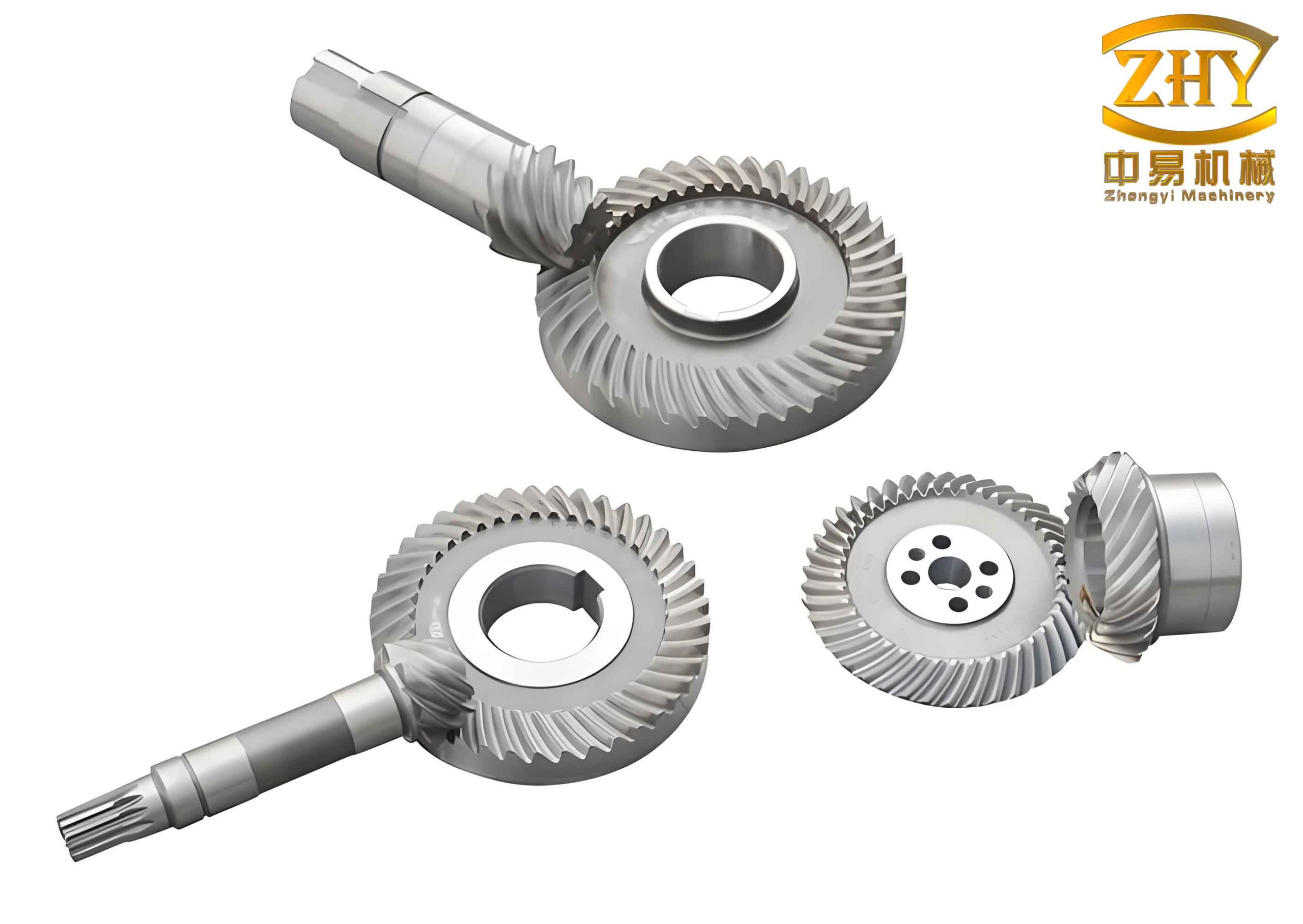
The system I developed is modular, consisting of four main modules: geometric design, strength calculation, life estimation, and optimization design. These modules are interconnected but can also operate independently. The overall functionality is built on a Windows platform using Visual Basic, featuring a user-friendly interface with dynamic design navigation, automatic chart queries, data inheritance, online help, and report output. This ensures simplicity, interactivity, and visual appeal. The core focus is on hyperboloid gears, and the system aims to handle the intricate calculations involved in their design.
In the following sections, I will delve into each module, providing formulas and tables to illustrate the computational processes. The hyperboloid gear design involves numerous parameters, and my system automates these to minimize errors and enhance reliability.
Geometric Design Module
The geometric design module computes the geometric dimensions and positional parameters of hyperboloid gears based on user-input initial parameters. It follows the recommended blank calculation methods from Gleason Works, covering over sixty calculation parameters. This module serves as the foundation for gear drawing, strength calculation, life estimation, and optimization. The program flowchart involves inputting basic parameters, selecting design types (e.g., “double shrinking tooth” or “inclined root line shrinking tooth”), and performing iterative calculations. Key parameters include pinion tooth count, gear module, tooth width, offset distance, and spiral angle.
To summarize the geometric design process, I use formulas for critical dimensions. For instance, the pitch diameter for the gear can be expressed as:
$$d_2 = m_{et} \cdot Z_2$$
where \(d_2\) is the pitch diameter of the gear, \(m_{et}\) is the module at the large end, and \(Z_2\) is the number of teeth on the gear. The offset distance \(E\) is a crucial parameter in hyperboloid gears, influencing the gear’s hyperbolic nature. The spiral angle \(\beta_{m1}\) for the pinion is calculated based on meshing conditions. A table of key geometric parameters is provided below:
| Parameter | Symbol | Formula or Selection |
|---|---|---|
| Pinion Tooth Number | \(Z_1\) | Input based on design constraints |
| Gear Module (Large End) | \(m_{et}\) | \(m_{et} = \frac{d_2}{Z_2}\) |
| Tooth Width | \(b_2\) | Typically 0.3 times the cone distance |
| Offset Distance | \(E\) | Optimized for strength and life |
| Pinion Spiral Angle | \(\beta_{m1}\) | Calculated from \(\tan \beta_{m1} = \frac{E}{R_m}\) |
| Cone Distance | \(R_m\) | \(R_m = \frac{d_2}{2 \sin \delta_2}\) |
In my system, the geometric design module automates these calculations, ensuring accuracy and speed. Compared to manual methods, it reduces human error and improves trustworthiness. The hyperboloid gear geometry is complex, but this module simplifies it through systematic computation.
Strength Calculation Module
The strength calculation module verifies the load-bearing capacity of hyperboloid gears. Since methods for selecting basic parameters based on load capacity are not yet mature, initial parameters are often chosen by experience or analogy, followed by geometric calculation and strength verification. My system uses the methods and data recommended by Gleason Company, supplemented by ISO/FDIS 10300 Method C as an auxiliary approach. The module checks tooth root bending fatigue strength, tooth surface contact fatigue strength, tooth root static bending strength, and tooth surface wear resistance. It can work directly with data from the geometric design module or accept input from existing hyperboloid gears.
The strength calculation involves determining operational parameters such as torque, pinion speed, and expected life. The design load is calculated, and stresses are evaluated. For example, the tooth root bending stress \(\sigma_F\) is given by:
$$\sigma_F = \frac{F_t}{b m_n} Y_F Y_S Y_\beta K_A K_V K_{F\beta} K_{F\alpha}$$
where \(F_t\) is the tangential load, \(b\) is the face width, \(m_n\) is the normal module, \(Y_F\) is the form factor, \(Y_S\) is the stress correction factor, \(Y_\beta\) is the helix angle factor, and \(K_A\), \(K_V\), \(K_{F\beta}\), \(K_{F\alpha}\) are application, dynamic, face load, and transverse load factors, respectively. Similarly, the contact stress \(\sigma_H\) is:
$$\sigma_H = Z_E Z_H Z_\epsilon \sqrt{\frac{F_t}{d_1 b} \frac{u+1}{u} K_A K_V K_{H\beta} K_{H\alpha}}$$
where \(Z_E\) is the elasticity factor, \(Z_H\) is the zone factor, \(Z_\epsilon\) is the contact ratio factor, \(d_1\) is the pinion pitch diameter, and \(u\) is the gear ratio. Tables for factor selection are integrated into the system. Below is a summary of strength calculation factors:
| Factor | Description | Determination Method |
|---|---|---|
| \(K_A\) | Application factor | Based on load spectrum from field data |
| \(K_V\) | Dynamic factor | Function of pitch line velocity and gear accuracy |
| \(K_{F\beta}\) | Face load factor for bending | Depends on tooth width and alignment |
| \(K_{H\beta}\) | Face load factor for contact | Similar to \(K_{F\beta}\) but for contact stress |
| \(Y_F\) | Form factor | From gear geometry and tooth profile |
| \(Z_H\) | Zone factor | Related to pressure angle and helix angle |
The system employs interactive windows for real-time parameter modification, with online access to original charts. This ensures that designers can adjust parameters as needed. For hyperboloid gears, strength verification is critical due to their high-load applications in mining machinery.
Life Estimation Module
The life estimation module has two functions: estimating service life under known loads and determining the maximum load tolerable within a finite life. It uses data from the strength calculation module to compute the maximum equivalent cycle numbers for bending and contact fatigue. Based on actual speed, this is converted into operational hours. Alternatively, it calculates the maximum torque the hyperboloid gear can withstand without fatigue failure. The module is essential for predicting field performance and optimizing design for durability.
The life estimation is based on the S-N curve approach. For bending fatigue, the equivalent cycle number \(N_{e}\) is given by:
$$N_{e} = \left( \frac{\sigma_{F \lim}}{\sigma_F} \right)^m \cdot N_0$$
where \(\sigma_{F \lim}\) is the bending fatigue limit stress, \(\sigma_F\) is the calculated bending stress, \(m\) is the slope exponent (e.g., 6.25 for bending), and \(N_0\) is the reference cycle count (e.g., \(3 \times 10^6\)). For contact fatigue, a similar formula applies:
$$N_{e} = \left( \frac{\sigma_{H \lim}}{\sigma_H} \right)^p \cdot N_0$$
with \(p\) typically around 8.7. If \(N_{e}\) exceeds the infinite life cycle count (e.g., \(10^9\) for contact), the hyperboloid gear is considered to have theoretical infinite life. The system provides results in a user-friendly interface, as shown in the example below for a hyperboloid gear pair:
| Parameter | Pinion | Gear |
|---|---|---|
| Bending Stress \(\sigma_F\) (MPa) | 150 | 140 |
| Contact Stress \(\sigma_H\) (MPa) | 800 | 800 |
| Equivalent Cycles \(N_{e}\) | \(1.2 \times 10^7\) | \(1.5 \times 10^7\) |
| Life (hours at 1000 rpm) | 2000 | 2500 |
This module allows for design adjustments if the estimated life falls short of expectations. For hyperboloid gears in harsh environments, life estimation is vital for reliability.
Optimization Design Module
The optimization design module addresses the challenge of determining basic parameters for hyperboloid gears. Traditional methods rely on experience and analogy, but parameters are interdependent, and calculations involve numerous iterative formulas. This module optimizes geometric parameters such as pinion tooth number \(Z_1\), gear module \(m_{et}\), tooth width \(b_2\), offset distance \(E\), and pinion spiral angle \(\beta_{m1}\). The optimization objectives are minimizing the total volume of the hyperboloid gear pair and maximizing load-bearing capacity.
The optimization uses the complex method (compound shape method) to handle constraints. The objective function for volume minimization is:
$$V = \frac{\pi}{4} b_2 \left( d_1^2 + d_2^2 \right)$$
where \(d_1\) and \(d_2\) are pitch diameters. For load capacity maximization, the objective is to maximize the pinion torque \(T_1\). Constraints include strength limits from the previous modules. The optimization problem can be formulated as:
$$\text{Minimize } V \quad \text{or} \quad \text{Maximize } T_1$$
$$\text{subject to: } \sigma_F \leq \sigma_{F \lim}, \quad \sigma_H \leq \sigma_{H \lim}, \quad \text{and geometric boundaries.}$$
The system integrates calculations from the geometric and strength modules. Below is a table summarizing optimization variables and constraints:
| Variable | Range | Constraint |
|---|---|---|
| \(Z_1\) | 5 to 50 | Integer |
| \(m_{et}\) (mm) | 2 to 20 | Standard values |
| \(b_2\) (mm) | 10 to 200 | \(b_2 \leq 0.3 R_m\) |
| \(E\) (mm) | 0 to 100 | \(E \leq 0.2 d_2\) |
| \(\beta_{m1}\) (degrees) | 20 to 50 | Meshing condition |
In my experience, optimizing hyperboloid gear parameters can increase torque capacity by over 10% without significant size changes. This module provides a scientific basis for parameter selection, enhancing design efficiency.
Application to Klingelnberg Spiral Bevel Gears
While my system focuses on hyperboloid gears, the principles extend to similar gear types like Klingelnberg spiral bevel gears, which are used in engineering machinery. These gears feature extended epicycloid equal-height teeth and are manufactured using the Cyclo-Palloid-System. Their cutter head is a two-part universal design, allowing for the machining of hyperboloid gears with different spiral directions. The cutter head consists of inner and outer cutter bodies with an eccentricity \(e\) for crowning. The cutting radii are:
$$R_1 = r \quad \text{for inner cutters}, \quad R_2 = r + e \quad \text{for outer cutters}$$
where \(r\) is the theoretical cutter radius. The linear eccentricity \(e\) is calculated based on gear parameters to ensure conjugate action. For hyperboloid gears, such manufacturing considerations are integrated into the design system to ensure producibility. The cutter head holds five groups of blades, each with four blades: inner finish A, inner intermediate B, outer intermediate C, and outer finish D. The arrangement order changes with spiral direction, but the same cutter head can machine different hyperboloid gear pairs.
Formulas for cutter head adjustment include the eccentricity calculation:
$$e = \frac{m_n \cdot \sin \beta}{2 \cdot \tan \alpha_n}$$
where \(m_n\) is the normal module, \(\beta\) is the spiral angle, and \(\alpha_n\) is the normal pressure angle. This highlights the interplay between design and manufacturing for hyperboloid gears.
System Implementation and Benefits
I implemented the system using Visual Basic on Windows, ensuring compatibility and ease of use. The modular structure allows for independent updates and expansions. Key features include dynamic design navigation, automatic chart querying, data inheritance, and online help. The system has been applied in field studies for mining machinery, showing satisfactory results. It reduces design time, improves accuracy, and enhances the quality of hyperboloid gears.
To illustrate the computational flow, here is a combined table summarizing inputs and outputs across modules for a hyperboloid gear design:
| Module | Input Parameters | Output Results |
|---|---|---|
| Geometric Design | \(Z_1, Z_2, m_{et}, E, \beta_{m1}\) | \(d_1, d_2, b_2, R_m, \delta_1, \delta_2\) |
| Strength Calculation | Torque \(T\), speed \(n\), life \(L_h\) | \(\sigma_F, \sigma_H\), safety factors \(S_F, S_H\) |
| Life Estimation | \(\sigma_F, \sigma_H\), material properties | \(N_e\), operational hours, max torque |
| Optimization Design | Constraints, objectives | Optimal \(Z_1, m_{et}, b_2, E, \beta_{m1}\) |
The system handles the complexity of hyperboloid gear design through automation. For instance, the geometric design module performs iterations for parameters like tooth thickness and taper. The strength module uses empirical factors from Gleason tables, which are encoded into the system. The life module applies fatigue theory specific to hyperboloid gears. The optimization module employs numerical methods to search for best parameters.
Advanced Formulas and Considerations
In hyperboloid gear design, additional formulas are needed for precise calculations. For example, the equivalent radius of curvature \(\rho_{red}\) for contact stress is:
$$\frac{1}{\rho_{red}} = \frac{1}{\rho_1} + \frac{1}{\rho_2}$$
where \(\rho_1\) and \(\rho_2\) are the radii of curvature at the contact point. For hyperboloid gears, these are derived from the hyperbolic geometry. The bending moment arm \(h_F\) for tooth root stress is calculated using the Lewis formula adapted for hyperboloid gears. Moreover, the load distribution factor \(K_{H\beta}\) for hyperboloid gears accounts for the offset and is often derived from finite element analysis. My system incorporates these aspects through simplified models or user-input data.
Thermal effects are also considered in life estimation. The operating temperature can affect material properties. A correction factor \(Y_\theta\) for temperature is included in bending stress calculations:
$$\sigma_F’ = \sigma_F \cdot Y_\theta$$
where \(Y_\theta = 1\) for temperatures below 120°C. For hyperboloid gears in mining machinery, environmental factors like dust and moisture are accounted for in wear calculations.
Conclusion
In this article, I have presented my optimization and selection design system for hyperboloid gears. The system comprises geometric design, strength calculation, life estimation, and optimization design modules, all focused on improving the performance and reliability of hyperboloid gears. By using formulas, tables, and interactive interfaces, it addresses the challenges in designing these complex gears. The hyperboloid gear is a critical component in many mechanical systems, and my system streamlines its design process. Future work may include integrating manufacturing simulations and expanding to other gear types. Overall, this system enhances design quality, reduces cycles, and supports the advancement of hyperboloid gear technology.
Throughout the discussion, I have emphasized the importance of hyperboloid gears in applications like mining machinery. The system’s ability to optimize parameters ensures that hyperboloid gears meet demanding operational requirements. By leveraging computational tools, I believe that the design and manufacturing of hyperboloid gears can be significantly improved, contributing to more efficient and durable machinery.