
As an engineer focused on component reliability and failure prevention, I have encountered numerous instances of critical component failures. Among these, the fracture of gear shafts in power transmission systems, particularly in demanding applications like aero-engines, presents a complex and significant challenge. The failure of a single gear shaft can lead to catastrophic system breakdown, emphasizing the need for rigorous analysis and robust prevention methodologies. This article consolidates my perspective and analytical approach, drawing upon principles of fracture mechanics, tribology, and systems engineering to dissect the root causes of gear shaft failures and formulate effective countermeasures. We will delve into failure modes, investigative techniques, and the interplay between wear and ultimate fracture, all centered on the integrity of gear shafts.
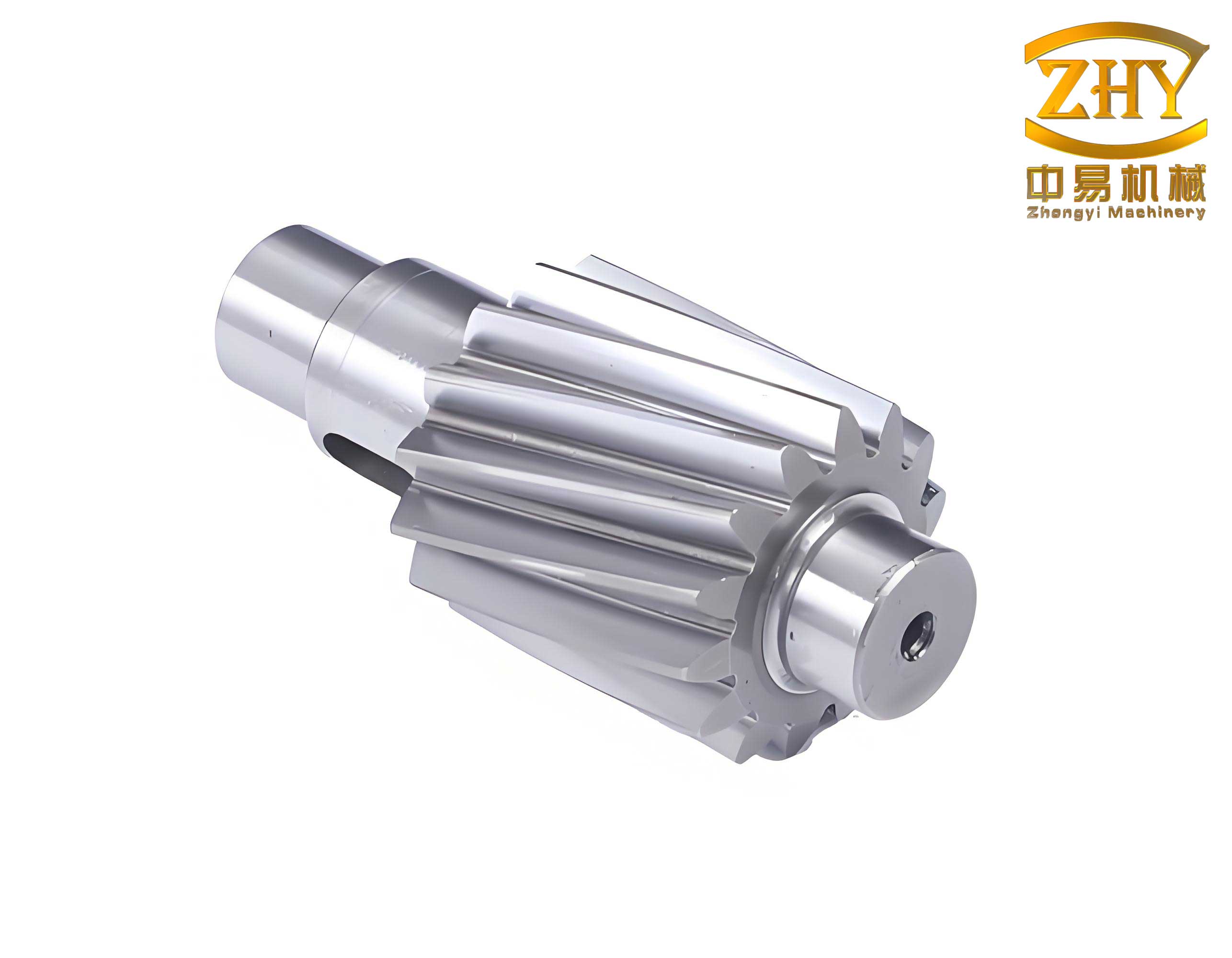
The primary function of gear shafts is to transmit torque and rotational motion. Their design must balance high strength to withstand operational stresses (bending and torsion) with sufficient toughness to resist crack propagation. A typical gear shaft failure analysis follows a systematic path: initial macroscopic examination, detailed fractography, metallurgical evaluation, and stress analysis. The fracture surface is the most critical evidence. Different loading conditions create distinct fracture features. For instance, a torsional overload, a common failure mode for gear shafts, often produces a flat, transverse fracture plane perpendicular to the shaft axis. At a microscopic level, this may exhibit a “smeared” appearance due to post-fracture rubbing or, in cleaner cases, reveal a pattern of elongated shear dimples, indicating ductile tearing under shear stress. The fracture morphology can be characterized by the relationship between shear stress ($\tau$) and the material’s ultimate shear strength ($S_{us}$). Failure occurs when:
$$
\tau_{max} \geq S_{us}
$$
For a solid circular gear shaft subjected to torque $T$, the maximum shear stress is given by:
$$
\tau_{max} = \frac{T \cdot r}{J} = \frac{16T}{\pi d^3}
$$
where $r$ is the radius, $d$ is the diameter, and $J$ is the polar moment of inertia. This simple calculation is the starting point for assessing whether the applied torque exceeded the design limits of the gear shaft.
However, a pure overload is often merely the final event in a sequence of degradations. In many cases, the root cause lies in a secondary failure that drastically increases the torque demand on the gear shaft. A classic scenario involves the seizure of a mating component, such as a pinion or a supported bearing/bushing. When a driven component seizes, the driving gear shaft experiences a massive, instantaneous spike in torsional load, leading to overload fracture. Therefore, analyzing the fracture of a gear shaft is incomplete without investigating the condition and interaction of all associated components in the kinematic chain.
Wear is a predominant degradation mechanism that frequently precedes catastrophic fracture. In the context of gear shafts running in bushings or bearings, several wear modes are relevant. The Archard wear equation provides a fundamental model for adhesive and abrasive wear:
$$
V = K \frac{W \cdot s}{H}
$$
where $V$ is the wear volume, $K$ is the dimensionless wear coefficient, $W$ is the normal load, $s$ is the sliding distance, and $H$ is the hardness of the softer material. A high wear coefficient $K$ indicates severe wear conditions.
The transition from normal wear to catastrophic failure often involves a shift in wear mechanisms. The table below summarizes key wear mechanisms relevant to gear shaft and bushing interfaces:
| Wear Mechanism | Primary Cause | Typical Features on Gear Shaft/Bushing | Potential Outcome |
|---|---|---|---|
| Abrasive Wear (2-body & 3-body) | Hard particles trapped between surfaces. | Scoring, grooving, ploughing. Embedded particles in softer surface (e.g., bushing). | Increased clearance, heat generation, particle generation. |
| Adhesive Wear (Scuffing) | Micro-welding of asperities due to high pressure and temperature. | Material transfer (e.g., Fe from shaft to Cu bushing), severe surface tearing, roughening. | Rapid increase in friction coefficient, possible seizure. |
| Fatigue Wear | Cyclic subsurface shear stresses. | Spalling, pitting, crack initiation below the surface. | Generation of large debris, vibration, loss of kinematic precision. |
In a case involving a pump, the sequence often begins with abrasive wear. Contaminants like sand ($SiO_2$), alumina ($Al_2O_3$), or silicon carbide ($SiC$) from a contaminated lubricant system act as third-body abrasives. These hard particles, with hardness $H_p$, are pressed against the softer bushing material (hardness $H_b$). If $H_p > 1.2 H_b$, the particles will cut or plough into the bushing surface. As these particles are cyclically dragged by the rotating gear shaft, they create deep grooves. This process increases the effective surface roughness and generates significant frictional heat. The wear rate in this regime can be high, leading to a loss of designed clearance between the gear shaft and the bushing.
The generated frictional heat ($Q$) is proportional to the coefficient of friction $\mu$, the load $W$, and the sliding velocity $v$:
$$
Q \propto \mu \cdot W \cdot v
$$
This heat causes localized temperature rises. For materials like tin bronze (a common bushing material, e.g., ZQSn10-1), the mechanical properties degrade with temperature. Furthermore, thermal expansion becomes critical. The change in diameter $\Delta d$ of a bushing due to a temperature increase $\Delta T$ is:
$$
\Delta d = d_0 \cdot \alpha \cdot \Delta T
$$
where $d_0$ is the original inner diameter and $\alpha$ is the coefficient of thermal expansion. If the bushing expands outward, constrained by its housing, the effective inner diameter may actually decrease, further reducing the running clearance with the gear shaft. This creates a vicious cycle: wear generates heat, heat reduces clearance and softens materials, leading to more severe wear.
This is the critical transition point where abrasive wear can escalate into adhesive wear (scuffing). As the oil film breaks down completely and clean metal surfaces of the gear shaft and bushing come into intimate contact under high pressure, local microwelds form. The separation of these welds causes severe tearing and significant material transfer. The appearance of elements from the gear shaft (e.g., Fe, Cr) on the bushing surface, as detected by Energy Dispersive X-ray Spectroscopy (EDS), is a definitive indicator of this process. The friction coefficient can spike dramatically, and the required torque to turn the gear shaft increases exponentially. Eventually, the welded junctions become so extensive that relative motion stops—this is seizure. At the moment of seizure, the torque on the driving gear shaft theoretically approaches infinity, resulting in instantaneous torsional overload fracture, often at a stress concentrator like a keyway, spline root, or sudden change in diameter.
The fractographic evidence on the broken gear shaft will typically show features of a fast, ductile shear rupture. The fracture plane is usually at a 45-degree angle to the axis in a cylindrical shaft, following the plane of maximum shear stress. Microscopically, the surface may be heavily smeared if the broken ends continued to rub, but underlying features like elongated dimples confirm the shear mode. The formula for shear strain $\gamma$ at fracture relates to the twist angle $\phi$ and shaft length $L$:
$$
\gamma = \frac{r \cdot \phi}{L}
$$
A large twist angle before fracture, observable macroscopically, indicates significant plastic deformation, which is consistent with a high-energy overload event rather than a fatigue failure.
Based on this integrated understanding of the failure sequence—from contaminant introduction to abrasive wear, thermal runaway, adhesive seizure, and final torsional fracture—a comprehensive prevention strategy for gear shafts can be established. This strategy must be multi-layered, targeting each stage of the potential failure chain.
The first and most critical line of defense is contamination control. The lubricant system must be protected from ingress of external abrasives. This involves:
- Ensuring the integrity of seals and filters.
- Implementing strict cleanliness protocols during assembly, maintenance, and fluid handling.
- Establishing a regular oil analysis program to monitor particulate counts and chemical composition, allowing for proactive fluid changes before contamination reaches critical levels.
The effectiveness of a filter can be described by its filtration ratio $\beta_x$, where $x$ is the particle size in microns. A $\beta_{10}=200$ filter removes 99.5% of particles 10µm and larger. For preventing abrasive wear in tight-clearance components like gear shaft bushings, high-efficiency filtration targeting particles smaller than the minimum oil film thickness is essential.
The second layer is design enhancement. While the gear shaft itself must be strong, the design of the supporting interface can be optimized to mitigate the consequences of unavoidable minor contamination.
- Bushing Design: Incorporating dedicated reservoir features into the bushing bore can be highly effective. These are small, strategically placed grooves or pockets that serve a dual purpose: they act as lubricant reservoirs to ensure oil film maintenance, and more importantly, they function as contaminant traps. Abrasive particles can settle into these grooves, effectively removing them from the active wear interface. The volume and geometry of these grooves must be carefully calculated to not significantly compromise the load-bearing area or hydrodynamic pressure generation.
- Material Selection: The hardness ratio between the gear shaft and the bushing is crucial. The bushing material should be softer to allow for embedded abrasives, but not so soft that it wears excessively under normal conditions. Modern materials like polymer composites or advanced, particle-reinforced bronzes can offer superior wear resistance and embeddability.
- Thermal Management: Designs that promote heat dissipation from the bushing and gear shaft interface can delay the onset of thermal runaway. This could involve strategic cooling passages or the use of bushing materials with higher thermal conductivity.
The third layer is condition monitoring and proactive maintenance. Vibration analysis can detect the onset of abnormal wear in gear shaft assemblies before seizure occurs. An increase in specific frequency harmonics related to shaft rotation or gear mesh can indicate developing problems. Torque monitoring, if feasible, provides a direct measure of the load on the gear shaft. A gradual or sudden increase in driven torque is a direct warning sign of increasing friction, potentially from a seizing bearing or bushing. Scheduled inspections should include checks for end-play and radial free movement of gear shafts, which can indicate abnormal wear in support bearings.
In summary, the fracture of a gear shaft is seldom an isolated event. It is typically the culmination of a progressive degradation process, very often initiated by wear at its supporting interfaces. A thorough failure analysis must extend beyond the fractured gear shaft itself to scrutinize all interacting components and the operating environment. By understanding the tribological sequence from abrasive particle ingress to adhesive seizure, we can develop a holistic and effective prevention strategy. This strategy rests on three pillars: rigorous contamination control to eliminate the root cause, intelligent design to tolerate and manage unavoidable particles, and vigilant condition monitoring to detect incipient failure. Through this integrated approach, the reliability and service life of critical gear shafts in demanding mechanical systems can be significantly enhanced, preventing costly downtime and ensuring operational safety.