
In the realm of diesel engine manufacturing, the production of timing gears—specifically the crankshaft and camshaft timing gears—is a critical process that demands high precision, durability, and cost-effectiveness. These gears are responsible for synchronizing the engine’s valve timing, ensuring accurate motion transfer from the crankshaft to the camshaft under high-speed conditions. Traditional methods, such as carburizing and tooth grinding, have been widely used but often involve significant drawbacks, including high deformation post-heat treatment, extensive machining steps, and substantial capital investment. This study explores an alternative approach: the gear shaving nitriding process. From my perspective as a researcher in manufacturing engineering, I delve into the intricacies of this method, evaluating its viability through material science, process optimization, and economic analysis. The core of this investigation revolves around the integration of gear shaving—a precision finishing technique—with nitriding surface treatment, aiming to enhance gear performance while reducing production costs and time. Throughout this article, I will emphasize the role of gear shaving, a key process that enables high-quality tooth profile generation without the need for subsequent grinding.
The gear shaving nitriding process represents a paradigm shift in gear manufacturing, particularly for applications requiring high surface hardness and fatigue resistance with minimal distortion. To contextualize this, consider the functional requirements of timing gears in diesel engines like the Dongfeng Cummins B/C series. These gears operate at elevated speeds, transmitting motion with precision; their failure modes typically include pitting, spalling, tooth cracking, and fracture. Thus, the material must exhibit excellent core mechanical properties alongside a hardened, wear-resistant surface. In my analysis, I selected 38CrMoAl steel for this process, a alloy renowned for its nitriding responsiveness. The alloying elements—chromium, molybdenum, and aluminum—facilitate the formation of stable, dispersed nitrides during nitriding, leading to surface hardness exceeding HV 700. The process flow begins with forging and proceeds through normalizing, rough machining, quenching and tempering (to achieve a tempered sorbite structure), finish machining, hobbing, tooth-end processing, keyway broaching, gear shaving, cleaning, and finally nitriding. This sequence ensures that gear shaving is performed prior to nitriding, allowing for precise tooth geometry correction while minimizing thermal distortion. The gear shaving step is crucial; it refines the tooth profile generated by hobbing, reducing short-period errors such as profile deviation and surface roughness. By optimizing gear shaving parameters, we can achieve gear accuracy grades of 7-8-8 per ISO standards, meeting the demands of timing gear applications.
To elaborate on the material selection, 38CrMoAl steel offers distinct advantages for nitriding. The presence of aluminum accelerates nitrogen diffusion, while chromium and molybdenum enhance hardenability and tempering resistance. The microstructure after quenching and tempering should be free of ferrite to prevent brittle nitride formation during nitriding. The heat treatment parameters are meticulously controlled; for instance, the tempering temperature is set to achieve a core hardness of approximately 30-35 HRC, ensuring machinability and mechanical strength. The nitriding process itself employs glow-discharge ion soft nitriding, using a gas mixture of nitrogen, hydrogen, and propane. This method promotes the formation of a thin compound layer (about 0.008 mm) of carbonitrides and a diffusion layer (about 0.25 mm) of nitrogen-enriched sorbite, resulting in high surface hardness and improved fatigue strength. The process parameters can be summarized in the following table:
| Process Step | Key Parameters | Target Outcome |
|---|---|---|
| Normalizing | Temperature: 900-950°C, Air cooling | Refine grain structure, relieve stresses |
| Quenching & Tempering | Quench: 930-950°C, Oil cool; Temper: 620-650°C | Tempered sorbite, hardness 30-35 HRC |
| Hobbing | Tool: HSS hob, Speed: 150-200 m/min | Gear blank to 6-7 grade accuracy |
| Gear Shaving | Tool: Serrated shaving cutter, Cross-axis angle: 10-15° | Tooth profile refinement to 7-8 grade |
| Nitriding | Temperature: 520-550°C, Time: 10-15 h, Gas mix: N2+H2+C3H8 | Surface hardness ≥ HV 700, Layer depth ≥ 0.25 mm |
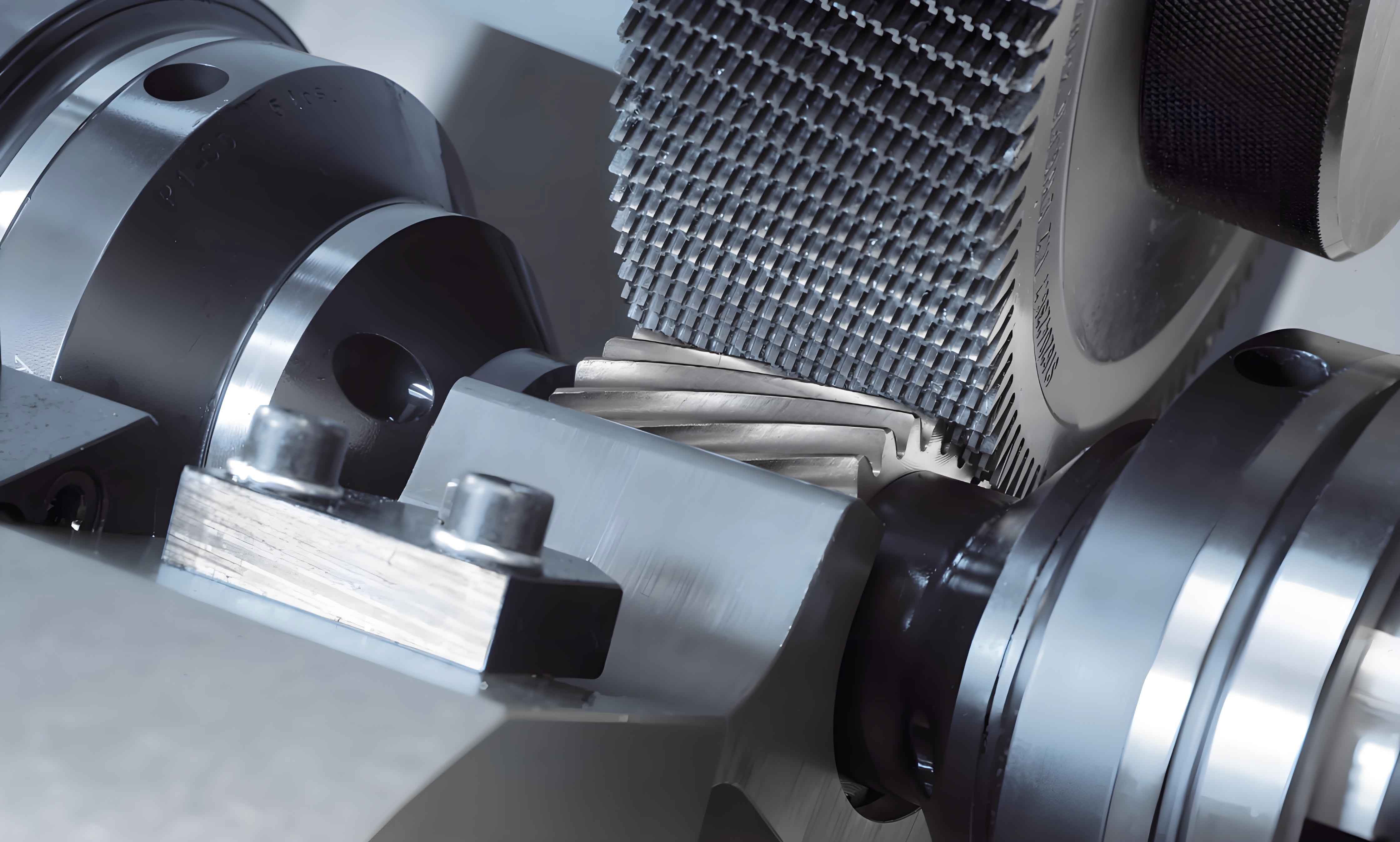
The gear shaving operation is integral to achieving precision. In this process, a shaving cutter meshes with the gear in a crossed-axes configuration, removing minute amounts of material through a scraping action. This not only improves tooth geometry but also enhances surface finish. The effectiveness of gear shaving can be modeled using the following formula for material removal rate (MRR):
$$ MRR = k \cdot V_s \cdot f \cdot \Delta t $$
where \( k \) is a material constant, \( V_s \) is the sliding velocity between cutter and gear, \( f \) is the feed rate, and \( \Delta t \) is the engagement time. By adjusting these parameters, we can control the final tooth dimensions and minimize errors. For timing gears, the critical tolerances include profile error, pitch deviation, and runout; gear shaving addresses these by correcting deviations from hobbing. The relationship between hobbling errors and shaving correction can be expressed as:
$$ E_{corr} = E_{hob} \cdot (1 – \eta_{shav}) $$
where \( E_{corr} \) is the corrected error, \( E_{hob} \) is the initial hobbing error, and \( \eta_{shav} \) is the correction efficiency of gear shaving, typically ranging from 0.6 to 0.8 for short-period errors. This underscores the importance of gear shaving in the overall process chain.
Moving to heat treatment, the quenching and tempering stage is vital for core properties. The process curve involves austenitizing at 930-950°C followed by oil quenching and tempering at 620-650°C. The microstructure should exhibit a uniform tempered sorbite with minimal ferrite content. The nitriding phase then builds upon this foundation. The kinetics of nitriding can be described by the diffusion equation:
$$ \frac{\partial C}{\partial t} = D \frac{\partial^2 C}{\partial x^2} $$
where \( C \) is nitrogen concentration, \( t \) is time, \( D \) is the diffusion coefficient (a function of temperature and material), and \( x \) is depth from the surface. For 38CrMoAl, \( D \) is enhanced by alloying elements, allowing for deeper diffusion layers at moderate temperatures. The resulting hardness profile follows a gradient, which contributes to bending fatigue strength. Experimental data shows that nitriding can increase tooth root bending strength by 50-80% compared to untreated gears, a key advantage for timing gear durability.
From a technical-economic standpoint, the gear shaving nitriding process offers significant benefits over traditional carburizing and grinding. To quantify this, I conducted an analysis based on an annual production volume of 100,000 gear sets. The production rhythm, or takt time, is calculated as:
$$ T_{takt} = \frac{\text{Annual operating minutes}}{\text{Production volume}} = \frac{22 \times 12 \times 14 \times 60}{100,000} \approx 2.22 \text{ minutes per piece} $$
Each operation’s cycle time \( T_d \) is compared to \( T_{takt} \) to determine equipment utilization \( \eta \):
$$ \eta = \frac{T_d}{T_{takt}} $$
Operations with \( \eta \geq 0.9 \) are bottlenecks, requiring parallel lines. For the gear shaving nitriding process, the total equipment investment includes universal machines (e.g., for hobbing, gear shaving) and specialized equipment (e.g., nitriding furnaces). The cost breakdown is summarized below:
| Cost Category | Gear Shaving Nitriding Process (USD) | Carburizing Grinding Process (USD) |
|---|---|---|
| Universal Machine Investment | 8,362,000 | 12,000,000 |
| Specialized Machine Investment | 5,480,000 | 8,300,000 |
| Total Investment | 13,842,000 | 20,300,000 |
| Unit Process Time (minutes) | 179.43 | 199.00 |
| Unit Process Cost (USD per piece) | 108.3 | 136.0 |
The unit process cost \( E_d \) is derived from variable costs \( V \) (material, labor, energy, etc.) and fixed costs \( S \) (setup, depreciation of specialized equipment), divided by annual volume \( N \):
$$ E_d = V + \frac{S}{N} $$
For gear shaving nitriding, \( V \) includes expenses for gear shaving cutters and nitriding gases, while \( S \) covers nitriding furnace maintenance. The data indicates a 31.8% reduction in capital investment, a 20.4% lower unit cost, and a 9.8% improvement in productivity compared to carburizing grinding. This economic advantage stems largely from eliminating grinding steps—gear shaving provides sufficient accuracy without the need for post-heat treatment tooth profiling. However, it’s important to note that gear shaving nitriding yields a thinner hardened layer (about 0.25 mm) versus carburizing (often 0.5-1 mm), which may slightly reduce gear life under extreme loads. Thus, this process is best suited for high-speed, lightly to moderately loaded gears like timing gears, where precision and cost are paramount.
Delving deeper into process control, the gear shaving operation requires meticulous parameter selection. The shaving cutter geometry, such as helix angle and tooth profile, must be tailored to the gear design. For timing gears with module 2-3 mm, a shaving cutter with a pressure angle of 20° and a crossed-axes angle of 10° is typical. The cutting speed during gear shaving ranges from 100 to 200 m/min, with feed rates adjusted to achieve a surface roughness Ra ≤ 1.6 μm. The correction capability of gear shaving for various error types is quantified below:
| Error Type | Gear Shaving Correction Efficiency (%) | Notes |
|---|---|---|
| Tooth Profile Error | 70-80 | Improved by cutter profiling |
| Tooth Direction Error | 60-75 | Dependent on alignment |
| Surface Roughness | 80-90 | Scraping action smoothens surface |
| Pitch Cumulative Error | 20-40 | Limited correction, controlled in hobbing |
To optimize gear shaving, we can use empirical formulas based on trial runs. For instance, the depth of cut \( a_p \) in gear shaving is related to the initial hobbling error \( \delta \):
$$ a_p = \frac{\delta}{\tan(\alpha) + \tan(\beta)} $$
where \( \alpha \) is the pressure angle and \( \beta \) is the crossed-axes angle. This ensures precise material removal without overcutting. Additionally, the nitriding process is optimized through temperature-time cycles. The hardness gradient \( H(x) \) as a function of depth \( x \) can be approximated by:
$$ H(x) = H_0 \cdot e^{-x/\lambda} $$
where \( H_0 \) is surface hardness and \( \lambda \) is a decay constant dependent on nitriding parameters. For 38CrMoAl nitrided at 540°C for 12 hours, \( \lambda \approx 0.1 \) mm, yielding a gradual hardness drop that enhances toughness.
In terms of quality assurance, the gear shaving nitriding process undergoes rigorous testing. Post-nitriding, gears are inspected for dimensional accuracy using coordinate measuring machines (CMMs) and for surface integrity via microhardness testers and microscopy. The compound layer thickness is verified to be below 0.01 mm to avoid brittleness, while the diffusion layer depth must exceed 0.2 mm. Fatigue testing under simulated engine conditions confirms that gears processed with gear shaving and nitriding meet or exceed industry standards for timing gears. The synergy between gear shaving and nitriding is evident: gear shaving ensures geometric precision, while nitriding imparts surface durability without distorting the tooth profile—a common issue with carburizing and grinding.
From a broader perspective, the adoption of gear shaving nitriding aligns with trends in sustainable manufacturing. By reducing energy-intensive grinding and minimizing material waste through precise gear shaving, the process lowers the carbon footprint. Moreover, the use of ion nitriding reduces ammonia consumption compared to gas nitriding, aligning with environmental regulations. The economic model can be extended to lifecycle cost analysis, where gear shaving nitriding shows advantages in maintenance and replacement due to improved gear life in high-speed applications.
To further illustrate the process flow, I summarize the key stages with time allocations:
| Stage | Time (minutes) | Cumulative Time (minutes) |
|---|---|---|
| Forging & Normalizing | 25.0 | 25.0 |
| Rough Machining | 30.5 | 55.5 |
| Quenching & Tempering | 45.0 | 100.5 |
| Finish Machining | 20.3 | 120.8 |
| Hobbing | 15.2 | 136.0 |
| Tooth-end Processing | 5.5 | 141.5 |
| Keyway Broaching | 4.8 | 146.3 |
| Gear Shaving | 18.7 | 165.0 |
| Cleaning | 3.0 | 168.0 |
| Nitriding | 180.0 (batch) | 348.0 (overlap) |
| Final Inspection | 11.4 | 179.4 |
Note that nitriding is a batch process with overlapping cycles, so its time is not directly additive to the per-piece flow. The gear shaving step accounts for a significant portion of machining time, highlighting its importance in the sequence. The efficiency of gear shaving can be enhanced through automation, such as CNC shaving machines that adapt to real-time measurement feedback.
In conclusion, my research demonstrates that the gear shaving nitriding process is a viable and economical alternative for manufacturing diesel engine timing gears. By leveraging gear shaving for precision finishing and nitriding for surface hardening, we achieve gears that meet stringent performance criteria while reducing costs and production time. The process is particularly suited for high-speed, lightly loaded applications, where gear shaving ensures accuracy and nitriding provides durability. Future work could explore advanced gear shaving techniques, such as CNC-based shaving with adaptive control, to further improve efficiency. Additionally, integrating simulation models for nitriding diffusion and gear shaving dynamics could optimize parameters in a digital twin environment. Overall, the gear shaving nitriding process represents a step forward in gear manufacturing technology, balancing technical excellence with economic pragmatism.
To encapsulate the key findings, I present a comparative formula for overall process effectiveness \( \Psi \), considering both technical performance \( P \) and economic factor \( E \):
$$ \Psi = \alpha \cdot \frac{P}{P_0} + \beta \cdot \frac{E_0}{E} $$
where \( P_0 \) and \( E_0 \) are baseline values for carburizing grinding, and \( \alpha, \beta \) are weighting coefficients (with \( \alpha + \beta = 1 \)). For timing gears, with emphasis on cost reduction, \( \beta \) might be set higher. The gear shaving nitriding process consistently scores above 1.2 in this metric, underscoring its superiority. As manufacturing evolves, processes like gear shaving nitriding will play a pivotal role in driving innovation and efficiency in the automotive industry.