
The reliable operation of an automotive transmission is fundamentally dependent on the performance and durability of its core rotating components. Among these, the gear shafts play a pivotal role, serving as the critical link between gears, bearings, and other elements within the gearbox. Their primary function is to transmit torque while supporting significant mechanical loads. The operational demands placed on these components are severe and multifaceted, necessitating a sophisticated approach to material selection and, more importantly, heat treatment process design. This analysis delves into the optimization of heat treatment for automotive transmission gear shafts, focusing on a systematic methodology that balances metallurgical requirements, manufacturing efficiency, and final performance.
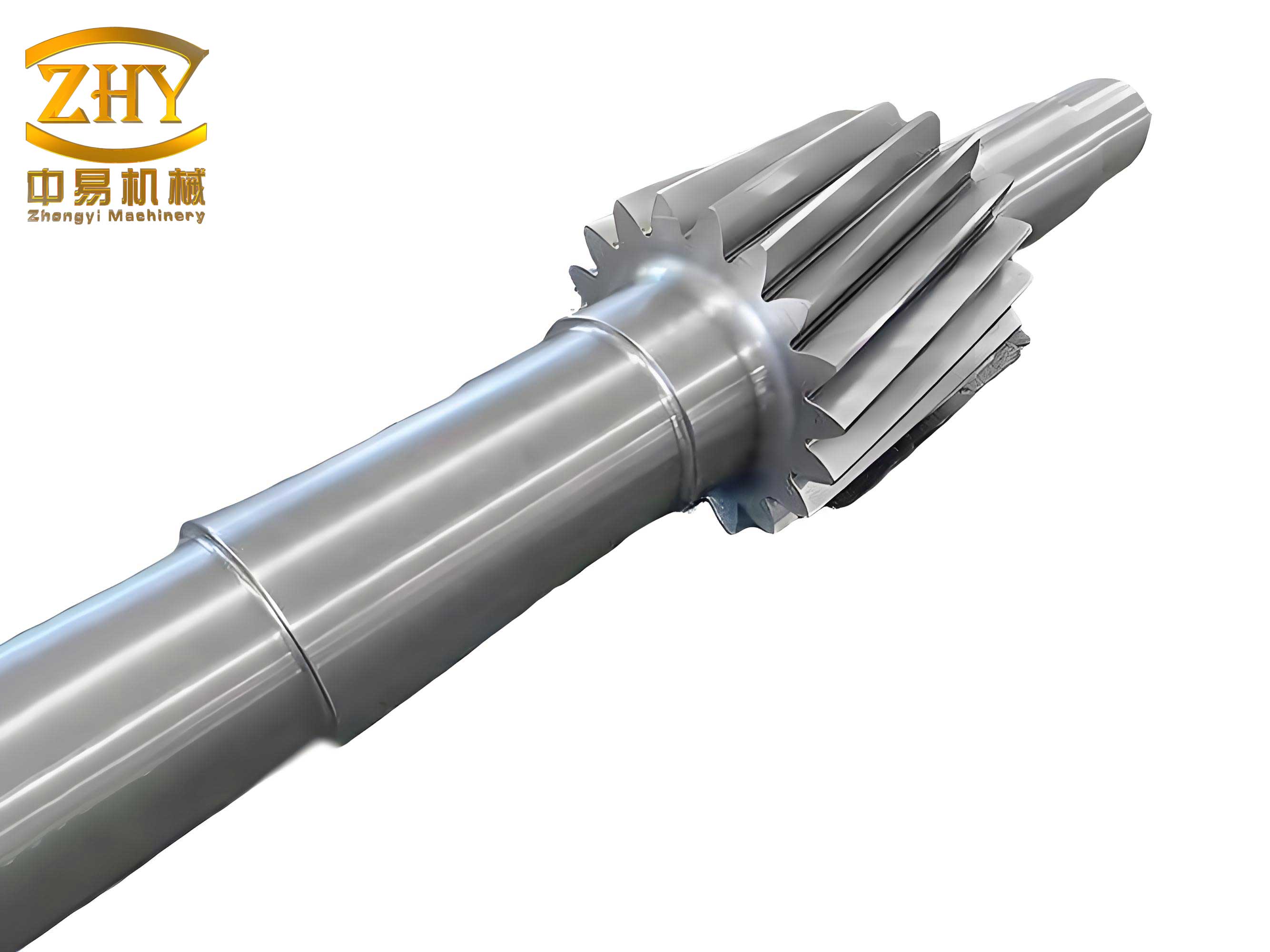
The service conditions for transmission gear shafts are exceptionally demanding. They are subjected to a complex superposition of stresses: high-cycle reversed bending moments from transmitted torque, torsional shear stresses, contact stresses at gear meshing points and bearing journals, and potential shock loads during gear shifts or irregular driving conditions. Consequently, surface phenomena such as wear, pitting, and scuffing, as well as bulk failures like fatigue fracture and plastic deformation, are common failure modes. To combat these, the gear shafts must exhibit a specific set of properties: a hard, wear-resistant surface layer to resist abrasion and contact fatigue, coupled with a tough, ductile core capable of absorbing impact energy and resisting crack propagation under high cyclic stresses. This combination of surface hardness and core toughness is classically achieved through case-hardening processes, making the choice of material and subsequent thermal processing the cornerstone of component reliability.
The selection of an appropriate steel grade is the first critical step in optimizing the lifecycle of gear shafts. The requirement for a hard case and a tough core naturally leads to the family of low-carbon alloy steels, which are amenable to surface enrichment processes like carburizing or carbonitriding. Among the candidate materials such as 20Cr, 18Cr2Ni4WA, and 20CrMnTi, a detailed analysis points to 20CrMnTi as the optimal choice for a majority of passenger vehicle transmission applications. While 20Cr is cost-effective, it suffers from a pronounced tendency for grain coarsening during high-temperature processing and offers insufficient load-bearing capacity for high-performance applications. 18Cr2Ni4WA, on the other hand, provides exceptional strength and toughness due to its high alloy content and hardenability but is disadvantaged by poor machinability and significantly higher material cost. 20CrMnTi strikes an excellent balance: it offers good hardenability, fine grain structure (aided by the titanium addition), favorable cold and hot workability, and a reasonable cost-performance ratio.
The efficacy of 20CrMnTi stems from its synergistic alloying elements. Each element plays a distinct role in defining the final properties of the heat-treated gear shafts.
| Element | Primary Role in 20CrMnTi for Gear Shafts | Metallurgical Effect |
|---|---|---|
| C (Carbon) | Strength and Hardness Foundation | Forms interstitial solid solutions (ferrite, austenite) to strengthen the matrix. Combines with alloying elements to form hard carbide precipitates (e.g., (Fe,Cr)3C, TiC), crucial for wear resistance. |
| Mn (Manganese) | Hardenability Enhancer, Solid Solution Strengthener | Lowers the critical cooling rate, increasing the depth of hardening during quenching. Dissolves in ferrite, providing significant solid solution strengthening. |
| Si (Silicon) | Solid Solution Strengthener, Oxidation Resistance | Strongly strengthens ferrite. Improves resistance to high-temperature oxidation, beneficial during heat treatment. |
| Cr (Chromium) | Hardenability Enhancer, Carbide Former, Wear & Corrosion Aid | Increases hardenability markedly. Forms stable carbides, improving wear resistance. Imparts mild corrosion resistance and refines the pearlite structure during slow cooling. |
| Ti (Titanium) | Grain Refiner, Strong Carbide Former | Forms very stable, finely dispersed TiC and TiN particles during solidification. These particles pin austenite grain boundaries during high-temperature exposure (e.g., carburizing), preventing excessive grain growth and ensuring a fine final microstructure, which is vital for toughness and fatigue strength. |
The critical transformation temperatures (Ac1: 740°C, Ac3: 825°C, Ms: ~365°C) for 20CrMnTi are essential for designing the thermal cycles. The primary goal of heat treatment optimization for these gear shafts is to establish a precisely controlled process sequence that transforms the selected material into a component meeting all performance specifications. The generic process route is: Forging → Preliminary Heat Treatment → Machining → Surface Hardening (Case Hardening) → Final Heat Treatment (Quenching & Tempering) → Finishing Operations.
The first thermal operation after forging is the preliminary or pre-machining heat treatment. Forged gear shafts often have a non-uniform, coarse-grained structure and high residual stresses, which are detrimental for subsequent machining and final properties. The objective here is to homogenize the microstructure, refine the grain size, soften the material for easier machining, and relieve internal stresses. The three standard options are Full Annealing, Normalizing, and Quenching & Tempering (Hardening & Tempering).
- Full Annealing involves heating above Ac3, holding, and very slow furnace cooling. It produces a soft, coarse pearlitic-ferritic structure ideal for machinability but is time-consuming and energy-intensive.
- Quenching & Tempering would produce a strong, tough tempered martensitic structure but is an over-treatment at this stage, making machining difficult and adding unnecessary cost.
- Normalizing is the optimal choice. It involves heating to approximately 30-50°C above the Ac3 temperature (for 20CrMnTi, around 870-880°C), holding for sufficient time to fully austenitize, followed by air cooling. This results in a finer, more uniform pearlitic-ferritic structure (often approaching a sorbitic morphology) with higher strength and hardness than annealed material, yet still very machinable. It is faster and more energy-efficient than annealing. The holding time can be estimated using an empirical formula considering part geometry and furnace load.
$$ t = \alpha \cdot K \cdot D $$
Where:
- $t$ is the holding time (hours),
- $\alpha$ is a material/furnace coefficient (e.g., 1.4 min/mm for this steel in a box furnace),
- $K$ is a load factor accounting for stacking (e.g., 1.3 for a closely packed load),
- $D$ is the effective section diameter (mm).
For a typical gear shaft blank with a 40mm diameter, the calculated time would be approximately 1.5 hours at 875°C.
Following machining to near-final dimensions, the core thermal process for enhancing surface properties is applied. For gear shafts, the primary surface hardening techniques considered are Carburizing, Nitriding, Nitrocarburizing, and Carbonitriding.
- Carburizing enriches the surface with carbon at high temperatures (900-950°C), creating a deep, carbon-rich case suitable for high contact loads. However, the high temperature increases the risk of distortion and grain growth, often necessitating a post-carburizing reheat for quenching.
- Nitriding & Nitrocarburizing are low-temperature processes (500-580°C) that create extremely hard surface layers with excellent wear and fatigue resistance via nitride formation. The main drawback is the relatively shallow, brittle case which may spall under high impact or Hertzian contact stresses common in gear shafts.
- Carbonitriding emerges as the optimized choice. It is a diffusion process conducted at an intermediate temperature (820-880°C) where the surface is simultaneously enriched with carbon and nitrogen, typically using a gaseous atmosphere of endothermic gas, natural gas (or methanol), and ammonia. The advantages for gear shafts are significant:
- Lower Processing Temperature (~860-880°C): Reduces thermal distortion compared to carburizing, allows for direct quenching from the furnace, and minimizes grain growth.
- Enhanced Hardenability: Nitrogen addition increases the hardenability of the austenite, allowing for effective quenching in less severe media (e.g., oil instead of water-based polymers), further reducing distortion and quenching stresses.
- Improved Wear and Fatigue Performance: The resulting case contains both carbon and nitrogen in solid solution and as fine carbonitride precipitates, leading to high surface hardness (often 58-63 HRC), superior wear resistance, and very good rolling contact fatigue strength.
The process is governed by diffusion kinetics. The case depth ($x$) is a function of time ($t$) and temperature ($T$), often approximated by a parabolic law:
$$ x^2 \approx D(T) \cdot t $$
where $D(T)$ is the temperature-dependent diffusion coefficient of carbon and nitrogen in austenite. For a target effective case depth (ECD) of 0.6-0.8 mm on gear shafts, a typical carbonitriding cycle at 870°C might last 4-6 hours. Atmosphere control is critical; for example, maintaining an ammonia addition rate of 30-40% of the total carrier gas flow is common to achieve the desired nitrogen potential.
Immediately following the carbonitriding soak, the gear shafts are direct-quenched in a warm, agitated oil bath. The martensite start temperature (Ms) of the carbonitrided case is lower than that of the core due to the enriched alloy content. The resulting microstructure is a high-carbon, high-nitrogen martensite case with retained austenite, transitioning to a low-carbon martensite or bainitic structure in the core. This as-quenched state, however, is highly stressed and brittle. A low-temperature tempering is essential. Heating to 160-200°C for 1-3 hours serves to:
- Relieve internal (quenching) stresses.
- Precipitate fine transition carbides/carbonitrides from the supersaturated martensite, increasing toughness.
- Transform some retained austenite to more stable phases.
- The final tempered martensite case provides the optimal balance of hardness, strength, and required ductility for the gear shafts.
The entire optimized thermal cycle can be summarized in the following sequence and parameters:
| Process Step | Purpose | Key Parameters for 20CrMnTi Gear Shafts | Resulting Microstructure/Property |
|---|---|---|---|
| 1. Normalizing | Refine forged structure, improve machinability, relieve stress. | Temperature: 870-880°C. Time: ~1.5 h (air). Cooling: Still air. | Fine ferrite + pearlite/sorbite. Hardness: 156-207 HB. |
| 2. Carbonitriding | Create a hard, wear-resistant surface layer. | Temperature: 860-870°C. Time: 4-6 h. Atmosphere: Endo gas + 2-4% NH3, C-potential ~0.8-0.9%. | Carbonitrided case depth: 0.6-0.8 mm. |
| 3. Direct Quenching | Harden the case and core. | Quench medium: Agitated oil at 60-80°C. | Case: High-C,N Martensite + R.A. Core: Low-C Martensite/Bainite. |
| 4. Low-Temp Tempering | Relieve stress, improve toughness, stabilize dimensions. | Temperature: 180-200°C. Time: 1.5-2.5 h (air). | Tempered martensite. Case Hardness: 58-62 HRC. Core Hardness: 30-45 HRC. |
The effectiveness of this optimized heat treatment regimen for transmission gear shafts is quantitatively evident in the final mechanical property profile. The high surface hardness (58-62 HRC) provides exceptional resistance to abrasive and adhesive wear at gear teeth and bearing surfaces. The case’s high compressive residual stress state, which can be estimated via models like:
$$ \sigma_{res} \approx -\frac{E \cdot \beta \cdot (C_s – C_0)}{1-\nu} $$
where $E$ is Young’s modulus, $\beta$ is the lattice parameter change per unit concentration, $C_s$ and $C_0$ are surface and core carbon concentrations, and $\nu$ is Poisson’s ratio, significantly enhances bending and contact fatigue limits. The hard case effectively impedes crack initiation from surface defects, while the tough, ductile core (with tensile strength often exceeding 1000 MPa and good impact toughness) arrests any propagating cracks, preventing catastrophic failure. This synergy ensures that the gear shafts can withstand the complex, high-cycle loading environment of an automotive transmission.
In conclusion, the performance and longevity of automotive transmission gear shafts are not merely a function of their design but are profoundly dictated by the applied metallurgical processes. The optimization presented—selecting 20CrMnTi steel for its balanced properties, employing normalizing for consistent pre-machining structure, and implementing a controlled carbonitriding, direct quenching, and low-temperature tempering sequence—creates an ideal property gradient. This process yields gear shafts with a hard, wear- and fatigue-resistant surface seamlessly integrated with a strong, shock-absorbing core. Such a holistic approach to heat treatment ensures that these critical components meet the rigorous demands of modern automotive powertrains, contributing directly to transmission reliability, efficiency, and service life.