
In the pursuit of optimizing the performance and reliability of mechanical transmission systems, the suppression of undesirable nonlinear vibrations stands as a critical engineering challenge. My research focuses specifically on the chaotic motions that can emerge in miter gear transmission systems due to inherent nonlinearities such as gear backlash and time-varying mesh stiffness. This article presents a comprehensive methodology I have developed, employing an intelligent control framework to effectively stabilize such chaotic dynamics. The core of this approach lies in a synergistic combination of an enhanced Particle Swarm Optimization (PSO) algorithm and a Fuzzy Neural Network (FNN) controller.
1. Dynamic Modeling and Analysis of the 7-DOF Miter Gear System
To accurately capture the complex dynamics, I established a nonlinear dynamic model for a spur miter gear pair. Utilizing the lumped mass method, the system is modeled with seven degrees of freedom, accounting for translational vibrations of both gears along three orthogonal axes and the relative torsional vibration along the line of action. Key nonlinear factors including periodic mesh stiffness, static transmission error, and most importantly, gear backlash are incorporated. The model parameters for a representative miter gear pair are summarized below:
| Basic Parameter | Symbol | Pinion | Gear |
|---|---|---|---|
| Number of Teeth | $z$ | 47 | 53 |
| Pressure Angle (°) | $\alpha_n$ | 20 | 20 |
| Cone Angle (°) | $\delta$ | 41.57 | 48.43 |
| Pitch Diameter (mm) | $d$ | 94 | 106 |
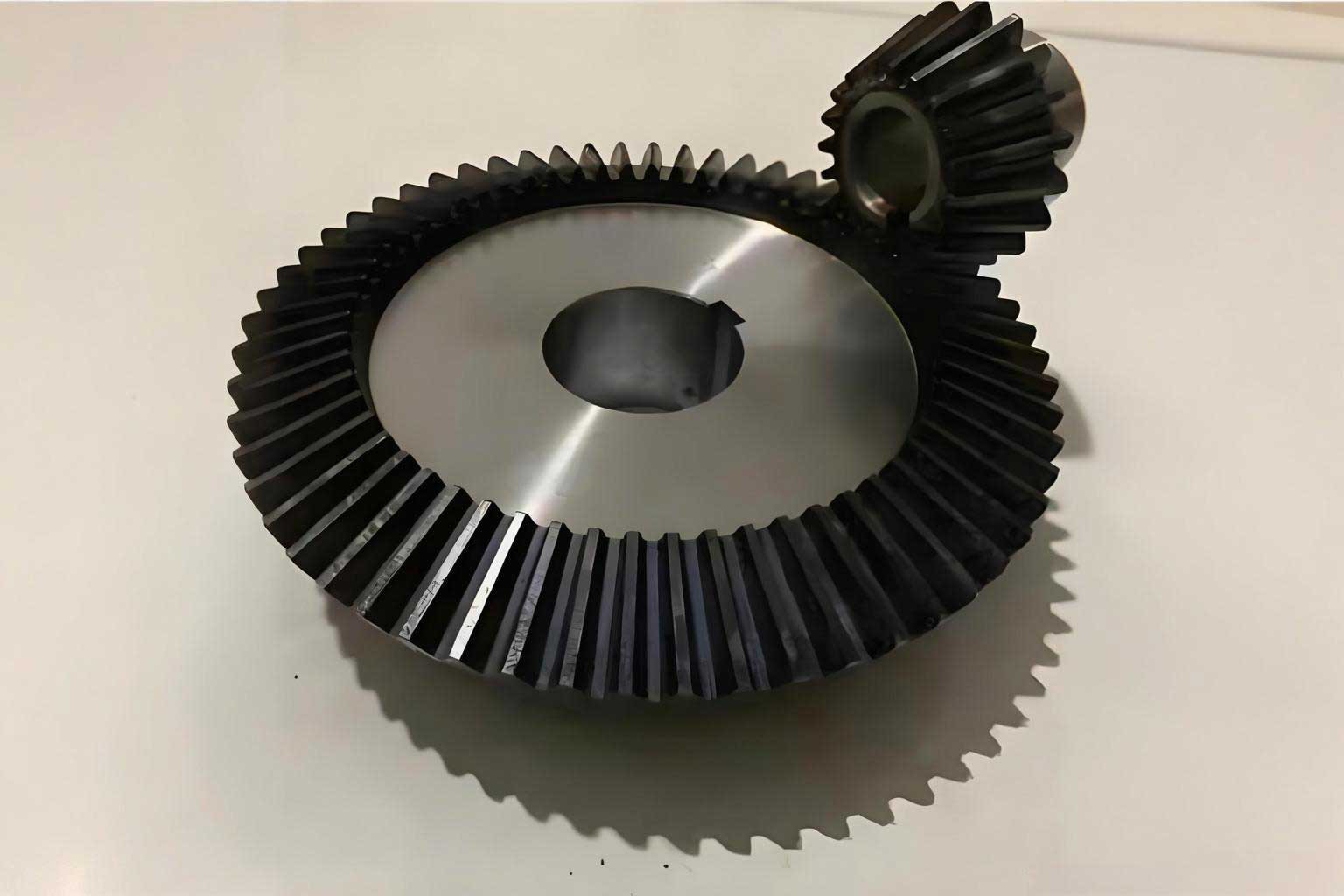
The dynamic excitation stems from the fluctuating mesh force. The relative displacement along the line of action, $\lambda$, which is crucial for defining the backlash function, is given by:
$$
\lambda = a_1(x_1 – x_2) – a_2(y_1 – y_2) – a_3(z_1 – z_2) – e_n(\tau)
$$
where $a_1 = \cos\delta_1 \sin\alpha_n$, $a_2 = \cos\delta_1 \cos\alpha_n$, $a_3 = \cos\alpha_n$, $x_i, y_i, z_i$ are dimensionless displacements, and $e_n(\tau)$ is the static transmission error. The backlash function $f(\lambda, b)$ is defined as:
$$
f(\lambda, b) =
\begin{cases}
\lambda – b, & \lambda > b \\
0, & |\lambda| \le b \\
\lambda + b, & \lambda < -b
\end{cases}
$$
where $b$ is the dimensionless half-backlash. Applying Newton’s second law and introducing dimensionless parameters yields the final set of governing equations:
$$
\begin{aligned}
&\ddot{x}_1 + 2\xi_{x1}\dot{x}_1 + 2a_4\xi_{h1}\dot{\lambda} + k_{x1}x_1 + a_4 k_{h1} f(\lambda) = 0 \\
&\ddot{y}_1 + 2\xi_{y1}\dot{y}_1 – 2a_5\xi_{h1}\dot{\lambda} + k_{y1}y_1 – a_5 k_{h1} f(\lambda) = 0 \\
&\ddot{z}_1 + 2\xi_{z1}\dot{z}_1 – 2a_3\xi_{h1}\dot{\lambda} + k_{z1}z_1 – a_3 k_{h1} f(\lambda) = 0 \\
&\ddot{x}_2 + 2\xi_{x2}\dot{x}_2 – 2a_4\xi_{h2}\dot{\lambda} + k_{x2}x_2 – a_4 k_{h2} f(\lambda) = 0 \\
&\ddot{y}_2 + 2\xi_{y2}\dot{y}_2 + 2a_5\xi_{h2}\dot{\lambda} + k_{y2}y_2 + a_5 k_{h2} f(\lambda) = 0 \\
&\ddot{z}_2 + 2\xi_{z2}\dot{z}_2 + 2a_3\xi_{h2}\dot{\lambda} + k_{z2}z_2 + a_3 k_{h2} f(\lambda) = 0 \\
&-a_1\ddot{x}_1 + a_2\ddot{y}_1 + a_3\ddot{z}_1 + a_1\ddot{x}_2 – a_2\ddot{y}_2 – a_3\ddot{z}_2 + \ddot{\lambda} + 2a_3\xi_h\dot{\lambda} + a_3 k_h f(\lambda) = f_{pm} + f_{pv} + f_e\Omega^2 \cos(\Omega\tau)
\end{aligned}
$$
Here, $\xi$ terms are damping ratios, $k$ terms are stiffness coefficients, $\Omega$ is the dimensionless meshing frequency ratio (the primary bifurcation parameter), and $f_{pm}, f_{pv}, f_e$ represent constant load, variable load, and error excitation amplitudes, respectively. The time-varying mesh stiffness $k_h(\tau)$ is expressed as:
$$
k_h(\tau) = 1 + \sum_{l=1}^{N} \frac{\Lambda_{kl}}{k_m} \cos(l\Omega\tau + \varphi_{kl})
$$
2. Nonlinear Dynamic Response and Emergence of Chaos
I numerically integrated the equations of motion using the fourth-order Runge-Kutta method to explore the system’s long-term behavior. By varying the dimensionless frequency ratio $\Omega$ within the range [1.5, 1.7] under medium load conditions ($f_{pm}=0.5$), the bifurcation diagram of the pinion’s displacement $x_1$ was obtained. The analysis reveals a rich bifurcation scenario: the system originates from a period-1 motion, undergoes period-doubling bifurcations to a period-3 state, transitions into chaos via a Hopf bifurcation, and eventually reverts to a periodic motion. This confirms that the miter gear system is prone to chaotic oscillations under specific operational parameters.
For a specific parameter set at $\Omega = 1.64$, the system exhibits clear chaotic characteristics. The phase portrait shows a bounded, non-repeating, and non-periodic trajectory. The Poincaré section, sampled at the period of the mesh frequency, displays a scatter of points forming a complex, fractal-like structure rather than a finite set, which is a definitive signature of chaotic motion in the miter gear dynamics.
3. Controller Architecture: Fuzzy Neural Network Design
To control the identified chaos, I designed a model-free Fuzzy Neural Network (FNN) controller. The objective is to stabilize the chaotic trajectory onto a desired periodic orbit by applying minute perturbations $\Delta \Omega$ to the system’s accessible parameter, the frequency ratio $\Omega$. The FNN combines the linguistic reasoning of fuzzy logic with the learning capability of neural networks. Its structure consists of five layers:
1. Input Layer: Receives two inputs derived from the system’s Poincaré map: $d(k) = ||X(k) – X(k-1)||$ and $d(k-1) = ||X(k-1) – X(k-2)||$, where $X(k)$ is the state vector on the Poincaré section at the $k$-th impact. These Euclidean distances capture the local divergence behavior of the trajectory.
2. Fuzzification Layer: Each input is fuzzified using Gaussian membership functions. For each input $i$ ($i=1,2$), five fuzzy sets (Very Large, Large, Medium, Small, Very Small) are defined. The membership degree is calculated as:
$$
\mu_i^M = \exp\left(-\frac{||D – C_{iM}||^2}{b_{iM}^2}\right)
$$
where $C_{iM}$ and $b_{iM}$ are the center and width of the $M$-th membership function for the $i$-th input, respectively.
3. Rule Layer: This layer implements the fuzzy T-norm operation (product) to compute the firing strength of each rule:
$$
\alpha_M = \mu_1^{M_1} \cdot \mu_2^{M_2}
$$
where $M$ indexes the fuzzy rule combining sets $M_1$ and $M_2$.
4. Normalization Layer: The firing strengths are normalized:
$$
\bar{\alpha}_M = \frac{\alpha_M}{\sum_{j=1}^{R} \alpha_j}
$$
where $R$ is the total number of fuzzy rules (25 for a 5×5 rule base).
5. Output Layer: Produces the final control output (parameter perturbation) through a weighted sum of the normalized firing strengths:
$$
U(k) = \Delta \Omega(k) = \sum_{M=1}^{R} \bar{\alpha}_M \cdot w_M
$$
where $w_M$ are the consequent parameters (singleton weights) to be optimized. The control perturbation is bounded, $|U(k)| \leq u_{max}$, to ensure it remains a small parameter adjustment.
4. Parameter Optimization via Improved Particle Swarm Optimization
The performance of the FNN controller heavily depends on the optimal selection of its parameters: the membership function centers $C_{iM}$, widths $b_{iM}$, and the consequent weights $w_M$. Manually tuning these parameters is impractical. Therefore, I employed a metaheuristic algorithm for global optimization. The standard Particle Swarm Optimization (PSO) algorithm, while simple, suffers from premature convergence and a tendency to get trapped in local optima, especially for high-dimensional problems like tuning an FNN for a miter gear system. To overcome these limitations, I propose a significantly Improved PSO (IPSO) with the following enhancements:
1. Chaotic Initialization: The particle population is initialized using a Piecewise chaotic map to ensure a more uniform and diverse coverage of the search space, increasing the probability of locating the global optimum.
2. Adaptive Inertia Weight: A nonlinear, time-varying inertia weight $w$ is used to balance global exploration and local exploitation:
$$
w = (w_{max} – w_{min}) \cdot \tan\left(0.875 \cdot \left(1 – (t/T)^k\right)\right) + w_{min}
$$
where $t$ is the current iteration, $T$ is the maximum iteration, and $k$ is a control factor. This allows for broad exploration initially and focused refinement later.
3. Dynamic Learning Factors: The cognitive ($c_1$) and social ($c_2$) learning factors are made adaptive:
$$
c_1 = 2 \cdot \sin\left(\frac{\pi}{2} \cdot \left(1 – \frac{t}{T}\right)\right)^2, \quad c_2 = 2 \cdot \sin\left(\frac{\pi}{2} \cdot \frac{t}{T}\right)^2
$$
This strategy emphasizes individual particle experience ($c_1 > c_2$) early on for exploration and shifts emphasis to swarm knowledge ($c_2 > c_1$) later for convergence.
4. Lévy Flight with Dynamic Center Migration: To prevent stagnation and escape local optima, a position update strategy based on Lévy flights is introduced. Crucially, the flight is centered around the global best position $p_{gbest}$ instead of the worst, with dynamic weighting:
$$
p_{is}(t+1) = b_2 \cdot p_{is}(t) + b_1 \cdot p_{gbest} + 0.01 \cdot S_{Levy} \cdot (p_{is}(t) – p_{gbest})
$$
where $S_{Levy}$ is the step length drawn from a Lévy distribution, and $b_1$, $b_2$ are time-varying coefficients that shift the search focus from exploration to exploitation. The Lévy flight step is given by:
$$
S_{Levy} = \frac{\mu}{|\nu|^{1/\beta}}, \quad \mu \sim N(0, \sigma_\mu^2), \quad \nu \sim N(0,1)
$$
with $\sigma_\mu = \left( \frac{\Gamma(1+\beta)\sin(\pi\beta/2)}{\Gamma[(1+\beta)/2] \beta 2^{(\beta-1)/2}} \right)^{1/\beta}$ and $\beta=1.5$.
5. Hybrid Update Strategy: At each iteration, a Bernoulli-distributed random variable selects either the standard PSO velocity update (with adaptive $w$, $c_1$, $c_2$) or the Lévy flight update, introducing stochasticity and further improving exploration.
The optimization goal is to minimize an objective function that measures the controller’s performance. I defined the fitness function based on the error between the desired and actual distance between consecutive Poincaré points after control is applied:
$$
\text{Fitness}(P_i) = \sum_{k=1}^{L} |d^* – ||X(k) – X(k-1)|| |
$$
where $P_i$ represents the particle (i.e., the set of FNN parameters), $L$ is the length of the evaluation data sequence, and $d^*$ is the target distance (zero for a fixed point, indicating a period-1 orbit). The IPSO searches for the particle $P_i$ that minimizes this fitness, thereby yielding the optimal FNN parameters for the miter gear chaos controller.
5. Numerical Simulation and Control Results
To validate the efficacy of the proposed IPSO-FNN control strategy, I conducted numerical simulations on the 7-DOF miter gear model. The system was run without control until $k=200$ iterations to establish a fully developed chaotic state at $\Omega_0 = 1.64$. At this point, the IPSO-optimized FNN controller was activated. The controller’s parameters, optimized offline, are listed below for a control target of period-1 motion:
| Consequent Weights ($w$) | MF Widths ($b_{1M}, b_{2M}$) | MF Centers ($C_{1M}, C_{2M}$) |
|---|---|---|
| 3.6333, 0.3153, 2.5269, 0.0590, 0.1842 | (0.3362, -1.0568), (-1.1805, -0.3960), (-0.3753, 0.7872), (2.5240, 0.3347), (2.6771, 3.6370) | (3.2058, 0.3838), (3.0718, 2.4506), (3.2917, 0.0920), (0.3000, -0.2998), (-0.6434, 2.5122) |
The simulation results demonstrate successful control. The initially chaotic trajectory is rapidly stabilized onto a period-1 limit cycle. The phase portrait collapses to a single, smooth closed curve, and the Poincaré section condenses to a single point. The control perturbation $\Delta \Omega$ applied to the frequency ratio is small, typically within a few percent of the nominal value, confirming the feasibility of the method. Furthermore, the controller was also tested for stabilizing period-3 motion with equally successful results, showcasing its versatility in targeting different periodic orbits within the miter gear system’s dynamics.
6. Conclusion
I have developed and demonstrated an effective intelligent control strategy for suppressing chaotic vibrations in a nonlinear 7-degree-of-freedom miter gear transmission system. The approach centers on a Fuzzy Neural Network controller, whose parameters are globally optimized using a robust Improved Particle Swarm Optimization algorithm. The IPSA incorporates chaotic initialization, adaptive parameters, and a dynamic Lévy flight mechanism to overcome classic PSO limitations, ensuring efficient and reliable convergence to an optimal controller configuration. The FNN controller utilizes readily available state information (Poincaré map distances) to generate minimal, real-time perturbations to an accessible system parameter. Numerical simulations confirm that this IPSO-FNN framework can successfully transition the system from a chaotic state to a stable periodic motion, such as period-1 or period-3, without requiring explicit knowledge of the system’s equilibrium points or Jacobian matrices. This method provides a practical, model-free, and universally applicable solution for enhancing the dynamic stability and operational reliability of complex gear transmission systems, including the critical miter gear configurations, by actively mitigating harmful chaotic oscillations.