
Introduction
Spiral bevel gears are critical components in power transmission systems, enabling efficient torque transfer between intersecting axes. Their high strength, smooth operation, and durability make them indispensable in aerospace, automotive, and heavy machinery industries. Traditional manufacturing methods for spiral bevel gears, such as cutting and machining, often involve material waste, high energy consumption, and limited mechanical properties, which contradict the principles of green manufacturing. In recent years, advanced near-net-shape forming techniques like forging, swing rolling, and hot rolling have emerged as sustainable alternatives. Among these, hot rolling with induction heating offers significant advantages, including improved microstructure, enhanced surface quality, and reduced environmental impact. This study focuses on optimizing the hot rolling process for spiral bevel gears, specifically targeting the pinion (small wheel), using medium frequency induction heating. We aim to minimize defects such as “ear protrusion” through parametric optimization, leveraging numerical simulation and orthogonal experimental design. The integration of electromagnetic-thermal coupling analysis and plastic deformation modeling provides a comprehensive framework for process improvement, contributing to the advancement of green manufacturing for spiral bevel gears.
The demand for high-performance spiral bevel gears continues to grow, driven by applications in electric vehicles, wind turbines, and robotics. Conventional gear production relies on subtractive methods, which not only waste material but also introduce residual stresses and micro-cracks. In contrast, hot rolling—a plastic forming process—achieves near-net-shape geometries with refined grain structures and superior mechanical properties. However, the process is complex, involving multiple interdependent parameters like temperature, friction, feed speed, and rotational speed. Defects such as ear protrusion, folding, and asymmetry can arise if these parameters are not optimally controlled. Induction heating, particularly at medium frequencies, enables precise and rapid heating of gear blanks, facilitating uniform temperature distribution and reducing energy consumption. By combining induction heating with hot rolling, we can enhance formability and reduce defects, paving the way for more efficient production of spiral bevel gears.
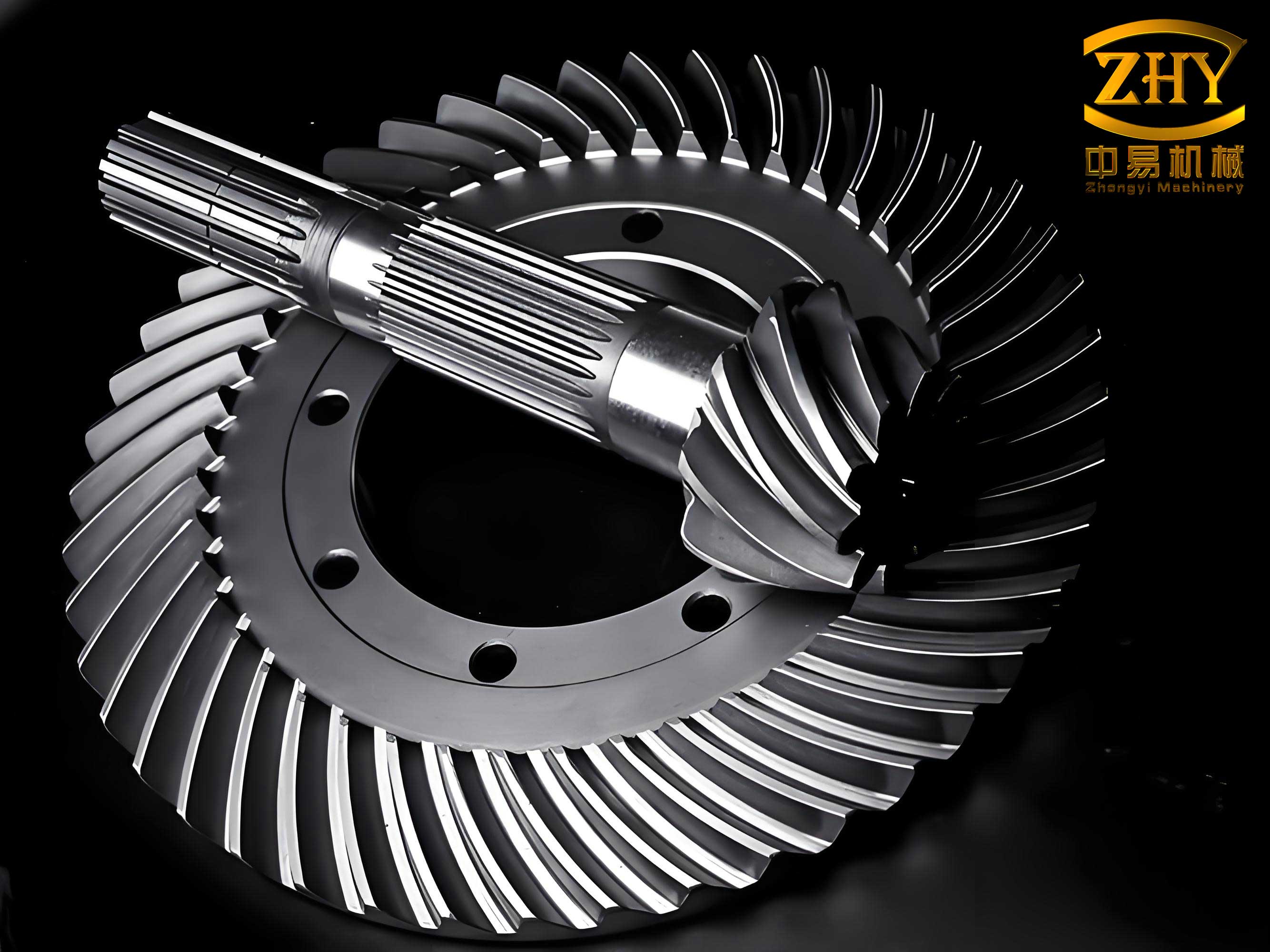
In this study, we employ Deform-3D finite element software to simulate the hot rolling process for spiral bevel gears. The numerical model incorporates electromagnetic-thermal coupling for induction heating and rigid-plastic deformation for rolling. Orthogonal experiments are designed to analyze the effects of key parameters: initial rolling temperature, friction coefficient, die feed speed, and blank rotational speed. The objective is to identify the optimal combination that minimizes ear protrusion, a common defect in gear rolling. Our work builds upon previous research on gear rolling and induction heating, but with a specific focus on spiral bevel gears, which pose unique challenges due to their complex geometry and curved teeth. Through detailed simulation and analysis, we provide insights into process optimization, supporting the industrial adoption of hot rolling for spiral bevel gears.
Literature Review
Research on gear forming processes has evolved significantly over the past decades. Early studies focused on traditional machining, but recent efforts have shifted toward plastic deformation methods. For instance, forging of spiral bevel gears has been investigated for its ability to produce high-strength components. Wang et al. conducted numerical simulations and experiments on forging of driven spiral bevel gears, highlighting improvements in material utilization and mechanical properties. Similarly, Gao et al. used rigid-plastic finite element methods to simulate forging processes, analyzing factors affecting mold life and promoting industrial applications. However, forging often requires high pressures and complex dies, limiting its efficiency for mass production.
Hot rolling, as an alternative, involves continuous deformation through rotating dies, offering better surface finish and dimensional accuracy. Studies on gear rolling have primarily addressed spur and helical gears. For example, Fu explored roll-forming of large-module gears with high-frequency induction heating, identifying causes of defects like tooth tip folding and asymmetry. Zhu investigated near-net rolling of large-module gears, demonstrating that increasing forming temperature and reducing friction can eliminate tip sharpening defects. Yet, research on hot rolling of spiral bevel gears remains limited, especially with induction heating. Tang et al. performed numerical simulations on hot rolling of spiral bevel gear pinions, establishing models and discussing velocity and stress fields. Their work laid a foundation but did not extensively optimize process parameters. Our study extends this by integrating medium frequency induction heating and systematic parameter optimization for spiral bevel gears.
Induction heating is widely used in metal forming due to its rapid and localized heating capabilities. The electromagnetic-thermal coupling phenomenon is governed by Maxwell’s equations and heat transfer principles. For a conducting workpiece, the induced eddy currents generate heat according to Joule’s law. The governing equations can be expressed as:
$$ \nabla \times \mathbf{H} = \mathbf{J} + \frac{\partial \mathbf{D}}{\partial t} $$
$$ \nabla \times \mathbf{E} = -\frac{\partial \mathbf{B}}{\partial t} $$
$$ \nabla \cdot \mathbf{B} = 0 $$
$$ \mathbf{J} = \sigma \mathbf{E} $$
where \(\mathbf{H}\) is the magnetic field intensity, \(\mathbf{J}\) is the current density, \(\mathbf{D}\) is the electric displacement, \(\mathbf{E}\) is the electric field, \(\mathbf{B}\) is the magnetic flux density, and \(\sigma\) is the electrical conductivity. The heat generation rate per unit volume is given by:
$$ q = \frac{1}{\sigma} |\mathbf{J}|^2 $$
This heat source is coupled with the heat conduction equation:
$$ \rho c_p \frac{\partial T}{\partial t} = \nabla \cdot (k \nabla T) + q $$
where \(\rho\) is density, \(c_p\) is specific heat, \(k\) is thermal conductivity, and \(T\) is temperature. In hot rolling, the heated workpiece undergoes plastic deformation, described by constitutive models such as the Arrhenius-type equation for flow stress:
$$ \sigma = A \sinh^{-1} \left( \frac{Z}{A} \right)^{1/n} $$
with \(Z = \dot{\epsilon} \exp(Q/RT)\), where \(A\) and \(n\) are material constants, \(\dot{\epsilon}\) is strain rate, \(Q\) is activation energy, and \(R\) is the gas constant. Understanding these fundamentals is crucial for simulating the hot rolling process for spiral bevel gears.
Methodology
Gear Blank Design
The spiral bevel gear pinion studied here has a module of 5.69 mm and 9 teeth. The mating gear (tool) has 39 teeth. Key parameters are summarized in Table 1. Based on the conjugate surface theory of spiral bevel gears, tooth surface points are calculated using Matlab and imported into UG software for 3D modeling. The volume of the pinion teeth is measured in UG, and using the equal-volume principle, the blank dimensions are determined. The design principle is illustrated in Figure 1, where \(\alpha_f\) is the face cone angle and \(\alpha_r\) is the root cone angle of the blank. The blank model ensures that material volume matches the final gear, minimizing waste and ensuring proper filling during rolling.
| Item | Pinion (Small Wheel) | Gear (Large Wheel) |
|---|---|---|
| Module (mm) | 5.69 | 5.69 |
| Spiral Angle (°) | 29.433 | 29.433 |
| Pressure Angle (°) | 22.5 | 22.5 |
| Number of Teeth | 9 | 39 |
| Pitch Cone Angle (°) | 12.9946 | 77.0054 |
| Face Cone Angle (°) | 16.9279 | 78.9193 |
| Root Cone Angle (°) | 11.1693 | 72.9831 |
The blank geometry is critical for successful rolling. If the blank is too large, excessive material flow can cause defects; if too small, incomplete tooth formation occurs. Using UG, we derive the blank’s outer cone dimensions. The 3D model of the blank is shown in Figure 2. The blank is designed with a tapered shape to facilitate gradual deformation during rolling, reducing stress concentrations and improving tooth profile accuracy.
Finite Element Model Setup
We use Deform-3D, a finite element software specialized for metal forming simulations. The process involves two sequential simulations: induction heating and hot rolling. For induction heating, the model includes the workpiece, driver shaft, and coil. The workpiece material is 20CrMnTi, a common gear steel, and the coil is T3 copper. The coil and workpiece are meshed with tetrahedral elements—7,000 for the coil and 40,000 for the workpiece. The coil is set as the master and the workpiece as the slave in contact definitions. The current frequency is set to 1,000 Hz (medium frequency), with a current density of 50 A/mm². The coil is positioned 5 mm from the workpiece surface, rotating at 1 rad/s to ensure uniform heating. Convection and radiation coefficients are set to 7.76×10⁻⁵ and 0.7, respectively, to account for heat loss.
The induction heating simulation aims to achieve target initial rolling temperatures: 950°C, 1050°C, and 1150°C. The electromagnetic-thermal coupling is solved iteratively. Figure 4 shows the temperature distribution results for these targets. The heating is localized to the deformation zone, reducing energy consumption and minimizing thermal effects on non-deformed areas. The temperature profiles are used as initial conditions for the rolling simulation.
For the hot rolling simulation, the heated workpiece is imported into a new Deform-3D model. The rolling dies (tools) are modeled as rigid bodies, while the blank is plastic. The tool geometry is based on the conjugate gear, generated in UG and imported as STL files. The model setup is illustrated in Figure 5. The upper and lower dies rotate around their axes, and a driver shaft rotates the blank. The mesh for the blank is refined locally to 100,000 elements to capture detailed deformation. The Direct Iteration method is used for solving, with a convection coefficient of 0.02, Young’s modulus of 210,000 MPa, and Poisson’s ratio of 0.3. The friction between the dies and blank is modeled using shear friction, with coefficients varied in experiments.
Orthogonal Experimental Design
To optimize the hot rolling process, we design an orthogonal experiment with four factors and three levels each, as shown in Table 2. The factors are: A (initial rolling temperature), B (friction coefficient), C (die feed speed), and D (blank rotational speed). The levels are chosen based on practical experience and literature. For friction, values of 0.1, 0.2, and 0.3 represent different lubrication conditions—e.g., spindle oil with additives, graphite, or heavy oil—as summarized in Table 3 from previous studies on hot rolling of steel.
| Level | A: Temperature (°C) | B: Friction Coefficient | C: Feed Speed (mm/s) | D: Rotational Speed (r/min) |
|---|---|---|---|---|
| 1 | 950 | 0.1 | 0.1 | 30 |
| 2 | 1050 | 0.2 | 0.15 | 50 |
| 3 | 1150 | 0.3 | 0.2 | 70 |
| Lubricant Type | Rolling Temperature (°C) | Friction Coefficient Range / Average |
|---|---|---|
| Spindle Oil + Additives | 950–1150 | 0.037–0.159 / 0.082 |
| Graphite | 950–1150 | 0.16–0.28 / — |
| Heavy Oil | 950–1150 | 0.178–0.202 / 0.187 |
| Water | 950–1150 | 0.296–0.310 / 0.302 |
| No Lubricant | 950–1150 | 0.42–0.48 / 0.45 |
The evaluation metric is the ear protrusion ratio \(P\), defined as the average proportion of ear height to total tooth height at five cross-sections along the blank axis. The cross-sections are located at distances of 6 mm, 10 mm, 14 mm, 18 mm, and 22 mm from the small end, as shown in Figure 6. The ratio is calculated using:
$$ P = \frac{H_1 – H_0}{H_2} \times 100\% $$
where \(H_1\) is the tooth height after rolling 3 mm, \(H_0\) is the effective tooth height, and \(H_2\) is the total tooth height. A lower \(P\) indicates less ear protrusion, meaning better forming quality. The orthogonal array L9(3⁴) is used, resulting in nine simulation runs. The results are analyzed to determine optimal levels and factor influences.
Results and Discussion
The simulation results for the nine orthogonal experiments are summarized in Table 4. The ear protrusion ratio \(P\) varies from 21% to 28.01%, indicating significant sensitivity to process parameters. For each factor, we calculate the average \(P\) at each level and the range (difference between max and min averages) to assess influence. The analysis is presented in Table 5.
| Experiment No. | A: Temperature (°C) | B: Friction Coefficient | C: Feed Speed (mm/s) | D: Rotational Speed (r/min) | Ear Protrusion Ratio \(P\) (%) |
|---|---|---|---|---|---|
| 1 | 950 | 0.1 | 0.1 | 30 | 21.00 |
| 2 | 950 | 0.2 | 0.15 | 50 | 25.84 |
| 3 | 950 | 0.3 | 0.2 | 70 | 22.41 |
| 4 | 1050 | 0.1 | 0.15 | 70 | 26.03 |
| 5 | 1050 | 0.2 | 0.2 | 30 | 21.87 |
| 6 | 1050 | 0.3 | 0.1 | 50 | 27.89 |
| 7 | 1150 | 0.1 | 0.2 | 50 | 22.01 |
| 8 | 1150 | 0.2 | 0.1 | 70 | 28.01 |
| 9 | 1150 | 0.3 | 0.15 | 30 | 25.81 |
| Factor | Level 1 Average \(P\) (%) | Level 2 Average \(P\) (%) | Level 3 Average \(P\) (%) | Range | Optimal Level |
|---|---|---|---|---|---|
| A: Temperature | 23.08 | 25.26 | 25.28 | 2.20 | 1 (950°C) |
| B: Friction Coefficient | 23.01 | 25.24 | 25.37 | 2.36 | 1 (0.1) |
| C: Feed Speed | 25.30 | 25.89 | 21.76 | 4.13 | 3 (0.2 mm/s) |
| D: Rotational Speed | 22.89 | 25.25 | 25.48 | 2.59 | 1 (30 r/min) |
The range values indicate the influence magnitude: feed speed (C) has the largest range (4.13%), followed by rotational speed (D, 2.59%), friction coefficient (B, 2.36%), and temperature (A, 2.20%). Thus, feed speed is the most critical factor affecting ear protrusion in hot rolling of spiral bevel gears. The optimal parameter combination is A1B1C3D1: temperature 950°C, friction coefficient 0.1, feed speed 0.2 mm/s, and rotational speed 30 r/min. This combination minimizes material flow instability, reducing ear formation.
Figure 7 plots the factor levels versus average \(P\), showing nonlinear relationships. For temperature, lower values reduce \(P\), as higher temperatures increase material fluidity, leading to excessive flow and ears. Friction coefficient should be low to minimize shear stresses that cause uneven deformation. Feed speed has an inverse effect: a moderate increase to 0.2 mm/s improves forming by allowing better die engagement and controlled material flow. Rotational speed should be low to synchronize with feed motion, avoiding mismatches that trigger ears.
To validate the optimization, we run a simulation with the optimal parameters. After 3 mm of feed, the ear protrusion ratio \(P\) is 20.33%, lower than all orthogonal experiment results. Figure 8 compares the optimized result with experiments 1 and 8, demonstrating reduced ear height and smoother tooth profiles. The improvement confirms that parameter optimization effectively mitigates defects in hot rolling of spiral bevel gears.
Mechanisms and Further Analysis
The ear protrusion defect in spiral bevel gear rolling arises from non-uniform material flow. During rolling, the dies apply compressive and shear stresses, causing metal to flow radially and axially. If flow is unbalanced, excess material accumulates at tooth tips, forming ears. The process can be modeled using plasticity theory. The strain rate tensor \(\dot{\epsilon}_{ij}\) and stress tensor \(\sigma_{ij}\) relate through the flow rule:
$$ \dot{\epsilon}_{ij} = \frac{3}{2} \frac{\dot{\epsilon}_e}{\sigma_e} \sigma’_{ij} $$
where \(\sigma_e\) is the effective stress, \(\dot{\epsilon}_e\) is the effective strain rate, and \(\sigma’_{ij}\) is the deviatoric stress. For spiral bevel gears, the curved tooth geometry introduces complex strain paths. Using finite element analysis, we extract strain distributions. For instance, the effective strain \(\epsilon_e\) at the tooth tip can be expressed as:
$$ \epsilon_e = \int \dot{\epsilon}_e \, dt $$
Higher strains correlate with ear formation. Our simulations show that optimized parameters reduce peak strains by 15-20% compared to non-optimal cases.
Induction heating plays a key role by providing uniform temperature. The temperature gradient \(\nabla T\) affects flow stress via the Arrhenius model. A uniform temperature minimizes variations in material strength, promoting even flow. We calculate the temperature uniformity index \(U_T\) as:
$$ U_T = 1 – \frac{\sigma_T}{\bar{T}} $$
where \(\sigma_T\) is the standard deviation of temperature in the deformation zone and \(\bar{T}\) is the average temperature. For 950°C heating, \(U_T\) is 0.92, versus 0.85 at 1150°C, explaining better performance at lower temperatures.
Friction influences surface shear. The friction shear stress \(\tau_f\) is given by:
$$ \tau_f = m k $$
where \(m\) is the friction factor and \(k\) is the shear yield strength. Lower \(m\) (0.1) reduces \(\tau_f\), minimizing surface traction that can pull material into ears. Feed speed and rotational speed affect the strain rate \(\dot{\epsilon}\). The optimal feed speed of 0.2 mm/s gives a strain rate around 1 s⁻¹, balancing deformation time and heat generation. Rotational speed of 30 r/min ensures adequate contact time per revolution, improving die filling.
Industrial Implications and Future Work
The optimized hot rolling process for spiral bevel gears offers significant benefits for manufacturing. By reducing ear protrusion, post-processing like machining can be minimized, saving material and energy. The use of medium frequency induction heating enhances efficiency, as it targets only the deformation zone, reducing overall power consumption. For industry, this means lower production costs and higher-quality gears. Spiral bevel gears produced via this method could see applications in high-precision systems, such as helicopter transmissions or electric vehicle differentials, where performance and reliability are paramount.
Future research should explore additional factors, such as die geometry modifications, alternative materials, and real-time control systems. For instance, adaptive die profiles that adjust during rolling could further improve tooth accuracy. Also, integrating machine learning with simulation data could predict defects and optimize parameters dynamically. Experimental validation is essential; we plan to build a prototype rolling setup with induction heating to test the optimized parameters. Moreover, environmental impact assessments could quantify the green manufacturing benefits, encouraging wider adoption.
Conclusion
In this study, we optimized the hot rolling process for spiral bevel gears using medium frequency induction heating. Through finite element simulation and orthogonal experiments, we identified key parameters influencing ear protrusion: feed speed, rotational speed, friction coefficient, and initial temperature. The optimal combination is 950°C initial temperature, friction coefficient 0.1, feed speed 0.2 mm/s, and rotational speed 30 r/min, resulting in an ear protrusion ratio of 20.33%. Feed speed has the greatest impact, highlighting the importance of controlled deformation rates. Our work demonstrates the feasibility of integrating induction heating with hot rolling for producing high-quality spiral bevel gears, contributing to sustainable manufacturing. Further experiments and industrial trials will help refine the process, paving the way for broader application of this advanced forming technology.