
As an essential component in precision motion control, the harmonic drive gear has revolutionized transmission systems with its unique operating principle. My focus in this investigation is on a critical phase of its lifecycle: the assembly process where the wave generator is inserted into the flexspline. This initial forced deformation is fundamental, setting the stage for the gear’s subsequent meshing characteristics, load distribution, and ultimately, its fatigue life. The primary failure mode for these gears is fatigue fracture of the flexspline, often initiating at the stress-concentrated junction between the gear teeth region (spline) and the cylindrical cup body. Therefore, a deep understanding of the stress and strain states induced during assembly is paramount for any design optimization aimed at enhancing durability and performance. This article details a comprehensive finite element analysis (FEA) using ABAQUS to simulate this assembly process, providing detailed insights into the deformation mechanics and stress evolution within the flexspline component of the harmonic drive gear.
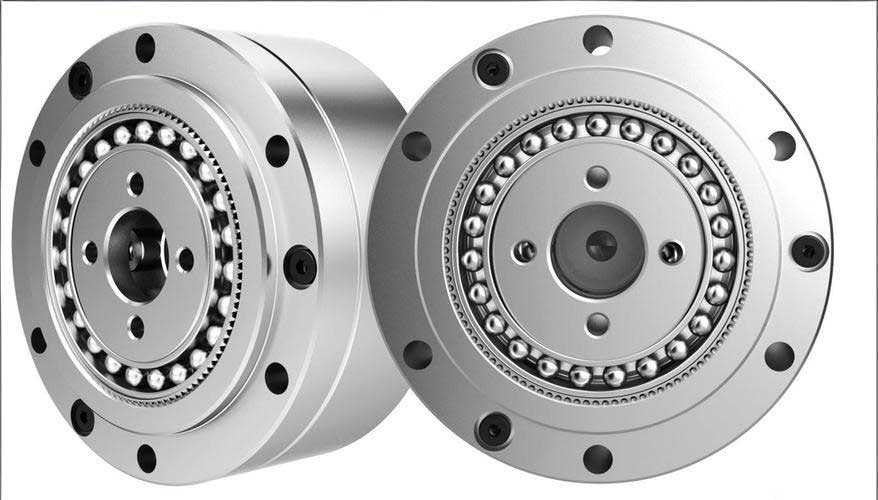
The exceptional advantages of the harmonic drive gear, such as high reduction ratios in a compact package, zero-backlash operation, and high positional accuracy, make it indispensable in fields like aerospace robotics, satellite positioning mechanisms, and precision industrial automation. However, these advantages come with the challenge of managing high cyclic stresses within the elastic metallic flexspline. The assembly process, where the elliptical wave generator deforms the initially circular flexspline into an elliptical shape, subjects the flexspline to significant pre-stress. This analysis serves as the foundational step to decode the motion law and stress characteristics of the harmonic drive gear, preceding any dynamic or loaded analysis. The goal is to create a validated simulation model that can predict stress concentrations and deformation patterns, thereby offering a theoretical reference for structural optimization of the flexspline to mitigate fatigue risks.
Geometrical Modeling and Theoretical Foundation
The first step in this finite element analysis of the harmonic drive gear assembly involved creating accurate three-dimensional models. For efficiency and computational tractability, certain simplifications were employed without sacrificing critical mechanical fidelity. The most significant simplification concerns the gear teeth on the flexspline’s open end. Modeling each individual tooth with high precision is computationally prohibitive for a nonlinear, contact-driven assembly analysis. Therefore, the toothed region was equivalently represented as a thickened ring. The equivalent thickness \(\delta_f\) is derived from the smooth cup wall thickness \(\delta\) using an established empirical formula, validated by prior research to yield results with negligible deviation from detailed tooth models. The formula used is:
$$ \delta_f = \sqrt[3]{1.67} \cdot \delta $$
This approach allows the analysis to focus on the global deformation and stress in the cup body and the critical tooth-spline junction. The key parameters for the modeled harmonic drive gear flexspline are summarized in the table below:
| Component | Parameter | Value (mm) |
|---|---|---|
| Flexspline | Inner Diameter of Cup | 76.7 |
| Cup Wall Thickness (\(\delta\)) | 0.8 | |
| Equivalent Spline Thickness (\(\delta_f\)) | ~0.96 | |
| Cup Height | 80.0 | |
| Fillet Radius at Cup Bottom | 6.0 | |
| Fillet Radius at Spline-Cup Junction | 1.4 | |
| Wave Generator | Elliptical Profile Major Axis (2a) | 77.50 |
| Elliptical Profile Minor Axis (2b) | 75.90 | |
| Width | 20.0 |
The wave generator is modeled as a solid ring with an outer elliptical profile and an inner circular bore. Its profile dictates the initial deformed shape of the flexspline. For a wave generator with a standard elliptical cam, the inner surface of the unloaded flexspline is forced to conform to the ellipse’s outer equidistant curve. To establish the theoretical foundation, a coordinate system is defined with the origin at the cam center, the x-axis along the minor axis, and the y-axis along the major axis. Let \(a\) and \(b\) be the semi-major and semi-minor axes, and \(e\) be the radial offset equal to the flexspline wall thickness. The parametric equations for this equidistant curve (the neutral surface of the deformed flexspline) are:
$$
\begin{aligned}
x_e &= b \sin\alpha + e \frac{a \sin\alpha}{\sqrt{a^2 \cos^2\alpha + b^2 \sin^2\alpha}} \\[6pt]
y_e &= a \cos\alpha + e \frac{b \cos\alpha}{\sqrt{a^2 \cos^2\alpha + b^2 \sin^2\alpha}}
\end{aligned}
$$
where \(\alpha\) is the parameter. Converting to polar coordinates \(\rho_e = \sqrt{x_e^2 + y_e^2}\) and \(\phi_e = \arctan(x_e / y_e)\) provides a more direct representation of the deformation:
$$
\begin{aligned}
\rho_e(\alpha) &= \sqrt{b^2 \sin^2\alpha + a^2 \cos^2\alpha + e^2 + \frac{2abe}{\sqrt{a^2 \sin^2\alpha + b^2 \cos^2\alpha}}} \\[6pt]
\phi_e(\alpha) &= \arctan\left( \frac{b \sin\alpha \sqrt{a^2 \sin^2\alpha + b^2 \cos^2\alpha} + e a \sin\alpha}{a \cos\alpha \sqrt{a^2 \sin^2\alpha + b^2 \cos^2\alpha} + e b \cos\alpha} \right)
\end{aligned}
$$
The radial displacement \(\omega\) of any point on the initially circular flexspline (radius \(R\)) is then given by:
$$ \omega(\phi) = \rho_e(\alpha) – R $$
Assuming the neutral surface of the flexspline does not elongate during this initial assembly (a valid assumption for thin-walled structures under bending-dominated deformation), the final relationship between the angular position \(\phi\) on the deformed flexspline and the parameter \(\alpha\) is defined by an integral enforcing constant arc length:
$$ \phi = \frac{1}{R} \int_{0}^{\alpha} \left( \sqrt{a^2 \sin^2 \xi + b^2 \cos^2 \xi} + \frac{eab}{a^2 \sin^2 \xi + b^2 \cos^2 \xi} \right) d\xi $$
These equations describe the precise theoretical deformation of the harmonic drive gear flexspline under the influence of the elliptical wave generator, forming the benchmark for validating the finite element results.
Finite Element Model Setup in ABAQUS
With the geometry defined, the next phase involved constructing a robust finite element model within ABAQUS/Standard to simulate the quasi-static assembly process. This setup encompasses material definition, meshing strategy, interaction modeling, boundary conditions, and analysis steps.
The flexspline material is a high-strength alloy steel, 35CrMnSiA, commonly used in such applications due to its excellent fatigue strength and toughness. It was modeled as an isotropic, linear elastic material for the assembly simulation, as the stresses should remain within the proportional limit. The key material properties are:
| Property | Symbol | Value | Unit |
|---|---|---|---|
| Density | \(\rho\) | 7.85E-09 | Ton/mm³ |
| Young’s Modulus | \(E\) | 2.09E+05 | MPa |
| Poisson’s Ratio | \(\nu\) | 0.295 | – |
A critical decision in meshing was to use predominantly hexahedral elements (C3D8R – 8-node linear brick with reduced integration) due to their superior performance in bending and contact problems. Wedge elements (C3D6) were used only in transitional zones. Special attention was paid to regions of high-stress gradients, particularly the fillets at the cup bottom and the spline-cup junction. These areas were partitioned and seeded with a finer mesh to capture stress concentrations accurately. The wave generator was also meshed with solid elements rather than being defined as an analytical rigid body. This allows for the simulation of minor elastic deformation in the generator’s outer ring, which can slightly influence the contact pressure distribution on the flexspline and increase analysis fidelity for the harmonic drive gear assembly.
| Component | Element Type | Primary Strategy | Special Treatment |
|---|---|---|---|
| Flexspline Cup & Body | C3D8R | Structured Sweep Mesh | N/A |
| Fillet Regions | C3D8R & C3D6 | Local Partitioning | Enhanced Local Seed Density |
| Wave Generator | C3D8R | Free Mesh | N/A |
The boundary conditions were applied to replicate the physical assembly fixture. The flange or mounting end of the flexspline (the closed end of the cup) was fully fixed (\(U1=U2=U3=UR1=UR2=UR3=0\)), simulating it being clamped in a rigid fixture. A reference point (RP) was coupled to the inner surface of the wave generator’s bore, representing the shaft on which it is mounted. All loads and motions were applied to this RP.
The interaction between the outer elliptical surface of the wave generator and the inner cylindrical surface of the flexspline is the driver of the deformation. A surface-to-surface contact pair was defined. The “Hard” contact property was assigned in the normal direction, preventing penetration. In the tangential direction, a “Frictionless” property was initially assumed to simplify the nonlinear convergence for the assembly step, focusing on the deformation-induced stresses rather than frictional effects.
The analysis was divided into three distinct steps to control the simulation sequence:
| Step Name | Type | Description | Boundary Condition at RP |
|---|---|---|---|
| Initial | – | Establish contact & small adjustment | Fully Fixed |
| Assembly_Insertion | Static, General | Wave generator moves radially into flexspline | Prescribed displacement in Y-direction to achieve full engagement |
| Assembly_Rotation | Static, General | Wave generator rotates 360° within the seated flexspline | Prescribed rotation (UR3) of 360° |
Analysis Results and Discussion
Solving the model in ABAQUS produced comprehensive data on the deformation, stress, and strain fields throughout the assembly process of the harmonic drive gear. The results confirm several critical aspects of flexspline behavior.
Upon complete insertion of the wave generator (end of Step 2), the flexspline adopts a distinctly elliptical shape. The contour plot of von Mises stress reveals a highly symmetrical and characteristic distribution. The maximum stress is not at the tips of the major or minor axis on the spline but is concentrated at the filleted transition region connecting the gear spline to the cylindrical cup body. This location aligns perfectly with the typical site of fatigue crack initiation observed in failed harmonic drive gear flexsplines. At the major axis position, this stress concentration reaches approximately 220 MPa, while at the minor axis position, it is about 117 MPa. The lower stress on the minor axis is expected due to the smaller radial displacement. The spatial displacement field shows that radial deformation is greatest at the open end along the major axis and gradually diminishes along the generator lines toward the fixed closed end, creating a tapered deformation profile.
To understand the temporal evolution of stress during assembly, history outputs were extracted for three representative elements located at the critical spline-cup junction: one near the open end (Top), one at the mid-height (Middle), and one closer to the fixed end (Bottom). The plot of von Mises stress versus time (or analysis step progression) is telling. All three elements show a monotonic increase in stress during the radial insertion of the wave generator (Step 2). The element at the Bottom location experiences the highest final stress, consistent with the contour plot identifying the fillet region as the peak. The curves are not perfectly smooth; they exhibit minor oscillations or “ripples.” These are attributed to the dynamic contact adjustments and slight numerical instabilities as the wave generator’s elliptical profile progressively engages the flexspline’s inner wall—a simulation of the real-world assembly impact effects. During the subsequent rotation step (Step 3), the stress in these elements undergoes a full cyclic variation. For instance, an element initially at the major axis will see its stress drop as it rotates toward the minor axis and then rise again, completing one full stress cycle per 180° of wave generator rotation (due to the two-lobe ellipse). This directly illustrates the high-cycle fatigue loading environment inherent to the harmonic drive gear operation.
The following table summarizes the key stress findings from the assembly analysis (Step 2 completion):
| Metric | Location | Value (MPa) | Implication |
|---|---|---|---|
| Max. Von Mises Stress | Major-Axis Spline-Cup Fillet | ~220 | Primary site for fatigue crack initiation. |
| Stress at Minor Axis | Minor-Axis Spline-Cup Fillet | ~117 | Secondary stress concentration zone. |
| Stress State | Major Axis Open End | High Bending + Membrane | Large radial displacement leads to combined loading. |
Comparing the FEA-predicted radial displacement \(\omega_{FEA}(\phi)\) around the circumference at the open end with the theoretical displacement \(\omega_{theory}(\phi)\) calculated from the equidistant curve equations shows excellent agreement. The minor deviations are within 1-2%, primarily due to the simplified boundary condition at the fixed end and the discrete nature of the finite element solution. This validation confirms that the model accurately captures the fundamental kinematics of the harmonic drive gear assembly.
Conclusions and Implications for Design Optimization
This detailed finite element analysis of the harmonic drive gear flexspline assembly process has successfully illuminated the critical stress and deformation states that define the initial operating condition of the gear. The simulation, grounded in theoretical deformation curves and executed with careful attention to contact nonlinearities, provides a reliable digital twin for this complex mechanical event.
The primary conclusion is that the most critical region in the flexspline under assembly pre-stress is the filleted transition zone between the gear spline and the cup body, not the point of maximum radial displacement at the open end. The stress concentration factor here is significant and is the root cause of the typical 45° fatigue cracks observed in practice. Furthermore, the analysis clearly traces the evolution of stress from initial contact to full engagement, highlighting the dynamic nature of the assembly process itself.
These findings directly suggest pathways for structural optimization of the harmonic drive gear flexspline to enhance its service life:
1. Fillet Geometry Optimization: The radius of the spline-cup junction fillet (\(r = 1.4\) mm in this model) is a key design parameter. Increasing this fillet radius (\(r_{opt} > r\)) would directly reduce the stress concentration factor. The relationship between fillet radius and peak stress \(\sigma_{peak}\) can be approximated for this geometry by a curve of the form:
$$ \sigma_{peak} \propto \frac{1}{\sqrt{r_{opt}}} $$
An optimization study can be performed using the established FEA model to find the largest feasible fillet radius that does not interfere with neighboring components or manufacturing constraints, thereby minimizing \(\sigma_{peak}\).
2. Spline and Cup Wall Thickness Profiling: The analysis shows a variation in stress along the axis. A constant wall thickness may not be optimal. Implementing a slight taper or variable thickness—where the wall is marginally thicker near the high-stress fillet region and tapers toward the open end—could create a more uniform stress distribution. This involves modifying the equivalent thickness parameter \(\delta_f(z)\) as a function of axial position \(z\).
3. Material Selection and Treatment: While 35CrMnSiA is common, the analysis provides quantitative stress data to evaluate other materials. The calculated assembly stress of ~220 MPa must be compared to the endurance limit of candidate materials after accounting for surface finish, mean stress (using Goodman or Gerber criteria), and required safety factors. The model enables virtual testing of different material properties (\(E, \nu, S_{ut}\)).
In summary, this work establishes a robust methodological foundation for analyzing the harmonic drive gear. The validated assembly model is the essential precursor to more advanced simulations, such as torque loading, dynamic meshing with actual tooth geometries, thermal effects, and full fatigue life prediction. By identifying and quantifying the stress concentrations arising from the very first stage of operation, this study provides actionable insights for engineers to design more durable and reliable harmonic drive gear systems, pushing the boundaries of their performance in demanding precision applications.