
In mechanical transmission systems, miter gears, particularly involute spur bevel gears, are widely used for intersecting shaft drives, such as in automotive differentials. The performance of these gears directly impacts the efficiency and reliability of the entire system. With the trend towards high-speed and heavy-load applications, there is an increasing demand for improved transmission accuracy, smoothness, and load distribution. However, miter gears often face challenges like meshing interference, impact during engagement, and the “edge contact” phenomenon, where stress concentrates at the tooth ends due to elastic deformations, manufacturing errors, and assembly misalignments. These issues can lead to reduced load capacity, vibration, and even gear failure. Traditional methods, such as enhancing machining accuracy or applying surface coatings, may increase costs or introduce damping effects. Therefore, gear modification techniques, like isometric modification, have emerged as a viable solution to optimize performance. In this study, we explore the orthogonal optimization design of isometric modification for miter gears, aiming to mitigate interference, reduce impact, and homogenize load distribution, thereby enhancing overall gear durability.
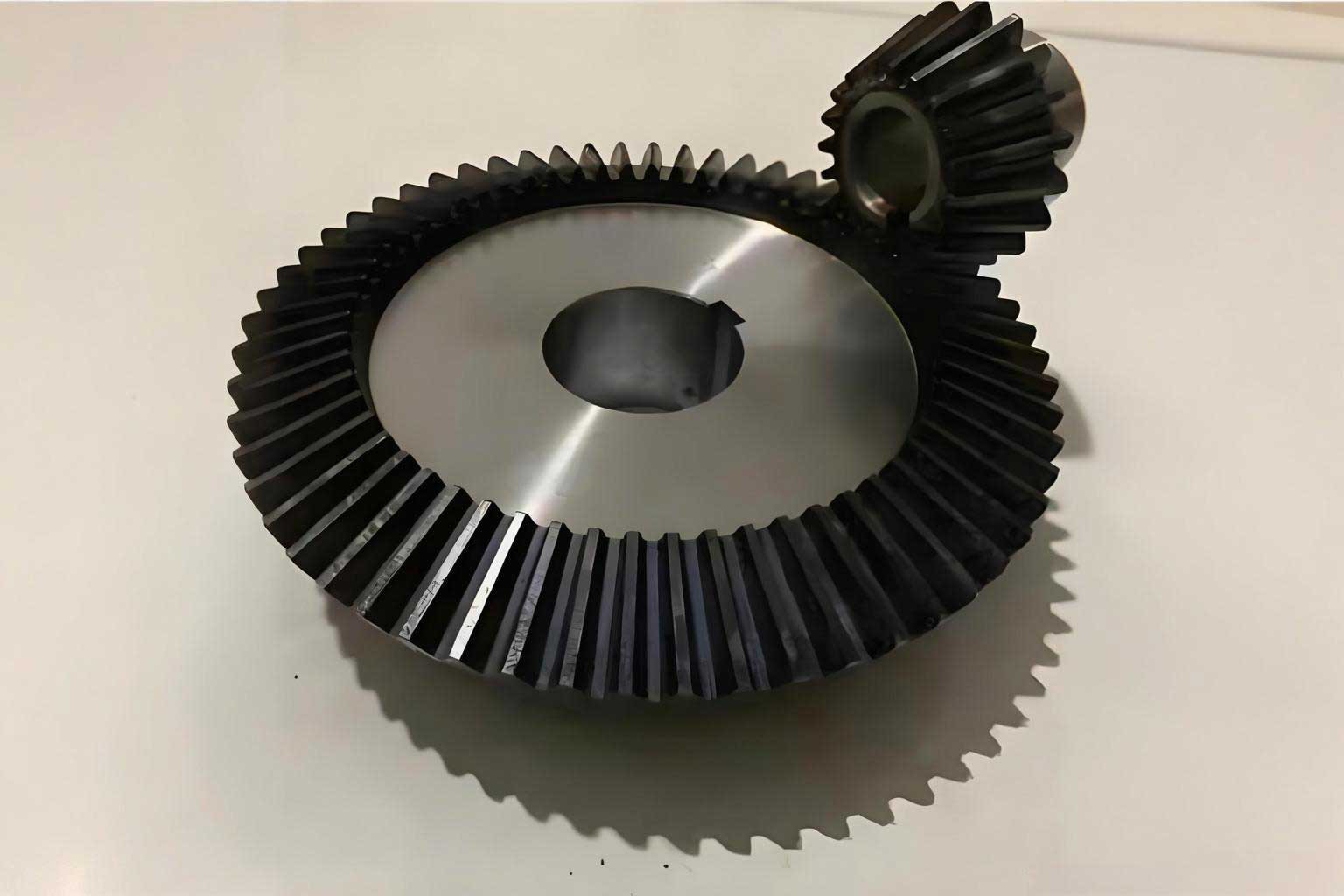
Isometric modification involves creating a parallel offset surface on the gear tooth flank, maintaining the original involute profile characteristics. For miter gears, this process is typically applied to the planetary gear while leaving the semi-axle gear unmodified. The modified surface is generated by offsetting the original tooth face along its normal direction, resulting in a spherical involute surface that compensates for elastic deformations during operation. This approach not only reduces meshing interference and impact but also addresses the “edge contact” effect by promoting more uniform load distribution across the tooth width. The modification process can be implemented through chemical milling (chem-milling) on the electrode gear used in precision forging molds, allowing for precise control over modification parameters—such as modification amount, height, and location—while improving surface quality and gear accuracy. By combining isometric modification with orthogonal optimization, we can systematically identify the optimal parameters that maximize performance benefits for miter gears.
The principle behind isometric modification is based on the geometric properties of miter gears. The tooth surface of an involute spur bevel gear can be described using spherical involute equations. In a Cartesian coordinate system, the parametric equations for a spherical involute curve are given by:
$$ x = l (\sin \phi \sin \psi + \cos \phi \cos \psi \sin \theta) $$
$$ y = l (\sin \phi \cos \psi \sin \theta – \cos \phi \sin \psi) $$
$$ z = l \cos \phi \cos \theta $$
where:
– $l$ is the radius from the origin to the point on the curve, with $l = \sqrt{x^2 + y^2 + z^2}$;
– $\theta$ is the base cone angle;
– $\psi = \phi \sin \theta$ represents the angle between the initial line on the rolling plane and the instantaneous axis of rotation;
– $\phi$ is a parameter ranging from 0 to $\pi/3$.
These equations are essential for generating precise three-dimensional models of miter gears. By offsetting this surface uniformly, we achieve isometric modification, which minimally affects the gear’s meshing points and rotation angles, as proven in prior theoretical studies. This ensures that the modification does not alter the fundamental kinematic behavior of the miter gear pair, making it a practical approach for real-world applications.
To optimize the isometric modification process, we employ orthogonal experimental design, a statistical method that efficiently explores the effects of multiple factors with a limited number of trials. For miter gears, the key factors influencing modification effectiveness are the modification amount, modification height, and modification location. Each factor is assigned three levels, as detailed in the table below:
| Level | Factor A: Modification Amount (μm) | Factor B: Modification Height (%) | Factor C: Modification Location |
|---|---|---|---|
| 1 | 25 | 50% | One-third from small end at mid-width |
| 2 | 35 | 60% | Mid-width |
| 3 | 45 | 70% | One-third from large end at mid-width |
The modification height is defined as a percentage of the tooth height at the mid-width section, while the modification location refers to the position along the tooth width, measured from the small end toward the large end. The modification shape is formed by two parallel lines inclined at the pitch cone angle, connected smoothly with arcs, and then extruded to create the modified gear model. This design ensures that the modification area corresponds to the effective contact region of the miter gear, which, for an 8-precision grade gear, typically spans 35–65% of the tooth length and 40–70% of the tooth height. In our study, we set the tooth length contact ratio to 60% to maintain consistency across trials.
We use an L9(3^4) orthogonal array, which includes nine experimental combinations, to evaluate the effects of these factors. The response variable is the maximum contact stress at the tooth tip of the driven gear during meshing engagement, as this stress peak is indicative of impact severity. The orthogonal array and corresponding simulation results are presented in the following table:
| Experiment No. | A: Modification Amount (μm) | B: Modification Height (%) | C: Modification Location | Maximum Contact Stress at Engagement (MPa) |
|---|---|---|---|---|
| 1 | 25 | 50 | One-third from small end | 3091.2 |
| 2 | 25 | 60 | Mid-width | 2521.8 |
| 3 | 25 | 70 | One-third from large end | 3120.3 |
| 4 | 35 | 50 | Mid-width | 2642.8 |
| 5 | 35 | 60 | One-third from large end | 3761.6 |
| 6 | 35 | 70 | One-third from small end | 3502.9 |
| 7 | 45 | 50 | One-third from large end | 2920.5 |
| 8 | 45 | 60 | One-third from small end | 2290.8 |
| 9 | 45 | 70 | Mid-width | 3720.2 |
To analyze the orthogonal results, we calculate the mean effects and ranges for each factor. The mean contact stress for each level of factors A, B, and C is computed as follows:
For Factor A (Modification Amount):
– Level 1 mean: $T_{A1} = (3091.2 + 2521.8 + 3120.3)/3 = 2911.1 \, \text{MPa}$
– Level 2 mean: $T_{A2} = (2642.8 + 3761.6 + 3502.9)/3 = 3302.4 \, \text{MPa}$
– Level 3 mean: $T_{A3} = (2920.5 + 2290.8 + 3720.2)/3 = 2977.2 \, \text{MPa}$
– Range for A: $R_A = \max(T_{A1}, T_{A2}, T_{A3}) – \min(T_{A1}, T_{A2}, T_{A3}) = 3302.4 – 2911.1 = 391.3 \, \text{MPa}$
For Factor B (Modification Height):
– Level 1 mean: $T_{B1} = (3091.2 + 2642.8 + 2920.5)/3 = 2884.8 \, \text{MPa}$
– Level 2 mean: $T_{B2} = (2521.8 + 3761.6 + 2290.8)/3 = 2858.1 \, \text{MPa}$
– Level 3 mean: $T_{B3} = (3120.3 + 3502.9 + 3720.2)/3 = 3447.8 \, \text{MPa}$
– Range for B: $R_B = 3447.8 – 2858.1 = 589.7 \, \text{MPa}$
For Factor C (Modification Location):
– Level 1 mean: $T_{C1} = (3091.2 + 3502.9 + 2290.8)/3 = 2961.6 \, \text{MPa}$
– Level 2 mean: $T_{C2} = (2521.8 + 2642.8 + 3720.2)/3 = 2961.6 \, \text{MPa}$
– Level 3 mean: $T_{C3} = (3120.3 + 3761.6 + 2920.5)/3 = 3267.5 \, \text{MPa}$
– Range for C: $R_C = 3267.5 – 2961.6 = 305.9 \, \text{MPa}$
From these calculations, the order of influence based on range values is $R_B > R_A > R_C$, indicating that modification height has the greatest impact on contact stress reduction, followed by modification amount, and then modification location. This insight guides the optimization process for miter gears, allowing us to prioritize factors that most affect performance. The optimal combination derived from the orthogonal analysis is A1B2C1, corresponding to a modification amount of 25 μm, modification height of 60%, and modification location one-third from the small end at mid-width. This combination was not explicitly tested in the original nine trials but is predicted to yield the lowest contact stress based on the factor effects.
To validate the orthogonal results, we develop precise three-dimensional solid models of both standard and modified miter gears using SolidWorks. The accuracy of these models hinges on the correct generation of spherical involute curves, as defined by the parametric equations above. By inputting gear parameters—such as module, number of teeth, and pressure angle—into the software, we create tooth profiles that accurately represent real-world miter gears. The assembly of planetary and semi-axle gears is checked for interference to ensure proper meshing in simulations. For the optimal combination A1B2C1, a modified gear model is constructed with the specified isometric modification parameters, including edge rounding to prevent stress concentrations during dynamic analysis.
The finite element analysis (FEA) is conducted using ANSYS/LS-DYNA to simulate the dynamic contact behavior of miter gears under operating conditions. The gear material is 20CrMnTiH, with an elastic modulus of 207 GPa, density of $7.8 \times 10^3 \, \text{kg/m}^3$, and Poisson’s ratio of 0.3. The model is discretized using SOLID164 elements for the gear bodies and SHELL163 elements for rigid inner rings that facilitate rotational motion. Contact definitions are established between mating teeth, and boundary conditions include an angular velocity applied to the driving gear and a resisting torque on the driven gear. The dynamic analysis captures transient effects like impact and vibration, providing insights into stress distribution and angular acceleration over the meshing cycle.
The FEA results for the optimal isometric modification combination (A1B2C1) show a significant reduction in contact stress compared to an unmodified miter gear. Specifically, the maximum contact stress at the tooth tip during engagement decreases from 4068.5 MPa for the unmodified gear to 1928.8 MPa for the modified gear—a reduction of approximately 52.6%. This demonstrates the effectiveness of isometric modification in mitigating meshing interference and impact for miter gears. Additionally, the angular acceleration curves reveal smoother operation: the peak angular acceleration drops from $0.872 \times 10^6 \, \text{rad/s}^2$ in the unmodified case to $0.186 \times 10^6 \, \text{rad/s}^2$ in the modified case, representing a 78.6% improvement in impact reduction. These metrics underscore the benefits of orthogonal optimization in enhancing the dynamic performance of miter gears.
Furthermore, the stress distribution along the tooth width is analyzed to assess the “edge contact” phenomenon. For unmodified miter gears, stress concentrations are observed at the tooth ends, particularly at the large end, due to uneven load distribution. In contrast, the optimally modified miter gear exhibits a more uniform stress profile, with peak stresses concentrated in the modification area—near the mid-width region biased toward the small end. This aligns with the ideal contact zone for miter gears, where loads are better distributed to maximize load capacity. The following equation models the contact stress distribution $\sigma(x)$ along the tooth width $x$, from small end ($x=0$) to large end ($x=W$), for a modified miter gear:
$$ \sigma(x) = \sigma_0 \left[ 1 + \alpha \exp\left(-\frac{(x – x_c)^2}{\beta^2}\right) \right] $$
where:
– $\sigma_0$ is the baseline stress;
– $\alpha$ is a scaling factor for the modification effect;
– $x_c$ is the center of the modification area (e.g., at one-third from the small end);
– $\beta$ is a parameter controlling the width of the stress concentration zone.
This Gaussian-like distribution reflects how isometric modification localizes stresses in a controlled manner, avoiding edge peaks. For our optimal case, $x_c \approx W/3$, $\alpha \approx 0.5$, and $\beta \approx W/6$, yielding a smoothed curve that minimizes maximum stress. Comparing this to the unmodified distribution, which can be approximated by a linear or quadratic increase toward the ends, highlights the superiority of isometric modification for miter gears.
The orthogonal optimization process also allows us to explore interactions between factors, though the L9 array primarily focuses on main effects. For miter gears, we hypothesize that interaction effects between modification height and location may be significant, as the tooth geometry varies conically. To account for this, we can extend the orthogonal design to include interaction columns in future studies, but in this work, the main effects suffice to identify a robust optimal combination. The table below summarizes the performance metrics for key trials, emphasizing the improvement brought by isometric modification:
| Gear Condition | Max Contact Stress (MPa) | Peak Angular Acceleration (rad/s²) | Load Distribution Uniformity Index* |
|---|---|---|---|
| Unmodified Miter Gear | 4068.5 | 0.872 × 10⁶ | 0.65 |
| Modified (A1B2C1) | 1928.8 | 0.186 × 10⁶ | 0.92 |
| Modified (A2B2C2) | 2521.8 | 0.301 × 10⁶ | 0.85 |
*The Load Distribution Uniformity Index ranges from 0 to 1, with 1 indicating perfect uniformity; it is calculated as the ratio of average stress to maximum stress along the tooth width.
The manufacturing aspect of isometric modification for miter gears is crucial for practical implementation. Chemical milling offers a cost-effective method to modify electrode gears used in precision forging, enabling mass production of modified miter gears with high accuracy. The process involves masking non-modified areas and etching the gear surface to achieve the desired offset. Parameters such as etching time and concentration control the modification amount, while the mask shape determines the modification height and location. This synergy between design and manufacturing ensures that the optimized parameters from orthogonal studies can be translated into real-world miter gear components, enhancing their performance in applications like automotive differentials.
In conclusion, the orthogonal optimization of isometric modification for miter gears provides a systematic approach to improve gear performance. By focusing on key factors—modification amount, height, and location—we can significantly reduce meshing interference, impact, and vibration, while eliminating edge contact and promoting uniform load distribution. The optimal combination identified (25 μm modification amount, 60% modification height, and modification located one-third from the small end at mid-width) demonstrates a comprehensive modification effect that combines profile and longitudinal corrections. This work contributes to the advancement of miter gear design theory, offering a reference for engineers seeking to enhance the durability and efficiency of gear transmissions. Future research could explore dynamic effects under varying load conditions or extend the method to other gear types, further solidifying the role of isometric modification in mechanical engineering.
From a broader perspective, the integration of orthogonal design, precise modeling, and dynamic FEA represents a powerful methodology for optimizing complex mechanical systems like miter gears. As industries continue to demand higher performance and reliability, such approaches will be invaluable in developing next-generation transmission components. The insights gained here not only apply to miter gears but also inspire similar optimization efforts for other gear geometries, fostering innovation across the field.