
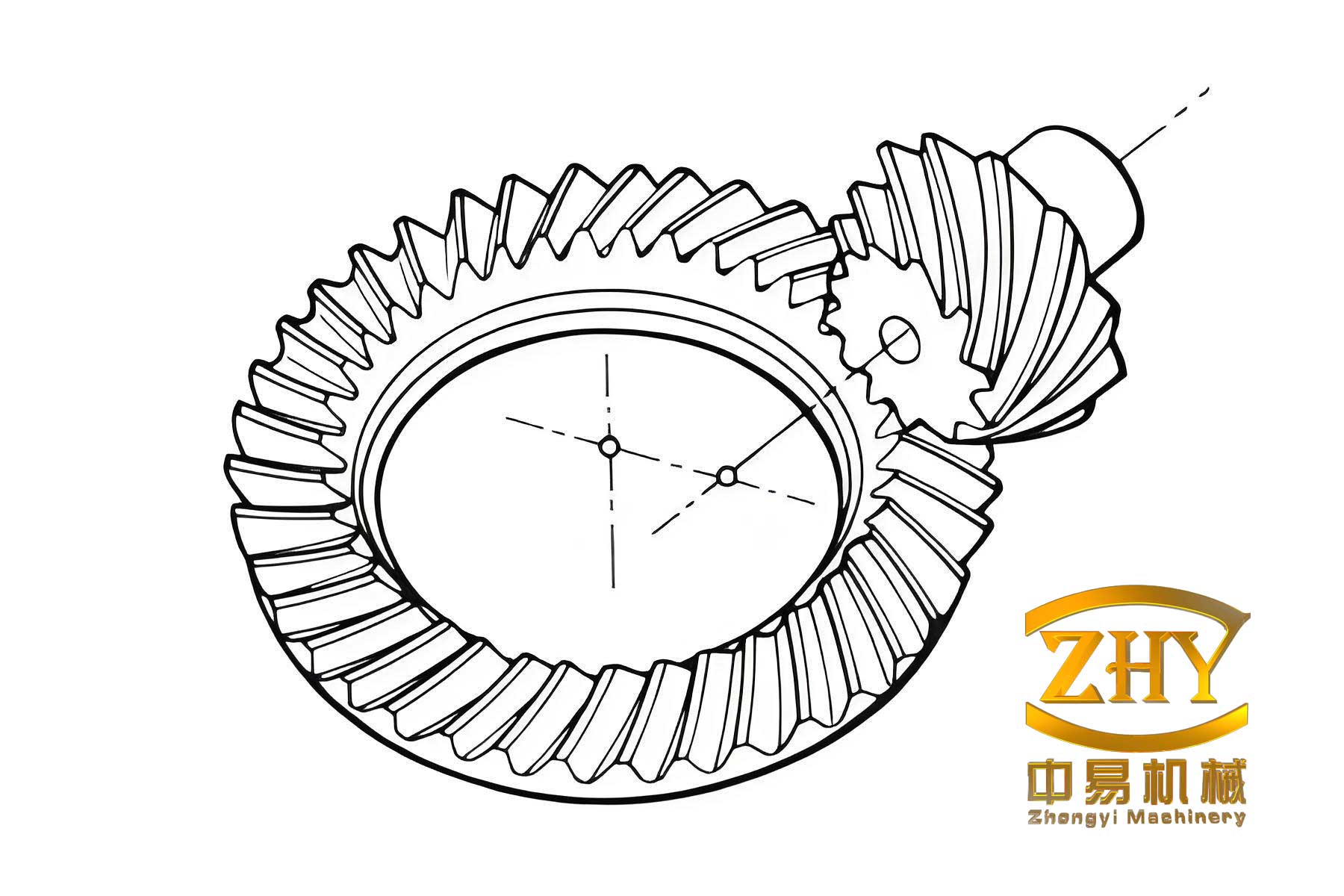
The transmission system incorporating hypoid gears represents a fundamental and widely adopted configuration in mechanical engineering. Characterized by significant overlap ratio, robust tolerance capabilities, high meshing stability, and the advantageous feature of offset installation, hypoid gears are extensively deployed across critical sectors including industrial robotics, automotive drivetrains, and aerospace applications. However, a persistent challenge in their application stems from the inevitable presence of assembly misalignments during the installation process. These misalignments can precipitate suboptimal contact conditions between meshing tooth flanks, leading to a cascade of detrimental effects such as diminished transmission efficiency, accelerated wear patterns, reduced operational lifespan, and elevated vibration and noise signatures. Consequently, investigating the influence of assembly errors on the contact behavior of hypoid gear pairs and developing design methodologies to mitigate the sensitivity of their performance to these errors is of paramount theoretical importance and practical engineering significance.
This work addresses this challenge by proposing a comprehensive design and optimization framework aimed at systematically reducing the sensitivity of hypoid gear contact characteristics to predefined assembly misalignments. The core of our methodology involves establishing a precise mapping between initial design parameters, the resulting tooth flank geometry, and the final meshing performance under error conditions. We employ advanced geometric modeling and sensitivity analysis to achieve a tooth flank design that maintains desirable contact patterns and low transmission error fluctuation even in the presence of typical installation inaccuracies.
1. Quantitative Evaluation of Contact Characteristics Under Misalignment
To objectively assess the performance of hypoid gears under imperfect assembly, a robust set of evaluation metrics must be defined. These metrics quantitatively capture the deviations in contact behavior induced by misalignments relative to the ideal, perfectly aligned condition. We consider four primary types of assembly errors as per industry standards: pinion axial offset $\Delta Z_p$, gear axial offset $\Delta X_g$, offset distance error $\Delta E$, and shaft angle error $\Delta \Sigma$.
We propose three key metrics to form our evaluation model:
1.1 Change in Contact Area ($\Delta S_{cp}$): The contact area on the tooth flank, approximated by the envelope of instantaneous contact ellipses, is a critical indicator of load distribution and carrying capacity. A large, stable contact area promotes uniform stress distribution and high durability. The change in this area due to misalignment is calculated as the difference between the area under misaligned conditions $S_{cp}^1$ and the ideal area $S_{cp}$:
$$
\Delta S_{cp} = S_{cp}^1 – S_{cp} = f_S(\Delta Z_p, \Delta X_g, \Delta E, \Delta \Sigma)
$$
A smaller absolute value of $\Delta S_{cp}$ indicates lower sensitivity of load distribution to assembly errors.
1.2 Shift of Contact Pattern Centroid ($\Delta x_{cp}, \Delta y_{cp}$): The location of the contact pattern on the tooth flank is crucial. An ideal pattern is centered to avoid edge-loading. The centroid coordinates $(x_{cp}, y_{cp})$ are calculated using an area-weighted average method. The shift due to misalignment is:
$$
\Delta x_{cp} = x_{cp}^1 – x_{cp} = f_x(\Delta Z_p, \Delta X_g, \Delta E, \Delta \Sigma)
$$
$$
\Delta y_{cp} = y_{cp}^1 – y_{cp} = f_y(\Delta Z_p, \Delta X_g, \Delta E, \Delta \Sigma)
$$
Minimizing this shift helps maintain a centered contact pattern and prevents detrimental edge contact.
1.3 Variation in Transmission Error Curve Amplitude ($\Delta TE$): Transmission Error (TE) is a primary excitation source for gear noise and vibration. A parabolic TE curve is often desired for its low noise characteristics. We focus on the change in the amplitude of the TE curve at its transition point (e.g., the peak of a parabolic curve) caused by misalignment:
$$
\Delta TE = TE^1 – TE = f_{TE}(\Delta Z_p, \Delta X_g, \Delta E, \Delta \Sigma)
$$
A smaller $\Delta TE$ signifies that the dynamic excitation of the hypoid gear pair is less affected by assembly inaccuracies.
2. Efficient Tooth Contact Analysis via NURBS Surface Representation
Accurately simulating the meshing of hypoid gears under misalignment requires solving complex sets of nonlinear equations derived from the condition of continuous tangency between the pinion and gear tooth surfaces. Traditional Tooth Contact Analysis (TCA) methods can be computationally intensive and sensitive to initial guesses. To enhance efficiency and robustness, we implement a TCA method based on a Non-Uniform Rational B-Spline (NURBS) representation of the pinion tooth flank.
The procedure begins with defining the pinion tooth surface via a manufacturing simulation based on the face-hobbing process. The surface is initially defined by a set of generation parameters $\mathbf{P}$ and is a function of surface parameters $(s_p, \theta_p)$ and the machine setting rotation $\phi_1$:
$$
\mathbf{r}_1 = \mathbf{r}_1(s_p, \theta_p, \phi_1; \mathbf{P})
$$
Directly using this parametrization in TCA is inefficient. Therefore, we fit a NURBS surface to a discrete point cloud sampled from $\mathbf{r}_1$. A NURBS surface offers a compact, parametric representation that is ideal for computational geometry operations:
$$
\mathbf{p}(u,v) = \frac{\sum_{i=0}^{m} \sum_{j=0}^{n} w_{i,j} \mathbf{d}_{i,j} N_{i,k}(u) N_{j,l}(v)}{\sum_{i=0}^{m} \sum_{j=0}^{n} w_{i,j} N_{i,k}(u) N_{j,l}(v)}
$$
where $\mathbf{d}_{i,j}$ are control points, $w_{i,j}$ are their associated weights, $N_{i,k}(u)$ and $N_{j,l}(v)$ are the B-spline basis functions of degrees $k$ and $l$, and $(u,v)$ are the new surface parameters conveniently aligned along the tooth length and profile directions. This re-parametrization reduces the complexity of subsequent contact calculations. The condition for contact between the pinion surface $\mathbf{p}(u,v)$ and the gear surface $\mathbf{g}(s_g, \theta_g)$ under misalignment $\mathbf{\Delta} = [\Delta Z_p, \Delta X_g, \Delta E, \Delta \Sigma]^T$ and respective rotations $\psi_1, \psi_2$ is given by the system:
$$
\begin{cases}
\mathbf{r}_{n1}^{(p)}(u, v, \psi_1, \mathbf{\Delta}) = \mathbf{r}_{n1}^{(g)}(s_g, \theta_g, \psi_2, \mathbf{\Delta}) \\[6pt]
\mathbf{n}_{n1}^{(p)}(u, v, \psi_1) = \mathbf{n}_{n1}^{(g)}(s_g, \theta_g, \psi_2)
\end{cases}
$$
This system of five scalar equations can be solved for $(u, v, s_g, \theta_g, \psi_2)$ as a function of $\psi_1$, yielding the path of contact and the transmission error $\Delta\psi_2(\psi_1)$. The contact ellipse dimensions at each point are derived from the relative surface curvatures.
3. Establishing the Design Chain: From Local Synthesis to Contact Response
To proactively control the meshing performance, we employ the local synthesis method at the design stage. This method allows for the pre-definition of contact characteristics at a chosen reference point on the tooth flank of the hypoid gears. The key local synthesis parameters are:
- $m’_{21}$: The first derivative of the gear ratio (related to the lengthwise curvature of the transmission error curve).
- $\eta_2$: The angle between the contact path and the tooth root line on the gear.
- $a$: The semi-major axis length of the instantaneous contact ellipse at the reference point.
These parameters $\mathbf{L} = [m’_{21}, \eta_2, a]^T$ directly influence the local tooth flank curvature. Through the principles of differential geometry and gear generation kinematics, a set of equations known as the “fundamental equations of meshing and contact” are solved. This process establishes a mathematical link between the desired local parameters $\mathbf{L}$ and the required machine-tool settings $\mathbf{M}$ (e.g., cutter geometry, machine angles, offsets) for manufacturing the pinion:
$$
\mathcal{F}(\mathbf{L}, \mathbf{M}) = 0
$$
The machine settings $\mathbf{M}$ uniquely determine the pinion tooth surface geometry $\mathbf{r}_1$, which after NURBS fitting becomes $\mathbf{p}(u,v; \mathbf{M})$. Finally, as described in Section 2, the TCA model computes the contact characteristics $\mathbf{C} = [\Delta S_{cp}, \Delta x_{cp}, \Delta y_{cp}, \Delta TE]^T$ for a given misalignment vector $\mathbf{\Delta}$.
Thus, we establish a complete chain: Local Synthesis Parameters ($\mathbf{L}$) $\rightarrow$ Machine Settings ($\mathbf{M}$) $\rightarrow\) Tooth Flank Geometry ($\mathbf{p}$) $\rightarrow\) Misalignment Response ($\mathbf{C}$). This chain allows us to treat $\mathbf{L}$ as the primary design variables for optimization.
4. Sensitivity Analysis and Formulation of the Optimization Problem
Before optimization, it is instructive to analyze how each type of assembly error affects the contact characteristics. By varying one error at a time within a realistic range (e.g., $\pm 0.1$ mm for linear errors, $\pm 0.1^\circ$ for angular error) and observing the change in metrics $\mathbf{C}$, we can gauge their individual influence. A typical sensitivity analysis for hypoid gears reveals the following trends:
| Contact Metric | Most Sensitive To | Remarks |
|---|---|---|
| $\Delta S_{cp}$ (Area Change) | $\Delta E$ (Offset) and $\Delta \Sigma$ (Angle) | Largest magnitude of change, critical for load capacity. |
| $\Delta TE$ (TE Amplitude Change) | $\Delta \Sigma$ (Angle) | Strongly affects dynamic excitation and noise. |
| $\Delta x_{cp}$ (Centroid X-Shift) | $\Delta E$ (Offset) and $\Delta Z_p$ (Pinion Axial) | Influences lengthwise positioning of contact. |
| $\Delta y_{cp}$ (Centroid Y-Shift) | $\Delta E$ (Offset) and $\Delta Z_p$ (Pinion Axial) | Influences profile-wise positioning of contact. |
This analysis indicates that the shaft angle error $\Delta \Sigma$ is particularly critical for the dynamic performance (TE) of hypoid gears, while the offset error $\Delta E$ broadly affects multiple metrics. These insights will inform the weighting of objectives in the optimization.
To create a single objective function, we first define a comprehensive sensitivity coefficient $C_k$ for each metric $k \in \{S, x, y, TE\}$. It is the sum of the absolute partial derivatives with respect to all normalized misalignment components, representing the total rate of change:
$$
C_S = \left| \frac{\partial f_S}{\partial \Delta Z_p} \right| + \left| \frac{\partial f_S}{\partial \Delta X_g} \right| + \left| \frac{\partial f_S}{\partial \Delta E} \right| + \left| \frac{\partial f_S}{\partial \Delta \Sigma’} \right|
$$
$$
C_x = \left| \frac{\partial f_x}{\partial \Delta Z_p} \right| + \left| \frac{\partial f_x}{\partial \Delta X_g} \right| + \left| \frac{\partial f_x}{\partial \Delta E} \right| + \left| \frac{\partial f_x}{\partial \Delta \Sigma’} \right|
$$
$$
C_y = \left| \frac{\partial f_y}{\partial \Delta Z_p} \right| + \left| \frac{\partial f_y}{\partial \Delta X_g} \right| + \left| \frac{\partial f_y}{\partial \Delta E} \right| + \left| \frac{\partial f_y}{\partial \Delta \Sigma’} \right|
$$
$$
C_{TE} = \left| \frac{\partial f_{TE}}{\partial \Delta Z_p} \right| + \left| \frac{\partial f_{TE}}{\partial \Delta X_g} \right| + \left| \frac{\partial f_{TE}}{\partial \Delta E} \right| + \left| \frac{\partial f_{TE}}{\partial \Delta \Sigma’} \right|
$$
where $\Delta \Sigma’$ is the angular error converted to an equivalent length at the gear pitch radius to ensure consistent units.
The overall sensitivity objective function $F$ is a weighted sum of these coefficients:
$$
F(m’_{21}, \eta_2, a) = w_S \cdot C_S + w_x \cdot C_x + w_y \cdot C_y + w_{TE} \cdot C_{TE}
$$
The weights $w_i$ are chosen based on the sensitivity analysis and design priorities (e.g., $w_S$ and $w_{TE}$ are often given higher values due to their strong impact on durability and noise). The optimization problem is then formulated as:
$$
\begin{aligned}
& \underset{m’_{21}, \eta_2, a}{\text{minimize}}
& & F(m’_{21}, \eta_2, a) = w_S C_S + w_x C_x + w_y C_y + w_{TE} C_{TE} \\
& \text{subject to}
& & m’_{21}^{min} \leq m’_{21} \leq m’_{21}^{max} \quad \text{(e.g., } m’_{21} < 0 \text{ for parabolic TE)}\\
& & & \eta_2^{min} \leq \eta_2 \leq \eta_2^{max} \quad \text{(e.g., } 20^\circ \leq \eta_2 \leq 50^\circ \text{)}\\
& & & a^{min} \leq a \leq a^{max} \quad \text{(e.g., } 0.15b_2 \leq a \leq 0.20b_2 \text{)}
\end{aligned}
$$
where the constraints ensure physically meaningful and manufacturable geometries for the hypoid gears.
5. Optimization Procedure and Comparative Results
We employ a Genetic Algorithm (GA) to solve the above optimization problem due to its ability to handle nonlinear, non-convex objective functions without requiring gradient information. The optimization loop integrates all previously described modules:
- Initialization: A population of candidate design vectors $\mathbf{L}_i = [m’_{21}^{(i)}, \eta_2^{(i)}, a^{(i)}]$ is generated within the specified bounds.
- Analysis: For each candidate $\mathbf{L}_i$:
- Compute the corresponding machine settings $\mathbf{M}_i$ via local synthesis.
- Generate the pinion tooth surface and fit the NURBS model.
- Perform TCA for the nominal (no misalignment) case and for several predefined misalignment scenarios $\mathbf{\Delta}_j$.
- Calculate the contact metrics $\mathbf{C}_{ij}$ for each misalignment scenario.
- Compute the sensitivity coefficients $C_S, C_x, C_y, C_{TE}$ and the aggregate objective value $F_i$.
- Evolution: The GA operators (selection, crossover, mutation) are applied to generate a new population based on the fitness scores ($F_i$).
- Termination: Steps 2-3 repeat until a maximum number of generations is reached, converging to an optimal set of local synthesis parameters $\mathbf{L}^*$.
To demonstrate the effectiveness of our method, we present results for a sample hypoid gear pair. Two distinct, representative misalignment conditions (Combination 1 and Combination 2) were used during optimization. The weights were set proportionally to the initial sensitivity coefficients. The table below compares the optimal local synthesis parameters found by the GA against a baseline design:
| Design Parameter | Baseline Design | Optimized for Comb. 1 | Optimized for Comb. 2 |
|---|---|---|---|
| $m’_{21}$ | -0.00199 | -0.00327 | -0.00475 |
| $\eta_2$ [deg] | 47.322 | 24.150 | 22.368 |
| $a$ [mm] | 4.089 | 4.658 | 4.571 |
The contact performance under misalignment for the baseline and optimized designs is summarized below. The percentage change relative to the nominal (no error) condition for each design is shown in parentheses, clearly illustrating the reduced sensitivity.
| Condition & Metric | Baseline (Nominal) | Baseline (With Misalignment) | Optimized (Nominal) | Optimized (With Misalignment) |
|---|---|---|---|---|
| Misalignment Combination 1 | ||||
| $S_{cp}$ [mm²] | 52.92 | 37.74 (-29%) | 72.15 | 60.87 (-16%) |
| $TE$ [arcsec] | 24.98 | 39.84 (+59%) | 41.06 | 40.40 (-2%) |
| Misalignment Combination 2 | ||||
| $S_{cp}$ [mm²] | 52.92 | 40.86 (-23%) | 70.29 | 60.09 (-14%) |
| $TE$ [arcsec] | 24.98 | 56.56 (+126%) | 39.36 | 47.58 (+21%) |
The results are conclusive. For both misalignment scenarios, the optimized hypoid gears exhibit significantly reduced sensitivity. The degradation in contact area $\Delta S_{cp}$ is markedly smaller (e.g., from -29% to -16% for Combination 1). Most strikingly, the fluctuation in transmission error amplitude $\Delta TE$ is drastically reduced (e.g., from +59% to -2% for Combination 1, and from +126% to +21% for Combination 2). This demonstrates that our optimization framework successfully tailors the tooth flank geometry of the hypoid gears to maintain more stable contact patterns and a more robust dynamic response in the presence of expected assembly variations.
6. Conclusion
This work presents a systematic methodology for the design of low-sensitivity hypoid gear pairs. By integrating local synthesis for proactive design control, efficient NURBS-based TCA for accurate performance simulation, and a sensitivity-driven multi-objective optimization, we establish a robust pipeline for improving the robustness of hypoid gears to assembly misalignments. The key findings and contributions are:
- A comprehensive evaluation model for hypoid gear contact under misalignment was established, incorporating area, location, and transmission error stability metrics.
- The computational chain linking local design intent ($m’_{21}, \eta_2, a$) to manufacturing parameters and finally to misalignment response was fully modeled, enabling optimization at the source.
- Sensitivity analysis confirmed that shaft angle and offset errors are the most critical misalignments affecting the contact behavior of hypoid gears, guiding the weighting of optimization objectives.
- The implementation of a Genetic Algorithm to minimize a composite sensitivity function yielded an optimized set of local synthesis parameters.
- Comparative analysis unequivocally showed that the optimized hypoid gear designs exhibit substantially reduced variation in contact area and, most importantly, transmission error amplitude under typical assembly errors. This leads to predictable contact patterns, maintained load capacity, and lower potential for noise and vibration excitation in real-world applications.
The proposed framework provides a powerful tool for engineers to design high-performance, reliable hypoid gear drives that are forgiving to inherent manufacturing and assembly tolerances, ultimately contributing to longer service life and quieter operation in demanding mechanical transmission systems.