
The pursuit of vibration and noise reduction in gear transmissions remains a paramount focus within the industry. As these systems evolve towards higher speeds, greater precision, and increased power density, the effective suppression of gear-induced vibrations becomes critically important. While gear tooth modifications, such as profile and lead crowning, are widely recognized as primary methods for mitigating meshing impacts, they often encounter manufacturing limitations. Consequently, alternative approaches focusing on gear blank structural design or the integration of damping elements have garnered significant attention. These methods offer relatively simple, effective, and practical solutions, particularly for high-speed and precision spur and pinion gear applications. This article presents a detailed investigation into a novel slotted hole structure designed for vibration damping in cylindrical spur gears, employing a combined methodology of dynamic simulation, orthogonal experimental optimization, and physical validation.
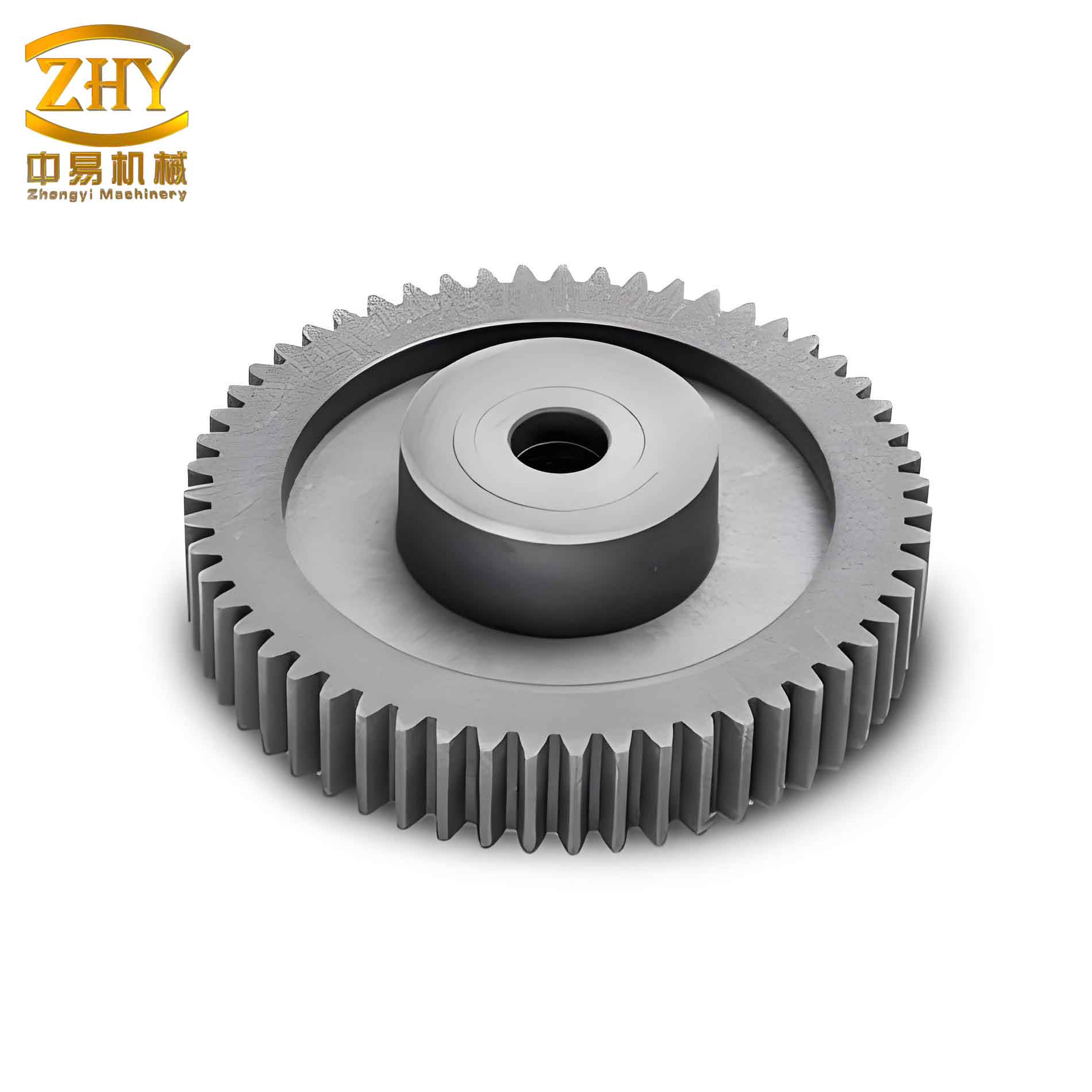
1. Conceptual Design of the Slotted Hole Damping Structure
The proposed vibration damping structure is integrated directly into the spur and pinion gear teeth. As illustrated in the accompanying figure, the design features a longitudinal slot machined from the midpoint of the tooth tip inwards, which connects to a through-hole. This slotted hole configuration serves multiple synergistic functions aimed at enhancing the dynamic performance of the spur and pinion gear pair. Firstly, it introduces a degree of controlled flexibility into an otherwise rigid tooth, creating a quasi-flexible coupling effect that can absorb and dissipate energy from meshing impacts, particularly during tooth entry. Furthermore, this localized compliance provides a safety margin against jamming in scenarios with minimal or negative backlash. Secondly, the slot effectively decouples the deformation of one tooth from its neighboring teeth and the opposing flank. This isolation prevents牵连变形 (chain deformation), meaning the elastic deflection under load of a specific tooth does not induce significant, unwanted changes in the pitch of adjacent teeth, thereby maintaining more consistent meshing conditions. Thirdly, the incorporated circular hole acts as a stress-relief feature at the critical fillet region, reducing stress concentration and potentially improving fatigue life. This analysis primarily focuses on quantifying its efficacy in vibration suppression. A specific spur and pinion gear pair was designed to validate this concept, with its core geometric parameters detailed in Table 1. The center distance for this pair is a = 208.4 mm.
| Gear | Pinion (z₁) | Gear (z₂) |
|---|---|---|
| Number of Teeth, z | 34 | 34 |
| Module, m (mm) | 6 | 6 |
| Profile Shift Coefficient, x | 0.3945 | 0.3945 |
| Pressure Angle, α (°) | 20 | 20 |
| Addendum Coefficient, hₐ* | 1 | 1 |
| Dedendum Coefficient, c* | 0.25 | 0.25 |
| Face Width, b (mm) | 60 | 60 |
2. Dynamic Simulation of Spur and Pinion Gear Meshing
2.1 Simulation Methodology and Baseline Analysis
A systematic dynamic simulation workflow was established using Adams software. Three-dimensional models of the spur and pinion gears, created in CAD, were imported. The simulation environment was configured with MMKS units (mm, kg, s). Both gears were modeled as rigid bodies with the material properties of 20CrMnTi steel. Revolute joints were applied at their respective centers of rotation. An ‘Impact’ contact force was defined between the gear teeth, with stiffness (K) and damping (C) coefficients calculated based on established gear dynamics principles. A STEP function was applied to the input pinion to ramp its rotational speed from 0 to 154 rad/s (approximately 1470 RPM) within 0.1 seconds. A corresponding load torque of 150 N·m was applied to the output spur gear using a similar STEP function. Following a model verification check, a dynamic simulation was run for 0.5 seconds with 4500 steps using the GSTIFF SI2 solver. The primary output for vibration analysis was the angular acceleration of the output spur gear.
The time-domain angular acceleration signal for the baseline (solid) spur and pinion gear pair shows the transient response during the 0.1s run-up period, after which the vibration reaches a quasi-steady state dominated by meshing dynamics. To analyze the frequency content, a Fast Fourier Transform (FFT) was performed on the steady-state portion of this signal. The resulting spectrum, shown conceptually, reveals a dominant peak at the gear meshing frequency, f_m. For this spur and pinion pair, the meshing frequency is calculated as:
$$f_m = \frac{n \cdot z}{60}$$
where \(n\) is the rotational speed in RPM (1470) and \(z\) is the number of teeth (34). This yields \(f_m \approx 833\) Hz. The amplitude of angular acceleration at this fundamental meshing frequency for the baseline design was found to be \(A_{base} = 194 \, \text{rad/s}^2\).
2.2 Power Spectrum Estimation for Energy Analysis
To obtain a more robust estimate of the vibration energy distribution, particularly for non-deterministic signals, the power spectral density (PSD) was computed using the correlation (Wiener-Khinchin) method. This method first calculates the autocorrelation function of the time-domain signal \(u_N(n)\):
$$r_{\hat{}}(m) = \frac{1}{N} \sum_{n=0}^{N-1} u_N(n) u_N^*(n-m), \quad |m| \leq N-1$$
where \(N\) is the total number of discrete data points. The power spectrum estimate \(S_{\hat{}}(\omega)\) is then the Fourier Transform of this autocorrelation function:
$$S_{\hat{}}(\omega) = \sum_{m=-M}^{M} r_{\hat{}}(m) e^{-j\omega m}$$
Applying this with a sampling frequency of 5500 Hz and 1024 data points to the baseline spur and pinion gear signal yielded its power spectrum. The total power, represented by the area under the PSD curve, serves as a scalar metric for overall vibration energy. For the baseline design, this total power was calculated as \(P_{base} = 2.515 \times 10^8 \, \text{rad}^2/\text{s}^4\).
3. Optimization of Damping Structure via Orthogonal Experiment Design
3.1 Experimental Design and Factor Selection
The performance of the slotted hole structure is governed by three key geometric parameters: slot width (\(a_1\)), gear backlash (\(a_2\)), and hole diameter (\(a_3\)). To efficiently investigate the influence of these factors and identify an optimal combination, a three-factor, three-level orthogonal experimental design (\(L_9(3^3)\)) was employed. The selected levels for each factor, considering structural integrity, manufacturing feasibility, and standard backlash ranges, are listed in Table 2. A negative backlash level implies a slight intentional interference, which is made feasible by the compliance introduced by the slot in the spur and pinion gear teeth.
| Level | Factor A: Slot Width \(a_1\) (mm) | Factor B: Backlash \(a_2\) (mm) | Factor C: Hole Diameter \(a_3\) (mm) |
|---|---|---|---|
| 1 | 0.2 | 0.20 | 4 |
| 2 | 0.3 | 0.07 | 6 |
| 3 | 0.4 | -0.03 | 8 |
The specific test schemes according to the \(L_9\) orthogonal array are presented in Table 3. For each of these nine unique spur and pinion gear configurations, a full dynamic simulation identical to the baseline analysis was conducted.
| Test No. | Factor A: \(a_1\) (mm) | Factor B: \(a_2\) (mm) | Factor C: \(a_3\) (mm) | Angular Accel. Amplitude at \(f_m\) (rad/s²) | Total Vibration Power (rad²/s⁴) |
|---|---|---|---|---|---|
| 1 | 0.2 | 0.20 | 4 | 201 | 2.683E+08 |
| 2 | 0.2 | 0.07 | 8 | 195 | 2.590E+08 |
| 3 | 0.2 | -0.03 | 6 | 162 | 1.984E+08 |
| 4 | 0.3 | 0.20 | 8 | 224 | 3.247E+08 |
| 5 | 0.3 | 0.07 | 6 | 184 | 2.338E+08 |
| 6 | 0.3 | -0.03 | 4 | 156 | 1.859E+08 |
| 7 | 0.4 | 0.20 | 6 | 211 | 2.921E+08 |
| 8 | 0.4 | 0.07 | 4 | 177 | 2.244E+08 |
| 9 | 0.4 | -0.03 | 8 | 173 | 2.185E+08 |
The simulation results for the angular acceleration amplitude at the meshing frequency (\(f_m\)) and the total vibration power are appended to Table 3. A clear correlation is observed between these two metrics; configurations with lower angular acceleration consistently exhibit lower total vibration power. Therefore, either metric can serve as a valid evaluation index for the orthogonal analysis. The data indicates that several configurations (Tests 3, 5, 6, 8, 9) show significant vibration reduction compared to the baseline value of 194 rad/s², with Test 6 exhibiting the most pronounced effect.
3.2 Analysis of Means and Signal-to-Noise Ratio
The angular acceleration amplitude, being a “smaller-is-better” characteristic, was chosen as the primary evaluation index. The mean response \(T_i\) for each factor at level \(i\) was calculated. The range \(S\) for each factor, defined as \(S = \max(T_i) – \min(T_i)\), determines the factor’s influence magnitude. The results of this range analysis are summarized in Table 4.
| Parameter | Mean Response T₁ (rad/s²) | Mean Response T₂ (rad/s²) | Mean Response T₃ (rad/s²) | Range S (rad/s²) | Order of Influence |
|---|---|---|---|---|---|
| Factor A (Slot Width \(a_1\)) | 186 | 188 | 187 | 2 | B > C > A |
| Factor B (Backlash \(a_2\)) | 212 | 185 | 164 | 48 | |
| Factor C (Hole Diameter \(a_3\)) | 178 | 186 | 197 | 19 |
The analysis reveals that backlash (\(a_2\)) exerts the most dominant influence on the vibration of the spur and pinion gear pair, with a range of 48 rad/s². The hole diameter (\(a_3\)) has a secondary but still significant effect (range = 19 rad/s²), while the slot width (\(a_1\)) shows a negligible impact (range = 2 rad/s²). The order of influence is conclusively: Backlash > Hole Diameter > Slot Width.
To account for variability and identify the parameter level combination that minimizes vibration, the Signal-to-Noise Ratio (S/N) for the “smaller-is-better” characteristic was computed for each factor level using the formula:
$$\eta = -10 \log_{10}\left(\frac{1}{n}\sum_{i=1}^{n} y_i^2\right)$$
where \(y_i\) are the test results for a given factor level. The level yielding the highest S/N ratio is optimal. The S/N ratio analysis confirmed the order of influence from the range analysis and pinpointed the optimal level combination as \(A_1B_3C_1\), i.e., Slot Width = 0.2 mm, Backlash = -0.03 mm, Hole Diameter = 4 mm.
3.3 Analysis of Variance (ANOVA)
To quantify the statistical significance and the percentage contribution of each factor to the total variation in the angular acceleration response, Analysis of Variance (ANOVA) was performed. The results are presented in Table 5.
| Source of Variation | Degrees of Freedom | Sum of Squares | Mean Square | F-Value | Contribution (%) |
|---|---|---|---|---|---|
| Factor A (Slot Width \(a_1\)) | 2 | 1.71E+04 | 8.55E+03 | 1.77 | 0.13 |
| Factor B (Backlash \(a_2\)) | 2 | 1.15E+07 | 5.75E+06 | 1189.0 | 85.84 |
| Factor C (Hole Diameter \(a_3\)) | 2 | 1.87E+06 | 9.35E+05 | 193.4 | 13.96 |
| Error | 2 | 9.67E+03 | 4.84E+03 | 0.07 | |
| Total | 8 | 1.34E+07 | 100.00 |
The ANOVA results strongly support the previous findings. The F-values for Backlash (\(a_2\)) and Hole Diameter (\(a_3\)) far exceed the critical value \(F_{0.05}(2,2)=19.0\), confirming they are highly significant factors. Slot Width (\(a_1\)) is insignificant. Most importantly, the percentage contribution quantifies the impact: Backlash accounts for 85.84% of the total variation in vibration response, Hole Diameter for 13.96%, and Slot Width for only 0.13%. This unequivocally demonstrates that within the context of this slotted spur and pinion gear design, the setting of backlash is the overwhelmingly dominant parameter for vibration control.
4. Dynamic Simulation of the Optimal Spur and Pinion Configuration
The optimal parameter combination identified through orthogonal analysis (\(A_1B_3C_1\): 0.2 mm slot, -0.03 mm backlash, 4 mm hole) was modeled and subjected to the same dynamic simulation as the baseline. The angular acceleration amplitude at the meshing frequency for this optimal slotted spur and pinion gear pair was found to be \(A_{opt} = 153 \, \text{rad/s}^2\). Compared to the baseline amplitude of \(A_{base} = 194 \, \text{rad/s}^2\), this represents a reduction of approximately 21.1%. Similarly, the total vibration power was reduced by about 20.4%. This confirms the substantial potential of the optimized slotted hole structure in suppressing vibrations in spur and pinion gear transmissions.
5. Experimental Validation and Study
5.1 Test Gear Design and Setup
To physically validate the simulation and optimization results, four spur gears were manufactured based on the parameters in Table 1, with varying measured base pin diameters (related to backlash) as listed in Table 6. Gear C incorporated the optimized slotted hole damping structure, while Gears A, B, and D were solid. Three distinct spur and pinion gear pairs were assembled for testing: Pair 1 (A-B) with ~0.20 mm backlash, Pair 2 (B-C) with ~0.07 mm backlash, and Pair 3 (C-D) with ~-0.03 mm backlash. Pair 3 represents the optimal configuration with the damping structure and negative backlash.
| Gear Designation | Measured Base Pin Diameter (mm) | Damping Structure | Test Role |
|---|---|---|---|
| A | 84.075 | None (Solid) | Input for Pair 1 |
| B | 84.101 | None (Solid) | Output for Pair 1 / Input for Pair 2 |
| C | 84.192 | Slotted Hole (Optimal) | Output for Pair 2 / Input for Pair 3 |
| D | 84.199 | None (Solid) | Output for Pair 3 |
The tests were conducted on a dedicated gear vibration test bench comprising a drive motor, the test gearbox, a torque/speed sensor, and a magnetic powder brake. Four accelerometers were mounted on the input and output shaft bearings in both radial and axial directions. Vibration signals were acquired and processed using an M+P data acquisition system. Prior to dynamic testing, contact pattern checks were performed for each spur and pinion pair to ensure proper meshing alignment.
5.2 Test Procedure and Results
Each of the three spur and pinion gear pairs was tested under two rotational speeds (780 RPM and 1470 RPM) and three load torques (20 N·m, 100 N·m, 150 N·m). The vibration acceleration signals were analyzed spectrally. The amplitudes at the fundamental meshing frequency (\(f_m\)) and its first harmonic (\(2f_m\)) for the axial directions of the input and output shafts (typically the most sensitive to gear vibrations) were extracted. A summary of the results for the key conditions is presented in Tables 7 and 8.
| Spur and Pinion Pair | Load (N·m) | Input Shaft Axial (Ch. 2) | Output Shaft Axial (Ch. 4) | ||
|---|---|---|---|---|---|
| @ f_m ≈ 442 Hz | @ 2f_m ≈ 884 Hz | @ f_m ≈ 442 Hz | @ 2f_m ≈ 884 Hz | ||
| 1 (A-B: 0.20 mm Bl) | 20 | 1.751 | 6.146 | 1.008 | 1.745 |
| 100 | 2.305 | 6.327 | 1.847 | 4.154 | |
| 150 | 3.277 | 4.776 | 0.483 | 4.352 | |
| 2 (B-C: 0.07 mm Bl) | 20 | 1.208 | 4.601 | 7.721 | 1.804 |
| 100 | 1.877 | 6.970 | 8.861 | 6.859 | |
| 150 | 3.792 | 2.625 | 3.591 | 5.197 | |
| 3 (C-D: -0.03 mm Bl) | 20 | 1.159 | 1.272 | 0.816 | 0.165 |
| 100 | 1.821 | 0.358 | 1.316 | 0.202 | |
| 150 | 2.491 | 0.777 | 0.387 | 0.575 | |
| Spur and Pinion Pair | Load (N·m) | Input Shaft Axial (Ch. 2) | Output Shaft Axial (Ch. 4) | ||
|---|---|---|---|---|---|
| @ f_m ≈ 833 Hz | @ 2f_m ≈ 1666 Hz | @ f_m ≈ 833 Hz | @ 2f_m ≈ 1666 Hz | ||
| 1 (A-B: 0.20 mm Bl) | 20 | 1.686 | 2.462 | 2.969 | 2.873 |
| 100 | 0.194 | 1.007 | 0.161 | 4.502 | |
| 150 | 0.254 | 0.874 | 0.256 | 2.442 | |
| 2 (B-C: 0.07 mm Bl) | 20 | 3.029 | 1.925 | 2.030 | 6.138 |
| 100 | 0.286 | 0.747 | 0.225 | 3.131 | |
| 150 | 0.231 | 0.850 | 0.228 | 5.419 | |
| 3 (C-D: -0.03 mm Bl) | 20 | 1.349 | 1.625 | 2.079 | 0.642 |
| 100 | 0.145 | 0.388 | 0.117 | 0.492 | |
| 150 | 0.196 | 0.470 | 0.180 | 0.469 | |
5.3 Analysis of Experimental Results
The experimental data leads to several key conclusions regarding the performance of the slotted spur and pinion gear. Firstly, rotational speed exhibits a more pronounced effect on vibration levels than load torque across all configurations. Most critically, under identical operating conditions (speed and load), Spur and Pinion Pair 3 (the optimal slotted design with negative backlash) consistently demonstrates lower vibration acceleration amplitudes compared to both Pair 1 (the baseline solid design) and Pair 2 (an intermediate design). Quantifying this reduction at the fundamental meshing frequency (\(f_m\)): At 780 RPM, the vibration for Pair 3 is 20.9% to 33.8% lower than Pair 1 at the input shaft, and 19.2% to 28.7% lower at the output shaft. At 1470 RPM, the reduction ranges from 19.9% to 25.6% at the input shaft and 27.3% to 29.9% at the output shaft. These figures align closely with the ~21% reduction predicted by the dynamic simulation for the optimal spur and pinion configuration. The significant suppression of harmonic content (e.g., \(2f_m\)) in Pair 3, as clearly seen in the tables, further confirms the effectiveness of the damping structure in smoothing the meshing dynamics.
6. Conclusion
This integrated study, employing dynamic simulation, statistical design of experiments, and physical testing, thoroughly investigates a slotted hole structure for vibration damping in spur and pinion gears. The primary conclusions are as follows:
- The proposed slotted hole structure embedded in the spur and pinion gear teeth provides a significant and measurable suppression of meshing vibrations. The introduced flexibility effectively manages meshing impacts and, crucially, enables the use of controlled negative backlash by preventing tooth jamming.
- Orthogonal experiment and ANOVA revealed that among the studied parameters—slot width, backlash, and hole diameter—backlash is the overwhelmingly dominant factor, accounting for approximately 86% of the variation in vibration response. The hole diameter has a secondary influence (~14%), while the slot width has a negligible effect within the studied range.
- The combination of a small hole diameter and negative backlash, facilitated by the slot’s compliance, produces the most pronounced damping effect. The optimal parameter set identified was a 0.2 mm slot width, -0.03 mm backlash, and a 4 mm hole diameter. This optimal spur and pinion configuration demonstrated a 21.1% reduction in meshing frequency vibration amplitude and a 20.4% reduction in overall vibration power compared to a standard solid gear pair in simulation.
- Experimental validation confirmed the simulation trends. The optimal slotted spur and pinion gear pair reduced vibration acceleration amplitudes by 19% to 34% across various speeds and loads, with the magnitude of improvement closely matching the theoretical predictions.
The slotted hole damping structure presents a viable and effective design strategy for enhancing the dynamic performance of spur and pinion gear transmissions. It is particularly promising for applications demanding high precision, smooth operation, minimal acoustic noise, and near-zero backlash, such as in robotics, precision machinery, and high-performance automotive systems. The insights gained into the critical role of backlash control within such a flexible tooth design are broadly applicable to the field of gear dynamics and quiet gear design.