
Variable Hyperbolic Circular-Arc-Tooth-Trace (VH-CATT) gears represent a transformative advancement in gear technology, featuring unique arc-shaped tooth traces instead of conventional straight or helical lines. This design significantly enhances load capacity, transmission stability, and fatigue strength compared to traditional cylindrical gears. However, the absence of specialized manufacturing equipment complicates parameter optimization during machining. This study addresses this challenge through finite element simulation and intelligent optimization algorithms, advancing precision manufacturing in modern gear technology.
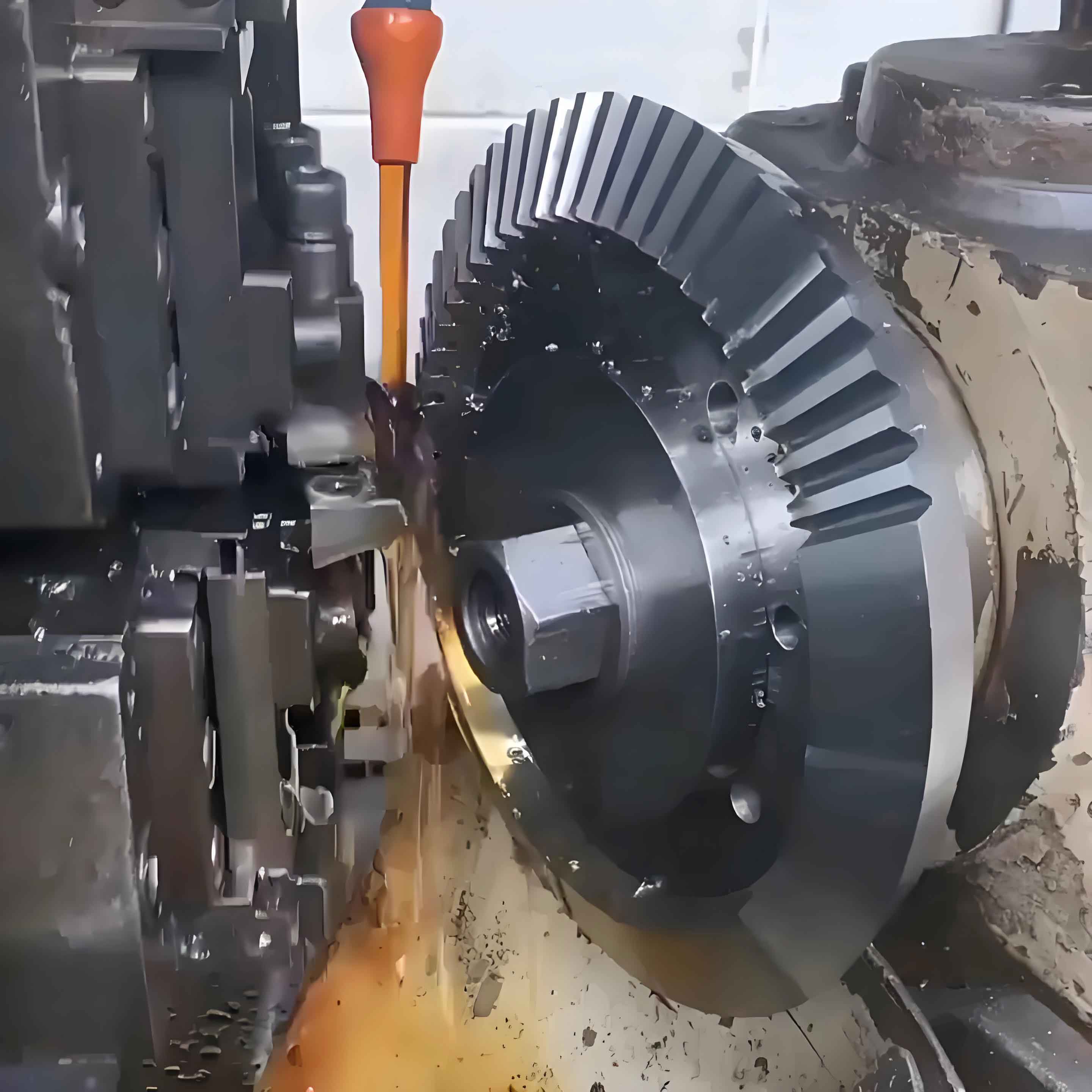
Machining Principles of VH-CATT Gears
VH-CATT gears exhibit a spatial tooth-trace curve where teeth adopt a hyperbolic profile in cross-sections away from the central plane. The machining process involves a rotating cutter head and coordinated workpiece movements:
1. Kinematic Framework:
$$ \begin{pmatrix} x_1 \\ \theta_{z2} \end{pmatrix} = \mathbf{T} \begin{pmatrix} v_x \\ \omega_{\alpha} \end{pmatrix} $$
Where \( x_1 \) denotes horizontal displacement, \( \theta_{z2} \) is rotational displacement, \( v_x \) is linear velocity, and \( \omega_{\alpha} \) is angular velocity. The transformation matrix \( \mathbf{T} \) couples these motions for precise tooth generation.
2. Tool-Path Calculation: The effective cutting length \( L_{DF} \) per tooth slot is derived as:
$$ L_{DF} = \frac{3m}{4} \sqrt{4z – 1} + m(\pi + \tan 20^\circ) $$
where \( m \) is the module and \( z \) is the tooth count. This formula ensures accurate tool engagement throughout the machining cycle.
Finite Element Cutting Simulation
ABAQUS simulations modeled the orthogonal cutting process using a simplified workpiece and carbide tool (WC). The Johnson-Cook constitutive model characterized 45-steel behavior:
| Parameter | 45-Steel | WC Tool |
|---|---|---|
| Density (g/cm³) | 7.89 | 11.9 |
| Elastic Modulus (GPa) | 209 | 650 |
| Johnson-Cook A (MPa) | 570.47 | – |
| Johnson-Cook B (MPa) | 689.65 | – |
| Thermal Conductivity (W/m·°C) | 5.2 | 35 |
The material failure criterion incorporated damage parameters \( D_1 = -0.09 \), \( D_2 = 0.25 \), \( D_3 = -0.5 \), \( D_4 = 0.014 \), and \( D_5 = 3.87 \). Simulations captured cutting forces under varied parameters, providing critical data for gear technology optimization.
Cutting Force Modeling via Orthogonal Testing
A \( L_9(3^3) \) orthogonal array evaluated spindle speed (\( n \)), feed per tooth (\( f_z \)), and depth of cut (\( a_p \)):
| Run | \( n \) (rpm) | \( f_z \) (mm) | \( a_p \) (mm) | Force (N) |
|---|---|---|---|---|
| 1 | 300 | 0.10 | 1.0 | 473.52 |
| 2 | 300 | 0.15 | 1.5 | 521.31 |
| 3 | 300 | 0.20 | 2.0 | 562.42 |
| 4 | 350 | 0.10 | 1.5 | 511.25 |
| 5 | 350 | 0.15 | 2.0 | 571.36 |
| 6 | 350 | 0.20 | 1.0 | 512.71 |
| 7 | 400 | 0.10 | 1.0 | 543.46 |
| 8 | 400 | 0.15 | 2.0 | 619.36 |
| 9 | 400 | 0.20 | 1.5 | 531.47 |
Regression analysis yielded the cutting force model (\( R^2 = 0.999 \)):
$$ F = 94.8287 \cdot n^{0.2904} \cdot f_z^{0.0164} \cdot a_p^{0.1822} $$
ANOVA validation confirmed model significance (\( F \)-ratio = 52,247.45, \( p < 0.01 \)), establishing its reliability for gear technology applications.
Multi-Objective Parameter Optimization
The Whale Optimization Algorithm (WOA) simultaneously minimized machining time (\( T_d \)) and cutting force (\( F \)):
1. Machining Time Function: For \( m = 4 \text{mm} \), \( z = 50 \) gears:
$$ T_d = \frac{25(3,173 + 66.2 \cdot n \cdot f_z)}{2 \cdot n \cdot f_z} $$
2. Normalized Objective Function:
$$ \min f(n, f_z, a_p) = \lambda_1 \frac{T_d – T_{\min}}{T_{\max} – T_{\min}} + \lambda_2 \frac{F – F_{\min}}{F_{\max} – F_{\min}} $$
where \( \lambda_1 = \lambda_2 = 0.5 \) balanced the objectives.
3. Manufacturing Constraints:
$$ 150 \leq n \leq 500 \quad \text{(rpm)} $$
$$ 0.03 \leq f_z \leq 0.20 \quad \text{(mm)} $$
$$ 0.5 \leq a_p \leq 2.5 \quad \text{(mm)} $$
WOA implementation used 30 search agents over 500 iterations, converging to optimal parameters:
| Parameter | Conventional | WOA-Optimized | Improvement |
|---|---|---|---|
| Spindle Speed (rpm) | 200 | 189.3 | 5.4% efficiency gain |
| Feed per Tooth (mm) | 0.03 | 0.046 | 53.3% feed increase |
| Depth of Cut (mm) | 2.00 | 1.89 | 5.5% force reduction |
Concluding Advancements in Gear Technology
This research establishes a comprehensive framework for optimizing VH-CATT manufacturing:
- Finite element simulations validated the Johnson-Cook model for 45-steel gear cutting dynamics.
- The cutting force model \( F = 94.8287n^{0.2904}f_z^{0.0164}a_p^{0.1822} \) enables precise parameter prediction.
- WOA-based optimization reduced machining forces by 5.5% while increasing feed rates by 53.3%.
These advancements demonstrate how intelligent algorithms enhance manufacturing precision and efficiency in next-generation gear technology. Future work will integrate these models into dedicated CNC systems for industrial-scale VH-CATT production.