
In my pursuit of advancing precision drive systems for industrial automation, I have dedicated significant effort to understanding and innovating upon the rotary vector reducer. This component is not merely a gearbox; it is the pivotal joint that dictates the accuracy, smoothness, and reliability of modern industrial robots. My work focuses on leveraging advanced parametric design tools and additive manufacturing, or 3D printing, to streamline the development cycle of these complex reducers. The primary goal is to establish a robust digital-to-physical workflow that enhances design flexibility, accelerates prototyping, and provides profound insights into the mechanical behavior of the rotary vector reducer. This article details my methodological approach, from the foundational principles to the tangible realization of a prototype, emphasizing the parametric modeling of its core component—the cycloidal drive—and its subsequent fabrication via stereolithography.
The fundamental appeal of the rotary vector reducer lies in its unique two-stage architecture. It ingeniously combines a traditional involute planetary gear train with a cycloidal pinwheel drive, resulting in a closed differential system. This hybrid design is what grants the rotary vector reducer its exceptional characteristics: a high reduction ratio, remarkable torsional stiffness, compact footprint, and near-zero backlash operation. These attributes make it indispensable in high-precision applications such as robotic arms, CNC machinery, and medical equipment. My investigation begins with a thorough deconstruction of its operational theory.
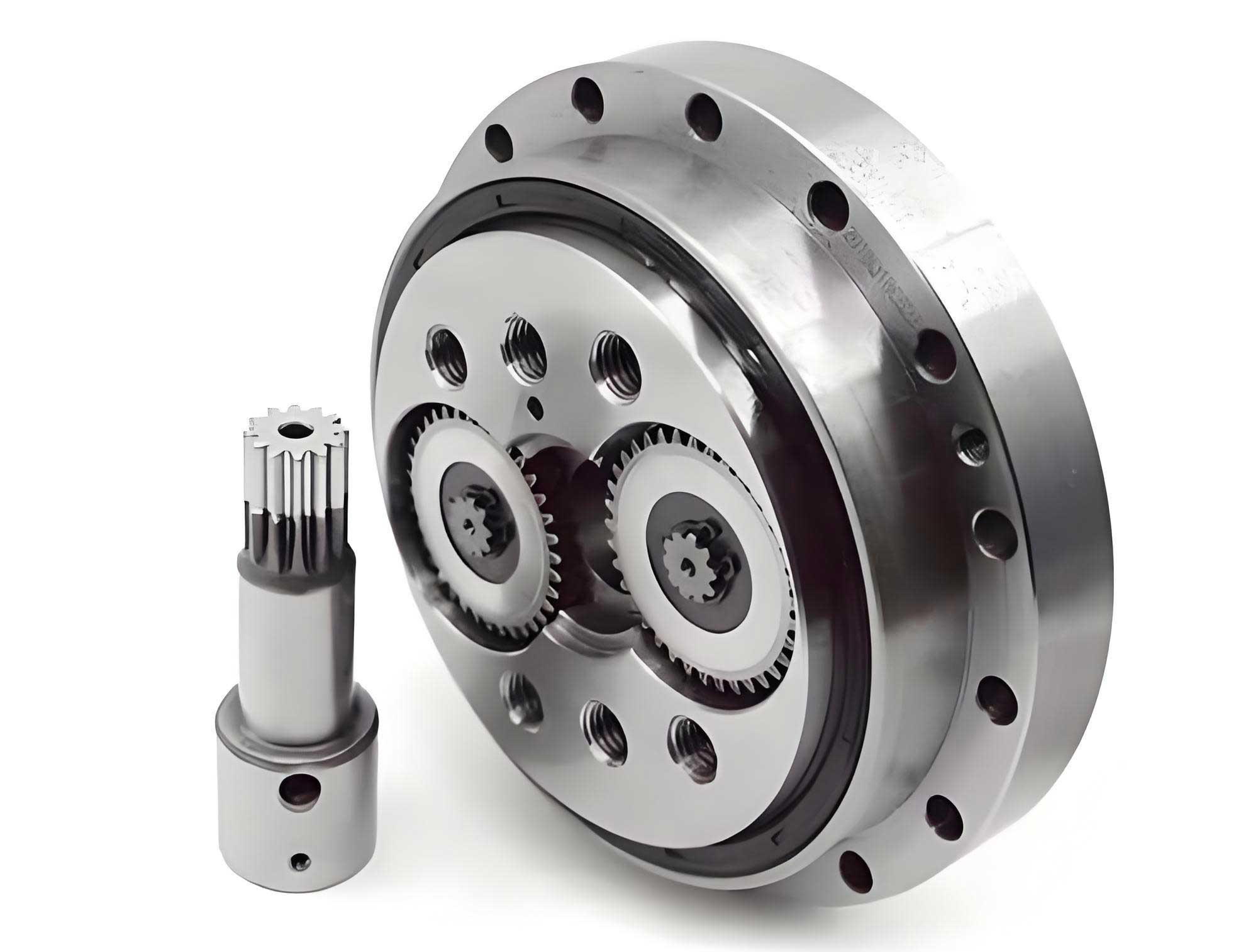
To understand the rotary vector reducer, one must trace the path of motion. The input shaft, often integrated with a sun gear, receives rotational force from a servo motor. This constitutes the first reduction stage. The sun gear meshes with multiple planetary gears (typically three), which are mounted on crankshafts. The rotation of these planetary gears causes the crankshafts to revolve. Each crankshaft has an eccentric section upon which the cycloidal discs are mounted. This is where the distinctive second stage, the heart of the rotary vector reducer, comes into play. The cycloidal discs, usually two in number and offset by 180° to balance radial forces, engage with a ring of stationary pin teeth housed in the fixed casing. As the crankshafts’ eccentric motion forces the cycloidal discs to undergo a compound epicyclic movement—simultaneous revolution and reverse rotation—the interaction with the fixed pins causes the discs to spin on their own axes. This self-rotation is then transmitted through bearings on the crankshafts to the output flange or planet carrier, completing the second reduction. The total reduction ratio i of the rotary vector reducer is the product of the ratios from both stages, often reaching values from 30 to over 100. The kinematic relationship for the second stage can be expressed in terms of the number of teeth. If $z_p$ is the number of pin teeth and $z_c$ is the number of lobes on the cycloidal disc, the reduction ratio for this stage is given by $i_h = z_p / (z_p – z_c)$. The overall ratio is then $i = i_{stage1} \times i_h$. This dual-stage mechanism is the cornerstone of the rotary vector reducer’s performance.
The physical embodiment of this principle is a marvel of mechanical packaging. The key components of a standard rotary vector reducer include:
- Input Shaft/Sun Gear: The primary power intake point.
- Planetary Gears and Crankshaft Assembly: Transmits and converts motion from the first to the second stage.
- Cycloidal Discs (Cycloid Wheels): The core torque-transmitting elements with a lobed profile.
- Pin Ring/Housing: Contains the stationary pin teeth against which the cycloidal discs mesh.
- Output Mechanism (Planet Carrier): The final output component, connected to the load.
- Support Bearings: A critical array of bearings (angular contact, cylindrical roller, needle thrust) to support complex loads and ensure smooth operation.
This 2K-V type structure affords the rotary vector reducer its compactness and high load capacity. The use of multiple crankshafts and phase-shifted cycloidal discs distributes the load, minimizing vibration and wear, which is crucial for the longevity and precision of the system.
The most critical and geometrically complex element in any rotary vector reducer is undoubtedly the cycloidal disc. Its tooth profile is not an involute but a curve derived from the epicycloidal family. The accuracy of this profile directly dictates the reducer’s backlash, contact stress distribution, efficiency, and noise generation. Therefore, creating a precise digital model is paramount. I employ a fully parametric approach, which allows for swift design iterations and sensitivity analyses. The foundation of this model is the mathematical definition of the standard cycloidal profile.
The standard tooth profile of a cycloidal disc, assuming conjugate action with zero backlash against circular pin teeth, is defined by a set of parametric equations. Let us establish the key parameters first:
| Parameter | Symbol | Value | Unit |
|---|---|---|---|
| Total Reduction Ratio | $i$ | 81 | – |
| Module (First Stage) | $m$ | 2 | mm |
| Sun Gear Teeth | $z_1$ | 24 | – |
| Planet Gear Teeth | $z_2$ | 60 | – |
| Number of Pin Teeth | $z_p$ | 32 | – |
| Number of Cycloid Lobes | $z_c$ | 31 | – |
| Pin Circle Radius | $r_p$ | 154 | mm |
| Eccentricity (Half of Bearings’ Offset) | $a$ | 4 | mm |
| Pin Radius | $r_{rp}$ | 5 | mm |
From these, we derive the shortening coefficient $K_1$, a crucial factor defining the shape of the curtate cycloid used in these reducers: $$K_1 = \frac{a z_p}{r_p}$$ For our sample rotary vector reducer, $K_1 = (4 \times 32) / 154 \approx 0.8312$.
The parametric equations for a single lobe of the cycloidal profile, using the simplified form based on the trochoidal generation principle, are as follows: $$ \begin{aligned} x_c(t) &= r_p \left[ \sin\left(\frac{360^\circ \cdot t}{z_c}\right) – \frac{K_1}{z_p} \sin\left(\frac{z_p}{z_c} \cdot 360^\circ \cdot t\right) \right] \\ y_c(t) &= r_p \left[ \cos\left(\frac{360^\circ \cdot t}{z_c}\right) – \frac{K_1}{z_p} \cos\left(\frac{z_p}{z_c} \cdot 360^\circ \cdot t\right) \right] \end{aligned} $$ where the parameter $t$ varies from $0$ to $z_c$ (i.e., 31) to generate one full lobe. The complete tooth profile is created by generating this curve for one lobe and then arraying it $z_c$ times around the center. It is vital to note that these equations describe the theoretical centroid path of the disc relative to the pins. The actual working surface of the cycloidal disc tooth is equidistant to this centroidal curve, offset by the pin radius $r_{rp}$.
To implement this in a CAD environment, I utilize Autodesk Inventor’s parametric and equation-driven curve capabilities. The process is systematic and highly adaptable:
- Create a New Part File: Initiate a standard part file within the Inventor workspace.
- Define User Parameters: In the parameters table, I create named parameters for all key variables: `rp=154 mm`, `zp=32 ul`, `zc=31 ul`, `K1=0.8312 ul`. This centralizes control.
- Sketch and Insert Equation Curve: In a 2D sketch, I navigate to the “Equation Curve” tool (found under the “Line” dropdown). For the coordinate system, I select “Explicit Equation” mode.
- Input Parametric Equations: In the dialog box, I define the X and Y components using the predefined parameters. For example:
X(t): `rp * ( sin(360 deg * t / zc) – (K1 / zp) * sin( (zp / zc) * 360 deg * t) )`
Y(t): `rp * ( cos(360 deg * t / zc) – (K1 / zp) * cos( (zp / zc) * 360 deg * t) )`
I set the parameter `t` to range from `0` to `zc`. - Generate and Complete the Profile: Upon clicking “OK,” a single cycloidal lobe curve is created. I then use the circular pattern tool to replicate this curve `zc` times around the origin, creating the full set of lobes. Finally, I offset this curve inward by the pin radius `rrp` to create the actual working profile, and extrude it to form the 3D solid model of the cycloidal disc, including necessary central hub and bearing seat features.
This parametric method is immensely powerful. Altering any fundamental parameter, like the eccentricity `a` or the pin count `zp`, automatically regenerates a geometrically correct new model. This is invaluable for optimizing the performance of the rotary vector reducer, allowing for rapid exploration of design spaces concerning stress, efficiency, and size.
Once the virtual assembly of the rotary vector reducer is complete—including the modeled planetary stage, crankshafts, bearings, and housing—the next phase is physical validation. Traditional machining of cycloidal discs, especially for prototyping, is costly and time-consuming due to the complex tooth form and high required precision. This is where additive manufacturing becomes a transformative tool. I selected Stereolithography (SLA) for creating the initial prototype of the cycloidal disc. SLA offers excellent feature resolution and surface finish, which are critical for assessing the form and fit of the intricate gear profile.
The workflow from digital model to physical part for the rotary vector reducer component involves several key steps:
| Step | Action | Tools/Software | Key Considerations |
|---|---|---|---|
| 1. Data Preparation | Export the cycloidal disc CAD model to STL (Standard Tessellation Language) format. | Autodesk Inventor | Ensure mesh resolution is high enough to accurately represent the curved surfaces. |
| 2. Model Orientation & Support Generation | Import STL into slicing software (e.g., PreForm for Formlabs printers). Orient the part to minimize overhangs and optimize build time. Automatically generate support structures. | PreForm Slicing Software | Orientation affects surface quality on critical features like tooth flanks. Supports must be placed strategically to avoid damaging functional surfaces upon removal. |
| 3. Slicing | The software slices the 3D model into thin horizontal layers (e.g., 0.025 mm or 25 microns). | PreForm Slicing Software | Layer thickness is a trade-off between surface smoothness and build time. Thinner layers yield better resolution. |
| 4. Printing | Upload the sliced file to the SLA printer. The printer uses a UV laser to selectively cure liquid photopolymer resin layer-by-layer. | Formlabs Form 2 SLA Printer, Methacrylate Resin | Process is unsupervised but requires stable temperature and a calibrated laser system. |
| 5. Post-Processing | a. Cleaning: Remove the part from the build platform and wash in isopropyl alcohol (IPA) or a dedicated solvent to remove uncured resin. b. Support Removal: Carefully detach the support structures using flush cutters. c. Post-Curing: Place the part in a UV curing chamber to fully polymerize and achieve final mechanical properties. |
IPA Bath, Curing Station, Hand Tools | Thorough cleaning is essential for dimensional stability and surface finish. Post-curing increases part strength and hardness. |
The entire printing process for a single cycloidal disc for our mid-sized rotary vector reducer took approximately 3 hours. The resulting component exhibited fine details on the tooth flanks and a smooth surface finish directly from the printer, which is a significant advantage of the SLA process for prototyping precision components like those in a rotary vector reducer.
The ultimate test of any prototype is its dimensional and geometric accuracy. For a cycloidal disc within a rotary vector reducer, the most critical tolerances relate to the central bearing bore and the tooth profile itself. These directly influence the assembly’s concentricity, backlash, and load distribution. To quantitatively assess the SLA-fabricated part, I employed a coordinate measuring machine (CMM).
The primary measurements focused on the bore intended for the crankshaft’s eccentric bearing:
- Roundness (Circularity): This measures how closely the bore conforms to a perfect circle. The CMM reported a maximum deviation of less than 0.018 mm.
- Position (Location) Tolerance: This checks if the bore’s axis is in its designed location relative to other datum features, such as the theoretical center of the tooth profile. The measured positional error was under 0.028 mm.
Both values were well within the preliminary design specification of 0.05 mm for prototyping purposes. Furthermore, a qualitative functional test was conducted by assembling the printed cycloidal disc into a mock-up of the rotary vector reducer’s second-stage housing with pins. The disc meshed smoothly with the stationary pins and rotated without binding, indicating that the parametric model’s accuracy was successfully translated into the physical part. This successful fit-check validates the entire digital design and rapid prototyping pipeline for critical components of the rotary vector reducer.
This integrated approach—combining rigorous parametric modeling with state-of-the-art additive manufacturing—offers a compelling framework for the design and development of complex mechanical systems like the rotary vector reducer. My experience confirms several key advantages:
- Design Agility: The parametric model of the cycloidal disc acts as a single source of truth. Modifying a driving parameter instantly propagates changes through the entire gear geometry, enabling rapid “what-if” scenarios for optimizing the rotary vector reducer’s performance metrics (e.g., contact ratio, pressure angle, root stress).
- Prototyping Speed and Cost-Effectiveness: Compared to conventional machining (e.g., gear hobbing or shaping of cycloidal profiles), SLA 3D printing drastically shortens the lead time from design to tangible part. This allows for multiple design iterations within a short period and at a fraction of the cost for hard-tooled parts.
- Functional Validation: While material properties of standard photopolymers differ from hardened steel, the geometric fidelity of SLA parts is sufficient for comprehensive form, fit, and assembly studies. It allows for the early detection of interferences, verification of clearances, and even basic kinematic testing of the rotary vector reducer mechanism before committing to expensive metal production.
- Foundation for Advanced Analysis: The high-quality digital model can be seamlessly transferred to finite element analysis (FEA) software for structural and dynamic simulations. Similarly, the physical prototype can be used in experimental setups to measure stiffness or vibration characteristics, providing valuable data to calibrate and improve the digital models.
In conclusion, the journey from the mathematical definition of a cycloidal curve to holding a functional prototype in hand encapsulates the modern engineering paradigm. The rotary vector reducer, with its intricate kinematics, serves as an excellent case study. The methodology I have detailed—centered on parametric CAD and rapid prototyping—proves to be an exceptionally powerful toolset. It not only demystifies the design of this sophisticated reducer but also paves the way for more innovative, optimized, and reliably manufactured precision drive systems in the future. The continued integration of these digital and physical tools promises to further accelerate the innovation cycle for critical components like the rotary vector reducer across robotics and advanced manufacturing.
Future work will naturally build upon this foundation. I intend to explore several avenues to deepen the understanding and capability surrounding the rotary vector reducer. First, the parametric model can be extended to include systematic tooth profile modifications, such as equidistant or offset modifications, which are essential for ensuring proper lubrication clearance and optimizing load distribution in a real-world rotary vector reducer under load. This involves adding new variables to the equation set, such as a modification distance $\delta$, transforming the profile equations to: $$ \begin{aligned} x_{c,mod}(t) &= x_c(t) + \delta \cdot \frac{dy_c/dt}{\sqrt{(dx_c/dt)^2 + (dy_c/dt)^2}} \\ y_{c,mod}(t) &= y_c(t) – \delta \cdot \frac{dx_c/dt}{\sqrt{(dx_c/dt)^2 + (dy_c/dt)^2}} \end{aligned} $$ where the derivatives define the normal direction to the curve. Implementing this will allow for a parametric study on how $\delta$ influences the transmission error and efficiency of the rotary vector reducer.
Second, material science within additive manufacturing offers a direct path forward. While standard resins were adequate for geometric validation, the use of advanced engineering photopolymers or the direct 3D printing of metals (via Selective Laser Sintering or Binder Jetting) could produce functional prototypes capable of withstanding actual operating loads and speeds. This would enable performance testing under torque, leading to more validated data for refining the design of a durable rotary vector reducer. The table below outlines a potential comparative study plan for different AM materials for a rotary vector reducer’s cycloidal disc:
| Material Type | AM Process | Target Property | Potential Application Stage |
|---|---|---|---|
| Standard Tough Resin | SLA | High Detail, Dimensional Accuracy | Form/Fit, Kinematic Prototype |
| High-Temperature Resin | SLA | Heat Resistance, Stiffness | Light-Load Functional Testing |
| Stainless Steel (e.g., 316L) | SLS / DMLS | High Strength, Wear Resistance | Heavy-Duty Functional Prototype |
| Tool Steel | DMLS | Very High Hardness, Durability | Pre-Production Tooling or End-Use Part |
Finally, the digital thread can be closed by incorporating sensor feedback. Instrumenting a 3D-printed prototype rotary vector reducer with strain gauges or torque sensors could provide real-world data on load sharing among the cycloidal disc lobes and planetary gears. This data would be invaluable for validating and improving multi-body dynamic simulation models of the entire rotary vector reducer assembly, leading to designs that are not only precise but also optimally robust and efficient. The synergy between parametric design, additive manufacturing, and data-driven validation constitutes a holistic framework for the next generation of high-performance rotary vector reducers.