
In the realm of mechanical transmission systems, the bevel gear stands as a pivotal component, facilitating power transfer between intersecting axes, particularly in orthogonal configurations. Its applications span diverse industries, including automotive, marine, agricultural machinery, mining equipment, and engineering machinery. The spatial geometry and complex parameterization of bevel gears render traditional design methodologies protracted and computationally intensive. Iterative modifications during the prototyping phase often consume substantial time and resources, with accuracy sometimes compromised. With the advent of computer-aided design (CAD) technologies, three-dimensional modeling software has revolutionized gear design, offering streamlined workflows and enhanced precision. Among these tools, Autodesk Inventor emerges as a comprehensive platform, boasting a design accelerator that excels in transmission system design. This article delves into the parametric design approach for typical Gleason system bevel gears using Inventor, emphasizing three-dimensional modeling, structural adjustments, and parameter standardization to elevate design efficiency and abbreviate development cycles.
The design process initiates with three-dimensional modeling of the bevel gear pair. Inventor’s design accelerator serves as a parametric modeling toolkit, distinct from conventional sketching, enabling the generation of complex yet regular components such as chains, shafts, and gear assemblies. For bevel gears, the accelerator incorporates a dedicated bevel gear component generator. By inputting fundamental design parameters—for instance, module (e.g., 6 mm), tooth ratio (e.g., 24:15), face width (e.g., 29 mm), and shaft angle (e.g., 90° for orthogonal straight bevel gears)—the software autonomously computes the mathematical model, yielding a preliminary three-dimensional gear pair. This model represents a theoretically meshed bevel gear assembly with accurate geometric proportions. The design accelerator performs internal parameter validation; erroneous inputs preclude model generation, providing immediate feedback on factors like strength, fatigue limits, and elastic modulus. This computer-aided approach drastically curtails preliminary calculations, allowing designers to focus on optimization rather than foundational arithmetic.
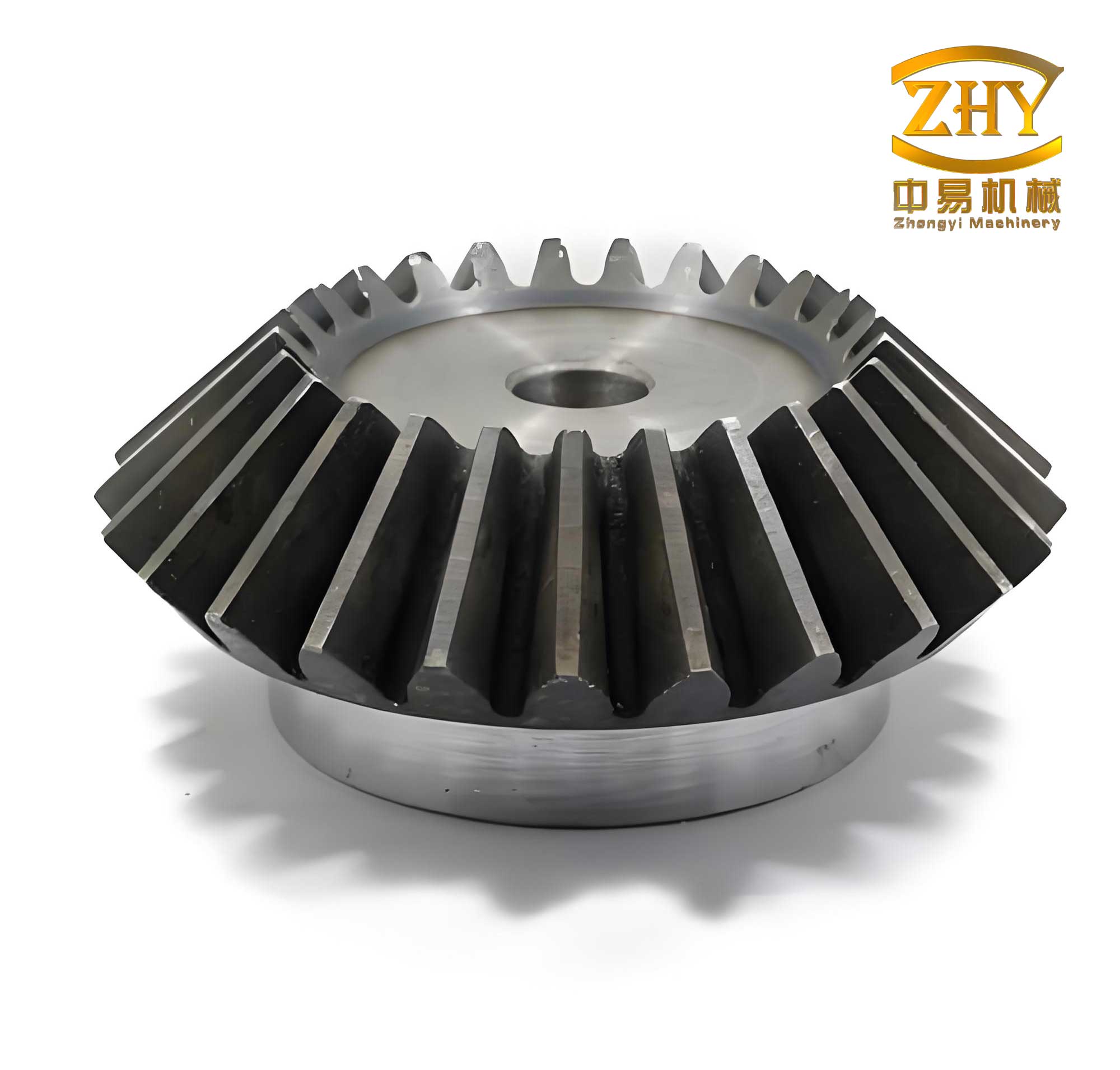
The initial three-dimensional model from the design accelerator is a generic bevel gear pair tailored solely to tooth geometry and theoretical mesh conditions. It lacks specific installation or structural requisites pertinent to individual products. Consequently, each bevel gear within the pair must be refined separately to align with application-specific demands, such as housing compatibility and shaft integration. By saving individual bevel gear models from the generated assembly, designers can employ Inventor’s solid modeling operations—extrusions, cuts, sweeps, and revolutions—to augment features like bore diameters, keyways, hubs, and flanges. This iterative refinement transforms the primitive bevel gear blank into a fully detailed component, ensuring seamless integration into broader mechanical systems. The parametric nature of Inventor facilitates rapid adjustments; modifying a dimension propagates changes throughout the model, maintaining associativity and design intent.
Parameter standardization is crucial for manufacturing and documentation. While the three-dimensional model embodies the theoretical mesh, engineering drawings necessitate explicit representation of invisible contours, such as pitch lines and reference diameters. For bevel gears, especially those conforming to the Gleason system, geometric parameters derive from standardized calculations. Based on input values like module, tooth count, and face width, additional parameters can be computed using established formulas. Below is a comprehensive table summarizing key geometric parameters for a typical straight bevel gear pair, followed by relevant mathematical expressions.
| Parameter | Symbol | Pinion Value | Gear Value | Units |
|---|---|---|---|---|
| Tooth System | – | Gleason | – | |
| Module (Outer/Midpoint) | $$m_e$$ | 6 | mm | |
| Number of Teeth | $$z$$ | 15 | 24 | – |
| Normal Pressure Angle | $$\alpha_n$$ | 20 | deg | |
| Addendum Coefficient / Dedendum Coefficient | $$h_a^* / c^*$$ | 1 / 0.1963 | – | |
| Pitch Cone Angle | $$\delta$$ | 32.0054 | 57.9946 | deg |
| Root Cone Angle | $$\delta_f$$ | 27.1732 | 53.1624 | deg |
| Cone Distance (Outer/Midpoint) | $$R_e / R_m$$ | 84.9058 | mm | |
| Radial Displacement Coefficient | $$x$$ | 0 | 0 | – |
| Tangential Displacement Coefficient | $$x_t$$ | 0 | 0 | – |
| Shaft Angle | $$\Sigma$$ | 90 | deg | |
| Mating Gear Teeth | – | 24 | 15 | – |
| Normal Backlash | $$J_n$$ | 0.24 | mm | |
The geometric relationships for bevel gears are governed by trigonometric and gear theory principles. For orthogonal bevel gears ($$\Sigma = 90^\circ$$), the pitch cone angles for pinion and gear are calculated as:
$$ \delta_1 = \arctan\left(\frac{z_1}{z_2}\right) $$
$$ \delta_2 = 90^\circ – \delta_1 $$
where $$z_1$$ and $$z_2$$ are tooth counts of pinion and gear, respectively. The outer cone distance $$R_e$$ is given by:
$$ R_e = \frac{m_e z_1}{2 \sin \delta_1} = \frac{m_e z_2}{2 \sin \delta_2} $$
The addendum and dedendum for bevel gears vary along the tooth length. At the outer end, the addendum $$h_{ae}$$ and dedendum $$h_{fe}$$ can be expressed as:
$$ h_{ae} = m_e (h_a^* + x) $$
$$ h_{fe} = m_e (h_a^* + c^* – x) $$
For standard Gleason straight bevel gears with no displacement ($$x = 0$$), these simplify to $$h_{ae} = m_e$$ and $$h_{fe} = 1.1963 m_e$$. The tooth thickness at the outer pitch diameter, $$s_e$$, is critical for backlash control and mesh quality. It relates to the circular pitch $$p_e = \pi m_e$$ as:
$$ s_e = \frac{p_e}{2} = \frac{\pi m_e}{2} $$
However, due to taper, the actual chordal tooth thickness and chordal addendum at the outer end require adjustment. The chordal tooth thickness $$s_{ec}$$ and chordal addendum $$h_{ac}$$ are approximated by:
$$ s_{ec} = s_e – \frac{s_e^3}{6 d_e^2} $$
$$ h_{ac} = h_{ae} + \frac{s_e^2 \cos \delta}{4 d_e} $$
where $$d_e = m_e z$$ is the outer pitch diameter. These formulas ensure accurate representation in engineering drawings, even when the three-dimensional model’s section views do not perfectly align with tooth centers due to odd-even tooth counts or section planes. In practice, Inventor’s model provides the root cone angle as precise, but pitch and tip cone lines may need manual supplementation in drawings based on calculated parameters. This hybridization of three-dimensional modeling and two-dimensional drafting standardizes the bevel gear design, enhancing clarity for manufacturing.
Parameterization extends beyond basic geometry to performance metrics. The design accelerator in Inventor can evaluate contact patterns, bending strength, and surface durability. For instance, the contact ratio for bevel gears, which affects smoothness of operation, is derived from the geometry of tooth engagement. The transverse contact ratio $$m_\alpha$$ and face contact ratio $$m_\beta$$ combine to give total contact ratio $$m_\gamma$$:
$$ m_\gamma = m_\alpha + m_\beta $$
where $$m_\alpha$$ depends on the pressure angle and tooth depths, and $$m_\beta$$ relates to face width and spiral angle (for spiral bevel gears). For straight bevel gears, $$m_\beta = 0$$, so $$m_\gamma = m_\alpha$$. This can be calculated using:
$$ m_\alpha = \frac{\sqrt{r_{a1}^2 – r_{b1}^2} + \sqrt{r_{a2}^2 – r_{b2}^2} – a \sin \alpha}{p \cos \alpha} $$
Here, $$r_a$$ and $$r_b$$ are tip and base radii, $$a$$ is center distance, and $$p$$ is base pitch. Inventor automates such computations, providing feedback on contact patch percentages—e.g., 50% tooth height and 55% tooth length—as noted in the parameter table. This accelerates design validation, ensuring the bevel gear pair meets operational requirements before physical prototyping.
Structural optimization of bevel gears often involves material selection and heat treatment considerations, which influence parameters like elastic modulus and fatigue limits. Inventor’s simulation tools can integrate these factors, allowing stress analysis under load. The bending stress at the tooth root, $$\sigma_b$$, can be estimated using the Lewis formula modified for bevel gears:
$$ \sigma_b = \frac{F_t}{b m_e} \cdot \frac{1}{Y} \cdot K_a K_v K_m $$
where $$F_t$$ is tangential force, $$b$$ is face width, $$Y$$ is tooth form factor, and $$K_a$$, $$K_v$$, $$K_m$$ are application, dynamic, and load distribution factors, respectively. Similarly, surface contact stress $$\sigma_h$$ follows the Hertzian theory:
$$ \sigma_h = Z_E \sqrt{\frac{F_t}{b d_e} \cdot \frac{u+1}{u}} $$
with $$Z_E$$ as elasticity factor and $$u = z_2/z_1$$ as gear ratio. By embedding these formulas into the parametric model, Inventor enables iterative refinement for weight reduction, noise minimization, and longevity enhancement—critical for demanding applications like agricultural machinery where bevel gears transmit high torques in compact spaces.
The integration of three-dimensional modeling with parametric design fosters a holistic approach to bevel gear development. For example, changes to module or tooth count automatically update all dependent geometries, including fillets, chamfers, and mounting features. This associativity reduces errors and ensures consistency across assemblies. Moreover, Inventor’s ability to generate detailed drawings with automated bill of materials (BOM) and tolerance annotations streamlines communication with manufacturing teams. The bevel gear design becomes a digital twin, capable of virtual testing under various loads and environments, thereby reducing physical trials and accelerating time-to-market.
In conclusion, the parametric design of bevel gears using Autodesk Inventor represents a significant leap forward in mechanical engineering practice. By leveraging the design accelerator for initial modeling, followed by meticulous structural adjustments and parameter standardization via tables and formulas, designers can achieve high accuracy and efficiency. The method simplifies complex geometric calculations, ensures compliance with Gleason standards, and facilitates rapid prototyping. As industries continue to demand robust and compact transmission solutions, such computer-aided methodologies will remain indispensable for innovating bevel gear systems, ultimately contributing to advancements in machinery performance and reliability.