
In my extensive experience with mechanical power transmission systems, I have consistently found the spur and pinion gear pair to be a cornerstone of reliable design. The simplicity, efficiency, and precision of the spur and pinion gear make it indispensable across countless industries, from automotive transmissions to industrial machinery. However, the traditional design process for a new spur and pinion gear is often tedious. Creating a detailed 3D model requires meticulous attention to complex geometry, particularly the involute tooth profile. Any change to a fundamental parameter, such as module or number of teeth, necessitates starting the modeling process almost from scratch. This repetition is not only time-consuming but also prone to human error. To address this, I have extensively utilized and advocate for the power of parametric design within modern Computer-Aided Design (CAD) software. By establishing a “smart” model governed by rules and equations, we can transform the design of a standard spur and pinion gear from a repetitive drafting task into an efficient, knowledge-driven engineering process.
The heart of an accurate spur and pinion gear model lies in its tooth geometry. The involute curve is the defining shape of a modern gear tooth, prized for its property of providing constant velocity ratio. To parametrically control this shape in a CAD system, we must define it mathematically. The Cartesian coordinates of a point on an involute curve, generated from a base circle, are given by the following set of equations, where the parameter $T$ varies from 0 to 1:
$$
\begin{aligned}
& R = \frac{d_b}{2} \\
& \theta = T \times 90 \\
& X = R \cdot \cos(\theta) + R \cdot \sin(\theta) \cdot \theta \cdot \frac{\pi}{180} \\
& Y = R \cdot \sin(\theta) – R \cdot \cos(\theta) \cdot \theta \cdot \frac{\pi}{180} \\
& Z = 0
\end{aligned}
$$
Here, $d_b$ represents the base circle diameter, a fundamental parameter derived from others. The successful parametric definition of a spur and pinion gear hinges on identifying a core set of independent design variables and then constructing a network of dependent “relation” or “equation” statements that define all other geometric features. For a standard spur and pinion gear, the primary independent variables are typically:
- Module (m): The fundamental size parameter.
- Number of Teeth (z): Defines the gear ratio and overall diameter.
- Pressure Angle (α): Commonly 20° or 14.5°, affecting tooth strength and undercut.
- Face Width (B): The axial length of the gear teeth.
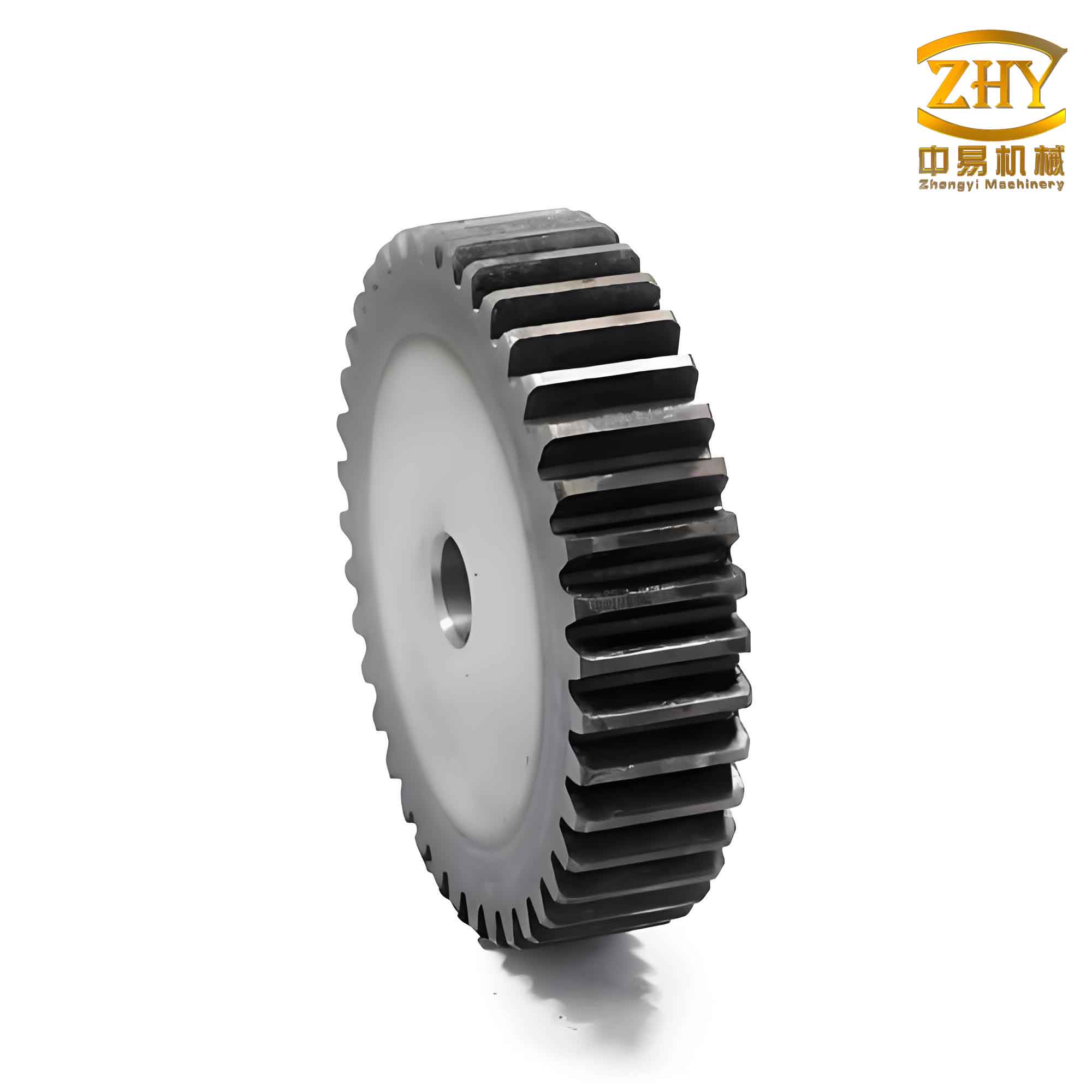
From these, all other critical diameters and dimensions are calculated. Assuming a standard full-depth tooth with an addendum coefficient of 1 and a dedendum coefficient of 1.25, the key geometric relations for any spur and pinion gear are summarized in the table below. These equations form the essential “skeleton” of the parametric model.
| Parameter | Symbol | Relation / Equation |
|---|---|---|
| Pitch Diameter | $d$ | $d = m \cdot z$ |
| Base Diameter | $d_b$ | $d_b = d \cdot \cos(\alpha)$ |
| Addendum Diameter (Tip Diameter) | $d_a$ | $d_a = m \cdot z + 2 \cdot m = d + 2m$ |
| Dedendum Diameter (Root Diameter) | $d_f$ | $d_f = m \cdot z – 2.5 \cdot m = d – 2.5m$ |
| Addendum | $h_a$ | $h_a = m$ |
| Dedendum | $h_f$ | $h_f = 1.25 \cdot m$ |
| Circular Pitch | $p$ | $p = \pi \cdot m$ |
| Tooth Thickness on Pitch Circle | $s$ | $s = \frac{p}{2} = \frac{\pi \cdot m}{2}$ |
The core principle of parametric CAD modeling is to create a feature-based history tree where dimensions are not static numbers but are driven by these algebraic relations and user-defined parameters. When I initiate a model for a spur and pinion gear, the first step is always to declare the driving parameters. In the software, I create parameters like `M` for module, `Z` for tooth count, `ALPHA` for pressure angle, and `FACE_WIDTH`. I assign them initial default values, for instance, m=3 mm, z=24, α=20°, B=20 mm. The software then allows me to create sketches and features, and instead of typing a numeric value for a dimension, I can input an expression like `=M*Z` for the pitch diameter. This creates a live link. Later, if I change `M` from 3 to 4, the pitch diameter automatically updates from 72 mm to 96 mm, and all features dependent on it regenerate accordingly.
The actual modeling sequence for a robust parametric spur and pinion gear is logical and follows the geometric construction. I begin by sketching the four critical concentric circles: the root circle, pitch circle, base circle, and addendum (tip) circle. Their diameters are not drawn freely; they are fully defined by the relations `D_F = M*Z – 2.5*M`, `D = M*Z`, `D_B = D*COS(ALPHA)`, and `D_A = M*Z + 2*M`, respectively. This ensures their sizes are always mathematically correct and linked to the primary variables.
The next critical step is generating the involute tooth profile. Using the curve-from-equation feature, I input the parametric involute equations, referencing the base diameter parameter `D_B`. This creates a precise, smooth involute curve from the base circle outward. To form a single tooth space, I need a segment of this curve. I create a datum point at the intersection of the involute and the pitch circle. The angular position of this point is key. Since the tooth thickness, `s`, occupies an angle of $(360 / (2*z))$ degrees on the pitch circle, the symmetry plane of a tooth slot is offset from this point by half of that angle: $\theta_{offset} = 360 / (4*z)$. I create a datum plane through the axis at this calculated angle, mirror the initial involute curve across it, and trim both curves with the root and addendum circles. This closed loop defines the cross-section of one tooth gap.
I then extrude this tooth gap profile to create a solid cut (or a surface) with a depth equal to the `FACE_WIDTH` parameter. To create all teeth, I do not pattern this cut 24 times manually. Instead, I use the pattern feature. I pattern the first tooth cut, choosing an “axis pattern” and setting the angular increment to be driven by a relation: `increment = 360 / Z`. The number of instances is set to `Z – 1`. This is a crucial detail; patterning `Z` instances at an increment of `360/Z` would cause the last instance to perfectly overlap the first, potentially causing regeneration errors. Patterning `Z-1` instances perfectly spaces the remaining teeth around the gear blank. The following table illustrates how changing the primary variables instantly drives a complete model regeneration.
| Design Scenario | Parameter Inputs | Key Resulting Dimension (Tip Dia.) |
|---|---|---|
| Base Design | m=3, z=24, B=20, α=20° | $d_a = 3*24 + 2*3 = 78.0 \text{ mm}$ |
| Increased Module | m=4, z=24, B=20, α=20° | $d_a = 4*24 + 2*4 = 104.0 \text{ mm}$ |
| Increased Tooth Count | m=3, z=30, B=20, α=20° | $d_a = 3*30 + 2*3 = 96.0 \text{ mm}$ |
| Wider Gear | m=3, z=24, B=30, α=20° | Face Width updates to 30 mm, diameters unchanged. |
The true power of this parametric approach extends far beyond the basic gear blank. Once the core tooth geometry is parametrically defined, I can easily add other common features through the same rule-based method. For example, a central hub, web, bore, keyway, or mounting holes can be added. Their dimensions can be linked to the primary gear parameters. The bore diameter might be defined as a function of the root diameter (`=D_F * 0.6`), or the keyway size might be selected from a standard based on the bore diameter. This creates a fully customizable yet standardized spur and pinion gear model library.
Parametric design fundamentally transforms the workflow for developing a spur and pinion gear. Its advantages are profound. First, it guarantees design consistency and accuracy. Once the correct relations (like those in Table 1) are validated and embedded, every generated gear, regardless of size, adheres to proper gear geometry standards. Human error in calculating and inputting individual dimensions is eliminated.
Second, it enables rapid design iteration and variant creation. Exploring “what-if” scenarios becomes trivial. To evaluate a gear with a different module or tooth count, I simply open the parameter table, input the new values, and regenerate the model. A new, perfectly accurate 3D model is ready in seconds. This is invaluable for optimization studies, where the model can be linked to simulation software to automatically evaluate performance metrics (stress, weight, inertia) across a range of sizes.
Third, it democratizes complex modeling. A well-constructed parametric gear model can be used by engineers, drafters, or technicians who may not be experts in 3D CAD modeling. They only need to understand the basic gear parameters. By filling in a simple input form (the parameter table), they can generate the exact model they need for their application, be it a small spur and pinion gear for a precision instrument or a large one for heavy machinery.
Finally, it creates a seamless bridge to downstream applications. A parametric model is not just a picture; it’s a precise digital twin. This model can be directly used for:
- Assembly and Interference Checking: Mating the parametric pinion with a parametrically-defined gear ensures proper mesh at any size.
- Kinematic and Dynamic Simulation: The model can be imported into Multi-Body Dynamics (MBD) software to analyze motion, forces, and vibration of the drive system.
- Finite Element Analysis (FEA): For stress and deflection calculations, the parametric model ensures the mesh is based on the exact geometry.
- Computer-Aided Manufacturing (CAM): The 3D model provides the exact geometry for generating toolpaths for milling, hobbing, or grinding the actual spur and pinion gear.
In conclusion, mastering the parametric design of a spur and pinion gear is more than a CAD technique; it is a foundational strategy for modern mechanical design efficiency. By investing time upfront to build an intelligent, relation-driven model, we create a dynamic template that pays endless dividends. It eliminates repetitive work, ensures geometric integrity, accelerates the design cycle, and facilitates integration with advanced engineering analysis. Whether you are designing a single custom gear or managing a vast library of standardized components, adopting a parametric approach for the fundamental spur and pinion gear is, in my professional judgment, an essential step towards leaner, more reliable, and more innovative mechanical design practice.