
In my experience as a mechanical design engineer, the传动 of worm gears has always been a fascinating area due to its critical role in various industrial applications. Worm gears offer significant advantages such as high reduction ratios, compact design, and smooth operation, making them indispensable in machinery like conveyors, lifts, and precision instruments. However, the complex geometry of worm gears poses challenges in traditional design methods, which are often time-consuming and error-prone. To address this, I have extensively explored parametric design techniques using UG software, which allows for efficient and accurate modeling of worm gears. This article delves into my approach to parameterizing worm gears, focusing on the use of tables and formulas to streamline the process. I will discuss the fundamental parameters, mathematical equations, and step-by-step modeling procedures, all while emphasizing the importance of worm gears in modern engineering.
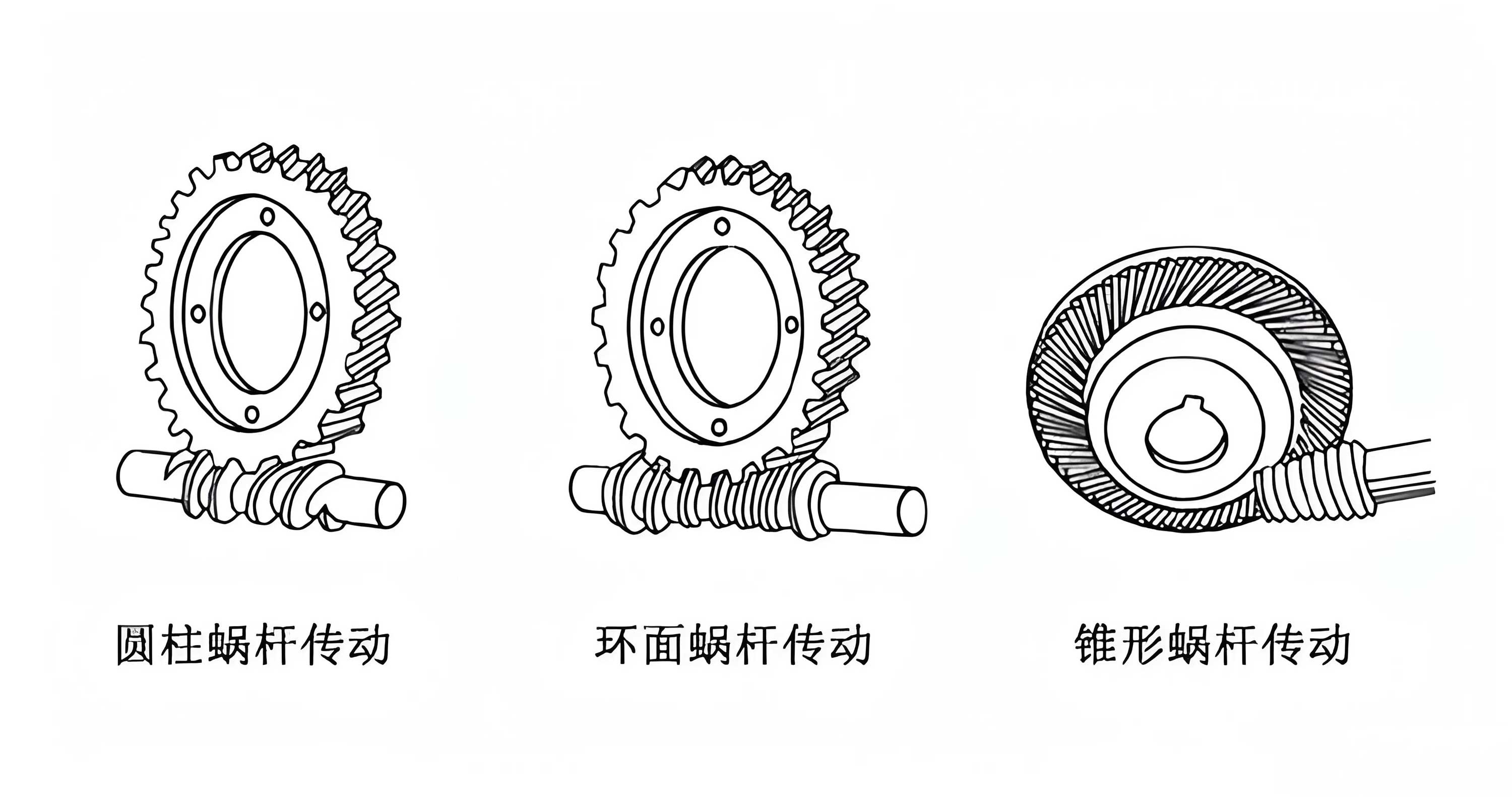
To begin, understanding the basic parameters of worm gears is essential for any parametric design. Worm gears consist of a worm (similar to a screw) and a worm wheel, and their interaction depends on precise geometric relationships. In my work, I rely on standardized parameters to ensure compatibility and performance. Below is a table summarizing the key design parameters for worm gears, which I use as a foundation for all calculations and modeling efforts. These parameters are derived from mechanical design handbooks and are crucial for generating accurate 3D models.
| Parameter Name | Symbol | Formula | Typical Value (Example) |
|---|---|---|---|
| Center Distance | a | $$a = \frac{d_1 + d_2 + 2x_2 m}{2}$$ | 50.25 mm |
| Number of Worm Threads | z₁ | Commonly z₁ = 1, 2, 4, 6 | 2 |
| Worm Gear Profile Shift Coefficient | x₂ | $$x_2 = \frac{a}{m} – \frac{d_1 + d_2}{2m}$$ | 0 |
| Axial Pitch of Worm | pₓ | $$p_x = \pi m$$ | 7.85 mm |
| Reference Diameter of Worm | d₁ | $$d_1 = m q$$ | 28 mm |
| Tip Diameter of Worm | d_{a1} | $$d_{a1} = d_1 + 2m$$ | 33 mm |
| Root Diameter of Worm | d_{f1} | $$d_{f1} = d_1 – 2.4m$$ | 22 mm |
| Tooth Height of Worm | h₁ | $$h_1 = \frac{d_{a1} – d_{f1}}{2}$$ | 5.5 mm |
| Number of Worm Gear Teeth | z₂ | $$z_2 = i z_1$$, where i is gear ratio | 29 |
| Reference Diameter of Worm Gear | d₂ | $$d_2 = m z_2$$ | 72.5 mm |
| Root Diameter of Worm Gear | d_{f2} | $$d_{f2} = d_2 – 2m(1.2 – x_2)$$ | 66.5 mm |
| Tip Diameter of Worm Gear | d_{a2} | $$d_{a2} = d_2 + 2m(1 + x_2)$$ | 77.5 mm |
| Outer Diameter of Worm Gear | d_{e2} | For z₁=2-3, $$d_{e2} = d_{a2} + 1.5m$$; for z₁=1, $$d_{e2} = d_{a2} + 2m$$ | 81.25 mm |
| Tooth Height of Worm Gear | h₂ | $$h_2 = \frac{d_{a2} – d_{f2}}{2}$$ | 5.5 mm |
These parameters are interconnected through mathematical relationships that define the geometry of worm gears. In my parametric design approach, I input these formulas into UG software’s expression editor to create a dynamic model. For instance, the module (m) is a fundamental parameter, and I typically set it to 2.5 mm for initial calculations. The worm diameter coefficient (q) is another critical value, often chosen as 11.2 to ensure proper meshing. The lead angle (γ) of the worm is calculated using the arctangent function: $$γ = \arctan\left(\frac{z_1}{q}\right)$$, which I find essential for determining the spiral path. Similarly, the helix angle (β) of the worm gear is set equal to γ to ensure correct engagement. By defining these expressions, I can easily modify any parameter, and the entire model updates automatically, saving considerable time in the design process.
Moving on to the parametric modeling of the worm gear, I start by generating the basic curves that form its轮廓. In UG, I use the sketch function to draw circles representing the reference, tip, and root diameters. The expressions for these diameters are derived from the parameters table. For example, the reference diameter of the worm gear is given by $$D_{d2} = m z_2$$, which I compute as 72.5 mm. The tip diameter is $$D_{da2} = d_2 + 2m(1 + x_2)$$, resulting in 77.5 mm, and the root diameter is $$D_{df2} = d_2 – 2m(1.2 – x_2)$$, yielding 66.5 mm. These curves serve as the foundation for building the 3D实体 of the worm gear. I emphasize that accuracy here is crucial because any deviation can lead to improper meshing in the final assembly of worm gears.
Next, I focus on creating the involute tooth profile of the worm gear, which is a key aspect of its design. The involute curve defines the shape of each tooth and ensures smooth transmission of motion. To generate this curve parametrically, I use a set of equations based on the渐开线 equation. I define a system variable t that ranges from 0 to 1, representing the parameter along the curve. The radius (r_k) at any point is calculated as $$r_k = \frac{d_{f2}}{2 \cos(\theta)}$$, where θ is the pressure angle. The展开 angle (θ_e) is given by $$θ_e = \tan(\alpha) – \alpha$$ in radians, with α being the pressure angle, typically 20°. In UG, I input these as expressions: for example, I set `t=1` as a variable, and then define `rk = df2/(2*cos(t*50))` to cover an angle range of 0° to 50°. The Cartesian coordinates are then derived as $$x_{1t} = r_k \cos(θ_e)$$ and $$y_{1t} = r_k \sin(θ_e)$$, with $$z_{1t} = 0$$ for the 2D plane. To create a symmetric tooth space, I also define $$y_{2t} = -y_{1t}$$. Additionally, I calculate the angular width of the tooth space on the reference circle as $$e = \frac{\pi m}{2}$$, and the展角 between the base and reference circles as $$b_k = \deg(\tan(\alpha) – \text{rad}(\alpha))$$. These values help me position the involute curves correctly on the worm gear. By using UG’s law curve function, I can plot these equations and generate precise involute segments, which form the tooth轮廓 for the worm gears.
After defining the tooth profile, I proceed to model the helix of the worm gear, which accounts for its spiral shape. The helix is essential because worm gears have teeth that wrap around the wheel, enabling continuous contact with the worm. I express the helix using parametric equations based on the helix angle β. For the worm gear, I define the angle as `angle = t*90` degrees, where t varies from 0 to 1. The coordinates along the helix are given by: $$x_{2t} = \frac{d_2}{2} \tan(\beta) t$$, $$y_{2t} = a – \frac{d_2}{2} \cos(\text{angle})$$, and $$z_{2t} = \frac{d_2}{2} t$$. Here, a is the center distance, which I set as 50.25 mm. To create a full spiral, I also define negative directions: $$x_{3t} = -x_{2t}$$ and $$z_{3t} = -z_{2t}$$. In UG, I use these expressions to generate a law curve that represents the path for sweeping the tooth profile. This helix ensures that the teeth of the worm gear are correctly aligned for meshing with the worm, a critical step in the design of worm gears.
With the basic curves and helix defined, I can now construct the solid model of the worm gear. First, I create a rotational surface by drawing an arc on the YZ-plane with a radius of $$r_{e2} = \frac{d_{f1}}{2} + 0.2m$$, where d_{f1} is the root diameter of the worm. The center of this arc is positioned at a distance equal to the center距 a along the Y-axis. I then revolve this arc around the Z-axis to form a surface. Next, I extrude the tip circle of the worm gear symmetrically to a width b, which I typically set based on design requirements. Using the rotational surface, I trim the extruded body to create the rough shape of the worm gear. For the teeth, I use the swept feature in UG: I select the involute tooth profile as the section curve and the helix as the guide curve. By sweeping this profile along the helix, I generate a single tooth space. To create all teeth, I employ the pattern feature in UG, rotating the tooth space around the Z-axis by an angle of $$\frac{360°}{z_2}$$ for each tooth. In this case, with z₂=29, I pattern 29 instances. Finally, I perform a Boolean subtraction operation, subtracting all tooth spaces from the rough gear body to obtain the complete worm gear model. This parametric approach allows me to quickly adjust the number of teeth or other parameters and regenerate the model, which is invaluable when designing custom worm gears for specific applications.
Now, let’s turn to the parametric modeling of the worm itself. The worm is essentially a screw-like component that meshes with the worm gear. I start by defining its basic parameters using expressions similar to those for the worm gear. For instance, the reference diameter of the worm is $$d_1 = m q$$, which I compute as 28 mm. The tip diameter is $$d_{a1} = d_1 + 2m$$, giving 33 mm, and the root diameter is $$d_{f1} = d_1 – 2.4m$$, resulting in 22 mm. In UG, I create a new coordinate system offset from the original by a distance $$l_{12} = \frac{d_2 – d_1}{2}$$, which aligns the worm with the worm gear. On the YZ-plane of this new system, I sketch circles for the tip, reference, and root diameters, then extrude them to form a cylindrical body as the worm blank. This blank serves as the base for adding the helical threads.
The next step is to generate the helix of the worm, which defines its thread path. Unlike the worm gear, the worm has a continuous spiral that wraps around its axis. I define the helix with parametric equations considering the number of threads z₁ and the axial pitch pₓ. For example, I set the number of turns n to 5 for a multi-start worm. The coordinates are given by: $$x_{4t} = \left(\frac{q m}{2}\right) \cos(360 n t)$$, $$y_{4t} = \left(\frac{q m}{2}\right) \sin(360 n t)$$, and $$z_{4t} = n \pi m z_1 t$$. Here, t ranges from 0 to 1, and I use UG’s law curve function to plot this spiral. This helix represents the path that the tooth profile will follow along the worm. I find that accurately defining this helix is crucial for ensuring proper meshing with the worm gear, as any misalignment can cause noise or wear in worm gears.
To create the threads on the worm, I use the same involute tooth profile that I defined for the worm gear, but I adjust its orientation to match the worm’s axis. In UG, I select the involute curve as the section and sweep it along the worm’s helix. During the sweep, I specify the orientation vector, typically along the Y-axis, to maintain the correct tooth alignment. After sweeping, I obtain a helical thread实体. I then use Boolean subtraction to subtract this thread from the worm blank, carving out the thread space. Since the worm has multiple starts, I repeat this process for each thread, or use a patterning feature to create them all at once. Finally, I trim any excess material from the ends of the worm to complete the model. This parametric method ensures that the worm and worm gear are perfectly matched, as both are derived from the same set of equations. By modifying parameters like module or number of threads, I can quickly generate new designs for worm gears, which is especially useful in prototyping and customization.
Throughout this process, I rely heavily on tables and formulas to organize and compute the design parameters. Below is another table that summarizes the key expressions I use in UG for both the worm and worm gear. This table serves as a quick reference for implementing parametric design.
| Component | Expression Name | Mathematical Formula | UG Expression Example |
|---|---|---|---|
| Worm Gear | Reference Diameter | $$d_2 = m z_2$$ | `Dd2 = m * z2` |
| Tip Diameter | $$d_{a2} = d_2 + 2m(1 + x_2)$$ | `Dda2 = d2 + 2*m*(1 + x2)` | |
| Involute X-Coordinate | $$x_{1t} = r_k \cos(\theta_e)$$ | `x1t = rk * cos(thez)` | |
| Involute Y-Coordinate | $$y_{1t} = r_k \sin(\theta_e)$$ | `y1t = rk * sin(thez)` | |
| Helix Y-Coordinate | $$y_{2t} = a – \frac{d_2}{2} \cos(\text{angle})$$ | `y2t = a – (d2/2)*cos(angle)` | |
| Worm | Reference Diameter | $$d_1 = m q$$ | `d1 = m * q` |
| Lead Angle | $$γ = \arctan\left(\frac{z_1}{q}\right)$$ | `gamma = atan(z1/q)` | |
| Helix X-Coordinate | $$x_{4t} = \left(\frac{q m}{2}\right) \cos(360 n t)$$ | `x4t = (q*m/2) * cos(360*n*t)` | |
| Helix Z-Coordinate | $$z_{4t} = n \pi m z_1 t$$ | `z4t = n * pi() * m * z1 * t` | |
| Axial Pitch | $$p_x = \pi m$$ | `px = pi() * m` |
In addition to these expressions, I often use derived formulas to check for design constraints. For example, the contact ratio of worm gears is critical for smooth operation. I calculate it using the formula $$ε_γ = \frac{\sqrt{d_{a1}^2 – d_{b1}^2} + \sqrt{d_{a2}^2 – d_{b2}^2} – a \sin\alpha}{p_x \cos\gamma}$$, where d_{b1} and d_{b2} are the base diameters of the worm and worm gear, respectively. This ensures that multiple teeth are in contact at any time, reducing stress and noise. Another important aspect is the efficiency of worm gears, which I estimate with $$η = \frac{\tan\gamma}{\tan(\gamma + φ)}$$, where φ is the friction angle. These calculations help me optimize the design for performance, and by incorporating them into UG expressions, I can automate the evaluation process. This holistic approach underscores the power of parametric design in creating reliable worm gears.
Moreover, the parametric design of worm gears extends beyond mere modeling; it facilitates analysis and simulation. In UG, I can assign material properties to the worm gear models and perform finite element analysis (FEA) to assess stress distribution and deformation under load. For instance, I often simulate the meshing of worm gears to identify high-stress areas, such as the tooth roots or contact surfaces. The parametric nature allows me to quickly iterate designs—for example, by increasing the module m to enhance strength or adjusting the profile shift coefficient x₂ to improve tooth engagement. I can also conduct motion analysis to verify that the worm gears operate smoothly without interference, which is crucial for applications like valve actuators or precision drives. By linking the 3D model with analytical tools, I ensure that the worm gears meet both geometric and performance requirements, reducing the need for physical prototypes.
Furthermore, the integration of worm gears into larger assemblies benefits greatly from parametric design. In UG, I can create an assembly model where the worm and worm gear are mated based on their parametric relationships. For example, I constrain the worm’s axis to be perpendicular to the worm gear’s axis, with a center distance defined by parameter a. As I modify the design parameters, the entire assembly updates accordingly, maintaining proper alignment. This is particularly useful when designing systems with multiple worm gears, such as in gearboxes or conveyors, where consistency across components is vital. I also use UG’s drafting tools to generate 2D drawings directly from the 3D models, with dimensions driven by the same parameters. This ensures that any change in the model automatically updates the drawings, streamlining the documentation process for worm gears.
In my experience, one of the key challenges in designing worm gears is managing the trade-offs between size, strength, and efficiency. Parametric design helps address this by enabling rapid exploration of design alternatives. For example, I can create a design table in UG that lists different combinations of module, number of teeth, and profile shift. By running simulations on each variant, I can select the optimal design for a given application. Below is a simplified table showing how varying the module affects key dimensions of worm gears, which I use for quick comparisons.
| Module (m) in mm | Worm Reference Diameter (d₁) in mm | Worm Gear Reference Diameter (d₂) in mm | Center Distance (a) in mm | Estimated Efficiency (η) for γ=10° |
|---|---|---|---|---|
| 2.0 | 22.4 | 58.0 | 40.2 | 0.85 |
| 2.5 | 28.0 | 72.5 | 50.25 | 0.87 |
| 3.0 | 33.6 | 87.0 | 60.3 | 0.88 |
| 3.5 | 39.2 | 101.5 | 70.35 | 0.89 |
This table illustrates that as the module increases, the worm gears become larger and potentially stronger, but the center distance also grows, which may impact the overall system size. The efficiency tends to improve slightly due to changes in the lead angle. By using such tables in conjunction with parametric models, I can make informed decisions early in the design phase, saving time and resources. This iterative process is at the heart of modern engineering for worm gears.
Another aspect I consider is the manufacturing feasibility of worm gears. Parametric design allows me to export the 3D models in formats suitable for CNC machining or 3D printing. For instance, I can generate STL files from UG for additive manufacturing of prototype worm gears, or create toolpaths for milling the teeth on a five-axis machine. The accuracy of the parametric model ensures that the manufactured parts will mesh correctly, reducing assembly issues. I also use the models to design custom fixtures or inspection gauges, further integrating design and production. In industries like automotive or aerospace, where worm gears are used in steering systems or actuators, this seamless workflow is essential for meeting tight tolerances and deadlines.
To enhance the parametric design process, I often incorporate advanced features in UG, such as user-defined functions (UDFs) or macros. For example, I can write a script that automatically generates a worm gear model based on input parameters like power rating or speed ratio. This script can include checks for design limits, such as minimum tooth thickness or maximum contact stress, ensuring that the worm gears are safe and reliable. I can also link UG with external databases or spreadsheets to pull in standard参数 values, such as those from ISO or AGMA standards for worm gears. This automation not only speeds up design but also reduces human error, leading to higher-quality worm gears.
In conclusion, parametric design using UG software revolutionizes the way we approach worm gears. By leveraging mathematical formulas and tables, I can create accurate, adaptable models that respond dynamically to changes. This method improves design efficiency, facilitates analysis, and supports manufacturing, making it invaluable for developing worm gears for diverse applications. Whether for heavy-duty machinery or precision instruments, parametric design ensures that worm gears meet the required performance criteria while minimizing development time. As technology advances, I believe that further integration with simulation and AI will continue to enhance the design of worm gears, driving innovation in mechanical systems.
Throughout this article, I have emphasized the importance of worm gears in engineering and detailed my parametric design methodology. From basic parameters to complex modeling steps, the use of expressions and curves in UG enables a robust workflow. I encourage engineers to adopt parametric techniques for worm gears, as they offer flexibility and precision that traditional methods cannot match. By doing so, we can push the boundaries of what worm gears can achieve, contributing to more efficient and reliable machinery worldwide.