
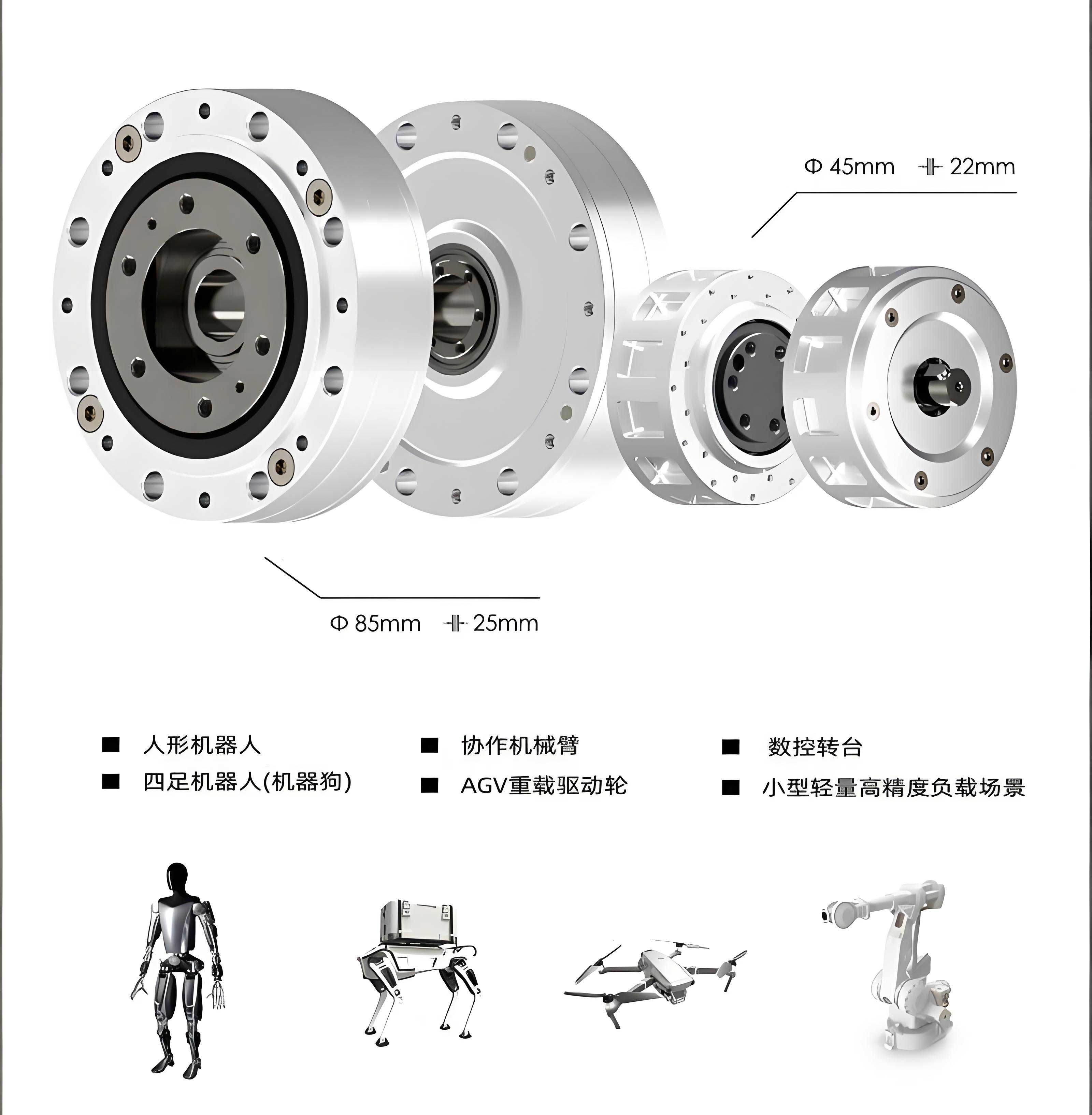
In the realm of high-precision transmission systems, such as those employed in industrial robotics and CNC machine tools, the RV reducer (often referred to as 2K-V transmission domestically) has emerged as a critical component. Its advantages, including compact size, light weight, high transmission ratio, substantial load capacity, excellent transmission accuracy and efficiency, smooth operation, and high rigidity, make it a focal point of research and development. The proliferation of various specifications and models of RV reducers presents a significant challenge: designing and analyzing each variant individually is immensely time-consuming and redundant. To address this, virtual prototyping technology offers a powerful solution. By creating digital equivalents of physical prototypes, we can employ modern analysis tools like ANSYS for finite element analysis (FEA) and ADAMS for dynamic multi-body simulation. This approach allows for performance evaluation, design optimization, and virtual testing—capabilities often impossible or prohibitively expensive with physical prototypes—thereby drastically reducing development costs and cycle times.
However, the complexity of the RV reducer, with its numerous interconnected parts like cycloidal gears, involute gears, crank shafts, and needle bearings, necessitates an efficient modeling strategy. Traditional modeling for each specific规格 is impractical. Given the high degree of structural similarity among RV transmission components across different sizes, parametric modeling technology stands out as the most effective pathway for constructing versatile virtual prototype models. While prior research has explored modeling specific RV reducer instances in software like Pro/E or Solidworks for subsequent analysis, a holistic, system-level approach to parametric design for the entire assembly is less common. Some studies have delved into secondary development using programming toolkits, but these methods can be complex and require specialized skills. Therefore, this article presents a streamlined, practical, and easily implementable methodology for the three-dimensional parametric modeling and virtual assembly of RV reducers, utilizing Pro/Engineer (Pro/E) as the foundational platform. The resulting parametric virtual prototype is directly suitable for subsequent ANSYS finite element analysis and ADAMS virtual simulation, eliminating repetitive modeling tasks.
The core of our methodology is feature-based parametric modeling. In this paradigm, the three-dimensional geometry of a part is defined not by fixed dimensions but by a set of controlling parameters and the mathematical relationships between them. Changing a key parameter, such as the number of teeth on a cycloidal gear, automatically triggers a regeneration of the entire part geometry based on predefined rules (relations). This is immensely powerful for a family of parts like those in an RV reducer. We will dissect the parametric creation of the two most geometrically complex components: the cycloidal disc (摆线轮) and the involute spur gear, followed by the simpler structural components.
The cycloidal disc is the heart of the RV reducer’s second transmission stage. Its tooth profile is generated based on the theory of cycloidal motion relative to a circle of needle pins. To create a parametric model, we start by defining the fundamental characteristic parameters. These parameters are declared within Pro/E’s parameter table, establishing them as the primary drivers of the model.
| Parameter Symbol | Example Value (RV-40E) | Description |
|---|---|---|
| \(z_g\) | 39 | Number of teeth on the cycloidal disc |
| \(z_b\) | 40 | Number of needle pins (teeth on the stationary ring) |
| \(r_z\) | 66 mm | Radius of the needle pin center circle |
| \(r_{rz}\) | 3 mm | Radius of a single needle pin |
| \(e\) | 1.5 mm | Eccentricity (crank offset) |
| \(m\) | 0 mm | Profile shift modification (移距修正量) |
| \(n\) | 0 mm | Equidistant modification (等距修正量) |
| \(k\) | Derived | Short-width coefficient |
| \(a\) | Derived | Reference rotation angle |
After defining these parameters, we establish relations to calculate dependent variables. For instance, the short-width coefficient \(k\) and the angle \(a\) are calculated automatically via relations input into Pro/E:
$$k = \frac{e \cdot z_b}{(r_z + m) / (z_b – z_g)}$$
$$a = \frac{180}{z_g}$$
The crux of the cycloidal profile generation lies in its parametric equations. We use Pro/E’s equation-driven curve tool. Selecting a Cartesian coordinate system, we input the following set of equations, where \(t\) is the system’s intrinsic variable ranging from 0 to 1.
$$\text{ang} = a \cdot t$$
$$p = \frac{k \cdot \sin(z_b \cdot \text{ang}) – \sin(\text{ang})}{\sqrt{1 + k^2 – 2k \cdot \cos(z_g \cdot \text{ang})}}$$
$$q = \frac{-k \cdot \cos(z_b \cdot \text{ang}) + \cos(\text{ang})}{\sqrt{1 + k^2 – 2k \cdot \cos(z_g \cdot \text{ang})}}$$
$$x = (r_z + m) \cdot \sin(\text{ang}) – e \cdot \sin(z_b \cdot \text{ang}) + (r_{rz} + n) \cdot p$$
$$y = (r_z + m) \cdot \cos(\text{ang}) – e \cdot \cos(z_b \cdot \text{ang}) – (r_{rz} + n) \cdot q$$
$$z = 0$$
Executing these equations yields a curve representing half of a single cycloidal tooth lobe. Mirroring this curve about a plane of symmetry gives one complete tooth profile. The power of parametrics is then fully leveraged by creating a pattern (circular array) of this tooth. The pattern is defined by the number of instances, \(z_g\), and the increment angle, \(360/z_g\) degrees. Crucially, both the instance count and the angle increment are linked back to the parameter \(z_g\) via relations. This ensures that changing \(z_g\) automatically updates not only the base tooth geometry via the equations but also the patterning operation, generating a new disc with the correct number of teeth. The 2D profile is then extruded to create a solid, and features like mounting holes for the crank pins and central bearing bores are added using standard extrusion cuts, with their dimensions also parameterized where applicable.
The first reduction stage in an RV reducer typically employs a standard involute spur gear pair. Parametric modeling of such gears is a well-established practice, and we implement it systematically. The driving parameters for a spur gear are defined as follows.
| Parameter Symbol | Example Value | Description |
|---|---|---|
| \(m\) | 1.5 mm | Module |
| \(z\) | 32 | Number of teeth |
| \(\alpha\) | 20° | Pressure angle |
| \(h_a^*\) | 1 | Addendum coefficient |
| \(c^*\) | 0.25 | Dedendum clearance coefficient |
| \(b\) | 7 mm | Face width |
| \(x\) | 0 | Profile shift coefficient (变位系数) |
| \(h_a\) | Derived | Addendum |
| \(h_f\) | Derived | Dedendum |
| \(d\) | Derived | Pitch diameter |
| \(d_a\) | Derived | Tip diameter |
| \(d_f\) | Derived | Root diameter |
| \(d_b\) | Derived | Base circle diameter |
The fundamental gear geometry relations are input into Pro/E’s relation editor. These equations govern the dependent dimensions.
$$h_a = (h_a^* + x) \cdot m$$
$$h_f = (h_a^* + c^* – x) \cdot m$$
$$d = m \cdot z$$
$$d_a = d + 2 \cdot h_a$$
$$d_b = d \cdot \cos(\alpha)$$
$$d_f = d – 2 \cdot h_f$$
The modeling process involves sketching four concentric construction circles on a datum plane, representing the tip, pitch, root, and base circles. Their diameters are assigned the symbolic names from the relations (e.g., `d0 = d`, `d1 = d_a`). The involute curve is then created using another equation-driven curve. The parametric equations for a standard involute are used:
$$\text{ang} = 90 \cdot t$$
$$r = \frac{d_b}{2}$$
$$s = \frac{\pi \cdot r \cdot t}{2}$$
$$x_c = r \cdot \cos(\text{ang})$$
$$y_c = r \cdot \sin(\text{ang})$$
$$x = x_c + s \cdot \sin(\text{ang})$$
$$y = y_c – s \cdot \cos(\text{ang})$$
$$z = 0$$
This generates one side of a tooth space. A datum plane is constructed through the intersection point of this involute with the pitch circle and the gear axis. This plane is then rotated by \(360/(4z)\) degrees to serve as a mirror plane for the tooth profile. After mirroring the involute segment, the tooth fillet at the root is sketched, with its radius parameterized based on the addendum coefficient. A typical relation for the fillet radius \(r_f\) could be:
$$\text{IF } h_a^* \ge 1 \quad \text{THEN } r_f = 0.38 \cdot m \quad \text{ELSE } r_f = 0.46 \cdot m$$
The closed 2D tooth profile is then extruded to form a single solid tooth. Finally, a circular pattern is applied with \(z\) instances and an increment of \(360/z\) degrees, both linked to the parameter \(z\), completing the fully parametric involute gear model.
Other components of the RV reducer, such as the crank shafts (曲柄轴), output flange (输出盘), support plates (支撑盘), and housing (针齿壳), are geometrically less complex. They are modeled primarily using extrusions and revolutions. A critical practice is to maintain consistent sketch orientation; for example, all extrusions are sketched on a standard FRONT plane, and all revolutions on a standard TOP plane. This ensures the Z-axes of all parts are aligned in the global assembly coordinate system, greatly simplifying the subsequent virtual assembly process. All critical dimensions, such as bearing seat diameters, crank eccentricities, and mounting hole patterns, are parameterized by adding them to the relations editor. For simulation efficiency, some non-essential geometric details present in physical parts, such as chamfers, small fillets, or intricate keyway profiles, can be omitted in this virtual prototype stage without affecting the core kinematic or dynamic behavior. For instance, the spline connection between the involute sun gear and the crank shaft can be represented as a simple cylindrical joint since they are often treated as a rigid connection in initial simulations.
The virtual assembly of the parametric RV reducer model is where the “parent-child” relationships intrinsic to feature-based CAD systems like Pro/E become strategically important. A parent feature must exist before its child feature can be created, and changes to the parent propagate to the child. In assembly context, we can think of assembly constraints as creating dependencies between components. Our strategy is designed to ensure that when any part’s driving parameters are changed, the entire assembly updates correctly without breaking constraints, and to facilitate easy model simplification for different types of analysis (e.g., removing bearing details for kinematic studies).
We begin by creating a sub-assembly for the stationary needle pins. All needle pin instances are created within this sub-assembly using a pattern, resulting in a single component file representing the full needle ring. This needle sub-assembly is inserted into the main assembly first and placed using a “Default” (fixed) constraint. It serves as the foundational reference for the rest of the assembly.
The assembly sequence for the core moving parts proceeds as follows: Needle Sub-assembly -> Output Flange -> Crank Shafts -> Cycloidal Discs -> Involute Sun Gear -> Input Shaft. To enable motion simulation within Pro/E’s Mechanism module, connections are defined as “Pin” joints for rotating components. The output flange is constrained to the housing or ground with a pin joint. Each crank shaft is assembled onto the output flange using a pin joint, making the output flange its “parent.” Each cycloidal disc is then mounted onto its respective crank pin. The disc must have two rotational degrees of freedom relative to the crank: one for its revolution around the crank center (eccentric motion) and one for its rotation about its own center. In the physical RV reducer, this is enabled by bearings. In our virtual model for initial kinematics, this can be represented by connecting the cycloidal disc to the crank shaft with a pin joint, effectively defining their relative rotation axis. The involute sun gear is assembled onto the crank shaft (often via a simplified cylindrical joint), and the input shaft is assembled to mesh with the sun gear. To prevent initial geometric interference during assembly, temporary datum planes aligned with tooth spaces and tooth thicknesses can be used to position the gears, which are later suppressed to allow free motion definition.
Finally, the supporting structure is added. The support plates and main bearing are assembled relative to the output flange (their parent). The crank pin bearings and crank support bearings are assembled relative to the crank shafts. The housing (针齿壳) is assembled relative to the fixed needle sub-assembly. This carefully chosen hierarchy ensures that if the output flange’s geometry changes (e.g., its diameter due to a parameter change), the crank shafts, their bearings, and the support plates will move accordingly, maintaining proper alignment. Similarly, changes to the needle ring parameters will automatically reposition the housing.
With the fully assembled parametric RV reducer model, validation is essential. We perform an interference check to ensure no components physically overlap in their nominal positions. Following this, we define the kinematic joints within Pro/E’s Mechanism application. The input shaft is assigned a pin joint connected to ground. A gear pair connection is defined between the input shaft’s pinion and the involute sun gear. The gear ratio is set according to their tooth numbers, e.g., \(i_1 = z_{\text{sun}} / z_{\text{input}} = 32/16 = 2\).
Defining the second-stage reduction (cycloidal stage) requires a more nuanced approach because it is a planetary mechanism. The reduction ratio \(i_2\) between the crank shaft’s rotation (input to the cycloidal stage) and the output flange’s rotation is given by \(i_2 = -z_b / (z_g – z_b)\). For the example with \(z_g=39\) and \(z_b=40\), \(i_2 = -40\). The negative sign indicates direction reversal. To model this in Pro/E’s mechanism, which requires defining gear pairs between two defined pin joints, we can create a “virtual” gear pair. We define a pin joint for the cycloidal disc’s rotation relative to the crank shaft. Then, we define a gear pair between this disc pin joint (representing the disc’s “spin”) and the crank shaft’s pin joint relative to ground (representing the crank’s “orbit” or revolution). The effective ratio for this virtual pair is set to achieve the overall motion. A servo motor is applied to the input shaft’s pin joint, prescribing a rotational velocity, for example, 1500 deg/s or 1500 rpm. Executing a kinematic analysis runs the simulation. We can then measure the rotational velocity of the output flange. For an input of 1500 rpm and a total theoretical reduction ratio of \(i_{\text{total}} = i_1 \cdot i_2 = 2 \cdot (-40) = -80\), the output speed should be \(1500 / 80 = 18.75\) rpm (ignoring sign). The simulation output from our parametric model confirms this value, verifying the geometric and kinematic correctness of our parametric RV reducer assembly.
The true value of a parametric virtual prototype extends far beyond simple model creation. It enables rapid, systematic exploration of the RV reducer’s performance under various design modifications and analysis assumptions. We can conduct several tiers of investigation.
Pure Kinematic Analysis: This is the baseline, as described in the validation step. All joints are idealized (pin joints, gear pairs), implying no backlash, no elastic deformation, and perfect force transmission. It provides the ideal motion transfer function and is excellent for visualizing the complex compound motion of the cycloidal discs—their combined orbital and rotational movement—which is fundamental to understanding the compact, high-ratio nature of the RV reducer.
Dynamic Analysis with Contact Forces: For more realistic simulation, especially when studying vibration, noise, or load distribution, we must consider forces. This involves exporting the model to a multi-body dynamics software like ADAMS. The parametric model simplifies this process. We can create different export configurations. In one configuration, we can replace the kinematic gear pair for the first stage with a contact force definition between the involute teeth, while keeping the cycloidal stage as kinematic constraints. This isolates the dynamic effects (impacts, fluctuations) stemming from the involute gear meshing on the overall output. Conversely, we can model the cycloidal disc and needle pins with contact forces (using the precise cycloidal profiles generated by our parameters) while keeping the first stage kinematic. This reveals the unique dynamic behavior of the cycloidal meshing, which is often credited for the RV reducer’s high stiffness and smooth motion. Finally, a fully dynamic model with contact forces in both stages can be built to study their coupled interactions. The material properties assigned to each component are also parameterized attributes, allowing for quick studies on the effect of material changes (e.g., from steel to a composite).
Analysis of Tolerances and Clearances (Gap Analysis): The parametric model is exceptionally well-suited for studying the effects of manufacturing tolerances and intentional design clearances. A key application is the analysis of profile modifications on the cycloidal disc. In practice, cycloidal teeth are often slightly modified from the theoretical profile to optimize load distribution, reduce friction, or accommodate lubrication and assembly tolerances. The common modifications are profile shift (\(m\)) and equidistant modification (\(n\)). With our parametric model, investigating the impact of these modifications is trivial. We simply change the values of parameters \(m\) and \(n\) in Table 1 and regenerate the model. The entire assembly updates. We can then re-export to ADAMS, define contacts, and simulate to see how the modified clearance affects transmission error, load sharing among needle pins, bearing forces on the crank, and ultimately, the vibration spectrum of the output. Similarly, the effect of backlash in the involute gear stage or clearance in bearing fits can be studied by parametrically adjusting corresponding dimensions in the parts or joint definitions. This capability allows for virtual tolerance stacking analysis and design-for-assembly studies long before any physical part is manufactured.
To further illustrate the parametric relationships and their impact on RV reducer design space, consider the following table summarizing key performance-linked parameters.
| Aspect | Governing Parameters | Primary Relationship / Effect |
|---|---|---|
| Reduction Ratio | \(z_g\), \(z_b\), \(z_{\text{input}}\), \(z_{\text{sun}}\) | \(i_{\text{total}} = \left( \frac{z_{\text{sun}}}{z_{\text{input}}} \right) \cdot \left( \frac{-z_b}{z_g – z_b} \right)\) |
| Cycloidal Tooth Profile | \(z_g\), \(z_b\), \(r_z\), \(e\), \(r_{rz}\), \(m\), \(n\) | Defined by the parametric equations system. Modifications \(m, n\) control meshing clearance and contact stress distribution. |
| Size/Scale | \(r_z\), \(m\) (module for gears) | Approximate outer diameter is proportional to \(r_z\). Torque capacity scales with size parameters cubed. |
| Eccentricity & Forces | \(e\) | Larger \(e\) increases the “wobble” amplitude of cycloidal disc, affecting bearing loads and overall compactness. |
| Load Sharing | \(z_g\), \(z_b\), modification parameters | Number of teeth in contact theoretically is \(z_g / 2\). Profile modifications optimize load sharing among needle pins. |
The parametric framework also seamlessly bridges to finite element analysis. After validating the kinematics, the exact same Pro/E model can be used for structural analysis. For instance, to perform a static stress analysis on the cycloidal disc under maximum torque load, we simply assign material properties, apply boundary conditions (constraining the bearing bores and applying force to the tooth faces from the needles), and mesh the geometry. Because the model is parametric, a design iteration—say, increasing the disc thickness to reduce stress—requires changing just one or two thickness parameters and regenerating. The updated geometry is immediately ready for a new FEA run. This integrated workflow from parametric CAD to FEA to dynamics simulation is the cornerstone of modern digital prototyping for complex systems like the RV reducer.
In conclusion, the methodology presented here establishes a robust and efficient pipeline for the design and analysis of RV reducers through parametric modeling and virtual assembly. The core achievement is the creation of a fully parametric three-dimensional virtual prototype of the complete RV reducer assembly using standard CAD functionality, without the need for complex secondary development. The strategic definition of parent-child relationships during assembly ensures model integrity and automatic update propagation when any driving parameter is altered, be it the number of teeth, eccentricity, or modification coefficients. This directly addresses the challenge of variety in RV reducer specifications, eliminating the need for repetitive, error-prone manual remodeling for each new design variant or analysis scenario.
The model’s correctness is rigorously verified through kinematic simulation, matching theoretical reduction ratios. More importantly, this parametric virtual prototype serves as a versatile digital twin, enabling a stratified investigation into the RV reducer’s behavior. It facilitates pure kinematic studies, dynamic analysis with varying levels of fidelity (from idealized joints to detailed contact forces), and sensitivity analyses on critical design parameters like cycloidal tooth modifications. This empowers engineers to explore the design space virtually, optimizing for performance, durability, and manufacturability before committing to physical prototypes. The process is characterized by its simplicity, relying on the native parametrics of mainstream CAD software, making it highly accessible and practical for engineering teams focused on advancing RV reducer technology for the next generation of precision machinery.