
The pursuit of efficient, reliable, and controllable speed variation in mechanical power transmission has led to the development of various types of continuously variable transmissions (CVTs). Among mechanical CVTs, the pulsating type offers distinct advantages, including a simple structure, reliable operation, a wide speed range (theoretically down to zero output speed), and the capability for speed adjustment both at standstill and during motion. A novel variant within this category is the swash plate pulsating CVT, which utilizes a unique axial meshing transmission mechanism employing helical gears. In this configuration, the driving helical gear is constrained to reciprocating axial motion, while the driven helical gear performs a continuous rotary output. This article provides a comprehensive analysis of how the key geometric parameters of these helical gears fundamentally influence the transmission characteristics—namely, the transmission ratio, output torque, power capacity, and operational smoothness—of the swash plate pulsating CVT.
The core operational principle of the swash plate pulsating CVT revolves around converting the continuous rotation of an input shaft into the oscillatory axial motion of multiple driving helical gears, which is then rectified into a continuous, unidirectional rotation of the output shaft via overrunning clutches and the helical gear pair’s kinematics. The input shaft rotates a swash plate, whose inclined surface interacts with several evenly distributed push rods (or guide rods). These rods are constrained to only axial translation. Attached to the end of each rod is a driving helical gear, connected through an overrunning clutch. As the swash plate rotates, its inclination causes the rods, and consequently the driving helical gears, to undergo a reciprocating axial stroke.
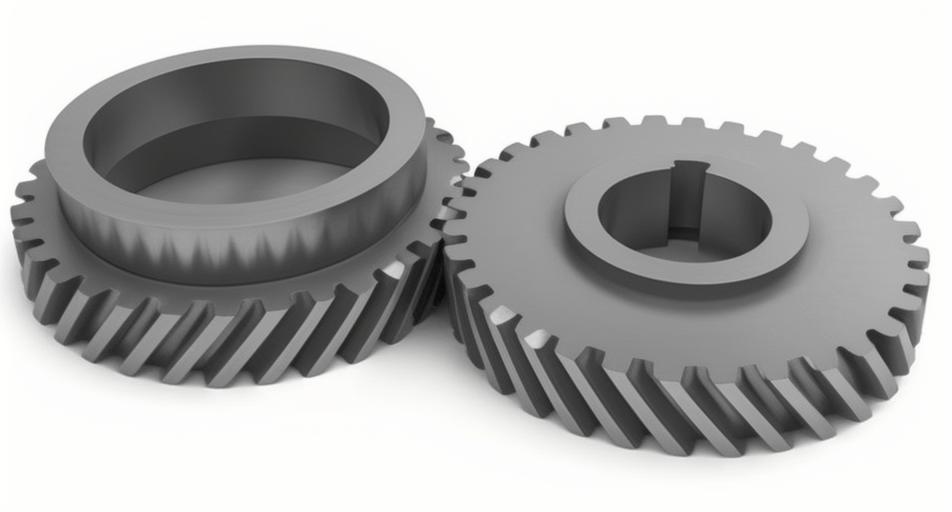
During one phase of the stroke (e.g., the forward push), the overrunning clutch locks, preventing the driving helical gear from rotating. Due to the helix angle of its teeth, this forced axial displacement directly causes the meshing driven helical gear on the output shaft to rotate through a specific angle. During the return stroke, the overrunning clutch disengages, allowing the driving gear to spin freely as it is pulled back, thus not affecting the output shaft’s rotation. With at least three such rod-gear assemblies phased around the input axis, the pulsating rotations from each are superimposed, resulting in a continuous, albeit slightly fluctuating, output speed. The magnitude of the output speed is controlled by adjusting the inclination angle of the swash plate, which changes the axial stroke length of the rods.
The kinematic relationship governing the instantaneous angular velocity of the output shaft ($\omega_2$) is derived from the geometry of the swash plate and the axial meshing action of the helical gears. The axial displacement $s$ of a rod is given by $s = \frac{d}{2} \tan\theta \sin\varphi_1$, where $d$ is the pitch circle diameter on which the rods are distributed, $\theta$ is the swash plate inclination angle, and $\varphi_1 = \omega_1 t$ is the angular position of the input shaft (with constant angular velocity $\omega_1$). For a helical gear pair with a helix angle $\beta$, an axial movement $s$ of the driving gear causes a rotational displacement $\Delta\varphi_2$ of the driven gear, related by $s = \frac{d_2}{2} \frac{\Delta\varphi_2}{\tan\beta}$, where $d_2$ is the driven gear’s pitch diameter. Differentiating with respect to time yields the instantaneous output angular velocity:
$$
\omega_2 = \frac{d\varphi_2}{dt} = \left( \frac{d}{d_2} \tan\beta \tan\theta \sin\varphi_1 \right) \omega_1
$$
This equation reveals the direct, pulsating nature of the output speed, modulated by $\sin\varphi_1$. The transmission ratio $i_{21}$ is defined as:
$$
i_{21} = \frac{\omega_2}{\omega_1} = \frac{d}{d_2} \tan\beta \tan\theta \sin\varphi_1
$$
Recognizing that the distribution circle diameter $d$ is essentially the sum of the pitch diameters of the driving ($d_1$) and driven ($d_2$) helical gears ($d \approx d_1 + d_2$), and that $d_1 = \frac{m_n z_1}{\cos\beta}$ and $d_2 = \frac{m_n z_2}{\cos\beta}$ (where $m_n$ is the normal module, and $z_1$, $z_2$ are the tooth numbers), the ratio can be expressed in terms of fundamental helical gear parameters:
$$
i_{21} = \left(1 + \frac{z_1}{z_2}\right) \tan\beta \tan\theta \sin\varphi_1
$$
This foundational equation serves as the starting point for analyzing the impact of each helical gear parameter.
1. Influence of the Helix Angle (β)
The helix angle $\beta$ is arguably the most influential parameter among all helical gear specifications, as it directly governs the kinematic transformation from axial motion to rotation and defines the force relationships within the transmission.
1.1 Impact on Kinematics and Transmission Ratio
From the transmission ratio equation $i_{21} \propto \tan\beta$, it is evident that the output speed magnitude is directly proportional to the tangent of the helix angle. A larger $\beta$ yields a higher transmission ratio for a given swash plate angle $\theta$ and gear ratio $z_1/z_2$. This provides a powerful design lever for achieving a desired speed range. For instance, to achieve a high-ratio, low-torque output characteristic, a designer would select a larger helix angle. Conversely, the helical gears in a CVT designed for high-torque, low-speed applications would typically feature a smaller helix angle.
1.2 Impact on Dynamics and Torque Capacity
The force relationship in the axial meshing of helical gears is critical. The axial force $F_a$ required to push the driving gear is related to the tangential force $F_t$ generated on the driven gear by:
$$
F_t = \frac{F_a}{\tan\beta}
$$
The output torque $T_2$ is then:
$$
T_2 = \frac{d_2}{2} F_t = \frac{d_2 F_a}{2 \tan\beta}
$$
This reveals a fundamental trade-off: output torque is inversely proportional to $\tan\beta$ for a given input axial force $F_a$. Therefore, while increasing $\beta$ boosts speed, it simultaneously reduces the torque output capability. The axial force $F_a$ itself is derived from the swash plate mechanics and is proportional to $\tan\theta$. The maximum transmissible torque is thus constrained by both the helix angle and the maximum permissible swash plate angle, as well as the structural strength of the components.
1.3 Impact on Efficiency, Vibration, and Design Constraints
The choice of helix angle also affects mechanical efficiency and noise. Larger helix angles generally provide smoother engagement due to higher contact ratios, reducing vibration and noise—a valuable trait for a pulsating transmission seeking to minimize inherent speed fluctuations. However, they also generate larger axial thrust loads ($F_a$) on the push rods and their bearings, demanding more robust and potentially less efficient thrust bearing arrangements. Standard design practice for conventional rotating helical gears suggests a range of $8^\circ$ to $20^\circ$ for $\beta$ to balance smooth operation with manageable axial loads. For this axial meshing CVT application, the upper limit is similarly constrained by thrust bearing considerations, often capping at around $20^\circ$. The lower limit is set by the need for a meaningful speed transformation; an excessively small $\beta$ would require impractically large axial strokes or swash plate angles to achieve useful output speeds.
The table below summarizes the multi-faceted influence of the helix angle in helical gears used for axial meshing transmission.
| Parameter | Effect of Increasing Helix Angle (β) | Primary Design Consideration |
|---|---|---|
| Transmission Ratio ($i_{21}$) | Increases proportionally to $\tan\beta$ | Enables wider output speed range. |
| Output Torque ($T_2$) | Decreases inversely with $\tan\beta$ (for fixed $F_a$) | Trade-off between speed and torque capacity. |
| Axial Thrust Force ($F_a$) | Increases for a desired output torque. | Requires stronger thrust bearings and sturdier push rods. |
| Meshing Smoothness | Improves due to higher overlap ratio. | Reduces vibration and noise, mitigating pulsation effects. |
| Design Guideline | Typically $8^\circ – 20^\circ$ | Balances performance, forces, and size. |
2. Influence of Tooth Numbers (z1 and z2)
The selection of tooth numbers for the driving ($z_1$) and driven ($z_2$) helical gears is a complex decision influenced by kinematic, geometric, and strength requirements.
2.1 Kinematic and Geometric Implications
From the ratio formula $i_{21} \propto (1 + z_1/z_2)$, the tooth numbers directly affect the transmission ratio’s amplitude. For a fixed center distance (approximated by the rod distribution diameter $d$), the sum of the teeth is constrained by the geometry:
$$
d = d_1 + d_2 = \frac{m_n}{\cos\beta}(z_1 + z_2) \quad \Rightarrow \quad z_1 + z_2 = \frac{d \cos\beta}{m_n}
$$
Therefore, $z_1$ and $z_2$ are not independent. Increasing $z_1$ to raise the ratio $(1 + z_1/z_2)$ necessitates a decrease in $z_2$, and vice-versa. This interplay must be carefully managed. Furthermore, to avoid undercutting and ensure proper tooth form, the virtual number of teeth ($z_v = z / \cos^3\beta$) for both helical gears should be greater than the minimum required to prevent interference, typically around 17.
2.2 Influence on Strength and Wear
For a given module $m_n$ and face width, the bending strength of a gear tooth is largely independent of the tooth number. However, surface durability (pitting resistance) is highly dependent on the size of the gears, specifically their pitch diameters. The contact stress $\sigma_H$ for helical gears follows the formula:
$$
\sigma_H = Z_E Z_H Z_\epsilon Z_\beta \sqrt{\frac{F_t}{d_1 b} \cdot \frac{u \pm 1}{u}}
$$
where $Z$ factors are material, geometry, and contact ratio coefficients, $b$ is the face width, and $u = z_2 / z_1$. The term $F_t/d_1$ highlights that for a given tangential force $F_t$, a larger pitch diameter $d_1$ (achieved by a larger $z_1$) reduces contact stress, enhancing pitting life. Thus, from a wear and durability perspective, selecting higher tooth numbers (within the geometric constraint) is beneficial as it reduces surface stress and sliding velocities between meshing teeth.
2.3 Influence on Pulsation Characteristics and Manufacturing
While the fundamental pulsation frequency is determined by the number of push rods, the interaction of the helical gears themselves can influence high-frequency vibration. Having tooth counts that are co-prime (sharing no common factors other than 1) helps distribute wear more evenly across all tooth surfaces over time. Additionally, the choice of $z_1$ and $z_2$ must consider manufacturability and standardization.
| Aspect | Consideration | Design Guideline |
|---|---|---|
| Kinematics | Defines ratio amplitude $ (1 + z_1/z_2) $. | Choose based on target speed range, subject to $z_1+z_2$ constraint. |
| Geometry | Defined by $z_1 + z_2 = \frac{d \cos\beta}{m_n}$. | Must satisfy center distance $d$ and avoid undercutting ($z_{v} > ~17$). |
| Contact Strength | Contact stress $\sigma_H \propto 1/\sqrt{d_1}$. | Favor larger $z_1$ and $z_2$ (larger diameters) to reduce stress and wear. |
| Wear Distribution | Even wear across tooth flanks. | Select $z_1$ and $z_2$ to be co-prime numbers. |
3. Influence of the Normal Module (m_n)
The normal module $m_n$ is a primary measure of tooth size and load-carrying capacity. Its influence is predominantly static and strength-related rather than kinematic.
3.1 No Direct Kinematic Effect
Noticeably absent from the transmission ratio equation $i_{21} = (1 + z_1/z_2) \tan\beta \tan\theta \sin\varphi_1$ is the normal module $m_n$. This indicates that the basic speed transformation ratio is independent of tooth size. Changing the module while keeping $z_1$, $z_2$, and $\beta$ constant will alter the physical size of the gears and the center distance but will not change the input-output speed relationship for a given swash plate angle.
3.2 Primary Influence on Strength and Size
The module is the key parameter governing bending strength. The tooth root bending stress $\sigma_F$ is calculated as:
$$
\sigma_F = \frac{F_t}{b m_n} Y_F Y_S Y_\epsilon Y_\beta
$$
where $Y$ factors are the form, stress correction, contact ratio, and helix angle coefficients. This shows bending stress is inversely proportional to the module. A larger module significantly increases the tooth’s cross-sectional area at its base, dramatically improving its ability to withstand the repetitive bending loads induced by the pulsating transmission of power. Therefore, the module is selected primarily to ensure safe bending stress levels under the maximum anticipated tangential load $F_t$, which is linked to the maximum output torque $T_2$.
3.3 Cascading Effects on Design
Selecting a larger module for strength has cascading effects:
- Increased Size: For fixed tooth numbers $z_1$ and $z_2$, a larger $m_n$ increases pitch diameters $d_1$ and $d_2$, thereby increasing the required center distance $d$. This enlarges the overall transmission package.
- Weight and Inertia: Larger, heavier helical gears increase rotational inertia, which could affect the dynamic response during rapid speed changes.
- Manufacturing: Larger modules may be easier to manufacture precisely but require more material.
The design process often involves an iterative loop: an initial module is chosen based on torque estimates, gear sizes and center distance are calculated, other parameters (like face width $b$) are adjusted, and stresses are verified. If bending stress is too high, the module must be increased, and the geometric layout is revised, potentially affecting other components like the swash plate diameter.
| Characteristic | Influence of Normal Module (m_n) | Design Implication |
|---|---|---|
| Transmission Ratio | No direct effect. | Can be chosen independently of kinematic requirements. |
| Bending Strength ($\sigma_F$) | Critical; $\sigma_F \propto 1/m_n$. | Primary design driver. Selected to withstand maximum pulsating torque. |
| Gear Size & Center Distance | Directly proportional: $d_1, d_2 \propto m_n$. | Determines the overall radial dimensions of the transmission. |
| Weight and Inertia | Increases with $m_n$. | Affects dynamic response and material cost. |
4. Integrated Parameter Optimization and Conclusion
The design of the helical gears for a swash plate pulsating CVT is a multi-objective optimization problem. The parameters $\beta$, $z_1$, $z_2$, and $m_n$ are deeply intertwined through geometric constraints, kinematic goals, and strength requirements.
The Helix Angle ($\beta$) sits at the core of the performance trade-off, directly linking the speed ratio and torque capacity. Its selection dictates the fundamental character of the CVT—whether it is geared towards high-speed or high-torout application. The choice is bounded by practical limits on axial thrust and standard manufacturing practices.
The Tooth Numbers ($z_1$, $z_2$) are constrained by the fixed center distance imposed by the mechanical layout. Their ratio fine-tunes the transmission ratio amplitude set by $\beta$, while their absolute values significantly impact contact fatigue life and wear characteristics. Maximizing them within the spatial constraint is generally advantageous for durability.
The Normal Module ($m_n$) is the cornerstone of structural integrity, sized specifically to resist tooth bending failure under pulsating loads. It determines the physical scale and weight of the gears but does not influence the basic speed transformation law.
A successful design requires an iterative approach: establishing kinematic requirements leads to preliminary choices for $\beta$ and the $z_1/z_2$ ratio. System layout defines the allowable center distance $d$, which, with $\beta$, constrains the sum $(z_1 + z_2)$ for a chosen trial module $m_n$. Load analysis determines the necessary module and face width to meet strength criteria, which may force a re-evaluation of the initial choices for size or even the center distance. Advanced design would also consider the impact of these parameters on the dynamic loads, efficiency, and the overall minimization of the output speed pulsation inherent to this clever mechanism.
In conclusion, the innovative use of axial-meshing helical gears in a swash plate pulsating CVT creates a unique set of design relationships. A deep understanding of how the helix angle, tooth numbers, and module each govern different aspects of transmission performance—from the fundamental speed-torque trade-off and kinematic ratio to the ultimate power capacity and operational life—is essential for developing efficient, reliable, and compact continuously variable transmissions for modern engineering applications.