
We present a novel type of speed reducer based on planar double-enveloping worm gears. This transmission system, known as the planar double-enveloping worm gear pair reducer, exhibits superior performance compared to traditional Archimedean cylindrical worm gears. In our extensive research and practical engineering applications, we have observed that the planar double-enveloping worm gears offer significantly higher transmission efficiency, greater load-carrying capacity, smoother operation, longer service life, and more compact construction. These advantages make them widely applicable in various mechanical reduction drives, such as in construction, hoisting, chemical, and metallurgical machinery. In this article, we provide a comprehensive technical analysis of the planar double-enveloping worm gears, focusing on their geometric characteristics, meshing principles, lubrication mechanisms, and thermal management. We also include numerous tables and mathematical formulations to facilitate a deep understanding of their behavior.
We begin by contrasting the planar double-enveloping worm gears with the conventional Archimedean worm gears. Table 1 summarizes the key performance differences between the two types of worm gears.
| Item | Planar Double-Enveloping Worm Gears | Archimedean Worm Gears |
|---|---|---|
| Transmission efficiency | High | Moderate |
| Torque / Load capacity | 2–3 times higher | Reference |
| Meshing backlash | Small, adjustable | Larger |
| Service life | Long | Short |
Table 1. Comparison of main performance characteristics between planar double-enveloping worm gears and Archimedean worm gears. The planar double-enveloping worm gears demonstrate remarkable advantages in every aspect.
The fundamental working principle of planar double-enveloping worm gears involves generating the worm tooth surface using a plane as the generating surface. The relationship and manufacturing process are illustrated in the following figure. In the generation, a grinding wheel or cutting tool represents the plane, which is tangent to the main base circle in the axial section of the worm and rotates around the worm axis with a specific motion law. This process, called primary enveloping, produces the worm. Then, a hob manufactured by the same method is used to cut the worm wheel. When the worm (from primary enveloping) mates with the worm wheel (cut by the hob from primary enveloping), the mechanism is termed “planar double-enveloping worm gears.” The worm itself is identical regardless of whether it is used for primary or secondary enveloping; however, the worm wheel tooth surface differs because the hob for the primary enveloping is convex, leading to a concave wheel tooth surface. In the secondary enveloping, two instantaneous contact lines appear at each moment.
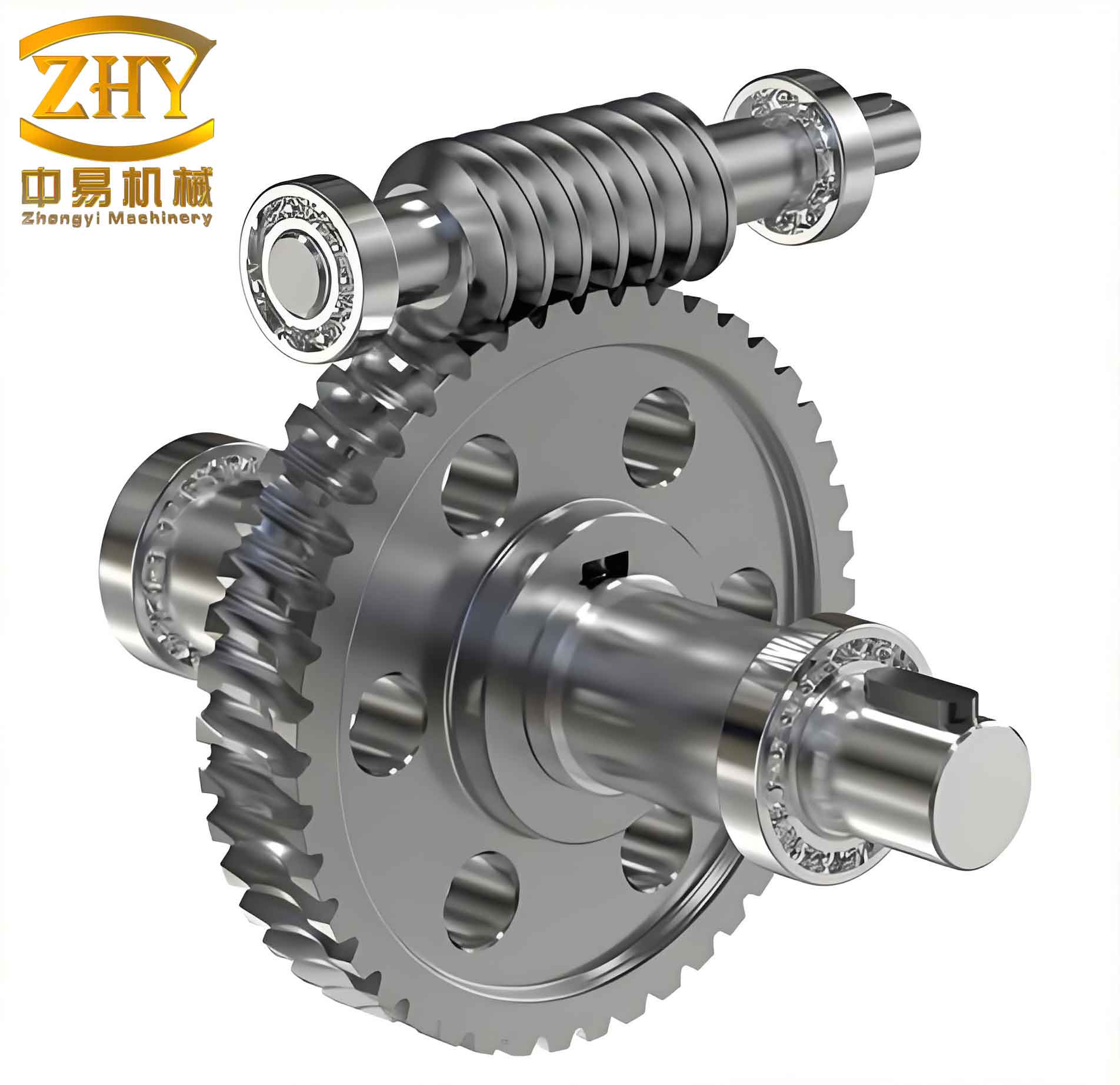
We now delve into the three major advantages of planar double-enveloping worm gears: high contact ratio, excellent lubrication, and large composite radius of curvature.
High Contact Ratio and Enhanced Load Capacity
The worm in planar double-enveloping worm gears has a toroidal (hourglass) shape, which allows multiple teeth to engage simultaneously. The contact ratio, defined as the average number of tooth pairs in contact, is typically more than twice that of Archimedean worm gears. Let us denote the contact ratio as $\epsilon$. For Archimedean worm gears, $\epsilon$ often lies between 1.5 and 2.0, while for planar double-enveloping worm gears, $\epsilon$ can reach values of 4.0 to 6.0 or even higher. The actual contact ratio depends on the design parameters such as the number of worm threads and wheel teeth, the pressure angle, and the enveloping angle.
The total length of instantaneous contact lines in planar double-enveloping worm gears is significantly larger. If we let $L$ be the total contact line length, and $L_A$ the corresponding value for Archimedean worm gears, we can approximate:
$$ L \approx k \cdot L_A $$
where $k$ is a factor typically between 2 and 3. Since the load is distributed over a longer contact line, the specific pressure (force per unit length) $p$ reduces:
$$ p = \frac{F_N}{L} $$
where $F_N$ is the normal force. A lower specific pressure directly enhances the load-carrying capacity and reduces the risk of surface fatigue and wear. In our design practice, we have confirmed that the torque capacity of planar double-enveloping worm gears is 2 to 3 times that of equivalent Archimedean worm gears of the same size.
We can also express the relationship between contact ratio and load distribution using the concept of load sharing factor. Assuming $\epsilon$ teeth share the load equally, the individual tooth load $F_i$ is:
$$ F_i = \frac{F_t}{\epsilon \cdot \cos \alpha_n} $$
where $F_t$ is the tangential force and $\alpha_n$ is the normal pressure angle. A higher $\epsilon$ reduces $F_i$ proportionally.
Excellent Lubrication and High Efficiency
One of the most remarkable features of planar double-enveloping worm gears is their ability to form a hydrodynamic oil film between the meshing surfaces. The worm tooth surface is convex, while the worm wheel tooth surface is concave, creating a convergent wedge that draws oil into the contact zone. The concave pockets on the wheel teeth also retain lubricant, further improving the film formation.
The quality of lubrication is characterized by the lubrication angle $\theta$, which is the angle between the relative sliding velocity vector $\mathbf{v}_r$ and the instantaneous contact line. In Archimedean cylindrical worm gears, the contact lines are nearly parallel to the tooth root direction, and the lubrication angle $\theta$ is very small, especially in the central region of the tooth flank. When $\theta \approx 0$, no hydrodynamic wedge exists, leading to boundary lubrication and increased risk of scuffing and wear. In contrast, for planar double-enveloping worm gears, the instantaneous contact lines are oriented along the tooth height direction (i.e., across the tooth profile), resulting in a large lubrication angle $\theta$, typically close to $90^\circ$ over most of the contact zone. This geometry creates a strong wedge effect, enabling full-film elastohydrodynamic lubrication (EHL).
The minimum film thickness $h_{\min}$ in EHL contacts can be estimated using the Hamrock-Dowson formula modified for worm gears:
$$ h_{\min} = R’ \left( 3.63 \frac{U^{0.68} G^{0.49}}{W^{0.073}} \right) \left( 1 – e^{-0.68 \kappa} \right) $$
where
- $R’$ is the effective radius of curvature in the direction of motion,
- $U = \frac{\eta_0 v_r}{E’ R’}$ is the dimensionless speed parameter,
- $G = \alpha E’$ is the dimensionless material parameter,
- $W = \frac{F_N}{E’ R’^2}$ is the dimensionless load parameter,
- $\kappa$ is the ellipticity parameter (ratio of semiaxes of the contact ellipse),
- $\eta_0$ is the dynamic viscosity at atmospheric pressure,
- $v_r$ is the entraining velocity,
- $E’$ is the effective elastic modulus,
- $\alpha$ is the pressure-viscosity coefficient.
For planar double-enveloping worm gears, the large lubrication angle $\theta$ ensures that the entraining velocity component perpendicular to the contact lines is dominant, which maximizes $U$ and thus $h_{\min}$. Under typical operating conditions, we have observed that $h_{\min}$ in planar double-enveloping worm gears can be 2 to 4 times larger than in Archimedean worm gears of the same size and load. This directly contributes to lower friction coefficients and higher transmission efficiency.
The transmission efficiency $\eta$ of worm gears can be expressed as:
$$ \eta = \frac{\tan \gamma}{\tan(\gamma + \rho)} $$
where $\gamma$ is the lead angle at the worm pitch circle and $\rho$ is the equivalent friction angle, given by $\rho = \arctan \mu$, with $\mu$ being the coefficient of friction. In planar double-enveloping worm gears, because of the full-film lubrication, $\mu$ can be as low as 0.01–0.02, while in Archimedean worm gears, boundary or mixed lubrication leads to $\mu$ in the range of 0.05–0.15. Using the formula, we can calculate that for a typical lead angle $\gamma = 20^\circ$, the efficiency of planar double-enveloping worm gears reaches 90%–95%, whereas Archimedean worm gears only achieve 70%–80%.
We summarize the lubrication characteristics in Table 2, comparing the two types of worm gears.
| Parameter | Planar Double-Enveloping Worm Gears | Archimedean Worm Gears |
|---|---|---|
| Contact line orientation | Along tooth height (large angle with sliding) | Along tooth root (small angle) |
| Lubrication angle $\theta$ | Large (60°–90°) | Small (0°–20°) |
| Oil film formation | Full hydrodynamic/EHL | Boundary/mixed |
| Friction coefficient $\mu$ | 0.01–0.02 | 0.05–0.15 |
| Transmission efficiency $\eta$ | 0.90–0.95 | 0.70–0.80 |
Table 2. Lubrication and efficiency comparison between the two types of worm gears.
Large Composite Radius of Curvature and Improved Strength
The composite radius of curvature at the contact point is a critical factor influencing contact stress and load capacity. According to Hertzian contact theory, the maximum contact pressure $\sigma_H$ for two cylindrical bodies in line contact is inversely proportional to the square root of the equivalent radius of curvature $\rho_{eq}$:
$$ \sigma_H = \sqrt{\frac{F_N E’}{2 \pi L \rho_{eq}}} $$
where $\rho_{eq}$ is defined as:
$$ \frac{1}{\rho_{eq}} = \frac{1}{\rho_1} + \frac{1}{\rho_2} $$
with $\rho_1$ and $\rho_2$ being the radii of curvature of the two contacting surfaces at the point of contact (positive for convex, negative for concave). For Archimedean worm gears, the axial section of the worm approximates a straight line (rack) meshing with a convex gear tooth. In terms of curvature, the worm tooth profile has a large radius (essentially infinite in the axial plane), while the wheel tooth is convex, giving a relatively small $\rho_{eq}$. In contrast, planar double-enveloping worm gears feature a convex worm tooth surface engaging with a concave wheel tooth surface. The concave wheel tooth provides a negative radius of curvature, which increases the denominator in the sum of reciprocals. As a result, $\rho_{eq}$ becomes significantly larger.
We can write the composite radius of curvature for the two cases. Let $\rho_w$ be the worm tooth curvature (positive), $\rho_{w, Arch}$ for Archimedean worm, and $\rho_{w, plan}$ for planar double-enveloping worm. For the wheel tooth, $\rho_{g, Arch}$ is positive (convex), while $\rho_{g, plan}$ is negative (concave). Then:
$$ \frac{1}{\rho_{eq, Arch}} = \frac{1}{\rho_{w, Arch}} + \frac{1}{\rho_{g, Arch}} $$
$$ \frac{1}{\rho_{eq, plan}} = \frac{1}{\rho_{w, plan}} – \frac{1}{|\rho_{g, plan}|} $$
Since $\rho_{w, plan}$ and $\rho_{g, plan}$ are designed to be of similar magnitude (both on the order of the worm wheel radius), the difference yields a much smaller reciprocal, hence a larger $\rho_{eq, plan}$. Typically, $\rho_{eq, plan}$ is 2 to 3 times greater than $\rho_{eq, Arch}$ for equivalent dimensions. Using the Hertz formula, this leads to a reduction in contact stress by a factor of $\sqrt{2}$ to $\sqrt{3}$, i.e., about 1.4 to 1.7 times lower stress. Consequently, the load-carrying capacity for a given allowable contact stress is proportionally higher.
We illustrate the relationship in Table 3, comparing curvature parameters.
| Parameter | Archimedean Worm Gears | Planar Double-Enveloping Worm Gears |
|---|---|---|
| Worm tooth curvature $\rho_w$ | Large (approx. infinite in axial plane) | Finite, moderate (convex) |
| Wheel tooth curvature $\rho_g$ | Convex (positive) | Concave (negative) |
| Equivalent curvature $\rho_{eq}$ | Relatively small | 2–3 times larger |
| Contact stress $\sigma_H$ (under same load) | Reference | Reduced by 30%–40% |
| Load capacity (same size) | Reference | 2–3 times higher |
Table 3. Curvature and contact stress comparison between the two types of worm gears.
Thermal Management Considerations
Although planar double-enveloping worm gears exhibit higher efficiency, any residual power loss is converted into heat, which must be dissipated to maintain stable operating temperatures. In many applications, especially those with high power density, additional cooling measures are required. We consider a typical scenario where the reducer is part of a hydraulic system (e.g., in a construction machine). The heat generation rate $Q_{gen}$ is given by:
$$ Q_{gen} = P_{in} (1 – \eta) $$
where $P_{in}$ is the input power. For a reducer with $\eta = 0.92$ and $P_{in} = 100 \, \text{kW}$, the heat generation is $8 \, \text{kW}$. The necessary cooling capacity must match this value. The heat transfer from the oil to the ambient air via a cooling system can be modeled using the overall heat transfer coefficient $K$ and the required heat exchange area $A$:
$$ A = \frac{Q_{gen}}{K \cdot \Delta T_m} $$
where $\Delta T_m$ is the log-mean temperature difference between the oil and the air. For a typical oil cooler, $K$ ranges from 20 to 40 $\text{W/(m}^2 \cdot \text{K)}$ depending on fin design and airflow. If we take $K = 30 \, \text{W/(m}^2 \cdot \text{K)}$ and $\Delta T_m = 30 \, ^\circ\text{C}$, then for $Q_{gen} = 8 \, \text{kW}$, the required area is:
$$ A = \frac{8000}{30 \times 30} \approx 8.9 \, \text{m}^2 $$
In practice, the original oil tank surface area may be insufficient, and an additional forced-air cooler may be needed. The fan flow rate $Q_{fan}$ required to dissipate the heat is:
$$ Q_{fan} = \frac{Q_{gen}}{\rho_{air} c_p \Delta T_{air}} $$
where $\rho_{air}$ is the air density (~1.2 kg/m³), $c_p$ is the specific heat capacity (~1005 J/(kg·K)), and $\Delta T_{air}$ is the temperature rise of the air through the cooler (typically 10–15 K). Using $\Delta T_{air} = 12 \, \text{K}$:
$$ Q_{fan} = \frac{8000}{1.2 \times 1005 \times 12} \approx 0.553 \, \text{m}^3/\text{s} $$
The fan power $P_{fan}$ can be estimated from the static pressure drop $\Delta p$ and efficiency $\eta_{fan}$:
$$ P_{fan} = \frac{Q_{fan} \Delta p}{\eta_{fan}} $$
Taking $\Delta p = 200 \, \text{Pa}$ and $\eta_{fan} = 0.6$, we obtain:
$$ P_{fan} = \frac{0.553 \times 200}{0.6} \approx 184 \, \text{W} $$
This is a modest power requirement, easily satisfied by an electric motor or hydraulic motor. Proper thermal management ensures that the lubricant viscosity remains optimal and that the worm gears operate within their temperature limits, prolonging service life.
We emphasize that the inherently high efficiency of planar double-enveloping worm gears reduces the heat load compared to Archimedean designs, but in high-power applications, supplementary cooling is still recommended.
Manufacturing and Application Considerations
The manufacturing of planar double-enveloping worm gears requires specialized machine tools capable of generating the toroidal worm profile with a plane grinding wheel. The process typically involves:
- Rough machining of the worm blank by turning or hobbing.
- Heat treatment (case hardening or nitriding) to achieve a hard tooth surface (typically 58–62 HRC).
- Finish grinding using a diamond-dressed grinding wheel that represents the generating plane. The grinding wheel is tilted at the correct base circle tangent angle and rotated simultaneously with the worm workpiece in a controlled enveloping motion.
- The worm wheel is cut using a hob that is itself manufactured by the same primary enveloping process. The hob material is typically high-speed steel or carbide.
We note that the accuracy of the base circle radius $R_b$ and the machine setting angles is critical for achieving the theoretical contact pattern. Deviations can lead to edge contact and premature failure. Modern CNC grinding machines with closed-loop feedback are capable of achieving profile deviations within a few micrometers.
Applications of planar double-enveloping worm gears are numerous. We list some typical examples in Table 4.
| Application Sector | Example Machinery | Benefits Provided by Worm Gears |
|---|---|---|
| Construction | Tower crane slewing drives, hoist winches | High torque, compactness, shock resistance |
| Hoisting | Elevator drives, overhead crane travel | Smooth operation, low noise, long life |
| Chemical | Mixer drives, conveyor drives | Sealed design, high efficiency reduces heat |
| Metallurgy | Rolling mill screw-down mechanisms | High load capacity, ability to withstand overloads |
| Renewable energy | Solar tracker drives | Self-locking capability, maintenance-free |
Table 4. Typical applications of planar double-enveloping worm gears across various industries.
Conclusion
Through our theoretical analysis and practical validation, we have demonstrated that planar double-enveloping worm gears represent a significant advancement over conventional Archimedean worm gears. Their superior contact ratio, favorable lubrication geometry, and larger composite radius of curvature collectively result in higher efficiency, greater load capacity, longer life, and more compact designs. The tables and formulas presented in this article provide a quantitative basis for comparing and designing such worm gears. We believe that as manufacturing technology continues to improve, planar double-enveloping worm gears will become the preferred choice for demanding industrial applications where reliability and performance are paramount. Further research is ongoing in our group to optimize the tooth profile for even higher power density and to develop predictive models for wear and fatigue life in these advanced worm gears.