
In the field of spatial power transmission, hyperboloid gears, also known as hypoid gears, play a crucial role due to their ability to transmit motion between non-parallel and non-intersecting shafts. Traditional design methods for hyperboloid gears are well-established for orthogonal configurations, but they become inadequate when applied to scenarios with low crossed shaft angles. These low-angle scenarios, such as those found in high-speed marine propulsion systems or all-wheel-drive vehicle differentials, present extreme geometric constraints that challenge conventional gear design. The small shaft angles and offset distances lead to complex tooth surface evolution and meshing mechanisms that are not fully understood. This paper addresses these challenges by proposing a comprehensive geometric design methodology for face-milled hyperboloid gears with low crossed shaft angles. I derive the spatial geometric relationships based on the instantaneous axis of a unipartite hyperboloid pair, develop a meshing characteristic control method that ensures smooth root transitions, and validate the approach through numerical analysis and prototype testing. The goal is to enable the reliable application of hyperboloid gears in compact, high-efficiency transmission systems where space is limited and performance is critical.
The fundamental principle behind spatial gear transmission lies in the relative screw motion between two shafts. When considering two rotating hyperboloidal surfaces, their interaction can be modeled as a pair of unipartite hyperboloids. The line of contact between these surfaces is defined as the instantaneous axis. Let the distance between the two rotational axes be denoted as $E$, the crossed shaft angle as $\Sigma$, and the angular velocity ratio as $m_{21} = \omega_2 / \omega_1$. By establishing a global coordinate system $S_f(x_f, y_f, z_f)$ at the intersection point of the axes, the coordinates of any point on the instantaneous axis can be expressed as:
$$
x_f = \frac{E m_{21} (\cos \Sigma – m_{21})}{1 – 2 m_{21} \cos \Sigma + m_{21}^2}
$$
$$
y_f = -u \sin \beta
$$
$$
z_f = u \cos \beta
$$
where $u$ is a parameter representing the position along the axis, and $\beta$ is the angle between the instantaneous axis and the $z_f$-axis, given by:
$$
\sin \beta = \frac{m_{21} \sin \Sigma}{\sqrt{1 – 2 m_{21} \cos \Sigma + m_{21}^2}}
$$
$$
\cos \beta = \frac{1 – m_{21} \cos \Sigma}{\sqrt{1 – 2 m_{21} \cos \Sigma + m_{21}^2}}
$$
Transforming these coordinates into the individual coordinate systems of the two hyperboloids yields their parametric equations. For a practical gear pair, the tooth surfaces are localized segments of these hyperboloids, which can be approximated by pitch cones for design purposes. This approximation converts the complex hyperboloidal contact problem into a simpler spatial pitch cone tangency problem. The point of tangency, $M$, serves as the reference point for defining the gear geometry.
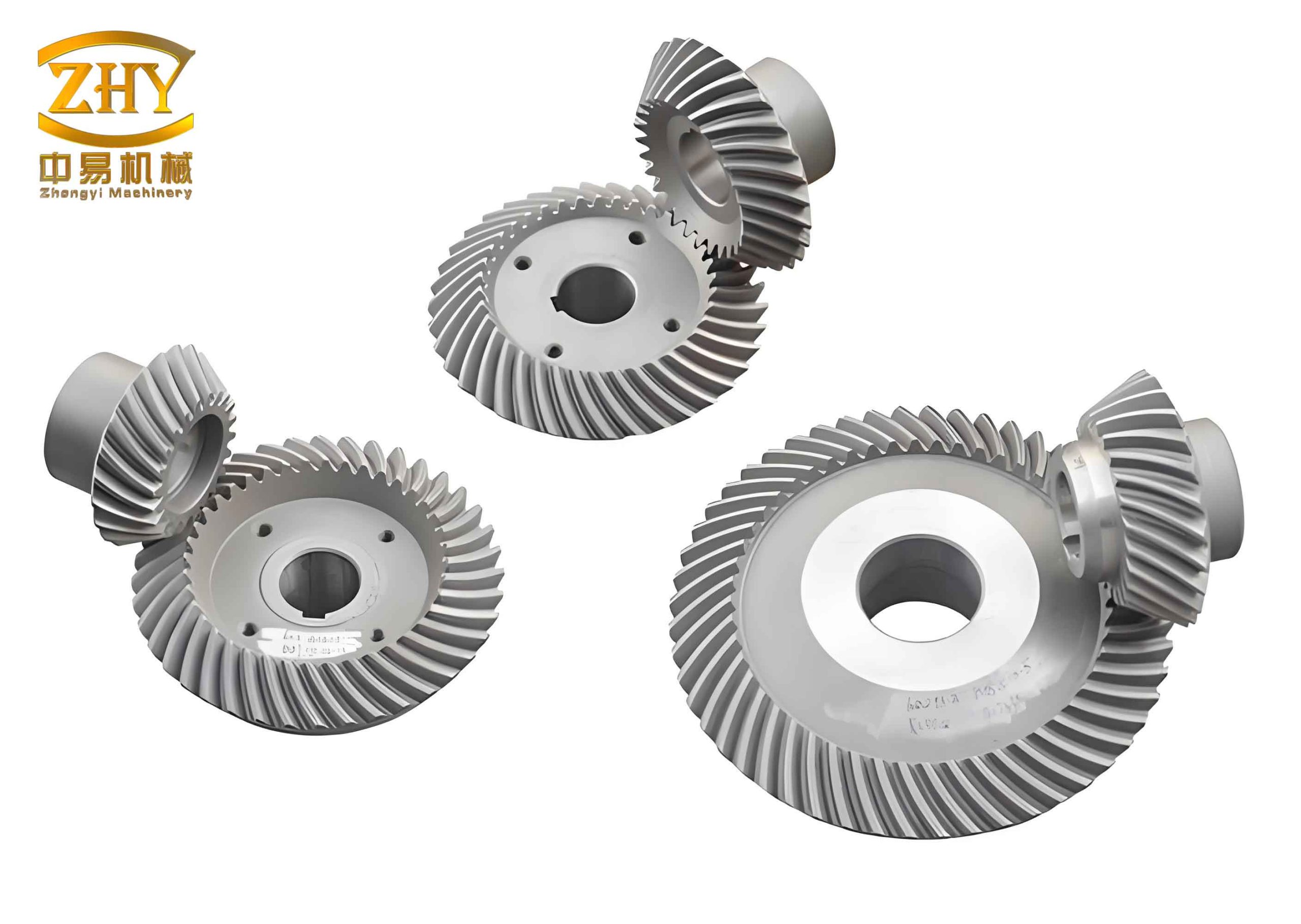
The geometric design of low crossed shaft angle hyperboloid gears hinges on three fundamental spatial relationships derived from the pitch cone model. The first relationship involves the difference in spiral angles at the reference point. Let $\gamma_{m1}$ and $\gamma_{m2}$ be the pitch cone angles of the pinion and wheel, respectively, and $\beta_{m12}$ be the difference between their spiral angles $\beta_{m1}$ and $\beta_{m2}$. The unit vectors along the cone generators, $\boldsymbol{\tau}_1$ and $\boldsymbol{\tau}_2$, satisfy:
$$
\cos \beta_{m12} = \tan \gamma_{m1} \tan \gamma_{m2} + \frac{\cos \Sigma}{\cos \gamma_{m1} \cos \gamma_{m2}}
$$
The second relationship governs the velocity ratio at the tangency point $M$, where the radii are $r_{m1}$ and $r_{m2}$:
$$
i_{12} = \frac{\omega_1}{\omega_2} = \frac{r_{m2} \cos \beta_{m2}}{r_{m1} \cos \beta_{m1}}
$$
The third relationship connects the offset distance $E$ to the geometric parameters:
$$
E = \frac{\sin \beta_{m12}}{\sin \Sigma} (r_{m1} \cos \gamma_{m2} + r_{m2} \cos \gamma_{m1})
$$
These three equations form the core of the geometric design process for hyperboloid gears. Additionally, for manufacturability using face-milling, the limiting normal pressure angle $\alpha_{nlim}$ and the limiting curvature of the wheel tooth surface must be considered. The limiting normal pressure angle is derived from the geometry of the pitch cones:
$$
\alpha_{nlim} = \arctan \left( \frac{r_{m2} \sin \beta_{m2} \sin \gamma_{m1} – r_{m1} \sin \beta_{m1} \sin \gamma_{m2}}{(r_{m1} \cos \gamma_{m2} + r_{m2} \cos \gamma_{m1}) \cos \beta_{m12}} \right)
$$
The limiting curvature for the wheel, which must match the cutter curvature in formate cutting, is given by:
$$
r^*_o = \frac{\tan \beta_{m1} – \tan \beta_{m2}}{e_0 – W_0 \tan \alpha_{nlim}}
$$
where $e_0$ and $W_0$ are geometric coefficients:
$$
e_0 = \frac{\sin \gamma_{m1}}{r_{m1} \cos \beta_{m1}} – \frac{\sin \gamma_{m2}}{r_{m2} \cos \beta_{m2}}
$$
$$
W_0 = \frac{\tan \beta_{m1} \cos \gamma_{m1}}{r_{m1}} + \frac{\tan \beta_{m2} \cos \gamma_{m2}}{r_{m2}}
$$
Based on these relationships, I have developed an iterative design algorithm. Starting from basic input parameters such as pinion teeth $N_1$, wheel teeth $N_2$, wheel face width $b_2$, wheel outer diameter $d_{hp2}$, preset spiral angle $\beta_{m2}$, shaft angle $\Sigma$, offset $E$, and nominal cutter radius $r_{co}$, the algorithm solves for all geometric parameters. The process involves two nested loops: Loop A iterates the wheel offset angle $\varepsilon_{m2}’$ to satisfy the offset distance equation, and Loop B iterates both $\varepsilon_{m2}’$ and the wheel pitch cone angle $\gamma_{m2}’$ to achieve convergence of the limiting curvature. The design flowchart ensures that all spatial and manufacturing constraints are met for hyperboloid gears in low crossed shaft angle applications.
To control the meshing behavior of these hyperboloid gears, I have adapted the local synthesis method, which is commonly used for spiral bevel gears, to the extreme geometry of low shaft angles. The standard local synthesis approach can lead to a stepped discontinuity at the root fillet between the convex and concave sides of the pinion teeth due to significant differences in machine tool settings. This is unacceptable for bending strength. My improved method introduces a correction for the machine root angle calculation specific to low shaft angle hyperboloid gears. The pinion tooth surfaces are discretized into point grids. The root points on the convex and concave sides are projected onto a plane perpendicular to the axis, and the angles of the projected root lines, $\gamma_{mc}$ and $\gamma_{mv}$, are calculated. The machine root angles for both sides are then iteratively adjusted until they converge to the theoretical root cone angle, ensuring a smooth transition.
The local synthesis method presets the meshing characteristics at a designated conjugate point $F$, which is offset from the reference point $M$ by distances $\Delta x$ (axial) and $\Delta y$ (radial) in the wheel coordinate system. The control parameters are the semi-major axis length of the contact ellipse $L_{ce}$, the angle $\theta_{ce}$ between the contact path and the first principal direction, and the first derivative of the transmission error $m’_{12}$, which governs the peak-to-peak transmission error. The coordinates of point $F$ in the wheel coordinate system $S_w$ are:
$$
x_F = (R_{m2} + \Delta x) \cos \gamma_{m2} – \Delta y \sin \gamma_{m2} – z_{m2}
$$
$$
y_F = (R_{m2} + \Delta x) \sin \gamma_{m2} – \Delta y \cos \gamma_{m2}
$$
where $R_{m2}$ is the wheel pitch cone distance and $z_{m2}$ is the axial distance from the wheel apex to the shaft intersection. Given the wheel tooth surface (generated via formate cutting with known machine settings), the pinion machine settings for both flanks are computed by solving a system of equations that ensure the prescribed contact conditions at point $F$. This methodology allows for precise control over the meshing behavior of hyperboloid gears even under challenging low-angle geometries.
The effectiveness of the proposed design and synthesis methods is evaluated through tooth contact analysis (TCA) and loaded tooth contact analysis (LTCA). A numerical example of a hyperboloid gear pair with a low crossed shaft angle was developed. The basic design parameters are summarized in the following table:
| Parameter | Pinion (i=1) | Wheel (i=2) |
|---|---|---|
| Number of Teeth, $N_i$ | 29 | 37 |
| Face Width, $b_i$ (mm) | 25.5721 | 25.0000 |
| Shaft Angle, $\Sigma$ (°) | 15.0000 | |
| Offset Distance, $E$ (mm) | 25.0000 | |
| Pitch Cone Angle, $\gamma_{mi}$ (°) | 7.3421 | 6.8907 |
| Reference Spiral Angle, $\beta_{mi}$ (°) | 24.7482 | 20.0000 |
| Nominal Cutter Radius, $r_{mc}$ (mm) | 95.2500 | |
The preset meshing behavior parameters for the pinion flanks were: $L_{ce} = 8$ mm, $\theta_{ce} = 80^\circ$ (concave) and $100^\circ$ (convex), and $m’_{12} = -12$ arcsec. The corresponding machine tool settings for the wheel and pinion were calculated using the proposed method. The pinion settings for concave and convex sides are shown below:
| Machine Setting | Concave Side | Convex Side |
|---|---|---|
| Cutter Tilt Angle, $T_{r1i}$ (°) | -81.6208 | -82.6193 |
| Cutter Swivel Angle, $W_{r1i}$ (°) | 153.1653 | 152.5904 |
| Radial Setting, $S_{r1i}$ (mm) | 104.6076 | 96.0393 |
| Angular Setting, $Q_{r1i}$ (mm) | 83.6987 | 78.5459 |
| Machine Root Angle, $M_{r1i}$ (°) | -73.5183 | -74.6013 |
The TCA was performed using a discretization approach. The tooth surfaces of both gears were represented as dense point clouds. The contact condition was determined by finding the minimum distance between points on the pinion and wheel surfaces during incremental rotation. The unloaded transmission error and contact pattern obtained from TCA closely matched the preset values, confirming the accuracy of the synthesis. The contact ellipse was centered in the middle of the tooth surface with the prescribed orientation and size.
For the loaded analysis, a finite element model (FEM) was constructed. The gear bodies were meshed with hexahedral elements (C3D8R), with refined grids in the contact zones. The pinion was assigned a rotational displacement, and the wheel was subjected to a resisting torque. The material was isotropic steel with a Young’s modulus of 209 GPa and a Poisson’s ratio of 0.3. The LTCA results for varying torque loads from 25 N·m to 150 N·m revealed the following trends: The contact patch size and the magnitude of contact stress increased with load. However, the location and orientation of the contact pattern remained stable, as designed. The root bending stress distribution along the tooth length showed a consistent shape that scaled with load. The transmission error curve shifted downward and its peak-to-peak value exhibited a non-linear relationship with torque, initially decreasing slightly before increasing at higher loads. Importantly, edge contact at the tooth tips and roots began to occur for torques exceeding 100 N·m, leading to a sharp rise in contact stress. This highlights the importance of load-dependent design checks for hyperboloid gears.
The transmission error $\Delta \phi_2(\phi_1)$ as a function of pinion rotation can be expressed based on the meshing condition. For a given load $T$, the composite deviation from ideal motion is:
$$
\Delta \phi_2(\phi_1) = \phi_2(\phi_1) – \frac{N_1}{N_2} \phi_1
$$
The loaded contact stress $\sigma_H$ at the surface follows a relationship influenced by the local curvature and load per unit length. According to Hertzian theory, for an elliptical contact patch, the maximum contact pressure is proportional to the cube root of the normal force $F_n$ and depends on the reduced radius of curvature $R’$ and material properties:
$$
\sigma_{H,max} \propto \left( \frac{F_n E^*}{R’} \right)^{1/3}
$$
where $E^*$ is the equivalent elastic modulus. For hyperboloid gears, the complex surface geometry makes $R’$ vary along the contact path, which is captured in the FEM analysis.
To physically validate the design and manufacturing methodology, a prototype of the low crossed shaft angle hyperboloid gear pair was built. The tooth surface point clouds from the mathematical model were used to create CAD models. These models were then fabricated using high-accuracy 3D printing technology with a layer resolution of 0.05 mm. The printed gears accurately reproduced the theoretical tooth geometry. The gears were assembled into a test rig alongside a pair of parallel-axis involute gears to create a functional low-angle transmission system. The input shaft, connected to the hyperboloid pinion, was driven by an electric motor. The output shaft was coupled to the parallel gear system. The entire assembly operated smoothly without abnormal noise or vibration, demonstrating that hyperboloid gears can function reliably under low crossed shaft angle conditions. This prototype serves as a practical proof of concept for the proposed geometric design, machining parameter calculation, and assembly methodology for such specialized hyperboloid gears.
In conclusion, this work presents a systematic framework for the design and analysis of face-milled hyperboloid gears operating at low crossed shaft angles. The derivation of the three fundamental spatial geometric relationships provides the foundation for parameter calculation. The enhanced local synthesis method, incorporating a root smoothness correction, enables precise control over meshing characteristics like contact pattern and transmission error. Numerical simulations through TCA and LTCA confirm that the designed hyperboloid gears exhibit stable and predictable behavior under load, although edge contact must be monitored at high torques. Finally, the successful fabrication and operation of a physical prototype validate the entire process. This research expands the application envelope of hyperboloid gears, making them a viable solution for compact, high-performance spatial transmissions where small shaft angles are required. Future work could focus on dynamic modeling, thermal analysis, and optimization of these hyperboloid gears for specific industrial applications to further enhance their performance and durability.