
In the field of gear engineering, the bending strength of gear teeth is a critical performance metric, especially for hyperboloid gears which are widely used in automotive and industrial applications due to their ability to transmit power between non-parallel and non-intersecting shafts. Hyperboloid gears, also known as hypoid gears, exhibit complex geometrical configurations that make stress analysis challenging. Traditional methods, such as the Gleason system, rely on empirical formulas derived from material mechanics and statistical data. While convenient, these approaches are approximate and cannot accurately capture the dynamic stress distribution during the load transmission process, nor can they account for real-world factors like manufacturing errors, assembly misalignments, support deformations, and variable loading conditions. With advancements in computational technology, finite element analysis (FEA) has become a powerful tool for stress and deformation studies in hyperboloid gears. However, its application in industrial design and manufacturing is often hindered by the computational complexity—each instant in the meshing cycle requires a separate FEA simulation, leading to prohibitive memory and time requirements. In this article, I present a novel stress influence matrix method that enables precise calculation of the bending stress distribution process in hyperboloid gears with minimal computational effort. This method leverages a single finite element computation to derive stress influence matrices, followed by multivariate interpolation and stress superposition, allowing for the efficient determination of three-dimensional stress distributions throughout the entire meshing cycle under various practical conditions.
The core innovation lies in the concept of stress influence matrices, which encode the mechanical response of hyperboloid gear teeth to unit loads applied at discrete points on the working tooth surface. By performing one FEA simulation where unit normal loads are sequentially applied at all grid nodes on the tooth surface, we obtain a comprehensive set of stress responses at the root nodes. These responses form a stress influence matrix that serves as a fundamental characteristic of the gear. Subsequently, for any given loading scenario—including those influenced by errors and variable loads—the stress distribution at the tooth root can be computed through interpolation and linear superposition, eliminating the need for repeated FEA runs. This approach not only maintains the accuracy of finite element methods but also drastically reduces computational overhead, making it feasible for practical engineering applications. Hyperboloid gears, with their unique geometry, require meticulous attention to stress analysis to prevent failures and ensure reliability. The proposed method addresses this need by providing a high-fidelity, efficient solution for bending stress evaluation.
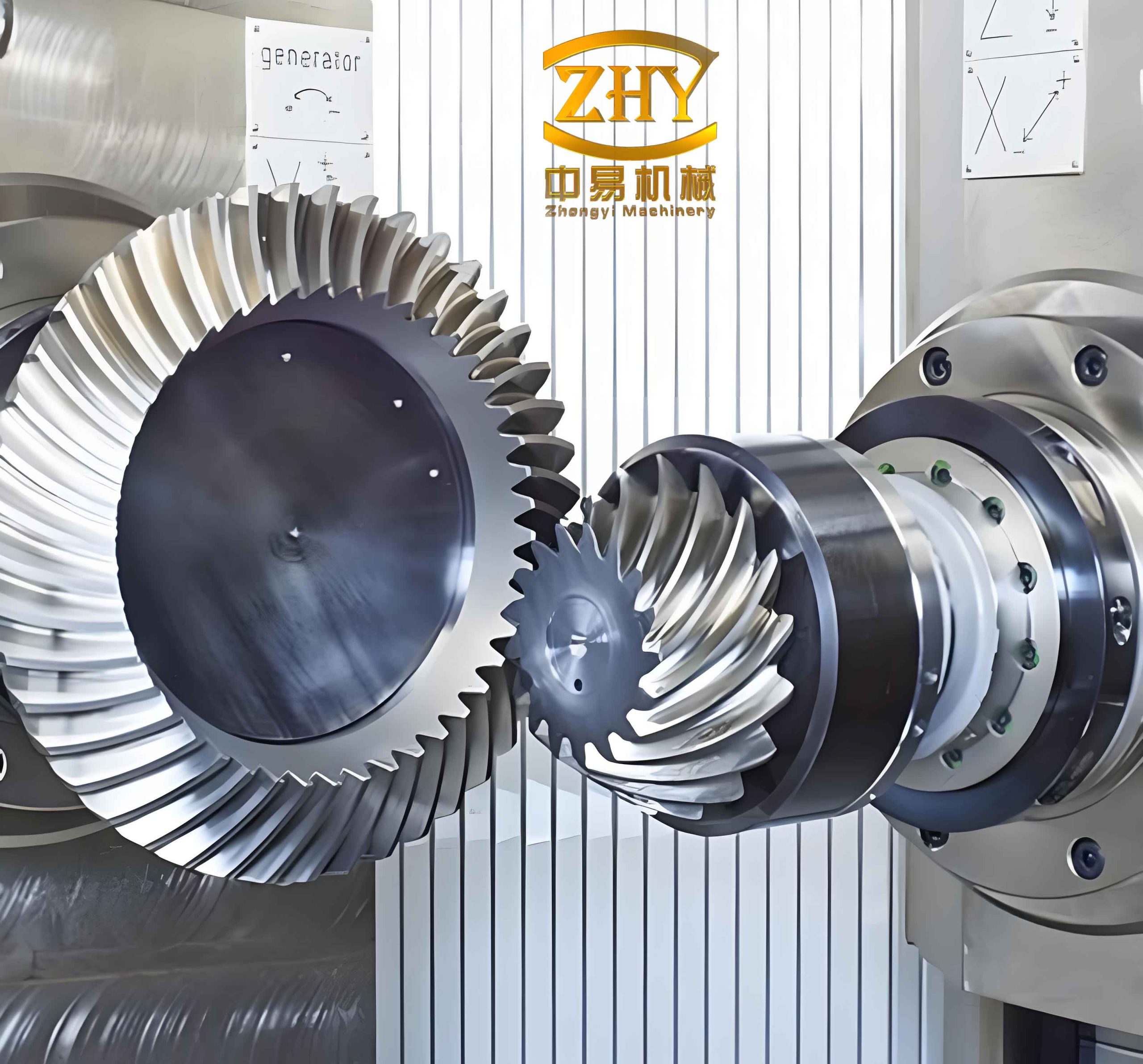
To implement this method, the first step involves the automatic generation of a finite element mesh for the hyperboloid gear teeth. Given the geometric and manufacturing parameters of the gear pair, the tooth surfaces—including the root transition surfaces—can be numerically simulated. The mesh generation process begins by defining the grid density on the tooth and root surfaces based on computational precision, time, and resource constraints. In the rotational projection plane (a plane containing the axis of rotation), grid nodes are projected, and their coordinates are determined by solving nonlinear equations derived from the gear geometry. Specifically, for a point on the tooth surface, its coordinates (x, y, z) satisfy:
$$ r_i = \sqrt{x_i^2 + y_i^2 + z_i^2}, \quad \delta_i = \text{angle between } r_i \text{ and the rotation axis}, $$
where $r_i$ and $\delta_i$ are functions of surface parameters. By solving these equations, we obtain the coordinates for all mesh nodes. The gear body and tooth regions are then discretized accordingly, with nodes on the working tooth surface designated as load application points and nodes at the gear body interface as fixed displacement points. This automated meshing ensures consistency and accuracy in subsequent analyses. The finite element model for both the pinion and gear, as shown in the image above, captures the intricate geometry of hyperboloid gears, which is essential for precise stress computation.
The stress influence matrix is a key component of this methodology. Let $N_r$ be the total number of nodes on the root transition surfaces (for both sides of the tooth), and $N_s$ be the number of nodes on the working tooth surface. When a unit normal load is applied at a tooth surface node $j$, the resulting stress values at all root nodes form a vector $\mathbf{s}_j$ of dimension $N_r$. By applying unit loads sequentially at all $N_s$ tooth surface nodes, we assemble the stress influence matrix $\mathbf{S}$:
$$ \mathbf{S} = [\mathbf{s}_1, \mathbf{s}_2, \dots, \mathbf{s}_{N_s}], $$
where $\mathbf{S}$ is an $N_r \times N_s$ matrix. Each element $S_{ij}$ represents the stress at root node $i$ due to a unit load at tooth surface node $j$. This matrix is computed once via FEA and stored as a fundamental property of the hyperboloid gear. To handle the actual loading conditions, we define a contact load matrix based on the gear contact analysis. Using tooth contact analysis (TCA) techniques, we discretize the contact path on the tooth surface into $M$ contact positions, each with an instantaneous contact ellipse. Along the major axis of each ellipse, we define $L_m$ discrete points (where $m = 1, 2, \dots, M$). The stress influence matrix for contact point loading, denoted $\mathbf{T}$, is an $N_r \times L$ matrix, where $L = \sum_{m=1}^{M} L_m$. Elements of $\mathbf{T}$ are obtained by interpolating from $\mathbf{S}$ using bivariate spline interpolation, since the tooth surface mesh is non-rectangular. This interpolation transforms the grid-based influence data to the contact point coordinates, enabling accurate stress prediction under realistic contact conditions.
The bending stress distribution process is then computed using the principle of superposition and Saint-Venant’s principle. Saint-Venant’s principle allows us to replace the distributed force system on the contact ellipse with an equivalent set of concentrated forces at the discrete points along the major axis, without significantly affecting the stress distribution at the tooth root. The load matrix $\mathbf{P}$ is defined as:
$$ \mathbf{P} = [\mathbf{p}_1, \mathbf{p}_2, \dots, \mathbf{p}_M], $$
where each $\mathbf{p}_m$ is a vector of concentrated forces at the $L_m$ discrete points on the $m$-th contact ellipse. The bending stress process matrix $\mathbf{B}$, which captures the stress distribution at all root nodes over the entire meshing cycle, is given by:
$$ \mathbf{B} = \mathbf{T} \cdot \mathbf{P}^T. $$
Here, $\mathbf{B}$ is an $N_r \times M$ matrix; each column $b_m$ represents the stress distribution at the root nodes when the $m$-th contact position is loaded, and each row corresponds to the stress history at a specific root node as the load moves through the meshing cycle. This formulation enables a comprehensive view of stress variations, which is crucial for assessing the fatigue life and reliability of hyperboloid gears. The computational efficiency stems from the fact that only one FEA run is needed to obtain $\mathbf{S}$, after which $\mathbf{B}$ can be computed rapidly via matrix operations and interpolation.
The detailed steps for calculating the bending stress in hyperboloid gears are summarized in the following table, which outlines the procedure from mesh generation to stress synthesis:
| Step | Description | Key Equations or Outputs |
|---|---|---|
| 1 | Automatic generation of finite element mesh for hyperboloid gear teeth based on geometric parameters. | Solve $r_i = \sqrt{x_i^2 + y_i^2 + z_i^2}$, $\delta_i = f(\text{parameters})$ for node coordinates. |
| 2 | Apply unit normal loads sequentially at all tooth surface grid nodes and compute displacement and stress fields via FEA. | Obtain stress influence matrix $\mathbf{S}$ of size $N_r \times N_s$. |
| 3 | Perform tooth contact analysis (TCA) to determine contact paths, ellipses, and load distributions under actual conditions. | Define contact load matrix $\mathbf{P}$ from TCA results. |
| 4 | Interpolate $\mathbf{S}$ to obtain stress influence matrix $\mathbf{T}$ for contact point loading. | Use bivariate spline interpolation: $\mathbf{T} = \text{interp}(\mathbf{S})$. |
| 5 | Compute bending stress process matrix $\mathbf{B}$ using superposition. | $\mathbf{B} = \mathbf{T} \cdot \mathbf{P}^T$. |
| 6 | Smooth stress distributions in root regions and synthesize stress components according to failure criteria (e.g., von Mises). | $\sigma_{\text{effective}} = \sqrt{\sigma_x^2 + \sigma_y^2 – \sigma_x \sigma_y + 3\tau_{xy}^2}$ for plane stress. |
| 7 | Incorporate effects of errors, deformations, and variable loads by updating TCA and load matrices accordingly. | Modify $\mathbf{P}$ to account for misalignments, load fluctuations, etc. |
To illustrate the application of this method, consider a hyperboloid gear pair with specific geometric and cutting parameters, as referenced in related literature. The finite element model, generated automatically, comprises detailed meshes for both the pinion and gear. Under a maximum load condition—say, an output torque of 500 N·m—the tooth contact analysis reveals the load distribution across the contact ellipses along the path from the toe to the heel of the tooth. For instance, in a drive side contact (pinion concave side, gear convex side), there might be 10 contact lines numbered from the toe to the heel. The stress influence matrix method allows us to compute the root stress fields for each contact position efficiently. The results show that as the load moves from the toe to the heel, the maximum compressive stress at the tooth root shifts accordingly. Due to the helical nature of hyperboloid gears, the pinion experiences higher stresses near the heel, while the gear sees them near the toe. This behavior is captured dynamically through the $\mathbf{B}$ matrix, providing insights that are essential for design optimization.
The advantages of this approach are manifold. Compared to conventional finite element methods that require separate simulations for each load step, the stress influence matrix method reduces computational time significantly. For example, in a case with 10 contact positions, traditional FEA would necessitate 10 full analyses, each demanding substantial resources. With our method, only one FEA run is performed to obtain $\mathbf{S}$, and subsequent stress calculations are done through fast matrix operations. This efficiency makes it practical for iterative design processes and sensitivity analyses, where multiple scenarios need to be evaluated. Moreover, the method inherently accounts for the complex geometry of hyperboloid gears, ensuring high accuracy in stress predictions. By integrating TCA, it also accommodates real-world factors like misalignments and load variations, which are critical for reliable gear performance. The use of interpolation and superposition leverages linear elasticity principles, valid for the typical operating ranges of hyperboloid gears.
In terms of mathematical formulation, the stress superposition principle is expressed as:
$$ \sigma_i = \sum_{j=1}^{N_s} S_{ij} F_j, $$
where $\sigma_i$ is the stress at root node $i$, $S_{ij}$ is the stress influence coefficient, and $F_j$ is the normal load at tooth surface node $j$. For contact point loading, this becomes:
$$ \sigma_i = \sum_{m=1}^{M} \sum_{k=1}^{L_m} T_{i,k} P_{m,k}, $$
with $T_{i,k}$ from the interpolated matrix and $P_{m,k}$ as the concentrated force. This linear relationship allows for rapid computation of stress distributions under any load configuration. To handle non-linear effects such as plasticity or large deformations, the method can be extended by updating the influence matrix iteratively, though for most bending stress analyses in hyperboloid gears, linear elasticity suffices.
The following table compares the proposed stress influence matrix method with traditional approaches, highlighting key aspects relevant to hyperboloid gears:
| Aspect | Traditional Gleason Method | Standard Finite Element Analysis (FEA) | Stress Influence Matrix Method |
|---|---|---|---|
| Computational Cost | Low (empirical formulas) | High (multiple simulations needed) | Moderate (one FEA, then fast operations) |
| Accuracy | Approximate, based on statistics | High, but depends on mesh and load steps | High, leveraging FEA accuracy with interpolation |
| Ability to Model Dynamic Processes | Limited (static analysis only) | Yes, but computationally intensive | Yes, efficient via matrix superposition |
| Inclusion of Practical Factors (errors, etc.) | Limited or through corrections | Possible, but increases complexity | Directly integrated via TCA and load matrices |
| Suitability for Hyperboloid Gears | Designed for, but generic | Applicable, but time-consuming | Tailored, efficient, and precise |
For hyperboloid gears, which often operate under high loads and stringent reliability requirements, precise bending stress analysis is paramount. The stress influence matrix method offers a balanced solution, combining accuracy with efficiency. In practice, engineers can use this method to perform parametric studies, optimizing tooth geometry, material selection, and heat treatment processes to enhance gear life. Additionally, by coupling with fatigue analysis tools, the computed stress histories can be used to predict failure probabilities and establish maintenance schedules. The flexibility of the method allows it to be adapted to other gear types, but its benefits are particularly pronounced for hyperboloid gears due to their complexity.
In conclusion, the stress influence matrix method represents a significant advancement in the computation of bending stresses for hyperboloid gears. By requiring only a single finite element analysis to derive the stress influence matrix, and then using interpolation and superposition to compute stress distributions under various loading conditions, this approach drastically reduces computational effort while maintaining high accuracy. It enables the detailed analysis of stress processes throughout the meshing cycle, accounting for practical factors such as manufacturing errors, assembly misalignments, and load variations. This makes it a valuable tool for the design and evaluation of hyperboloid gears in automotive and industrial applications. Future work could focus on extending the method to include non-linear material behavior, thermal effects, and dynamic loading scenarios, further enhancing its applicability. Hyperboloid gears, with their unique characteristics, will continue to benefit from such computational innovations, ensuring their reliable performance in demanding environments.
The methodology described here underscores the importance of leveraging computational mechanics for gear engineering. As hyperboloid gears evolve to meet higher power density and efficiency demands, precise stress analysis methods like this will play a crucial role in their development. By integrating finite element analysis with analytical techniques, we can achieve a deeper understanding of gear behavior, leading to more robust and optimized designs. This, in turn, contributes to the advancement of transmission systems across various industries, from automotive to aerospace. Hyperboloid gears, as a key component in these systems, deserve the attention to detail that this method provides, ensuring they operate safely and efficiently under all conditions.