
In my extensive experience with precision gear systems, the harmonic drive gear represents a fascinating and critical technology for applications requiring high accuracy, minimal backlash, and compact design. Essentially, a harmonic drive gear is a specialized form of internal gear transmission. According to its fundamental principles, if either the flexspline or the circular spline employs an involute tooth profile, the conjugate profile of the other is not necessarily an involute. However, for the sake of manufacturing and inspection convenience, it is common to design both the flexspline and circular spline with involute profiles. This necessitates a careful selection and modification of the profile shift coefficients for both components based on a thorough analysis of internal gear interference conditions. This article, from my perspective, delves into the types of internal gear interference, their mathematical conditions, and the detailed methodology for determining and correcting profile shift coefficients to achieve near-zero backlash in high-precision harmonic drive gear systems.
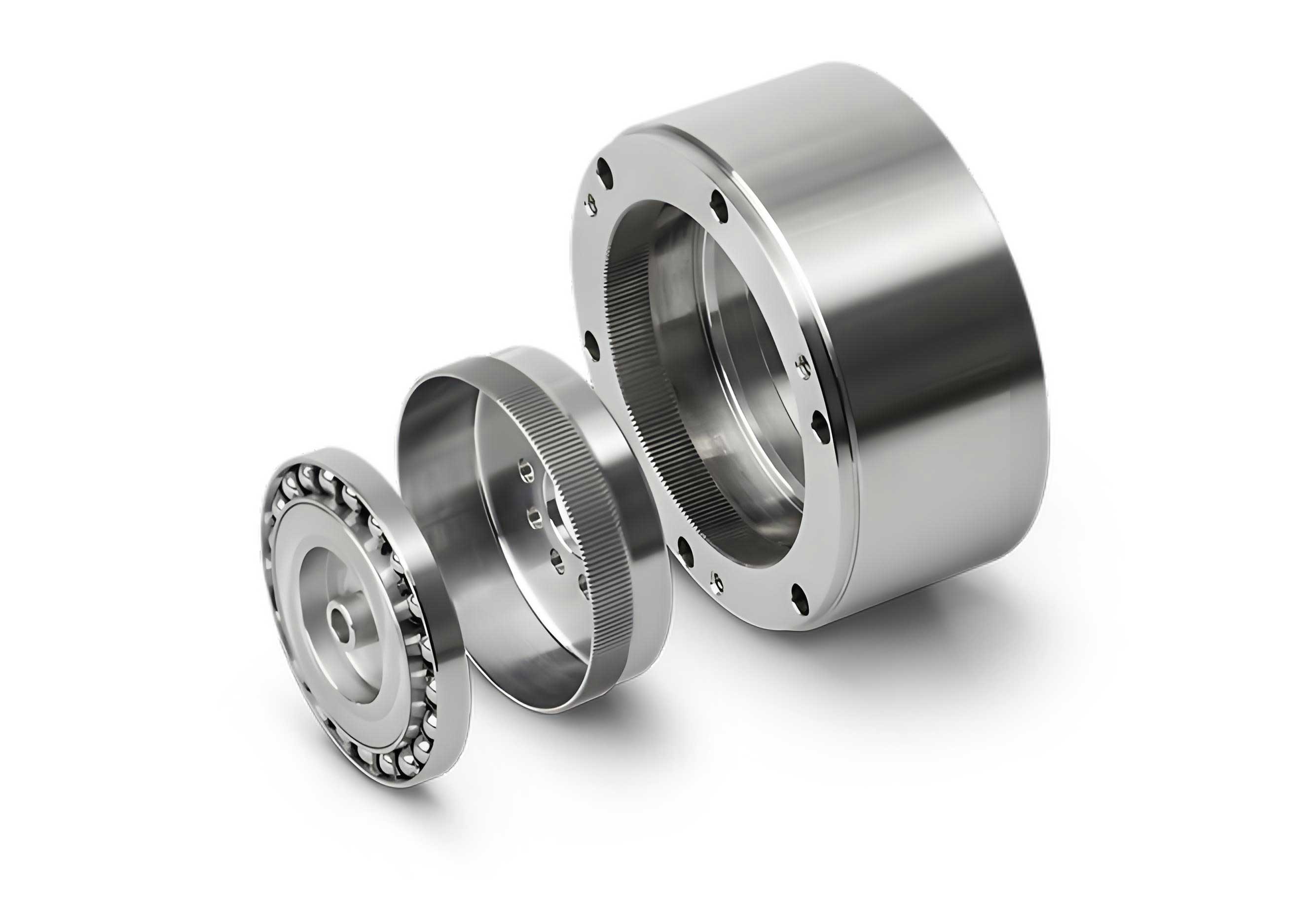
The core challenge in designing an involute harmonic drive gear lies in avoiding various types of interference that can occur between the internal gear (circular spline) and the external gear (flexspline). These interferences can lead to jamming, increased wear, noise, and failure. Based on my analysis, the primary interference types in internal gear pairs, which directly apply to the harmonic drive gear, are: involute interference, tooth profile overlap interference, radial interference, and fillet interference. Understanding and preventing these is paramount for a functional harmonic drive gear.
To systematically address these issues, I have compiled the definitions, non-interference conditions, and preventive measures for each type in the following table. This summary serves as a foundational guide for any engineer working on harmonic drive gear design.
| Interference Type | Definition | Non-Interference Condition | Preventive Measures |
|---|---|---|---|
| Involute Interference | Occurs when the endpoint B2 of the actual path of contact lies to the left of the limit point N1 on the theoretical line of action. | For standard gears (x1 = x2 = 0): $$ \frac{Z_1}{Z_2} \geq 1 – \frac{\tan\alpha_{a2}}{\tan\alpha’} $$ where $Z_1$ and $Z_2$ are tooth numbers of the pinion and internal gear, $\alpha_{a2}$ is the tip pressure angle of the internal gear, and $\alpha’$ is the operating pressure angle. | 1. Increase the pressure angle. 2. Increase the profile shift coefficients of both the internal gear and the pinion. |
| Tooth Profile Overlap Interference | Occurs when the tooth tip of the disengaging pinion overlaps with the tooth tip of the internal gear as it exits the tooth space. | $$ Z_2 \geq \frac{Z_1^2 \sin^2\alpha – 4(h_{a2}^*)^2}{2Z_1\sin^2\alpha – 4h_{a2}^*} $$ where $h_{a2}^*$ is the addendum coefficient of the internal gear and $m$ is the module. | 1. Increase the pressure angle. 2. Reduce the addendum height. 3. Increase the tooth number difference between the internal gear and pinion. 4. Increase the profile shift coefficient of the internal gear. |
| Radial Interference | Occurs when radially assembling the pinion into the internal gear from a concentric position, interference happens if the condition CD > EF is met (referring to specific radial clearance geometry). | The condition involves a complex geometric check. A derived condition to avoid it is: $$ \arccos\left(\frac{a^2 + r_{a2}^2 – r_{a1}^2}{2r_{a2}a}\right) + (\text{inv }\alpha’ – \text{inv }\alpha_{a2}) \geq 0 $$ where $a$ is the center distance, $r_{a1}$ and $r_{a2}$ are tip radii, and $\text{inv }x = \tan x – x$ is the involute function. | 1. Increase the pressure angle. 2. Reduce the addendum height. 3. Increase the tooth number difference. 4. Increase the profile shift coefficient of the internal gear. |
| Fillet (Undercut) Interference | Occurs when the tooth tip of the pinion contacts the fillet (transition curve) of the internal gear’s root, or vice-versa. | Condition to avoid fillet interference on internal gear: $$ (Z_2 – Z_1)\tan\alpha’ + Z_1\tan\alpha_{a1} \leq (Z_2 – Z_1)\tan\alpha_{a2′} + Z_2\tan\alpha_{a2} $$ Here, $\alpha_{a1}$ is the tip pressure angle of the pinion, and $\alpha_{a2′}$ is related to the form diameter. The parameter $\theta$ is calculated from: $$ \cos[\theta – (\text{inv }\alpha_{a1} – \text{inv }\alpha’)] = \frac{r_{a2}^2 – r_{a1}^2 – a^2}{2r_{a1}a} $$ |
1. Increase the profile shift coefficient of the internal gear. 2. Reduce the addendum height. |
For a harmonic drive gear, both the flexspline (acting as the external pinion) and the circular spline (the internal gear) typically use positive profile shifts to avoid radial interference. To prevent tooth profile overlap and further ensure smooth assembly, it is advisable to reduce the addendum coefficient of the flexspline. Furthermore, to enhance the contact ratio—which is beneficial for minimizing backlash—an angular modification with a negative transmission type is often employed, where the profile shift coefficient of the circular spline ($\xi_G$) is chosen to be slightly smaller than that of the flexspline ($\xi_R$).
The precise determination and modification of these profile shift coefficients are critical. The goal is to ensure the clearance between the tooth profiles is greater than zero (no interference) but less than a minimum allowable clearance $[H]$ to achieve near-zero backlash. The process I follow involves establishing an initial guess for the coefficients and then iteratively correcting them based on a calculated clearance function.
Determination and Modification of Mesh Parameters and Profile Shift Coefficients
Let me illustrate this process with a detailed example from a high-precision harmonic drive gear design project. The initial conditions for the involute working tooth profiles were as follows:
| Component | Parameters |
|---|---|
| Flexspline (Pinion) | Module $m = 0.3 \text{ mm}$, Number of teeth $Z_R = 170$, Reference pressure angle $\alpha = 20^\circ$, Addendum coefficient $h_{aR}^* = 0.408$, Dedendum clearance coefficient $c_R^* = 0.842$. The characteristic curve is a double-eccentric circle closed curve. |
| Circular Spline (Internal Gear) | Module $m = 0.3 \text{ mm}$, Number of teeth $Z_G = 172$, Reference pressure angle $\alpha = 20^\circ$, Addendum coefficient $h_{aG}^* = 1.0$, Dedendum clearance coefficient $c_G^* = 0.2$. The characteristic curve is a circle. |
The fundamental equation governing the design is the clearance $H_{RG}$ between the flexspline tooth tip and the circular spline tooth profile. This is a function of the roll angle and is given by:
$$ H_{RG} = \pm \sqrt{ (x_{aR}^G – x_{RG})^2 + (y_{aR}^G – y_{RG})^2 } $$
where $(x_{aR}^G, y_{aR}^G)$ are the coordinates of the flexspline tooth tip in the circular spline coordinate system, and $(x_{RG}, y_{RG})$ are the corresponding points on the circular spline tooth profile. The sign is determined by the relative position (inside/outside).
The first step is to determine the initial profile shift coefficients, $\xi_{R0}$ for the flexspline and $\xi_{G0}$ for the circular spline. For a harmonic drive gear with a pressure angle of $20^\circ$, empirical formulas are often used:
$$ \xi_{R0} = K_a K_i \sqrt[3]{2 i_{BR}^G} $$
$$ \xi_{G0} = \xi_{R0} + (0.2 \sim 0.25)m $$
Here, $K_a$ is a coefficient related to the pressure angle (1 for $\alpha=20^\circ$), $K_i$ is related to the transmission ratio (0.59 for $i=45-100$), and $i_{BR}^G$ is related to the wave generator configuration. Substituting the values for our case:
$$ \xi_{R0} = 1 \times 0.59 \times \sqrt[3]{2 \times 85} \approx 3.2684 $$
$$ \xi_{G0} = 3.2684 + 0.22 \times 0.3 = 3.3350 $$
These values provide a starting point that generally avoids gross interference.
Next, I calculate the clearance $H_{RG}$ at numerous discrete points (e.g., 210 points) around the entire mesh cycle using the coordinate transformation and gear geometry equations. A subset of the results might look like this:
| Point Index | Roll Angle $\phi_R$ (rad) | Clearance $H_{RG}$ (mm) |
|---|---|---|
| 0 | 0.000000 | 0.007332 |
| 1 | 0.005000 | 0.007171 |
| … | … | … |
| 25 | 0.108782 | 0.005392 |
| … | … | … | 210 | 1.050000 | 0.013162 |
From this full set of calculations, I identify the minimum clearance $H_{RG\text{min}}$. In this case, it occurs at point index 25 with a value of:
$$ H_{RG\text{min}} = 0.005391647 \text{ mm} $$
All calculated clearances were positive, indicating no interference with the initial coefficients. However, for a high-precision harmonic drive gear, we aim for a much smaller, controlled clearance to minimize backlash.
The allowable minimum clearance $[H]$ is set based on manufacturing tolerances and desired performance. For this example, let’s assume $[H] = 0.0006375 \text{ mm}$. The initial minimum clearance is larger than this. Therefore, a correction $\Delta\xi_R$ is applied to the flexspline’s profile shift coefficient to reduce the clearance. Assuming the tooth profiles can be approximated as straight lines in the contact region near the minimum point, the relationship between the shift change and clearance change is:
$$ \Delta\xi_R = \frac{H_{RG\text{min}} – [H]}{m \sin(\alpha + \delta)} $$
where $\delta$ is a small angle accounting for local profile orientation. An initial calculation yielded $\Delta\xi_R \approx 0.04576$. This would give a modified coefficient $\xi_R = \xi_{R0} + 0.04576 = 3.31416$. However, this still results in an average clearance of about 0.0113 mm, which does not meet the ultra-low backlash requirement for a high-performance harmonic drive gear.
To achieve near-zero backlash, a more aggressive correction is needed, allowing a small portion of the mesh to have negative clearance (slight interference), which will be accommodated by elastic deformation in the harmonic drive gear assembly. The objective is to have about 30-40% of the mesh points with a small negative clearance (between 0 and -0.0055 mm) and the remaining 60-70% with a small positive clearance (between 0 and 0.0117 mm). This ensures continuous contact and minimal overall backlash.
Through an iterative optimization process (e.g., using the golden section search method), I seek a correction $\Delta\xi_{RW}$ that makes the modified clearance $H_{RG\xi}$ zero at a specific point. After several iterations, I found that $\Delta\xi_{RW} = 0.1066$ achieves the desired distribution. With this correction:
$$ \xi_R = \xi_{R0} + \Delta\xi_{RW} = 3.2684 + 0.1066 = 3.3750 $$
$$ \xi_G = \xi_{G0} = 3.3350 $$
Now, $\xi_R > \xi_G$, which maintains the desired negative传动 type for higher contact ratio. The resulting clearance distribution after this final modification is:
- Maximum Negative Clearance (Interference): $H_{RG\xi\text{min}} = -0.005626 \text{ mm}$ at one specific point.
- Maximum Positive Clearance: $H_{RG\xi\text{max}} = 0.011720 \text{ mm}$ at another point.
- Distribution: Approximately 76 out of 210 mesh points exhibit negative clearance, while the remaining 134 points exhibit positive clearance.
This state is ideal for a harmonic drive gear. The points with slight negative interference will cause elastic deformation in the flexspline, ensuring tight contact without causing jamming. The majority of points have a small positive clearance, guaranteeing smooth operation. The net effect is an effective near-zero backlash across the entire rotation, which is critical for precision positioning applications using harmonic drive gears.
Mathematical Foundation and Further Considerations
The entire correction process relies heavily on the accurate calculation of the operating pressure angle $\alpha’$ and the tip pressure angles $\alpha_{a1}, \alpha_{a2}$. For an internal gear pair with profile shifts, the operating pressure angle is found by solving the involute function equation:
$$ \text{inv }\alpha’ = \text{inv }\alpha + \frac{2(\xi_2 – \xi_1) \tan\alpha}{Z_2 – Z_1} $$
where $\xi_1$ and $\xi_2$ are the profile shift coefficients of the pinion and internal gear, respectively. The tip radii are:
$$ r_{a1} = m\left(\frac{Z_1}{2} + h_{a1}^* + \xi_1\right) $$
$$ r_{a2} = m\left(\frac{Z_2}{2} – h_{a2}^* + \xi_2\right) $$
And the tip pressure angles are:
$$ \alpha_{a1} = \arccos\left(\frac{d_{b1}}{2r_{a1}}\right) = \arccos\left(\frac{Z_1 \cos\alpha}{Z_1 + 2(h_{a1}^* + \xi_1)}\right) $$
$$ \alpha_{a2} = \arccos\left(\frac{d_{b2}}{2r_{a2}}\right) = \arccos\left(\frac{Z_2 \cos\alpha}{Z_2 – 2(h_{a2}^* – \xi_2)}\right) $$
These formulas are essential for evaluating the non-interference conditions listed in the first table and for performing the clearance calculations.
Furthermore, the contact ratio $\epsilon_\alpha$ for the internal gear pair in a harmonic drive gear should be checked to ensure smooth transmission of motion. It is given by:
$$ \epsilon_\alpha = \frac{ \sqrt{r_{a1}^2 – r_{b1}^2} – \sqrt{r_{a2}^2 – r_{b2}^2} – a \sin\alpha’ }{p_b} $$
where $r_b$ are base radii and $p_b = \pi m \cos\alpha$ is the base pitch. A contact ratio greater than 1.1 is typically desirable for harmonic drive gears.
In conclusion, the design of a high-precision harmonic drive gear is a meticulous balance between avoiding geometric interference and minimizing operational backlash. The process I have described—starting from interference analysis, initial coefficient estimation, detailed clearance simulation, and iterative profile shift correction—is crucial for optimizing performance. The unique kinematics of the harmonic drive gear, where the flexspline undergoes elastic deformation, allows us to strategically employ slight negative clearances in the calculation, knowing they will be absorbed elastically to create a taut, near-zero backlash mesh. This approach underscores the sophisticated engineering behind reliable and accurate harmonic drive gear systems, enabling their use in robotics, aerospace, and other precision industries.