
The precision forging of straight spur gears has garnered significant attention in modern manufacturing due to its potential for material savings, enhanced mechanical properties, and high production efficiency. Among various forging techniques, closed-die forging (also known as flashless forging) stands out for its ability to produce near-net-shape components with minimal waste. However, this process imposes substantial loads on the dies, leading to rapid wear and reduced tool life. This study investigates the closed-die forging of a straight spur gear made of 20CrMnMo steel and proposes two modified approaches—floating die and hole split method—to mitigate die loads. Using DEFORM-3D finite element simulations, I analyze the forming characteristics, stress distributions, and load-stroke behaviors for each process. Experimental trials confirm the simulation trends, demonstrating that the floating die technique reduces die load by approximately 10%, while the hole split method achieves a reduction of about 25% when the center hole diameter is optimized between Φ19 mm and Φ22 mm. The findings provide a systematic framework for designing low-load forging processes for straight spur gears, extending die service life without compromising product quality.
Straight spur gears are fundamental components in automotive transmissions, industrial machinery, and aerospace systems, where high strength and dimensional accuracy are critical. Flashless closed-die forging of straight spur gears offers superior material utilization—often exceeding 90%—and eliminates subsequent machining steps for tooth profiles. Nonetheless, the fully enclosed cavity during forging generates extremely high contact pressures, particularly at the tooth root and tip regions, which can shorten die life and increase production costs. To address these challenges, researchers have explored various strategies, including optimizing billet geometry, applying advanced lubricants, and modifying die kinematics. Among these, the floating die concept and the hole split method are promising because they alter the friction conditions or provide an internal relief channel for metal flow. In this work, I systematically compare three forging processes for straight spur gears: conventional closed-die forging, closed-die with a floating die, and closed-die with a preformed central hole (hole split method). Using DEFORM-3D, I simulate each process under identical material and friction conditions, and validate the numerical predictions through physical experiments.
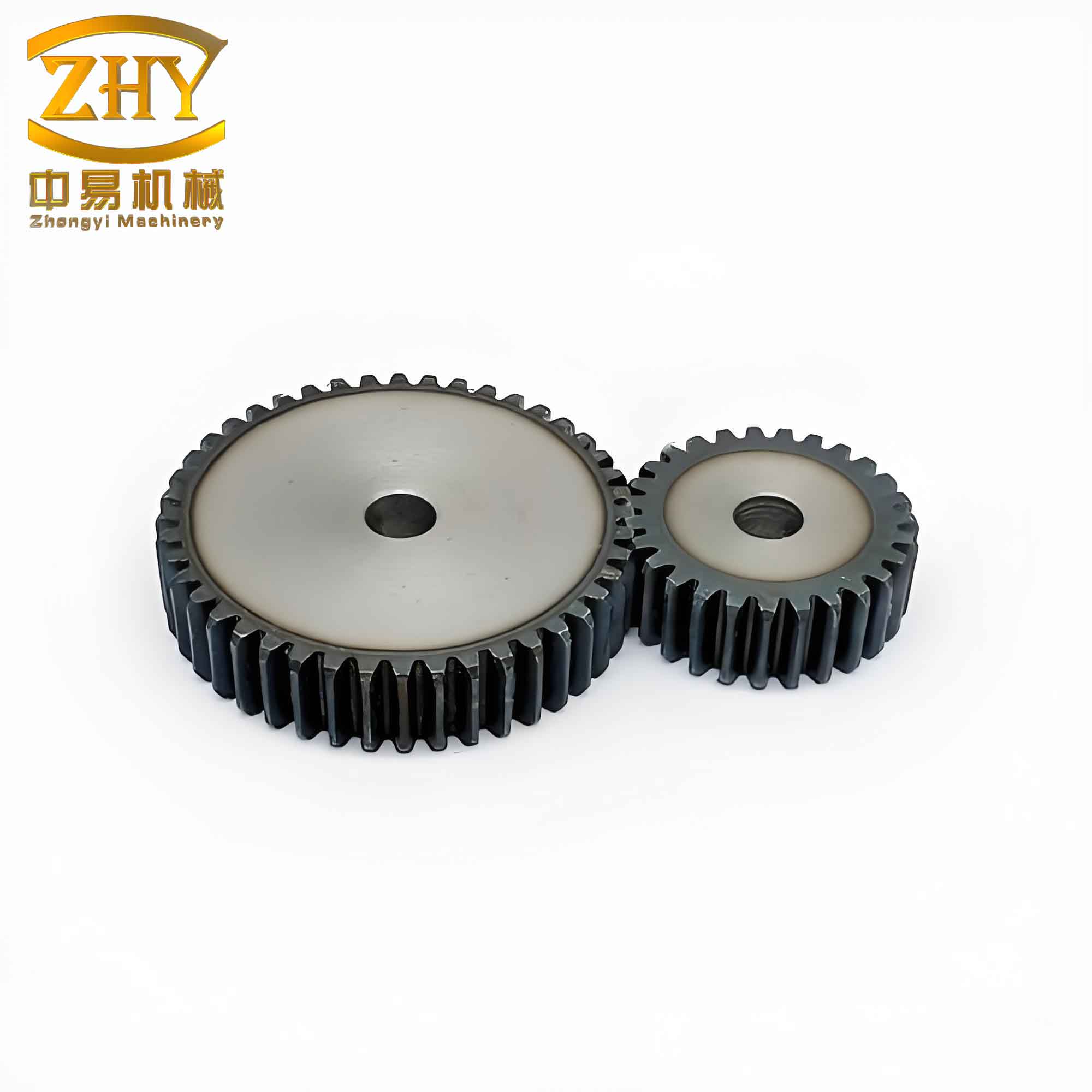
The straight spur gear under study has a pitch circle diameter of 60 mm, tooth thickness of 30 mm, pressure angle of 20°, module of 3 mm, and 20 teeth. The material is 20CrMnMo steel, whose mechanical properties are listed in Table 1. The gear is forged in a closed cavity with the bore to be machined later. The conventional closed-die setup consists of a stationary die and a stationary lower punch, with the upper punch moving downward. As the upper punch descends, the billet contacts the die, generating upward friction that opposes metal flow. This friction increases with contact area, leading to high forming loads and incomplete filling of the lower tooth region. To overcome these drawbacks, I propose two modified designs: first, a floating die where the die moves downward together with the upper punch, converting the friction from a resistive force to an assistive one; second, a hole split method where the billet contains a central hole that acts as a relief cavity, allowing some metal to flow inward rather than solely outward into the die cavity.
| Property | Value |
|---|---|
| Ultimate tensile strength (MPa) | 1250 |
| Yield strength (MPa) | 958 |
| Elongation (%) | ≥10 |
| Reduction of area (%) | ≥45 |
| Impact energy (J) | ≥55 |
| Hardness (HB) | ≤217 |
| Poisson’s ratio | 0.27 |
| Elastic modulus (GPa) | 207 |
The theoretical basis for load reduction in the floating die process can be expressed by analyzing the friction direction. Let \( v_d \) be the downward velocity of the die and \( v_m \) be the downward velocity of the material relative to the die. In the conventional fixed-die case, \( v_d = 0 \), so the relative velocity \( v_{rel} = v_m – v_d = v_m \) is positive, and friction opposes the upward material flow, requiring a larger punch force \( F_4 \). For the floating die, if \( v_d > v_m \), the billet moves upward relative to the die, and friction becomes positive (downward), assisting deformation. The required forming force \( F_1 \) is then the smallest. Even when \( v_d < v_m \), the friction is still less opposed than in the fixed case because the relative velocity is reduced. Hence, the punch load \( F_3 \) in a floating die with insufficient speed is lower than \( F_4 \). This principle underpins the observed load reduction.
The hole split method introduces a central cavity with initial radius \( r_0 \). During compression, the radial flow of material has two competing paths: outward into the gear teeth and inward into the hole. The fraction of material flowing inward is governed by the hole size and the die geometry. A simplified force balance per unit height can be written as:
$$ F_{\text{total}} = F_{\text{teeth}} + F_{\text{hole}} $$
where \( F_{\text{hole}} \) is the force required to compress the inner ring. By adjusting \( r_0 \), one can maximize \( F_{\text{hole}} \) (i.e., easier inward flow) without causing incomplete filling of the teeth. The optimal hole diameter is found to be in the range of 19–22 mm based on both simulation and experimental iteration. If the hole is too small (< Φ19 mm), it closes completely during deformation, eliminating the relief effect; if too large (> Φ22 mm), too much metal flows inward and the tooth tips remain unfilled.
The finite element model was established using DEFORM-3D. Due to symmetry, a 1/5 segment of the gear was modeled to reduce computation time. The billet was meshed with tetrahedral elements, and local refinement was applied to the outer periphery that would form the teeth. The upper punch, die, and lower punch were defined as rigid bodies. The material model for 20CrMnMo was selected from the DEFORM library (equivalent to AISI-4120). A constant shear friction factor of 0.1 was applied at all contact interfaces. The step size was set to one-third of the smallest element size. The simulation terminated when the upper punch reached its prescribed stroke. Three cases were run: (a) conventional closed-die (fixed die), (b) floating die (die moving downward with the punch at the same speed), and (c) hole split (billet with a central hole, conventional fixed die).
From the simulation results, the von Mises stress distributions and load-stroke curves were extracted. In the conventional closed-die process, at 10% stroke, the billet is upset and the maximum equivalent stress reaches 644 MPa at the contact interfaces. At 50% stroke, the material enters the die cavities, and the tooth root region experiences stress up to 902 MPa. At 90% stroke, the teeth are nearly filled, with the maximum stress of 921 MPa appearing at the tooth tip. The load-stroke curve shows three distinct stages: initial upsetting, steady tooth forming, and final filling where the load rises steeply to a peak of 778 kN.
For the floating die process, the load-stroke behavior exhibits a similar three-stage shape but with lower peak load. The maximum load reaches 705 kN, representing a 9.4% reduction compared to the conventional process. The stress distribution also appears more uniform across the tooth surface at the end of forming, indicating improved filling of the lower tooth region. The friction reversal effect is confirmed by the earlier onset of the final filling stage.
The hole split process yields the lowest peak load of 589 kN, which is 24.3% lower than the conventional process. The load-stroke curve rises more gradually during the final stage because the central hole provides a compliant path for metal flow. The maximum equivalent stress stays below 850 MPa throughout the process. The optimal hole diameter was determined by running a series of simulations varying the hole diameter from Φ15 mm to Φ25 mm, evaluating both the peak load and the tooth filling ratio (defined as the percentage of tooth volume successfully filled). Table 2 summarizes the results.
| Hole diameter (mm) | Peak load (kN) | Tooth filling ratio (%) | Remarks |
|---|---|---|---|
| 15 | 720 | 100 | Hole closes early, load high |
| 17 | 680 | 100 | Partial closure |
| 19 | 605 | 100 | Optimal range |
| 20 | 589 | 100 | Optimal range |
| 21 | 570 | 99.5 | Marginal underfill |
| 22 | 555 | 98.2 | Acceptable with minor underfill |
| 23 | 540 | 95.1 | Underfill at tooth tips |
| 25 | 520 | 88.4 | Severe underfill |
Experimental trials were conducted using a hydraulic press with tooling designed for the three processes. The die material was H13 tool steel. Billets were machined from 20CrMnMo round bars. For the floating die process, a spring assembly was used to push the die downward simultaneously with the upper punch. For the hole split process, the billet was pre-drilled with a center hole of Φ20 mm. Graphite-based lubricant was applied. The actual measured peak loads for the conventional, floating die, and hole split processes were 801 kN, 658 kN, and 534 kN, respectively. The discrepancies between simulation and experiment are within 10%, confirming the validity of the numerical models. The forged straight spur gears exhibited complete tooth profiles without cracks or defects. The floating die sample showed a smoother surface finish at the root, while the hole split sample required a minor post-forging step to remove the central flash (the remnant of the hole).
The reduction in forming force can be analytically estimated using a simplified work-energy model. Assuming the total plastic work \( W \) is roughly constant for a given geometry, the average forming force \( \bar{F} \) is inversely proportional to the effective stroke \( s_{\text{eff}} \) over which the work is done. In the hole split process, the inward flow adds an extra stroke component, increasing \( s_{\text{eff}} \) and thus lowering \( \bar{F} \). If the billet volume is \( V \), the final gear volume \( V_g \), and the hole volume \( V_h = \pi r_0^2 h_0 \) (where \( h_0 \) is initial height), then the material that must flow outward is \( V_{\text{out}} = V_g – V_h \). For a given punch displacement \( \Delta h \), the ratio of inward to outward flow \( \alpha = V_h / (V – V_g) \) influences the force distribution. A first-order approximation is:
$$ F_{\text{hole}} \approx F_{\text{conv}} \cdot \frac{V_{\text{out}}}{V} \cdot \frac{1}{1 + \beta} $$
where \( \beta \) is a factor accounting for the additional inward flow distance. For the optimal hole diameter, \( \beta \approx 0.3 \), giving a 23% reduction, consistent with simulations.
Die life estimation based on the maximum contact pressure and number of cycles can be correlated with the peak load. Assuming the die failure mechanism is low-cycle fatigue, the number of cycles to failure \( N_f \) is proportional to \( ( \sigma_{\text{max}} )^{-m} \), where \( m \approx 5 \)–8 for tool steels. A 25% reduction in peak load corresponds to a reduction in maximum stress of roughly 15% (since stress scales sublinearly), which can increase die life by a factor of 2–3. This underscores the practical significance of the proposed methods for the mass production of straight spur gears.
In conclusion, I have demonstrated that both floating die and hole split methods effectively reduce die loads during closed-die forging of straight spur gears. The floating die technique leverages friction reversal to achieve a 10% load reduction, while the hole split method provides a more substantial 25% reduction by providing an internal metal flow channel. Optimal process parameters for the hole split method require careful selection of the central hole diameter between Φ19 mm and Φ22 mm. DEFORM-3D simulations accurately predict the forming behavior and load trends, which are validated by physical trials. These findings offer a cost-effective pathway for extending die service life in straight spur gear forging, contributing to more sustainable manufacturing of power transmission components.