
Gear transmissions are a fundamental component in mechanical systems, prized for their smooth operation, wide power range, high efficiency, compact structure, and long service life. Among various gear types, bevel gears, which transmit motion and power between intersecting shafts, are crucial. Our research focuses specifically on a type of bevel gear known as the miter gear, where the shaft angle is 90 degrees and the gear ratio is 1:1. Understanding the dynamic behavior of these miter gears under high-speed conditions, typical in aerospace applications, is critical for ensuring reliability and performance.
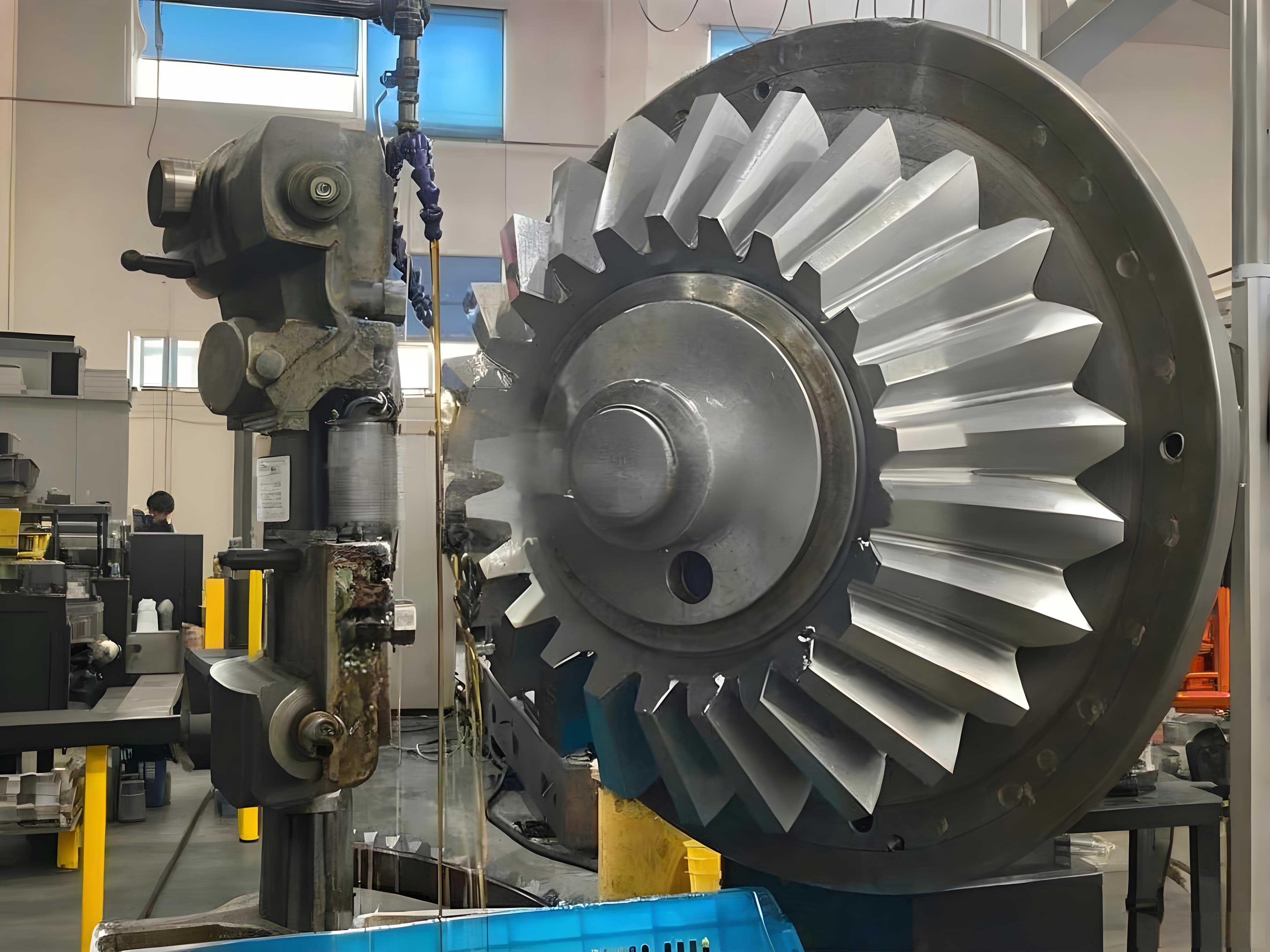
Transmission Error (TE) is widely recognized as a primary excitation source for vibration and noise in gear transmission systems. It reflects the deviation of the driven gear’s actual position from its ideal theoretical position. Dynamic Transmission Error (DTE), measured under operating conditions, serves as a key indicator of gear pair performance, meshing quality, and overall system dynamics. It provides invaluable data for refining gear design and manufacturing processes. While significant research exists on the dynamic analysis of spiral and hypoid bevel gears, detailed experimental studies on the high-speed DTE of straight miter gears, especially within complex drivetrains, are less common. This study addresses this gap by constructing a specialized test platform to measure and analyze the DTE of a high-speed straight miter gear pair within a two-stage transmission system, and to correlate these findings with measured vibration data.
1. Fundamental Principles of Transmission Error Testing
1.1 Definition of Dynamic Transmission Error
For a gear pair, the Dynamic Transmission Error (DTE) is defined as the difference between the actual angular position of the driven gear and its ideal angular position, the latter being defined under the assumption of perfect gear geometry and no tooth deflection. For the miter gear pair under investigation, this is mathematically expressed as:
$$ DTE = \theta_g – \frac{N_p}{N_g} \theta_p $$
where:
$N_p$, $N_g$ are the number of teeth on the driving (pinion) and driven (gear) miter gears, respectively.
$\theta_p$, $\theta_g$ are the instantaneous angular positions of the pinion and gear, respectively.
1.2 Testing Methodology for Miter Gears
We employ the single-flank mesh testing method for dynamic measurement. This method involves the continuous meshing of the test gear pair under actual working conditions (with backlash) while their angular positions are recorded in real-time using high-precision angular sensors. The DTE is derived by comparing the actual angular relationship with the ideal one defined by the gear ratio.
High-speed DTE measurement presents specific challenges: limited sensor installation space in a prototype assembly, a harsh lubricated environment generating oil mist, extremely high rotational speeds demanding exceptional measurement accuracy, and the subsequent handling of massive data streams for transmission and storage.
To meet these demands, we selected Renishaw LM13 series magnetic encoders. The key specifications of the encoder system are summarized in the table below:
| Parameter | Specification (LM13 Series) |
|---|---|
| Signals per Revolution | 3,200 |
| Theoretical Resolution | 21.06 arc-seconds |
| Maximum Allowable Speed | 19,500 rpm |
| Output Type | ABR RS422 (Square Wave, ±5V) |
| Supply Voltage | 5 V DC |
2. Construction of the High-Speed Miter Gear DTE Test Platform
The test subject is a two-stage transmission system consisting of a parallel spur gear pair followed by a straight miter gear pair. Our analysis concentrates on the miter gear mesh. The primary parameters of the gear pairs are listed below:
| Design Parameter | Symbol | Spur Pinion (z7) | Spur Gear (z8) | Miter Pinion (z9) | Miter Gear (z10) |
|---|---|---|---|---|---|
| Number of Teeth | z | 37 | 35 | 19 | 32 |
| Module | m (mm) | 2.00 | 2.00 | 2.75 | 2.75 |
| Pressure Angle | α (°) | 20 | 20 | 20 | 20 |
The test system hardware comprises three main subsystems: the magnetic encoder subsystem, the data acquisition subsystem, and the data storage subsystem. One magnetic encoder ring was installed on the input shaft (driving the miter gear pinion) and another on the output shaft (driven by the miter gear gear). The encoder readers output square wave pulse trains. The angular position of each shaft is determined by precisely timing the rising edges of these pulses. The theoretical resolution is governed by the timer’s clock frequency. By synchronously capturing the pulse trains from both encoders and applying Equation (1), the DTE time history for the miter gear pair is computed.
The software system was developed on the LabVIEW platform using a virtual instrument architecture. A “producer-consumer” design pattern with a dataflow model (acquisition -> transfer -> storage) was implemented to maximize efficiency and minimize memory usage during high-speed data logging.
3. DTE Testing and Data Analysis for the Miter Gear Pair
3.1 DTE Waveforms and Spectral Characteristics
Applying Equation (1) to the recorded data yields the DTE curve. Figure 1 shows the raw DTE signal for an input pinion speed of 8,135 rpm. The signal approximates a sinusoidal waveform, dominated by low-frequency components. To analyze the constituent frequencies, we separate the DTE signal into low-frequency (0.1 – 1,000 Hz) and high-frequency components via filtering.
The low-frequency spectrum (Figure 2) reveals that the DTE is primarily composed of shaft frequency components and their harmonics. Let $f_{s1}$ and $f_{s2}$ represent the rotational frequencies of the input and output shafts connected to the miter gear pair, respectively. The dominant peaks correspond to $f_{s2}$, $f_{s1}$, and their multiples (e.g., $2f_{s2}$, $3f_{s2}$). These low-frequency elements are primarily associated with geometric errors like cumulative pitch error and run-out.
The high-frequency component (Figure 3) and its spectrum (Figure 4) show significant energy at the gear mesh frequency $f_m = N_p * f_{s1} = N_g * f_{s2}$ and its harmonics. The amplitude at $f_m$ is notably larger than at $2f_m$. Furthermore, sidebands around the mesh frequency indicate modulation, suggesting coupling between the miter gear meshing excitation and other vibrations within the drivetrain.
Figures 5 and 6 present the low-frequency and high-frequency spectra, respectively, for a higher speed of 16,200 rpm. Comparison with the 8,135 rpm data shows that: 1) The DTE of the miter gear pair remains dominated by shaft frequency components, with amplitudes largely unchanged by speed, confirming their link to fixed geometric errors. 2) A distinct low-frequency component $f$ emerges at the higher speed, suspected to be a shaft frequency related to the broader engine rotor dynamics.
3.2 DTE Variation Across the Speed Range
To analyze trends, we examined the Root Mean Square (RMS) value of the DTE across a speed range from 8,135 to 16,200 rpm. The overall DTE RMS (Figure 7a) shows a significant peak near 14,800 rpm, indicating a strong dynamic response likely driven by the excitation of low-frequency components. The RMS is relatively stable below 11,000 rpm but exhibits larger fluctuations above 14,000 rpm.
We also calculated the RMS of the DTE’s high-frequency component, isolated via a band-pass filter centered on the mesh frequency (e.g., $0.5f_m$ to $3.5f_m$). This curve (Figure 7b) shows distinct peaks at approximately 9,200 rpm and 11,000 rpm. These peaks correspond to speeds where the system’s response to the miter gear meshing excitation is amplified.
A more detailed spectral analysis tracking the amplitude of the mesh frequency ($f_m$) and its second harmonic ($2f_m$) versus speed is shown in Figure 8. This confirms that the first mesh harmonic is the dominant high-frequency component in the miter gear DTE. The clear peak at 11,000 rpm in the $f_m$ amplitude aligns with the peak in the high-frequency DTE RMS, pinpointing a speed where meshing-induced vibration is pronounced.
3.3 Correlation Between DTE and Vibration Measurements
To validate the DTE as an indicator of system dynamics, we compared it with vibration acceleration measurements taken on the gearbox housing near the supporting bearings. Figure 9 shows the amplitude of the vibration acceleration at the mesh frequency $f_m$ and its harmonic $2f_m$ across the same speed range.
The correlation is evident: 1) The vibration response of the system is also dominated by the first mesh frequency of the miter gear pair. 2) The speeds at which peaks occur in the DTE mesh-frequency amplitude (e.g., ~11,000 rpm) correspond directly to peaks in the vibration acceleration amplitude. This demonstrates a consistent dynamic response captured by both the direct miter gear DTE measurement and the external housing vibration measurement.
4. Conclusions
Our investigation into the high-speed dynamic transmission error of a straight miter gear pair within a two-stage transmission system yields the following conclusions:
- The low-frequency components of the miter gear Dynamic Transmission Error are strongly speed-dependent. Analysis of the DTE curves can successfully identify speed intervals (e.g., 11,000-14,000 rpm) where significant system vibration is expected, a finding consistent with independently measured vibration data.
- The developed high-speed DTE measurement system, overcoming challenges related to space, environment, and data handling, effectively acquired reliable data for the miter gear pair. This methodology provides a valuable reference for high-speed gear transmission error testing.
- Data analysis conclusively shows that the dynamic transmission error of this straight miter gear pair is predominantly composed of shaft frequency components and their harmonics, with the output shaft frequency being the most significant. This characteristic is a key dynamic signature of the miter gear pair and provides critical insight for its design and application.
- There is a direct and consistent correlation between the measured Dynamic Transmission Error of the miter gear and the vibration acceleration measured on the gearbox. Both metrics reflect the same underlying dynamic excitations and system responses, validating DTE as a fundamental diagnostic parameter for gear dynamics.
This work underscores the importance of direct miter gear transmission error measurement in understanding and predicting the dynamic behavior of high-speed power transmission systems.