
In the realm of precision motion control for aerospace, robotics, and optical systems, the harmonic drive gear stands out for its exceptional capabilities. Characterized by high reduction ratios, compact design, zero-backlash operation, and positional accuracy, this unique gear system is often the preferred choice for demanding applications. The core principle of the harmonic drive gear involves three primary components: a rigid circular spline, a flexible spline, and an elliptical wave generator. The wave generator deforms the flexible spline, causing its external teeth to mesh progressively with the internal teeth of the circular spline, resulting in a high-ratio, smooth transmission of motion. Understanding the stiffness characteristics of these components, particularly under low-torque conditions typical of precision applications, is paramount for predicting system performance, ensuring stability, and avoiding resonant vibrations.
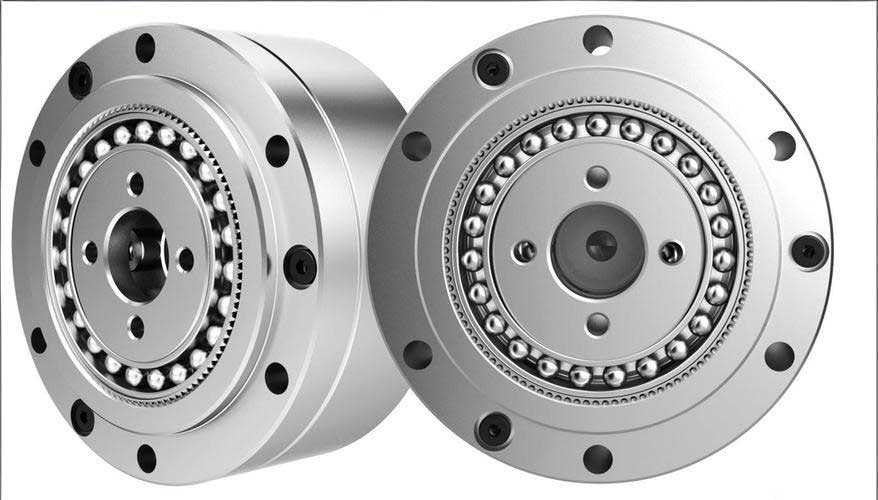
Conventionally, the torsional stiffness of a harmonic drive gear is often characterized from the input side. The standard methodology involves locking the output shaft (typically the circular spline or flexible spline, depending on the configuration) and applying a torque to the input wave generator. The resulting angular deflection is measured, yielding the input stiffness, $K_{in}$. The output stiffness, $K_{out}$, is then theoretically derived using the square of the gear reduction ratio, $i$:
$$K_{out} = i^2 \times K_{in}$$
However, empirical observations in high-precision systems frequently contradict this idealized relationship. Specifically, when a complete system incorporating a harmonic drive gear is subjected to low-torque dynamic analysis or vibration testing, the observed overall output stiffness can be significantly lower than the value calculated from the nominal input stiffness. This discrepancy suggests a potential compliance elsewhere in the system not captured by the standard input-side test, or a breakdown of the simple squared-ratio relationship under specific loading conditions, particularly in the micro-torque regime.
To isolate and investigate this anomaly, a dedicated test methodology for directly measuring the output shaft torsional stiffness of a precision harmonic drive gear was developed. The core objective was to determine whether the output shaft assembly itself—comprising the output flange, connecting hardware, and the integrated component (flexible or circular spline)—exhibits insufficient stiffness that could explain the system-level compliance. This paper details the design philosophy, implementation, and results of a bespoke test system capable of applying pure, bidirectional torque couples to the output shaft and measuring the resultant nanoradian-level angular displacements.
Fundamental Principles of the Measurement System
The accurate measurement of torsional stiffness requires the application of a known, pure torque and the precise quantification of the resulting angular twist. To achieve this for the output shaft of a harmonic drive gear, two key principles were employed: the application of a calibrated force couple and high-resolution angle measurement via optical autocollimation.
Application of a Pure Torque via Force Couple
Applying a single tangential force to a shaft can induce unwanted bending moments and side loads, leading to friction in supports and erroneous deflection readings. To generate a pure, reactionless torque on the harmonic drive gear output shaft, a force couple system was designed. A force couple consists of two parallel forces of equal magnitude, $F$, acting in opposite directions, separated by a perpendicular distance, $d$, the moment arm. The torque, $M$, applied is given by the vector cross product:
$$\vec{M} = \vec{d} \times \vec{F}$$
with magnitude:
$$M = F \cdot d$$
This configuration induces a pure rotational effect without net translational force on the shaft, isolating the torsional response. In the constructed system, this was implemented using a large-diameter torque disk attached to the output shaft. Cables routed over low-friction pulleys connected opposing sides of the disk to weight pans, allowing for the symmetrical application of bidirectional torques.
High-Precision Angle Measurement with an Autocollimator
The torsional deflection of a stiff harmonic drive gear output shaft under modest torque is exceedingly small, often on the order of arcseconds. Measuring such minuscule angles demands instrumentation with sub-arcsecond resolution. An optical autocollimator is ideally suited for this task. Its operation is based on the principle of projecting a collimated beam of light onto a reflective surface and measuring the lateral displacement of the returned image. A high-precision right-angle prism was securely mounted to the torque disk, with one reflective face acting as the target mirror. Any rotation, $\alpha$, of the output shaft and attached prism deflects the return beam by an angle $2\alpha$. The autocollimator’s internal optics and scale convert this angular deviation into a digital readout. For small angles, the relationship is linear and provides exceptional sensitivity and accuracy.
The effective stiffness, $K$, at any point on the torque-angle curve is defined as the derivative of torque with respect to angular displacement, $\phi$:
$$K = \frac{dT}{d\phi}$$
where $T$ is the applied torque and $\phi$ is the measured twist angle in radians. The primary experimental output is a $\phi$ vs. $T$ curve, from which local and global stiffness values can be computed.
Design and Implementation of the Torsional Stiffness Test Rig
The test system was engineered to provide a stable, low-friction, and highly measurable environment for evaluating the harmonic drive gear. A summary of the key system parameters and instrumentation is provided in the table below.
| Subsystem / Component | Specification / Model | Purpose |
|---|---|---|
| Test Structure | Rigid optical breadboard with vertical mounting plate | Provides a stable, non-compliant base for the harmonic drive gear under test. |
| Torque Application | Diameter $d = 300\ mm$ disk, low-friction pulley system, calibrated mass sets | Generates a pure, bidirectional torque couple. Max Torque: $\approx 80\ N\cdot m$. |
| Harmonic Drive Gear Mounting | Custom adapter flanges | Securely fixes the input component (wave generator) to the base and connects the output component to the torque disk. |
| Primary Angle Sensor | Nikon 6B Photoelectric Autocollimator | Measures output shaft rotation with a resolution of $0.5$ arcseconds. |
| Reference Mirror | High-precision right-angle prism | Reflective surface for autocollimator, kinematically mounted to torque disk. |
| Mass Calibration | TP3001N Electronic Balance (0.1 g resolution) | Ensures accurate knowledge of applied force $F$ from masses. |
The assembly sequence was critical for ensuring that only the torsional compliance of the output side of the harmonic drive gear was measured. The wave generator was rigidly fixed to the stationary mounting plate, acting as the locked input. The output component (e.g., the flexible spline for a “cup” style harmonic drive gear) was then connected directly to the central torque disk. The circular spline was either fixed or left free depending on the gear configuration being tested. This setup ensured that any measured rotation of the torque disk under applied load was solely due to the elastic wind-up of the path from the gear’s output teeth through its flange and into the disk, not from any rotation of the wave generator.
Experimental Methodology and Data Acquisition
The testing protocol was designed to characterize the stiffness of the harmonic drive gear output shaft across multiple engagement positions and under both increasing and decreasing torque profiles, revealing any hysteresis or positional dependence.
- System Zeroing: With a balanced, pre-loaded torque applied to establish steady-state conditions and eliminate lash, the autocollimator was adjusted to define the angular zero reference.
- Bidirectional Torque Cycling: A sequence of mass additions and removals was performed to execute a complete torque cycle:
- Phase 1 – Positive Unload: Masses were incrementally removed from the “positive” torque pans, moving from maximum torque ($+M_{max}$) to zero torque. Angle readings were recorded after each step.
- Phase 2 – Negative Load: Masses were incrementally added to the “negative” torque pans, moving from zero torque to maximum negative torque ($-M_{max}$).
- Phase 3 – Negative Unload: Masses were incrementally removed from the negative pans, moving from $-M_{max}$ back to zero.
- Phase 4 – Positive Reload: Masses were incrementally added back to the positive pans, moving from zero to $+M_{max}$.
This $+M \to 0 \to -M \to 0 \to +M$ cycle captures stiffness behavior in all quadrants of rotation.
- Multiple Engagement Position Testing: A critical aspect of harmonic drive gear behavior is its dependence on the angular engagement position between the flexible and circular splines. After one complete measurement cycle, the output component (e.g., flexible spline) was rotated by a precise angular increment relative to the fixed component while keeping the input locked. A new measurement cycle was then conducted. This was repeated at multiple positions (e.g., every 60 degrees over one full rotation of the flexible spline) to sample the stiffness across different tooth engagement conditions.
The raw data for each test consisted of a set of torque values, $T_j$, and their corresponding angular deviation measurements, $\phi_j$. Data reduction involved plotting $\phi$ versus $T$ and performing piecewise or polynomial curve fitting to obtain the local slope, $k = \Delta \phi / \Delta T$, for each phase of the loading cycle. The torsional stiffness $K$ in consistent units of $N \cdot m / rad$ was then calculated using:
$$K = \frac{1}{k} \times \frac{3600 \times 180}{\pi}$$
where the factor converts the slope $k$ from units of $[arcsec / (N\cdot m)]$ to $[N\cdot m / rad]$.
Results, Analysis, and Discussion
The testing of a representative precision harmonic drive gear yielded highly informative results. The primary data product was a series of torque-angle hysteresis loops for different engagement positions. A key finding was that while the relationship was predominantly linear, indicating a constant stiffness, the slope and shape of the curve varied depending on the engagement position and the direction of torque change.
For example, at an initial engagement position (denoted 0°), the curves for all four loading phases were nearly coincident, exhibiting minimal hysteresis and a consistent slope. This suggests a linear, repeatable torsional spring behavior at that specific engagement point. However, at other engagement positions, such as 120°, the curves for the negative torque loading phase showed a noticeably different slope (lower stiffness) compared to the positive torque loading phases, indicating a positional dependence of the stiffness characteristic. This can be attributed to variations in the load distribution across the meshing teeth of the harmonic drive gear at different angular alignments, potentially engaging slightly different sets of teeth or stress distributions within the flexible spline.
The calculated stiffness values for all tested engagement positions and loading phases are consolidated in the table below. This comprehensive data set allows for a robust assessment of the output shaft’s performance.
| Engagement Position (°) | Torsional Stiffness, $K_{out}$ (×10⁴ N·m/rad) | |||
|---|---|---|---|---|
| Phase 1: +M → 0 | Phase 2: 0 → -M | Phase 3: -M → 0 | Phase 4: 0 → +M | |
| 0 | 4.42 | 4.22 | 4.28 | 4.29 |
| 60 | 4.44 | 4.39 | 4.38 | 4.31 |
| 120 | 4.16 | 3.49 | 3.57 | 4.07 |
| 180 | 4.18 | 3.21 | 3.61 | 3.99 |
| 240 | 4.28 | 3.43 | 3.63 | 4.20 |
| 300 | 4.24 | 3.26 | 3.49 | 4.10 |
| Mean Stiffness (All Positions & Phases): ~4.0 ×10⁴ N·m/rad | ||||
The analysis of these results leads to several critical conclusions regarding the harmonic drive gear under test:
- High Absolute Stiffness: The measured output shaft torsional stiffness values are consistently on the order of $4 \times 10^4\ N\cdot m/rad$. This is an exceptionally high stiffness value.
- Positional Variance: The stiffness is not constant but varies with the engagement position of the harmonic drive gear, with variations of up to approximately 25% between the highest and lowest measured values. The stiffness in the negative torque direction is often, but not always, lower than in the positive direction for a given position.
- Non-Applicability of Squared-Ratio Rule: Given the high measured $K_{out}$, if the theoretical relationship $K_{out} = i^2 \times K_{in}$ held, it would imply an input stiffness $K_{in}$ also far higher than what is typically measured or specified for such harmonic drive gears. This directly confirms that the simple squared-ratio model is invalid for predicting the low-torque, system-relevant output stiffness of this precision harmonic drive gear. The overall system compliance must therefore originate from a different source.
The primary implication is that the output shaft assembly of this harmonic drive gear—comprising the flange, bolts, and the output spline’s integral structure—is inherently very rigid. It is not the “weak link” responsible for the unexpectedly low overall system stiffness observed in dynamic tests. The source of the system compliance must be sought elsewhere in the harmonic drive gear assembly. Potential candidates include:
- Flexible Spline Bending and Radial Compliance: The thin-walled flexible spline may exhibit significant radial or axial deflection under load, which is not captured in a pure torsion test but can affect the effective rotational stiffness when the gear is mounted in a system.
- Wave Generator Compliance: The elastic deformation of the wave generator bearing and its elliptical raceway under load could be a major source of wind-up, effectively appearing as a low input stiffness, $K_{in}$.
- Hysteresis and Loss Motion: While stiffness is an elastic property, phenomena like friction in the meshing teeth and material damping within the flexible spline can create non-linear, hysteresis-dominated behavior at very small torque amplitudes, making the effective dynamic stiffness much lower than the large-signal, elastic stiffness measured here.
A more complete system model for a harmonic drive gear, especially under low torque, might therefore require a multi-degree-of-freedom stiffness matrix or a non-linear function that accounts for these additional compliances, rather than a single torsional spring constant. This model could be represented as:
$$\begin{bmatrix} T_{in} \\ T_{out} \end{bmatrix} = \begin{bmatrix} K_{11} & K_{12} \\ K_{21} & K_{22} \end{bmatrix} \begin{bmatrix} \theta_{in} \\ \theta_{out} \end{bmatrix} + \vec{F}_{hyst}(\theta, \dot{\theta})$$
where the off-diagonal terms $K_{12}, K_{21}$ represent cross-coupling compliances, and $\vec{F}_{hyst}$ represents a hysteresis operator.
Conclusion and Forward Path
The development and application of a dedicated output shaft torsional stiffness test system for harmonic drive gears has yielded definitive insights. The direct measurement approach, utilizing a pure force couple and autocollimator-based angle metrology, provides a clear and accurate picture of one specific compliance path within the complex harmonic drive gear assembly.
The key finding is that for the precision harmonic drive gear tested, the torsional stiffness of the output shaft assembly is substantially high (mean ~$4.0 \times 10^4\ N\cdot m/rad$) and exhibits predictable, though position-dependent, linear elastic behavior. This conclusively eliminates the output shaft as the primary contributor to the overall system-level stiffness shortfall observed in practical applications. The search for the root cause must now focus on other elements, particularly the radial/bending stiffness of the flexible spline and the torsional compliance of the wave generator assembly under load.
Future work will involve designing complementary test rigs to isolate and measure these other compliance components. For instance, a radial stiffness test station that applies controlled radial forces to the flexible spline while measuring its deflection is a logical next step. Similarly, a test to directly measure the wave generator’s rotational wind-up relative to the flex spline would be invaluable. Integrating the compliance data from all these individual characterizations—output shaft torsion, flex spline radial/bending, and wave generator torsion—will enable the creation of a high-fidelity, multi-parameter stiffness model for the complete harmonic drive gear. This model is essential for system designers to accurately predict resonant frequencies, servo bandwidth limits, and positional stability in next-generation precision mechanisms reliant on harmonic drive gear technology.