
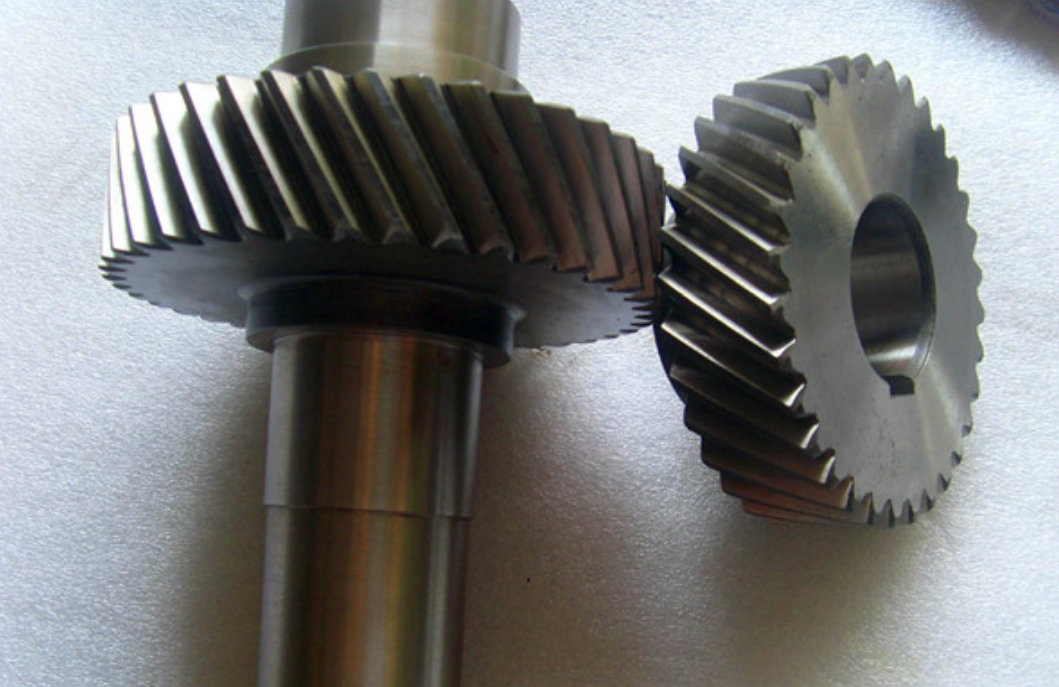
The manufacturing of helical gears through precision forging represents a significant advancement over traditional machining processes, offering superior material utilization, enhanced mechanical properties, and improved production efficiency. The quality of precision forged helical gears is critically dependent on the complex interplay of several process parameters during deformation. To prevent internal or surface defects and ensure the structural integrity and fatigue life of the final component, precise control over the forming process is essential. A key metric for assessing the risk of fracture during plastic deformation is the damage factor, derived from ductile fracture criteria. This study integrates finite element (FE) simulation with an artificial neural network (ANN) to establish a predictive model for the damage factor in precision forged helical gears, enabling the analysis and optimization of forging conditions.
Theoretical Foundation: Damage Factor and Neural Networks
The damage factor is a state variable that quantifies the accumulated damage within a material subjected to plastic deformation, providing an indicator of its propensity for ductile fracture. Among various ductile fracture criteria, the Cockcroft and Latham criterion is widely used for metal forming analyses. It postulates that fracture occurs when the accumulated tensile strain energy reaches a critical material value. The damage factor \( D \) is calculated according to the following integral:
$$
D = \int_{0}^{\bar{\varepsilon}_f} \frac{\sigma^*}{\bar{\sigma}} d\bar{\varepsilon}
$$
where \( \bar{\varepsilon}_f \) is the equivalent strain at fracture, \( \sigma^* \) is the maximum principal tensile stress, \( \bar{\sigma} \) is the equivalent (von Mises) stress, and \( d\bar{\varepsilon} \) is the incremental equivalent strain. In a finite element simulation of the forging process for helical gears, this integral is evaluated for every element in the workpiece. The maximum damage factor value, \( D_{max} \), within the forged gear is of particular interest, as it identifies the location most susceptible to cracking. Minimizing \( D_{max} \) is thus a primary objective for process optimization, directly contributing to the improved reliability and longevity of the helical gears.
Artificial Neural Networks (ANNs), particularly the Backpropagation (BP) network, are powerful tools for modeling complex, non-linear relationships between multiple inputs and outputs. A typical multi-layer perceptron consists of an input layer, one or more hidden layers, and an output layer. Each layer contains interconnected neurons (nodes). The output of a neuron is determined by a transfer function applied to the weighted sum of its inputs plus a bias term. For a neuron \( i \) in a hidden or output layer:
$$
u_i = \sum_{j=1}^{n} w_{ij} x_j + b_i
$$
$$
y_i = f(u_i)
$$
where \( x_j \) are the input signals, \( w_{ij} \) are the connection weights, \( b_i \) is the bias, \( f \) is the transfer function (e.g., sigmoid, tanh), and \( y_i \) is the neuron’s output. The network learns by adjusting its weights and biases to minimize the error between its predictions and the target values. The backpropagation algorithm efficiently calculates the gradient of this error with respect to each network parameter, enabling iterative optimization via methods like gradient descent or the Levenberg-Marquardt algorithm.
Methodology: Integrated FE-ANN Approach
Finite Element Modeling of Helical Gear Forging
The first step involves creating a detailed digital model of the isothermal precision forging process. A three-dimensional FE model was developed using DEFORM-3D, a specialized software for metal forming simulation. The key specifications for the modeled helical gears and process are as follows:
| Parameter Category | Specification |
|---|---|
| Gear Geometry | Normal Module: 1.745 mm, Normal Pressure Angle: 20°, Number of Teeth: 24, Helix Angle: 30.3°, Face Width: 30 mm. |
| Workpiece Material | AISI-4120 Steel. Modeled as a rigid-plastic, temperature-sensitive body. |
| Process Type | Closed-die forging. |
| Initial Billet | Cylinder, Ø45 mm x 39 mm height. |
| Mesh | Approximately 10,000 tetrahedral elements with automatic remeshing. |
The simulation was designed to investigate the influence of three critical forging parameters on the resulting damage in the helical gears: deformation temperature (T), deformation speed or ram velocity (V), and the friction factor (m) at the die-workpiece interface. A design of experiments (DOE) was formulated using these three factors.
| Process Parameter (Input Variable) | Symbol | Range / Levels |
|---|---|---|
| Deformation Temperature | T | 750°C, 800°C, 850°C, 900°C |
| Deformation Speed | V | 30, 50, 80, 100 mm/s |
| Friction Factor | m | 0.05, 0.10, 0.25, 0.45 |
An L16 orthogonal array was initially used, supplemented with two additional parameter combinations to ensure an adequate number of test samples, resulting in a total of 18 distinct simulation runs. For each run, the FE software calculated the evolution of stress, strain, and temperature fields, and subsequently integrated the Cockcroft and Latham criterion to output the spatial distribution of the damage factor. The single scalar value \( D_{max} \) was extracted from each simulation result, creating the essential dataset for neural network training and testing.
BP Neural Network Model Development
The core objective was to construct a network that could accurately map the three input parameters (T, V, m) to the single output \( D_{max} \). The development was carried out using MATLAB’s Neural Network Toolbox. The architecture and training parameters were carefully selected and tuned.
| Network Component | Design Choice / Value |
|---|---|
| Network Type | Feedforward Backpropagation (Multilayer Perceptron) |
| Structure | 3-layer: Input (3 neurons), Hidden (1 layer), Output (1 neuron) |
| Hidden Layer Neurons | 9 (determined through iterative testing for optimal performance) |
| Hidden Layer Transfer Function | Log-Sigmoid: \( f(x) = \frac{1}{1 + e^{-x}} \) |
| Output Layer Transfer Function | Log-Sigmoid |
| Training Algorithm | Levenberg-Marquardt (‘trainlm’) |
| Data Normalization | Min-Max scaling to [0, 1] range |
| Performance Goal (MSE) | 1 × 10⁻⁸ |
| Maximum Epochs | 20,000 |
The 18 data samples were partitioned into a training set (12 samples) and an independent testing set (6 samples). The training process involved presenting the normalized input-output pairs to the network. The Levenberg-Marquardt algorithm, which is a robust and fast-converging method for medium-sized networks, adjusted the weights and biases to minimize the Mean Squared Error (MSE) between the network’s predictions and the actual FE-simulated \( D_{max} \) values. The training converged successfully after a small number of epochs, indicating the network had effectively learned the underlying relationship between the forging parameters for helical gears and the resulting damage factor.
Results and Analysis
Neural Network Prediction Performance
The trained BP neural network was validated using the six unseen test samples. The comparison between the FE-simulated damage factor and the ANN-predicted damage factor for these test cases demonstrates the model’s accuracy.
| Test Case | Temperature (°C) | Speed (mm/s) | Friction (m) | FE-Simulated \( D_{max} \) | ANN-Predicted \( D_{max} \) | Absolute Error | Relative Error (%) |
|---|---|---|---|---|---|---|---|
| 1 | 750 | 30 | 0.05 | 0.450 | 0.426 | 0.024 | 5.33 |
| 2 | 800 | 50 | 0.45 | 0.327 | 0.345 | 0.018 | 5.50 |
| 3 | 850 | 80 | 0.10 | 0.448 | 0.473 | 0.025 | 5.58 |
| 4 | 900 | 100 | 0.25 | 0.392 | 0.368 | 0.024 | 6.12 |
| 5 | 850 | 30 | 0.25 | 0.281 | 0.295 | 0.014 | 4.98 |
| 6 | 850 | 50 | 0.45 | 0.421 | 0.447 | 0.026 | 6.18 |
The results show excellent agreement, with all relative prediction errors hovering around 6%. This level of accuracy is highly satisfactory for engineering analysis and preliminary process optimization for helical gears manufacturing, confirming that the BP neural network has successfully captured the non-linear effects of the process parameters on material damage.
Influence of Forging Parameters on Damage in Helical Gears
With the validated predictive model, it is possible to systematically analyze the individual and combined effects of temperature, speed, and friction on the maximum damage factor for the forged helical gears. The neural network acts as a fast-running surrogate model, allowing for the generation of continuous response surfaces.
Effect of Deformation Temperature: The relationship between temperature and \( D_{max} \) is non-monotonic and interacts with other parameters. For instance, at a high friction factor (m=0.45), \( D_{max} \) remains relatively stable from 750°C to 810°C, then increases sharply, peaking around 870°C before stabilizing again at higher temperatures. This peak suggests a temperature window where the material’s workability might be less favorable, potentially due to changes in dynamic recrystallization behavior or flow stress characteristics specific to the steel grade used for the helical gears.
Effect of Deformation Speed: The influence of ram speed is also complex. At lower temperatures (e.g., 750°C), increasing speed generally leads to a reduction in \( D_{max} \), especially at lower friction levels. This could be attributed to reduced heat transfer and less cooling of the workpiece surface, maintaining higher material ductility. However, at higher temperatures, the trend can reverse or become non-linear, indicating a strong interaction effect where high speed combined with high temperature may lead to localized adiabatic heating and increased damage accumulation.
Effect of Friction Factor: Friction plays a critical role in the flow of material into the intricate tooth cavities of the helical gears. At moderate to high speeds, \( D_{max} \) typically shows an initial increase with rising friction, reaching a maximum around m=0.25, before decreasing at very high friction (m=0.45). The initial increase is likely due to greater shear deformation and restraint, while the subsequent decrease at very high friction might be caused by a shift in the location of maximum tensile stress or a change in the dominant deformation zone.
The following table summarizes the general trends observed for the forging of these specific helical gears:
| Process Parameter | General Effect on \( D_{max} \) (Within Studied Ranges) | Remarks / Interaction |
|---|---|---|
| Temperature (T) | Increase → \( D_{max} \) increases, peaks ~870°C, then stabilizes. | Strong interaction with speed. Peak behavior is significant. |
| Speed (V) | Effect varies: often decreases \( D_{max} \) at low T; can increase it at high T. | Non-linear and highly interactive with temperature. |
| Friction (m) | Increase → \( D_{max} \) initially increases, peaks ~m=0.25, then decreases. | Trend is most consistent at higher deformation speeds. |
Process Window for Minimum Damage
Interrogating the neural network model over the entire parameter space allows for the identification of a promising process window for minimizing damage in the precision forging of helical gears. Based on the model’s predictions, the combination that yielded the lowest maximum damage factor (\( D_{max} \approx 0.29 \)) within the studied ranges was:
- Deformation Temperature: 810°C
- Deformation Speed: 100 mm/s
- Friction Factor: 0.45
This finding is somewhat counter-intuitive, as both high speed and high friction are often associated with increased processing severity. The model suggests that for this specific geometry of helical gears and material, this combination optimally manages the tensile stress state and strain distribution to minimize the Cockcroft and Latham integral. This highlights the power of the data-driven model to discover non-obvious optimal settings that might be missed by trial-and-error or purely heuristic approaches.
Discussion and Conclusion
The integration of finite element simulation and BP neural network modeling has proven to be a highly effective methodology for predicting and analyzing the damage factor in precision forged helical gears. The FE simulations provided a physically-grounded dataset that captures the complex thermomechanical phenomena occurring during the forging of helical gears. The BP neural network, in turn, successfully learned the underlying functional relationship from this data, creating a robust and fast-executing predictive model.
The key advantages of this approach are manifold. First, it decouples the computationally expensive FE analysis (used for generating training data) from the rapid evaluation required for multi-parameter optimization and sensitivity studies. Second, it provides clear insights into the individual and interactive effects of process parameters on product quality (damage), which are essential for robust process design. Third, it enables the identification of optimal or near-optimal forging conditions to minimize the risk of internal fracture in the helical gears, thereby enhancing their potential fatigue life and structural reliability.
The accuracy of the neural network predictions, with errors around 6%, is sufficient for guiding industrial process design and troubleshooting. This accuracy can likely be improved further by expanding the training dataset with more FE simulations, employing advanced network architectures (e.g., with more hidden layers or different training algorithms), or incorporating additional relevant input parameters, such as billet preform geometry or specific material heat treatment conditions.
In conclusion, this study demonstrates a practical and powerful framework for the intelligent design of forging processes for complex components like helical gears. By predicting the damage factor through a trained neural network, manufacturers can make informed decisions to select process parameters that enhance the integrity of helical gears, reduce scrap rates, and move towards a more deterministic and efficient production paradigm for high-performance power transmission components.