
In my years of engineering practice, I have consistently encountered the fascinating world of screw gears, a vital component in power transmission systems. Screw gears, often referred to as crossed helical gears, are unique due to their ability to transmit motion between non-parallel and non-intersecting shafts. This article delves into the intricate details of screw gears, from fundamental principles to advanced applications, aiming to provide a comprehensive resource. I will share insights based on my firsthand experience, utilizing formulas and tables to encapsulate key concepts. The versatility of screw gears makes them indispensable in industries ranging from automotive to aerospace, and understanding their design and behavior is crucial for any mechanical engineer.
To begin, let’s define what a screw gear is. A screw gear is a type of gear where the teeth are cut in a helical pattern, allowing for smooth and quiet operation compared to spur gears. The defining characteristic of screw gears is that they operate on shafts that are typically at a 90-degree angle but can be at any angle, and they do not intersect. This crossed-axis configuration leads to complex contact conditions, which I will explore in detail. The term “screw gear” is often used interchangeably with “crossed helical gear,” but it’s important to note that screw gears can also refer to worm gears in some contexts; however, in this discussion, I focus on the helical variant for non-intersecting shafts. Throughout this article, I will emphasize the role of screw gears in modern machinery, highlighting their design challenges and solutions.
The geometry of screw gears is paramount to their function. The helical teeth create a point contact rather than a line contact, which reduces load capacity but allows for flexibility in alignment. In my work, I have often relied on fundamental parameters to design screw gears. These include the helix angle, normal module, and shaft angle. The helix angle, denoted by $\beta$, is the angle between the tooth trace and the gear axis. For a pair of screw gears, the helix angles must satisfy the relationship based on the shaft angle $\Sigma$. If $\beta_1$ and $\beta_2$ are the helix angles of the two gears, then:
$$\Sigma = \beta_1 + \beta_2$$
This equation is critical for ensuring proper meshing of screw gears. Additionally, the normal module $m_n$ is standard across the gears, while the transverse module varies with the helix angle. The pitch diameter $d$ can be calculated as:
$$d = \frac{z \cdot m_n}{\cos \beta}$$
where $z$ is the number of teeth. I have found that these formulas are essential for initial design calculations, and they form the basis for more advanced analysis. Screw gears require precise manufacturing to achieve the desired performance, and even slight deviations in helix angles can lead to inefficient operation or noise.
In practice, the selection of screw gears depends on the application requirements. To illustrate, I have compiled a table comparing different types of screw gears based on their helix angles and typical uses. This table summarizes key aspects that I often reference in my projects.
| Type of Screw Gear | Helix Angle Range | Shaft Angle | Common Applications |
|---|---|---|---|
| Low Helix Screw Gears | 10° to 20° | 90° | Light-duty machinery, instruments |
| Medium Helix Screw Gears | 20° to 30° | 45° to 90° | Automotive steering systems, conveyors |
| High Helix Screw Gears | 30° to 45° | 0° to 90° | High-speed drives, aerospace actuators |
This table highlights how screw gears can be tailored for specific needs. For instance, in my experience, high helix screw gears are preferred for applications requiring smooth motion at high speeds, but they may have lower torque capacity due to increased axial forces. The design of screw gears must balance these factors, and I often use computational tools to simulate performance before manufacturing.
The kinematics of screw gears involve relative motion between the gears. The velocity ratio $i$ is given by the ratio of the number of teeth, but it is also influenced by the helix angles. For screw gears, the relationship is:
$$i = \frac{\omega_1}{\omega_2} = \frac{z_2}{z_1} = \frac{d_2 \cos \beta_2}{d_1 \cos \beta_1}$$
where $\omega$ represents angular velocity. This shows that the speed ratio depends not only on tooth counts but also on the helix angles, which adds a layer of complexity. In my designs, I always verify this ratio to ensure that the screw gears meet the desired transmission requirements. Additionally, the sliding velocity at the tooth contact is higher in screw gears compared to parallel-axis gears, leading to increased wear. The sliding velocity $v_s$ can be approximated as:
$$v_s = v_1 \sin \beta_1 + v_2 \sin \beta_2$$
where $v_1$ and $v_2$ are the pitch line velocities. This sliding action necessitates proper lubrication, and I often specify high-quality lubricants for screw gear systems to prolong lifespan.
When it comes to dynamics, screw gears exhibit unique behavior due to their point contact. The load distribution is concentrated, which can lead to high contact stresses. I frequently use the Hertz contact stress formula to evaluate this. For two cylindrical bodies in point contact, the maximum contact stress $\sigma_H$ is given by:
$$\sigma_H = \sqrt{\frac{F E^*}{\pi R^*}}$$
where $F$ is the normal load, $E^*$ is the equivalent modulus of elasticity, and $R^*$ is the equivalent radius of curvature. For screw gears, the radii of curvature depend on the helix angles and gear geometry. In my calculations, I derive these parameters from the gear specifications to ensure that the contact stress remains within material limits. This is crucial for preventing pitting and fatigue failure in screw gears.
Material selection for screw gears is another critical aspect. Based on my experience, I recommend using hardened steels for high-load applications, while bronze or polymers may be used for lighter duties. The table below summarizes common materials and their properties for screw gears, which I often consult during the design phase.
| Material | Hardness (HRC) | Typical Use in Screw Gears | Advantages |
|---|---|---|---|
| Carburized Steel | 55-62 | High-power transmissions | High wear resistance, durability |
| Case-Hardened Steel | 50-58 | Industrial machinery | Good toughness, moderate cost |
| Bronze | 20-30 (Brinell) | Low-speed, high-lubrication needs | Excellent anti-galling properties |
| Polymer (e.g., Nylon) | N/A | Light-duty, quiet operations | Low noise, self-lubricating |
This material selection directly impacts the performance of screw gears. For instance, in a project I worked on, using carburized steel for screw gears in a heavy-duty conveyor system significantly reduced maintenance costs. However, the choice must also consider manufacturing constraints, as helical teeth require precise cutting or grinding.
Manufacturing processes for screw gears involve specialized techniques. I have overseen the production of screw gears using hobbing, shaping, and grinding methods. The helix angle complicates the machining, as the tool must be aligned accordingly. The lead $L$ of the helix, which is the axial distance for one complete turn, is given by:
$$L = \pi d \tan \beta$$
This parameter is essential for setting up machine tools. In my experience, CNC hobbing machines have revolutionized the production of screw gears, allowing for high accuracy and repeatability. Quality control involves measuring helix angles and tooth profiles, often using coordinate measuring machines (CMMs). I always emphasize the importance of inspection to ensure that screw gears meet design specifications.
Applications of screw gears are diverse, and I have encountered them in various fields. In automotive systems, screw gears are used in steering mechanisms to transfer motion between non-intersecting shafts. In aerospace, they play a role in actuator systems for control surfaces. Robotics is another area where screw gears provide compact and efficient motion transmission. I recall designing screw gears for a robotic arm where space constraints necessitated a crossed-axis configuration. The flexibility of screw gears allowed for optimal placement of motors and joints. Additionally, in medical devices, screw gears enable precise movements in imaging equipment. The quiet operation of screw gears makes them suitable for environments where noise is a concern, such as in office machinery.
To delve deeper into the design aspects, let’s consider the efficiency of screw gears. Due to sliding contact, screw gears typically have lower efficiency compared to spur or helical gears on parallel shafts. The efficiency $\eta$ can be estimated using:
$$\eta = \frac{\cos \beta – \mu \tan \beta}{\cos \beta + \mu \cot \beta}$$
where $\mu$ is the coefficient of friction. This formula shows that efficiency decreases with higher helix angles and friction. In my designs, I aim for helix angles between 15° and 30° to balance efficiency and torque capacity. Lubrication plays a key role here, and I often use synthetic oils with extreme pressure additives to reduce friction in screw gears.
Another important consideration is the axial force generated by screw gears. The helical teeth produce an axial thrust that must be accommodated by bearings. The axial force $F_a$ can be calculated as:
$$F_a = F_t \tan \beta$$
where $F_t$ is the tangential force. This force increases with helix angle, so for high helix screw gears, robust bearing arrangements are necessary. I have designed thrust bearings specifically to handle these forces in screw gear systems. Failure to account for axial forces can lead to premature bearing wear or gear misalignment.
In terms of assembly and alignment, screw gears are more tolerant than other gear types due to point contact, but precise alignment is still crucial. I recommend using adjustable mounts to fine-tune the shaft positions during installation. The backlash in screw gears also needs careful control; excessive backlash can cause noise and vibration. The backlash $B$ is influenced by the center distance and tooth thickness, and it can be adjusted during manufacturing. In my projects, I specify backlash limits based on application requirements, such as less than 0.1 mm for precision instruments.
Now, let’s explore some advanced topics in screw gear design. With the advent of computer-aided engineering (CAE), I have used finite element analysis (FEA) to simulate the stress and deformation in screw gears under load. This allows for optimization of tooth geometry to minimize stress concentrations. Additionally, tribological studies help in understanding wear patterns. I have collaborated on research that investigated the effect of surface coatings on the performance of screw gears. Coatings like titanium nitride can reduce friction and wear, extending the life of screw gears in harsh environments.
To illustrate the practical implementation, consider a case study from my experience: designing screw gears for a packaging machine. The machine required motion transmission between two perpendicular shafts with a speed ratio of 2:1. I selected medium helix screw gears with $\beta_1 = 20°$ and $\beta_2 = 70°$ for a shaft angle of 90°. Using the formulas above, I calculated the pitch diameters and verified the contact stress. The screw gears were manufactured from case-hardened steel and operated smoothly with minimal noise. This project reinforced the importance of thorough design calculations for screw gears.
Looking ahead, innovations in additive manufacturing may revolutionize screw gear production. 3D printing allows for complex geometries that are difficult with traditional methods. I have experimented with printed polymer screw gears for prototyping, which offers rapid iteration. However, material strength remains a limitation for high-load applications. As technology advances, I anticipate more widespread use of composite materials in screw gears, enhancing their performance and reducing weight.
In conclusion, screw gears are a fascinating and essential component in mechanical systems. Their unique ability to transmit motion between non-intersecting shafts makes them invaluable in many applications. Through my career, I have appreciated the challenges and rewards of working with screw gears. From design to manufacturing, every step requires careful consideration of geometry, materials, and dynamics. I hope this article provides a comprehensive overview, and I encourage engineers to explore the potential of screw gears in their projects. By leveraging formulas, tables, and modern tools, we can continue to innovate and improve screw gear technology.
For visual reference, here is an image depicting a typical screw gear arrangement, which can aid in understanding the concepts discussed.
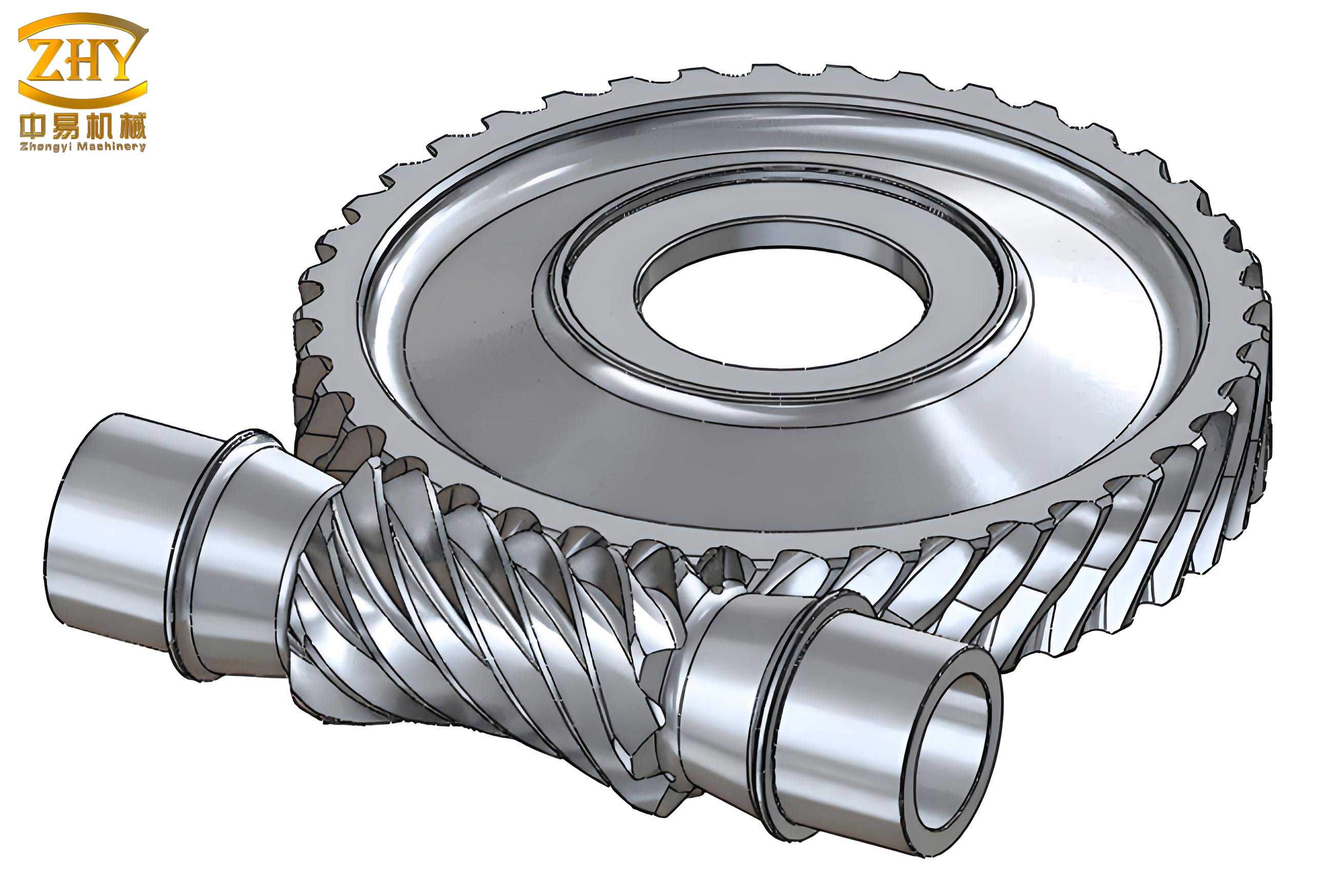
This image shows the helical teeth and crossed-axis configuration that characterize screw gears. In my designs, I often use such visuals to communicate with stakeholders and team members.
To further enrich the discussion, let’s examine some additional formulas and tables. The tooth bending stress in screw gears is another critical factor. According to the Lewis formula, modified for helical gears, the bending stress $\sigma_b$ is:
$$\sigma_b = \frac{F_t}{b m_n Y} K_a K_m K_v$$
where $b$ is the face width, $Y$ is the Lewis form factor, and $K_a$, $K_m$, $K_v$ are application, mounting, and velocity factors, respectively. For screw gears, the form factor $Y$ must be adjusted for the helix angle. I typically use empirical data or software to obtain accurate values. This stress should be kept below the endurance limit of the material to prevent tooth breakage.
Regarding thermal management, screw gears can generate heat due to sliding friction. The power loss $P_l$ can be estimated as:
$$P_l = F_t v_s \mu$$
This heat must be dissipated through lubrication or cooling systems. In high-speed applications, I often incorporate oil jets to cool the screw gears. The table below summarizes cooling methods for screw gears based on operating conditions, drawn from my experience.
| Operating Condition | Recommended Cooling Method | Typical Use Cases for Screw Gears |
|---|---|---|
| Low speed, light load | Natural convection | Instrument gears, small actuators |
| Medium speed, moderate load | Oil bath lubrication | Industrial gearboxes, conveyors |
| High speed, heavy load | Forced oil circulation with cooling | Aerospace drives, turbine gears |
This table helps in selecting appropriate thermal management strategies for screw gears. For instance, in a recent project involving high-speed screw gears for a compressor, I used forced oil cooling to maintain optimal operating temperatures, which significantly improved reliability.
Another aspect is noise and vibration control. Screw gears, due to their point contact, can produce less noise than spur gears, but improper design can lead to whining or rattling sounds. I have used modal analysis to predict natural frequencies and avoid resonance. The mesh frequency $f_m$ of screw gears is given by:
$$f_m = \frac{z \cdot n}{60}$$
where $n$ is the rotational speed in RPM. Ensuring that $f_m$ does not coincide with structural frequencies is key. In my designs, I often add damping materials or optimize tooth profiles to reduce noise in screw gears.
In terms of standardization, screw gears are covered by various norms, such as AGMA and ISO standards. I frequently refer to AGMA 929-A06 for design practices for screw gears. These standards provide guidelines for rating, tolerances, and testing. Adhering to standards ensures interoperability and safety, especially in critical applications like automotive or aerospace screw gears.
Finally, I want to touch on the future trends. With the rise of IoT and smart manufacturing, screw gears can be integrated with sensors to monitor condition in real-time. I have worked on projects where vibration sensors were embedded in screw gear housings to predict maintenance needs. This predictive approach can reduce downtime and extend the life of screw gears. Additionally, sustainability concerns are driving research into recyclable materials for screw gears, such as bio-based polymers.
In summary, screw gears are a complex yet rewarding area of mechanical engineering. From basic geometry to advanced dynamics, every facet requires attention to detail. I have shared my insights and experiences in this article, hoping to inspire further exploration. Whether you are a student or a seasoned engineer, understanding screw gears can enhance your design capabilities. Remember, the key to successful screw gear implementation lies in rigorous analysis, careful material selection, and continuous innovation. As technology evolves, so too will the applications and designs of screw gears, paving the way for more efficient and reliable machinery.