
In my extensive work with heavy-duty, low-speed rotational systems, particularly in industrial machinery, I have encountered a specialized type of bevel gear known as the double-contraction tooth straight bevel gear. These miter gears are characterized by a rapid decrease in tooth height from the large end to the small end, with the apexes of the tip cone, root cone, and pitch cone being non-coincident. This design is prevalent in imported equipment for demanding applications. However, mature domestic processing methods were lacking. Through meticulous calculation and experimentation, I have developed a successful forming milling method for manufacturing these miter gears. This article details the underlying principles, computational frameworks, and the specific design of the forming cutter, all from a first-person perspective of discovery and implementation.
The unique geometry of double-contraction teeth in miter gears presents distinct challenges. The fundamental characteristic is that the tooth depth is not constant along the face width; it contracts significantly towards the small end. This means that every cross-section along the gear width has a different tooth height and module. To analyze this, I focus on three key cross-sections: the large end, the small end, and an intermediate section. The intermediate section effectively serves as the datum, exhibiting the profile of a standard bevel gear. The large end tooth height is increased by a specific increment, while the small end tooth height is decreased by a corresponding decrement. This relationship is crucial for understanding the cutting process. The geometry can be defined by key angles and dimensions. Let the pitch angle be $\delta$, the root angle be $\delta_f$, and the tip angle be $\delta_a$. The face width is denoted as $b$. The distances from the large end of the pitch cone to the intersections of the pitch line with the root line and tip line are critical parameters.
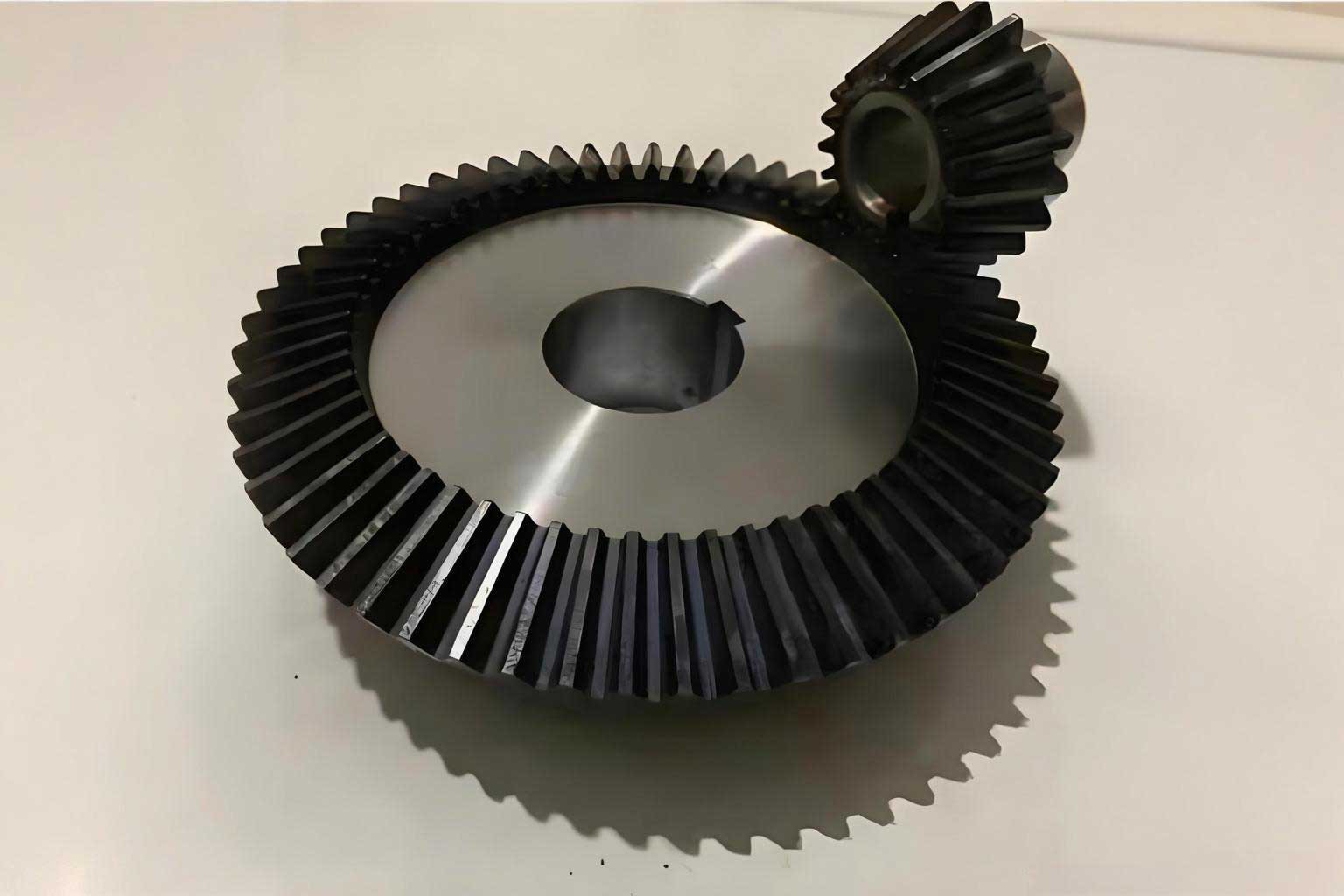
For calculation, consider the following derived parameters. The module at the large end is $m_e$, at the intermediate section is $m_m$, and at the small end is $m_i$. Similarly, the dedendum at these sections are $h_{fe}$, $h_{fm}$, $h_{fi}$ and the addendum are $h_{ae}$, $h_{am}$, $h_{ai}$. The contraction relationship dictates that the tooth profile at all three sections approximates an involute form, with slight errors concentrated uniformly at the root and tip regions of the large and small ends. Therefore, the intermediate section’s tooth form is adopted as the benchmark for machining and inspection of these miter gears. The following table summarizes the comparative parameters for a typical double-contraction miter gear setup.
| Parameter | Large End | Intermediate Section | Small End |
|---|---|---|---|
| Module (m) | $m_e = m_m + \Delta m$ | $m_m$ (Reference) | $m_i = m_m – \Delta m$ |
| Addendum (h_a) | $h_{ae} = h_{am} + \Delta$ | $h_{am}$ | $h_{ai} = h_{am} – \Delta$ |
| Dedendum (h_f) | $h_{fe} = h_{fm} + \Delta$ | $h_{fm}$ | $h_{fi} = h_{fm} – \Delta$ |
| Total Depth (h) | $h_e = h_{ae} + h_{fe}$ | $h_m = h_{am} + h_{fm}$ | $h_i = h_{ai} + h_{fi}$ |
Here, $\Delta$ represents the contraction increment, which is a function of the face width and the cone angles. It can be derived as $\Delta = b \cdot \tan(\delta_f – \delta) / 2$ for the dedendum-related adjustment, but a more generalized form for total depth variation along the face width is essential. For any section located at a distance $x$ from the small end along the pitch cone, the required additional depth relative to the small end is given by $\Delta_x = x \cdot \tan(\theta)$, where $\theta$ is related to the difference between the root and pitch angles. This principle is foundational for the machining strategy of these miter gears.
The machining of these double-contraction miter gears employs a forming milling technique. The core idea is to use a forming cutter whose profile matches the tooth form of the intermediate section. The gear blank is set up with its pitch angle oriented horizontally. The cutter is oriented perpendicular to the pitch cone element. The cutting motion involves two components: a longitudinal feed parallel to the pitch cone element and a transverse feed perpendicular to it. The transverse feed is precisely controlled to create the varying tooth depth. Starting the cut from the small end, the cutter is at a depth corresponding to the small end’s root. As the cutter moves longitudinally towards the large end, it must simultaneously advance transversely to increase the cutting depth. The total transverse displacement required over the full face width $b$ is the difference in dedendum between the large and small ends. This ensures the correct root cone angle is generated. Mathematically, if we take the small end as the starting reference (depth $h_{fi}$), then at the intermediate section (distance $b/2$ from small end), the cutter must advance transversely by $\Delta_{m} = (h_{fm} – h_{fi}) = \Delta$. At the large end, the additional transverse advance from the intermediate depth is another $\Delta$, making the total advance from the small end reference $2\Delta$. This relationship is encapsulated in the formula for the transverse feed increment at any point $x$: $$ \Delta_{feed}(x) = x \cdot \left( \frac{h_{fe} – h_{fi}}{b} \right) = x \cdot \left( \frac{2\Delta}{b} \right) $$ where $0 \le x \le b$. Since standard milling machines may not provide continuous synchronized transverse feed, the process is often performed in steps or followed by a finishing operation, such as planing, to perfect the root cone angle using a template based on the calculated geometry.
The design of the forming cutter is the most critical aspect of this method for producing accurate miter gears. As established, the cutter profile is based on the tooth form of the intermediate cross-section. To derive this profile, the intermediate section is conceptually developed onto a plane perpendicular to the pitch cone, creating an equivalent spur gear. The parameters of this equivalent gear are calculated first. Let $z$ be the actual number of teeth of the miter gear, and $\delta_m$ be the pitch angle at the intermediate section (which is essentially the nominal pitch angle $\delta$ for symmetric calculation). The pitch diameter at the intermediate section is $d_m = m_m \cdot z$. However, for the equivalent gear on the developed back cone, the equivalent pitch diameter $d_v$ and equivalent number of teeth $z_v$ are more relevant. They are given by: $$ d_v = \frac{d_m}{\cos \delta} = \frac{m_m \cdot z}{\cos \delta} $$ $$ z_v = \frac{z}{\cos \delta} $$ The equivalent base diameter $d_{bv}$ is: $$ d_{bv} = d_v \cdot \cos \alpha = \frac{m_m \cdot z \cdot \cos \alpha}{\cos \delta} $$ where $\alpha$ is the pressure angle (typically 20°). The equivalent tip diameter $d_{av}$ and root diameter $d_{fv}$ are: $$ d_{av} = d_v + 2h_{am} $$ $$ d_{fv} = d_v – 2h_{fm} $$ These equivalent spur gear parameters allow us to calculate the coordinate points for the involute tooth profile of the intermediate section, which becomes the cutter’s form.
To generate the cutter profile coordinates, I use the principle of calculating the arc tooth thickness at any arbitrary radius on a spur gear. For the equivalent gear, the arc tooth thickness $s_v$ at the pitch circle is $s_v = \frac{\pi m_m}{2}$ (assuming standard tooth thickness). At any arbitrary radius $R_v$ on the equivalent gear, the corresponding arc tooth thickness $s_{Rv}$ is calculated using the involute function: $$ s_{Rv} = R_v \left( \frac{s_v}{R_v} + \text{inv}\alpha – \text{inv}\alpha_{Rv} \right) $$ where $\text{inv}\alpha = \tan\alpha – \alpha$ (in radians), and $\alpha_{Rv}$ is the pressure angle at radius $R_v$, given by: $$ \alpha_{Rv} = \arccos\left(\frac{d_{bv}}{2R_v}\right) $$ The angle subtended by the arc thickness $s_{Rv}$ at the center is $\psi = s_{Rv} / R_v$ (in radians). The cutter profile is essentially the tooth space, so we are interested in the coordinates of points on the flank relative to the tooth space centerline. The half-angle of the tooth space at the pitch circle is $\pi / (2z_v)$. For a point on the involute at radius $R_v$ and pressure angle $\alpha_{Rv}$, its coordinates in a polar system centered on the gear, with the tooth space centerline as the reference, can be derived. Let $\phi$ be the angle from the tooth space centerline to the point on the involute. The calculation involves the roll angle. A more direct coordinate calculation for the cutter profile (which is the mirror of the tooth space) involves determining the $(X, Y)$ coordinates for points from the root to the tip. For a series of radii $R_v$ from $d_{fv}/2$ to $d_{av}/2$, we can compute the corresponding $X$ and $Y$ using: $$ X = R_v \sin(\mu) $$ $$ Y = R_v \cos(\mu) $$ where $\mu$ is the angle from the tooth centerline to the point on the involute profile, which is a function of the base circle radius and the involute parameter. A detailed step-by-step calculation is as follows for generating a point at radius $R_v$:
- Calculate $\alpha_{Rv} = \arccos(d_{bv} / (2R_v))$.
- Calculate the involute function value $\text{inv}\alpha_{Rv} = \tan(\alpha_{Rv}) – \alpha_{Rv}$ (in radians).
- The tooth thickness angle at radius $R_v$ is $\theta_{Rv} = \frac{s_v}{R_v} + 2(\text{inv}\alpha – \text{inv}\alpha_{Rv})$ where $s_v$ is the pitch circle arc tooth thickness. For a standard tooth, $s_v = \pi m_m / 2$.
- The angle from the tooth centerline to the point on the involute profile for the left flank (considering the tooth space) is $\phi = \frac{\theta_{Rv}}{2}$.
- However, for the cutter which mills the tooth space, we need the profile of the space, which is the mirror image. The coordinate of a point on the left flank of the tooth space, relative to the space centerline, can be given by: $$ X = R_v \sin(\phi) $$ $$ Y = R_v \cos(\phi) $$ But note: the actual profile for a forming cutter is the negative of the tooth shape. In practice, a set of $(R_v, \phi)$ coordinates is computed, and then mirrored to generate the complete cutting edge profile for one tooth space. The following table shows a sample of calculated coordinates for a specific miter gear example with $z=20$, $\delta=45°$, $m_m=5\text{mm}$, $\alpha=20°$, $h_{am}=5\text{mm}$, $h_{fm}=6\text{mm}$.
| Point # | Radius R_v (mm) | Pressure Angle α_Rv (deg) | Angle φ (deg) | X (mm) | Y (mm) |
|---|---|---|---|---|---|
| 1 (Root) | 40.00 | 25.84 | 4.52 | 3.15 | 39.88 |
| 2 | 45.00 | 22.79 | 5.12 | 4.02 | 44.82 |
| 3 (Pitch) | 50.00 | 20.00 | 5.73 | 5.00 | 49.75 |
| 4 | 55.00 | 17.40 | 6.37 | 6.10 | 54.66 |
| 5 (Tip) | 60.00 | 14.98 | 7.04 | 7.36 | 59.55 |
These coordinates are then used to manufacture the forming cutter. The cutter itself is typically a disc-type form milling cutter with the profile ground according to these calculated points. The cutter must be made from appropriate tool steel and heat-treated for wear resistance. In application, the cutter is mounted on a milling machine, and the gear blank is fixtured on a specially designed setup that allows precise orientation of the pitch cone and the coordinated feed motions. The process begins by setting the cutter to the depth for the small end. As the longitudinal feed proceeds, manual or automated transverse adjustments are made according to the calculated schedule $\Delta_{feed}(x)$. After roughing, a final planing or grinding operation can be used to refine the root cone surface, ensuring accurate clearance and contact patterns for the miter gears.
The effectiveness of this method hinges on accurate calculation of the contraction parameters. Let me delve deeper into the mathematical derivation. The key relationship between the modules at different sections stems from the conical geometry. If the pitch cone length is $L$, then the pitch radius at a distance $x$ from the apex is $R_x = L \cdot \sin\delta – x \cdot \cos\delta$ for a point measured from the large end? Actually, careful consideration is needed. For a straight bevel gear, the pitch radius varies linearly along the face width. Let $R_e$ be the pitch radius at the large end, $R_i$ at the small end, and $R_m$ at the midpoint. They relate as $R_m = (R_e + R_i)/2$. The module is proportional to the pitch radius divided by the number of teeth: $m = 2R / z$. Therefore, the module contraction is linear along the face width. The addendum and dedendum are designed to contract in a manner that maintains a constant working depth or similar functional relationship. The root line and tip line are straight generators on the root cone and tip cone, respectively. Their angles relative to the pitch line determine the contraction. Define $\gamma_f = \delta_f – \delta$ as the root angle offset and $\gamma_a = \delta_a – \delta$ as the tip angle offset. For double-contraction teeth, both $\gamma_f$ and $\gamma_a$ are non-zero and typically have the same sign, causing both root and tip to contract. The change in dedendum from the large end to a point at distance $x$ from the large end along the pitch cone is $\Delta h_f(x) = x \cdot \tan \gamma_f$. Similarly for addendum: $\Delta h_a(x) = x \cdot \tan \gamma_a$. If we set $x=0$ at the large end, then at the large end, $\Delta h_f(0)=0$, and at the small end ($x=b$), $\Delta h_f(b) = b \cdot \tan \gamma_f$. Therefore, the dedendum at the small end is $h_{fi} = h_{fe} – b \cdot \tan \gamma_f$. Since the intermediate section is at $x=b/2$, we have $h_{fm} = h_{fe} – (b/2) \cdot \tan \gamma_f$. This yields the relation $\Delta = (b/2) \cdot \tan \gamma_f = h_{fe} – h_{fm} = h_{fm} – h_{fi}$. The same applies to the addendum. Thus, the total contraction in tooth depth from large to small end is $b \cdot (\tan \gamma_f + \tan \gamma_a)/2$? Actually, the total depth change is $b \cdot (\tan \gamma_f + \tan \gamma_a)$? Let’s check: Total depth $h = h_a + h_f$. At large end: $h_e = h_{ae} + h_{fe}$. At small end: $h_i = h_{ai} + h_{fi} = (h_{ae} – b\tan\gamma_a) + (h_{fe} – b\tan\gamma_f) = h_e – b(\tan\gamma_a + \tan\gamma_f)$. So the total depth contracts by $b(\tan\gamma_a + \tan\gamma_f)$ from large to small end. The intermediate depth is $h_m = h_e – (b/2)(\tan\gamma_a + \tan\gamma_f)$. These formulas are essential for setting up the machining offsets.
In the forming milling process, the transverse feed compensates for this depth variation. The required transverse offset at any point $x$ (measured from the small end for programming convenience) to achieve the correct cutting depth relative to a reference is: $$ \Delta_{offset}(x) = \left[ h_f(x) – h_f(0) \right] = x \cdot \tan \gamma_f $$ if we reference the small end root. Since $\tan \gamma_f = 2\Delta / b$, we get $\Delta_{offset}(x) = x \cdot (2\Delta / b)$, as stated earlier. This linear relationship simplifies the feed schedule. For CNC applications, this can be programmed as a linear interpolation between the start and end points. For manual machines, marked settings can be used. The accuracy of the generated tooth form on the miter gears depends heavily on the precision of the cutter profile and the rigidity of the setup.
The design of the forming cutter also involves considerations beyond the basic profile. The cutter must have appropriate clearance angles to ensure free cutting. This is achieved by backing off the profile radially and axially. Typically, the profile coordinates are calculated for the cutting edge in the normal plane, and then modified to incorporate radial relief and side clearance. The cutter thickness must accommodate the tooth space width at the deepest point. For manufacturing the cutter, the coordinate data is used to grind the profile on a tool grinder. The cutter is then hardened and sharpened. In my experience, cutters designed with this method have successfully produced double-contraction miter gears that meet practical requirements for heavy-duty applications. The gears exhibit proper meshing characteristics and load distribution. The method is particularly suitable for small to medium batch production or for repairing existing miter gears in imported machinery where replacement parts are unavailable.
To further elaborate on the application context, miter gears with double-contraction teeth are often found in situations requiring high torque transmission at low speeds, such as in large mixers, conveyors, and certain types of construction equipment. The contraction design helps in reducing stress concentration at the small end of the teeth, where the tooth is naturally weaker due to reduced cross-section. By making the tooth shorter at the small end, the bending moment is reduced, potentially improving the overall load capacity of the gear set. This makes these miter gears robust for demanding operations. However, the manufacturing complexity has been a barrier. The forming milling method I developed provides a viable solution that does not require highly specialized gear-cutting machines like spiral bevel gear generators. It leverages standard milling capabilities with custom tooling and fixturing.
In conclusion, the processing of double-contraction tooth straight bevel gears, a specific type of miter gears, can be effectively accomplished through forming milling with a specially designed cutter based on the intermediate section tooth profile. The key lies in accurately calculating the geometric parameters and implementing a controlled transverse feed during longitudinal milling to generate the contracting tooth depth. The cutter design involves developing the intermediate section to an equivalent spur gear and calculating involute profile coordinates. This method, while requiring precise setup and calculation, offers a practical route to manufacture or repair these specialized miter gears, ensuring their performance in heavy-duty, low-speed applications. Future work could involve automating the feed process with CNC systems and optimizing the cutter profile for higher precision and longer tool life. The principles outlined here form a solid foundation for the fabrication of these complex but essential components in power transmission systems.