
In my years of experience working with gear manufacturing, particularly in mechanical repair shops, I have often encountered the challenge of producing non-standard straight bevel gears. These gears, commonly referred to as miter gears when the shaft angle is 90 degrees, are essential components in various industrial machinery. One cost-effective method I’ve extensively used is the forming process with universal templates. This approach leverages standardized templates to machine gears, but it requires careful adjustments when dealing with non-standard parameters. In this article, I will delve into the principles, calculations, and practical steps involved, emphasizing how universal templates can be adapted for miter gears with different pressure angles or modification coefficients. The goal is to provide a comprehensive guide that blends theory with hands-on application, ensuring accurate gear profiles while maintaining economic efficiency.
The core idea behind using universal templates is based on the simplification of the gear tooth profile. For straight bevel gears, the actual tooth form is a spherical involute, but for practical machining, we approximate it by unfolding the back cone onto a plane. This unfolded profile resembles a planar involute curve, which is then scaled up to create the template’s contour. The universal template is designed with this scaled involute, allowing it to be used for multiple gear sizes as long as the scaled base circle radius remains constant or nearly so. This makes it highly versatile for standard miter gears, where the pressure angle is typically 20 degrees. However, when processing non-standard miter gears—such as those with pressure angles other than 20° or with profile modifications—the template selection and tool setup must be meticulously recalculated to avoid significant errors.
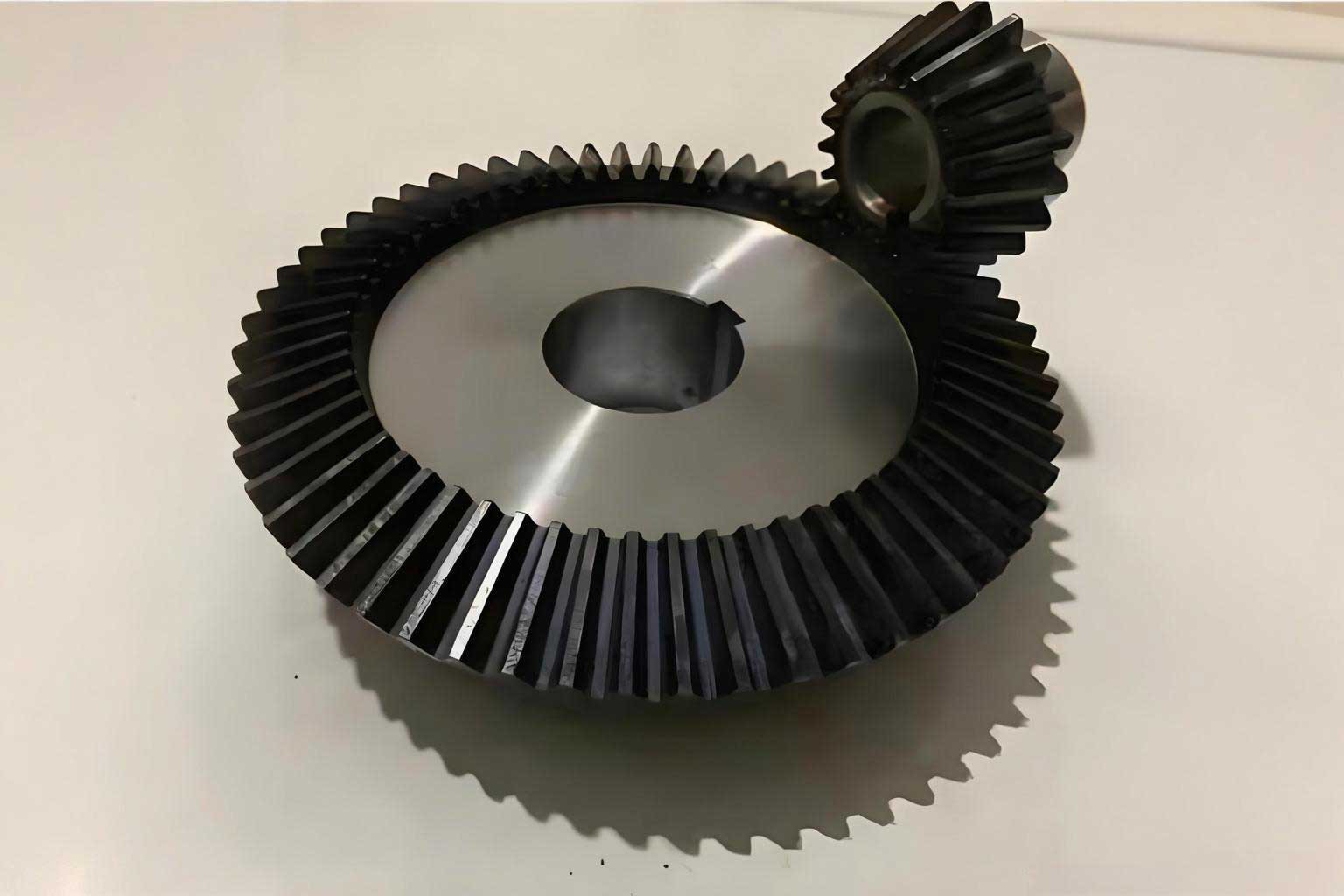
Let me start by explaining the fundamental geometry. For any straight bevel gear, the back cone radius \( R_b \) is derived from the pitch cone distance \( L \), the pitch cone angle \( \delta \), and the pressure angle \( \alpha \). The universal template’s theoretical involute is defined by its base circle radius \( \rho_0 \), which relates to these parameters. When setting up the machine, the template roller’s center must align with the template center—the point where the template’s pitch circle intersects its contour curve. At this position, the tool tip should be at a distance from the gear’s apex equal to the module at the large end. This initial alignment ensures that the machined tooth profile matches the desired geometry for standard miter gears.
For standard miter gears with a pressure angle of 20°, the universal template can be selected directly based on the gear’s pitch cone angle. The template’s base circle radius is calculated as follows, where \( L \) is the scaled pitch cone length (distance from the template holder center to the machine center), \( \delta \) is the pitch cone angle, and \( \alpha = 20° \):
$$ \rho_0 = L \cdot \sin \delta \cdot \cos \alpha $$
This formula ensures that the template’s involute corresponds to the gear’s back-cone development. Since \( \rho_0 \) is constant for a given template, gears with the same or similar scaled base circle radii can be machined using the same template, regardless of module or tooth count. This interchangeability is what makes universal templates economical for general repair workshops, where a variety of miter gears need to be produced without investing in custom tooling for each.
However, complications arise when processing non-standard miter gears. A common scenario is when the pressure angle \( \alpha’ \) is not 20°. If we simply choose a template based on the gear’s pitch cone angle \( \delta \), the resulting tooth profile will deviate substantially. This is because the template is designed assuming \( \alpha = 20° \), but the gear requires an involute with pressure angle \( \alpha’ \) at its pitch circle. To address this, we must select a template based on a modified cone angle \( \delta’ \) that corresponds to the point where the pressure angle equals 20° on the gear’s back-cone involute. The relationship is derived from equating the base circle radii:
$$ \rho_0 = L \cdot \sin \delta’ \cdot \cos 20° = L \cdot \sin \delta \cdot \cos \alpha’ $$
Solving for \( \delta’ \):
$$ \sin \delta’ = \frac{\sin \delta \cdot \cos \alpha’}{\cos 20°} $$
This adjusted angle \( \delta’ \) is used to select the appropriate universal template from available sets. Additionally, the tool position must be changed. When the template roller center aligns with the template center, the tool tip should now be placed on the circle where the pressure angle equals 20° on the gear’s back-cone, not at the pitch circle. Let \( r_\alpha \) be the radius of this circle on the back-cone development:
$$ r_\alpha = \frac{L \cdot \sin \delta}{\cos \alpha’} \cdot \cos 20° $$
Then, the distance from the tool tip to the gear apex, denoted as \( \Delta \), becomes:
$$ \Delta = L – r_\alpha = L – \frac{L \cdot \sin \delta}{\cos \alpha’} \cdot \cos 20° $$
This adjustment ensures that the machined involute profile aligns correctly with the non-standard pressure angle. Failing to recalibrate this can lead to inaccurate miter gears, causing noise, wear, or transmission errors in applications.
To summarize these adjustments for non-standard miter gears, I have compiled key formulas into the following table, which serves as a quick reference for machinists:
| Parameter | Symbol | Formula | Notes |
|---|---|---|---|
| Scaled Pitch Cone Length | \( L \) | Constant for machine setup | Typically fixed by the gear planer design |
| Pitch Cone Angle | \( \delta \) | Given by gear design | For standard miter gears, often 45° for 90° shaft angle |
| Pressure Angle | \( \alpha’ \) | Specified for non-standard gear | If \( \alpha’ = 20° \), use standard procedure |
| Template Selection Angle | \( \delta’ \) | \( \sin \delta’ = \frac{\sin \delta \cdot \cos \alpha’}{\cos 20°} \) | Choose universal template based on \( \delta’ \) |
| Tool Tip Radius on Back-Cone | \( r_\alpha \) | \( r_\alpha = \frac{L \cdot \sin \delta}{\cos \alpha’} \cdot \cos 20° \) | Position where pressure angle is 20° |
| Tool Apex Distance | \( \Delta \) | \( \Delta = L – r_\alpha \) | Adjust machine setting accordingly |
Another critical aspect is verifying the effective length of the template’s contour curve. Since the universal template has a finite involute profile, it must cover the entire tooth depth from tip to root. For non-standard miter gears, especially those with profile modifications (e.g., addendum or dedendum changes), the tooth profile shifts relative to the standard position on the template. If the template’s effective length is insufficient, the machined gear may have incomplete or truncated teeth. The effective length is determined by the scaled back-cone radii for the tip and root circles. Let \( z \) be the number of teeth, \( m \) the module, \( h_a^* \) the addendum coefficient, \( c^* \) the dedendum coefficient, and \( x \) the profile shift coefficient. For a modified miter gear, the tip and root radii on the back-cone development are:
$$ R_a = L \cdot \sin \delta + m \cdot (h_a^* + x) $$
$$ R_f = L \cdot \sin \delta – m \cdot (c^* – x) $$
These should be compared to the template’s contour limits. The template’s tip radius \( \rho_a \) and root radius \( \rho_f \) are typically designed for standard gears. To ensure compatibility, we require:
$$ \rho_a \geq R_a \quad \text{and} \quad \rho_f \leq R_f $$
If these conditions are not met, the template may need to be replaced or the gear design adjusted. This verification is crucial for miter gears with large modification coefficients, as even small deviations can affect meshing performance. In practice, I always calculate these values before machining to avoid rework.
Now, let’s consider the specific case of miter gears with profile shifts. These are common in applications requiring customized center distances or strength adjustments. The addendum and dedendum changes alter the tooth thickness and clearance, which in turn affects the template’s engagement range. Using the same universal template requires recalculating the effective profile shift on the back-cone. The modified base circle radius remains \( \rho_0 = L \cdot \sin \delta \cdot \cos \alpha’ \), but the operating pressure angle changes due to the shift. For accurate machining, we must ensure that the template’s involute segment spans from the modified tip to root circles. I often use the following formulas to compute the required template dimensions for such miter gears:
$$ \text{Tip circle radius on template: } \rho_a = \sqrt{ \left( \frac{\rho_0}{\cos \alpha_t} \right)^2 + (m \cdot (h_a^* + x))^2 } $$
$$ \text{Root circle radius on template: } \rho_f = \sqrt{ \left( \frac{\rho_0}{\cos \alpha_f} \right)^2 – (m \cdot (c^* – x))^2 } $$
Here, \( \alpha_t \) and \( \alpha_f \) are the pressure angles at the tip and root, respectively, derived from the involute function. In many workshops, simplified checks suffice. For instance, if the modification coefficient \( x \) is within ±0.5, standard templates usually work, but for larger shifts, custom templates might be necessary. However, by carefully adjusting the tool position and template selection, we can often extend the usability of universal templates even for these non-standard miter gears.
To illustrate the process flow, I have created a table outlining the steps for machining both standard and non-standard miter gears with universal templates. This serves as a practical checklist:
| Step | Action for Standard Miter Gears (α=20°) | Action for Non-Standard Miter Gears (α≠20° or x≠0) |
|---|---|---|
| 1. Gear Parameters | Obtain module \( m \), tooth count \( z \), pitch cone angle \( \delta \) | Additionally, obtain pressure angle \( \alpha’ \) and shift coefficient \( x \) |
| 2. Template Selection | Choose template based on \( \delta \) from standard set | Calculate \( \delta’ \) using \( \sin \delta’ = \frac{\sin \delta \cdot \cos \alpha’}{\cos 20°} \), then select template |
| 3. Machine Setup | Set tool tip distance \( \Delta = m \) from gear apex | Calculate \( r_\alpha = \frac{L \cdot \sin \delta}{\cos \alpha’} \cdot \cos 20° \), then set \( \Delta = L – r_\alpha \) |
| 4. Template Alignment | Align template roller center with template center | Same alignment, but verify tool position per step 3 |
| 5. Contour Verification | Usually not required for standard gears | Check \( \rho_a \geq R_a \) and \( \rho_f \leq R_f \) to ensure template length suffices |
| 6. Machining | Proceed with cutting; inspect tooth profile | Proceed; expect longer setup time due to adjustments |
In addition to these calculations, the physical setup on the gear planer is vital. The universal template must be mounted at the correct height and angle, as specified by the machine’s design parameters. For miter gears, which often transmit motion between perpendicular shafts, the symmetry of the teeth requires precise indexing. After sharpening the cutting tool, I always secure it firmly and adjust the clamping according to the machine’s requirements. Then, by moving the tool carriage, I bring the template roller center into coincidence with the template center. At this point, for standard miter gears, the tool tip should be exactly one module away from the gear’s apex. For non-standard ones, the distance is \( \Delta \) as computed earlier. This step ensures that the generated involute profile originates from the correct base circle, which is essential for proper tooth engagement in miter gear pairs.
The economic benefits of using universal templates cannot be overstated. In repair shops, where gear specifications vary widely, stocking dedicated templates for every possible miter gear would be impractical. Universal templates, with their adaptable design, allow us to machine a range of gears with minimal investment. However, this flexibility comes with the responsibility of understanding the underlying geometry. I have seen instances where machinists neglected the pressure angle adjustments, leading to noisy or inefficient miter gears in service. By applying the formulas and checks described here, such issues can be avoided, ensuring that the gears meet typical accuracy requirements for industrial applications.
Let me expand on the mathematical foundation. The universal template’s contour is not a pure involute but an equidistant curve to the theoretical involute, due to the roller’s finite diameter. This offset generates the actual cutting path. For a roller diameter \( d_r \), the template’s practical profile is an envelope of circles centered on the theoretical involute. This compensates for tool geometry, but the core relationships remain based on the base circle. When processing miter gears, we often deal with small batches, so time spent on setup calculations is justified by the savings in template costs. Moreover, for high-precision applications, post-machining inspection can catch deviations, but proactive adjustments reduce scrap rates.
To further aid in practical implementation, I want to emphasize the importance of the scaled pitch cone length \( L \). This parameter is intrinsic to the gear planer and template holder system. It represents the distance from the template pivot to the machine center, effectively scaling the back-cone development. For different machines, \( L \) may vary, so always refer to the equipment manual. In many cases, \( L \) is set to simplify template design, often related to the gear’s outer cone distance. For miter gears with a 90° shaft angle, the pitch cone angle \( \delta \) is 45°, simplifying some calculations. However, non-standard pressure angles still require the adjustments outlined.
Here is a summary of key formulas in LaTeX format for quick reference:
Base circle radius for universal template (design standard):
$$ \rho_0 = L \cdot \sin \delta \cdot \cos 20° $$
Base circle radius for non-standard miter gear:
$$ \rho_0′ = L \cdot \sin \delta \cdot \cos \alpha’ $$
Condition for template selection (base circle equality):
$$ \rho_0 = \rho_0′ \Rightarrow \sin \delta’ = \frac{\sin \delta \cdot \cos \alpha’}{\cos 20°} $$
Tool tip position radius for non-standard gears:
$$ r_\alpha = \frac{L \cdot \sin \delta}{\cos \alpha’} \cdot \cos 20° $$
Effective template length check for modified miter gears:
$$ \text{Tip: } R_a = L \cdot \sin \delta + m \cdot (h_a^* + x) $$
$$ \text{Root: } R_f = L \cdot \sin \delta – m \cdot (c^* – x) $$
These equations form the backbone of the process. When working with miter gears, I recommend creating a spreadsheet to automate these calculations, reducing human error and speeding up setup.
In conclusion, universal templates are powerful tools for machining straight bevel gears, including miter gears, in repair and small-scale production environments. By understanding the principles of back-cone development and involute geometry, we can adapt these templates for non-standard parameters such as pressure angles and profile shifts. The key lies in recalculating the template selection angle, adjusting the tool position, and verifying the template’s contour length. With careful application, this method offers a cost-effective and flexible solution that meets general accuracy needs. In my experience, it has enabled our workshop to handle diverse gear requests without compromising on quality or efficiency. For anyone involved in gear manufacturing, mastering these techniques is invaluable for extending the capabilities of universal template systems.
Finally, I encourage continuous learning and experimentation. The field of gear machining is rich with nuances, and each set of miter gears presents unique challenges. By sharing insights like these, we can collectively improve practices and ensure reliable performance in machinery worldwide. Whether you’re processing standard or non-standard miter gears, attention to detail in template usage will yield superior results, keeping industrial equipment running smoothly.