
In modern manufacturing, gear hobbing is a highly efficient and common method for producing both conventional and non-circular gears. However, the accuracy of gear hobbing, especially for non-circular gears, is often compromised by various factors such as guideway straightness errors, ball screw backlash, tool wear, thermal and force-induced deformations, and system control errors. Non-circular gears, with their unique advantages in motion transmission, have gained increasing attention, but their machining precision remains a challenge due to the complex multi-axis联动 required in gear hobbing processes. The non-circular pitch curve leads to frequent acceleration and deceleration of machine axes, causing vibrations, abrupt changes in cutting forces, and ultimately reducing tooth surface accuracy. As machine tool speeds continue to rise, motion control errors are becoming a more significant factor affecting the quality of gear hobbing for non-circular gears. In this study, we aim to enhance the machining accuracy of non-circular gears through advanced control strategies, focusing on optimizing servo control parameters using intelligent algorithms.
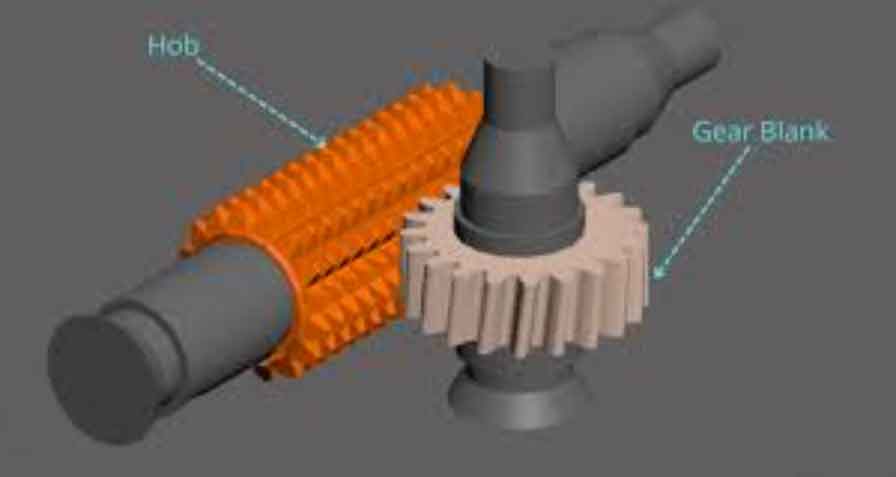
Gear hobbing for non-circular gears involves multiple coordinated movements, including generating motion, radial feed motion, and axial feed motion. The generating motion ensures the proper meshing relationship between the hob and the workpiece, while the radial feed adjusts the center distance according to the varying polar radius of the non-circular gear. The axial feed controls the tool’s movement along the workpiece axis. The mathematical model for gear hobbing of straight non-circular gears can be described as follows:
$$ \begin{cases} \omega_c = \frac{k m}{2} \cdot \frac{r + r^2 \frac{d\theta}{d r}}{\sqrt{1 + \left( \frac{dr}{d\theta} \right)^2}} \cdot \omega_b \\ v_x = \frac{k m}{2} \cdot \omega_b \cdot \frac{dr}{d\theta} \end{cases} $$
where $\omega_b$ is the rotational speed of the hob, $\omega_c$ is the rotational speed of the workpiece, $v_x$ is the radial feed velocity of the hob, $r$ is the polar radius of the pitch curve, $\theta$ is the polar angle, $k$ is the number of hob starts, and $m$ is the module. This relationship highlights the dynamic nature of gear hobbing, where precise control of the workpiece axis (C-axis) and radial feed axis (X-axis) is crucial for accurate tooth generation. In CNC gear hobbing machines, an electronic gearbox (EGB) module is employed to achieve real-time synchronization. Based on feedback from the main spindle encoder and the multi-axis联动 control model, the EGB computes incremental movements for the C-axis ($\Delta \theta_c$) and X-axis ($\Delta x$) during each interpolation cycle, ensuring that the跟随 axes closely track the master motion. This process is fundamental to gear hobbing accuracy, as any lag or error in these axes can lead to significant deviations in the gear profile.
The servo control system plays a pivotal role in gear hobbing machines, as it directly influences the tracking performance of the motion axes. Traditional PID controllers are widely used due to their simplicity and effectiveness in reducing errors caused by disturbances and parameter variations. However, in non-linear contouring applications like gear hobbing, PID control alone may result in substantial tracking errors due to its inherent lag. To address this, we incorporate feedforward control, which anticipates future command changes and compensates accordingly. By combining feedforward with feedback control, we can reduce tracking滞后 and improve overall system responsiveness. The composite control structure is depicted in a block diagram, where $R(s)$ is the input signal, $Y(s)$ is the output, $E(s)$ is the error, $P(s)$ is the plant transfer function, $G(s)$ is the PID controller, and $F(s)$ is the feedforward transfer function. The error transfer function is given by:
$$ E(s) = \frac{1 – F(s) P(s)}{1 + G(s) P(s)} R(s) $$
To achieve zero error ($E(s) = 0$), we require $F(s) = 1/P(s)$. Expanding $F(s)$ as a power series in $s$ yields terms involving derivatives of the position command. In practice, we typically limit this to second-order derivatives to balance performance and noise sensitivity. Thus, we implement a speed/acceleration feedforward combined with PID/PI control, where speed feedforward improves response speed and acceleration feedforward suppresses overshoot. For the critical axes in gear hobbing—the workpiece C-axis and radial feed X-axis—we adopt this enhanced control model to minimize tracking errors during the dynamic gear hobbing process.
The PID controller with feedforward has several parameters that need tuning for optimal performance. Manual tuning can be time-consuming and suboptimal. Therefore, we employ the particle swarm optimization (PSO) algorithm, a global optimization technique inspired by bird flocking behavior, to automatically optimize these parameters. In PSO, each particle represents a potential solution (i.e., a set of controller parameters), and the swarm iteratively updates based on individual and collective best positions. The velocity and position update equations are:
$$ \begin{aligned} x^{t+1} &= x^t + v^{t+1} \\ v^{t+1} &= \omega v^t + c_1 r_1 (p^t – x^t) + c_2 r_2 (g^t – x^t) \end{aligned} $$
where $x^t$ and $v^t$ are the position and velocity at iteration $t$, $\omega$ is the inertia weight, $c_1$ and $c_2$ are acceleration constants, $r_1$ and $r_2$ are random numbers in [0,1], $p^t$ is the particle’s best position, and $g^t$ is the swarm’s best position. To evaluate particle fitness, we use the Integrated Time Absolute Error (ITAE) criterion, which balances transient and steady-state performance. ITAE is defined as:
$$ J_{\text{ITAE}} = \int_0^\infty t |e(t)| \, dt $$
where $e(t)$ is the tracking error. A lower ITAE value indicates better control performance. In the context of gear hobbing, minimizing ITAE helps ensure precise axis movements, thereby enhancing tooth surface accuracy.
We focus on optimizing the controller parameters for the C-axis and X-axis in a CNC gear hobbing machine. These axes are prone to tracking errors due to the non-uniform motions required in non-circular gear hobbing. The parameters include proportional gain $K_p$, integral gain $K_i$, derivative gain $K_d$, speed feedforward gain $K_{fv}$, proportional gain for velocity loop $K_{pv}$, integral gain for velocity loop $K_{iv}$, and acceleration feedforward gain $K_{fa}$. The PSO algorithm is configured with a swarm size of 100 particles and a maximum of 200 iterations. The search ranges for each parameter are set based on prior knowledge and system constraints. For instance, the C-axis parameters are bounded within [0,50] for $K_p$, [0,0.2] for $K_i$, [0,5] for $K_d$, [0,0.02] for $K_{fv}$, [0,50] for $K_{pv}$, [0,15] for $K_{iv}$, and [0,0.02] for $K_{fa}$. Similarly, the X-axis has its own ranges. The driving axis parameters, such as torque constant and inertia, are listed in the following table:
| Parameter | C-axis | X-axis |
|---|---|---|
| $K_a K_t$ (Nm/V) | 0.6 | 0.6 |
| $J$ (kg·m²) | 0.95×10⁻³ | 0.95×10⁻³ |
| $B$ (kg·m²·s⁻¹) | 0.63×10⁻³ | 0.63×10⁻³ |
| $r_g$ (conversion factor) | 57.296 °/rad | 0.796 mm/rad |
Initial controller parameters, derived from empirical tuning, are shown below:
| Parameter | C-axis | X-axis |
|---|---|---|
| $K_p$ | 30 | 180 |
| $K_i$ | 0.5 | 5 |
| $K_d$ | 5 | 5 |
| $K_{fv}$ | 0.0174 | 1.256 |
| $K_{pv}$ | 30 | 50 |
| $K_{iv}$ | 0.3 | 5 |
| $K_{fa}$ | 0.000028 | 0.002 |
We develop simulation models in MATLAB/Simulink to validate the optimization approach. The traditional PID control model and the PSO-optimized feedforward PID model are built for both axes. A sinusoidal input signal $x(t) = \sin(t)$ is applied over a simulation time of 6.28 seconds to mimic the dynamic conditions encountered in gear hobbing. The PSO algorithm iteratively adjusts the parameters to minimize ITAE. After 200 iterations, the optimized parameters are obtained as follows:
| Parameter | C-axis | X-axis |
|---|---|---|
| $K_p$ | 44.27310 | 296.13690 |
| $K_i$ | 0.03940 | 3.32350 |
| $K_d$ | 4.48520 | 2.26350 |
| $K_{fv}$ | 0.00031 | 0.00667 |
| $K_{pv}$ | 48.77500 | 54.53080 |
| $K_{iv}$ | 9.83560 | 11.16490 |
| $K_{fa}$ | 0.00026 | 0.01084 |
The fitness function iteration curves for both axes show a consistent decrease in ITAE, indicating improved performance. For the C-axis, the ITAE value converges to a minimum after about 150 iterations, while the X-axis shows similar convergence behavior. This demonstrates the effectiveness of PSO in finding optimal control parameters for gear hobbing applications.
Simulation results reveal significant improvements in tracking accuracy. For the C-axis, the maximum tracking error with traditional PID control is approximately $5.85 \times 10^{-4}$ rad, whereas with the PSO-optimized feedforward PID control, it reduces to $3.96 \times 10^{-4}$ rad. Similarly, for the X-axis, the error decreases from $7.2$ μm to $4.36$ μm. These reductions in tracking error directly translate to better contouring performance during gear hobbing, as the axes can more precisely follow the desired trajectories. The response curves and error plots illustrate that the optimized controller not only reduces steady-state error but also enhances transient response, with smoother tracking and reduced overshoot. This is critical in gear hobbing, where abrupt movements can induce vibrations and affect surface finish.
To further analyze the impact on gear hobbing accuracy, we consider the overall contour error, which depends on the coordinated motion of multiple axes. In non-circular gear hobbing, the contour error $\epsilon$ can be approximated by the Euclidean norm of individual axis errors. For a two-axis system (C and X), we have:
$$ \epsilon = \sqrt{(\Delta \theta_c)^2 + (\Delta x)^2} $$
where $\Delta \theta_c$ and $\Delta x$ are the tracking errors of the C-axis and X-axis, respectively. With the optimized parameters, both errors are minimized, leading to a smaller contour error. This implies that the tooth profile of the non-circular gear will be closer to the theoretical design, improving functional performance in applications such as variable-ratio transmissions. Additionally, the reduced tracking error can lower the likelihood of chatter and tool wear in gear hobbing, contributing to longer tool life and higher productivity.
The integration of feedforward control with PID, optimized via PSO, offers a robust solution for enhancing servo performance in gear hobbing machines. Feedforward compensation effectively addresses the lag inherent in feedback systems by injecting command-based corrections. However, designing feedforward gains manually is challenging due to system nonlinearities and noise sensitivity. PSO automates this process, exploring a wide parameter space to find optimal values that minimize ITAE. This approach is particularly beneficial for gear hobbing, where machining conditions vary with gear geometry. For instance, in hobbing non-circular gears with high eccentricity, the axes undergo rapid changes in velocity and acceleration; the optimized controller can adapt to these demands, maintaining accuracy across the entire workpiece.
We also examined the sensitivity of the optimized parameters to variations in system dynamics. In real-world gear hobbing, factors like temperature changes and lubrication can alter friction and inertia. To account for this, we included a nonlinear friction model with a Coulomb friction torque $T_c = 0.016$ Nm, identified through bias-free parameter estimation methods. The PSO-optimized controller showed robustness against such variations, as the fitness function ITAE incorporates time-weighted error, penalizing prolonged deviations. This suggests that the optimized parameters are not only optimal for the nominal model but also provide some degree of resilience to perturbations, which is essential for consistent gear hobbing quality in industrial settings.
In terms of implementation, the optimized parameters can be directly programmed into the CNC system of a gear hobbing machine. Modern CNC controllers often support user-defined control loops and feedforward gains. By updating these parameters, machine operators can achieve better accuracy without hardware modifications. This is a cost-effective way to upgrade existing gear hobbing equipment, especially for small and medium-sized enterprises involved in non-circular gear production. Furthermore, the PSO algorithm can be run offline on a computer, and the results transferred to the machine, minimizing downtime.
To contextualize our work within broader research, several studies have explored control strategies for gear hobbing. For example, adaptive control has been proposed to compensate for tool wear, and iterative learning control has been used to improve contour accuracy in repetitive machining. However, these methods often require complex algorithms and extensive tuning. Our approach of combining feedforward with PID and optimizing via PSO strikes a balance between performance and simplicity, making it accessible for practical gear hobbing applications. Additionally, the use of ITAE as a performance metric ensures a good trade-off between response speed and damping, which is crucial for avoiding oscillations in precision gear hobbing.
The simulation environment allowed us to test various scenarios beyond the sinusoidal input. We also applied typical non-circular gear pitch curves, such as elliptical and logarithmic spirals, to generate command signals for the axes. The optimized controller consistently outperformed traditional PID in terms of tracking error and contour accuracy. This versatility is important because gear hobbing encompasses a wide range of gear types, and a robust control system should handle diverse trajectories. The mathematical model for these curves involves more complex derivatives, but the feedforward structure can accommodate them by including higher-order terms if necessary. For our purposes, second-order feedforward sufficed, as seen in the results.
Looking ahead, there are opportunities to extend this research. One direction is to incorporate real-time optimization, where the PSO algorithm adjusts parameters online based on sensor feedback during gear hobbing. This could further adapt to changing conditions like tool wear or material hardness. Another avenue is to expand the control model to include more axes, such as the axial feed Z-axis and the hob spindle B-axis, for a comprehensive multi-axis optimization. This would be particularly relevant for helical non-circular gears, where additional coordination is required. Moreover, integrating machine learning techniques with PSO could enhance convergence speed and solution quality.
In conclusion, our simulation study demonstrates that particle swarm optimization of feedforward PID controller parameters significantly reduces tracking errors in the workpiece C-axis and radial feed X-axis of a CNC gear hobbing machine. By minimizing the ITAE performance index, we achieved improvements in axis tracking precision, which directly contributes to higher accuracy in non-circular gear hobbing. The optimized control parameters enhance the system’s ability to follow dynamic commands, reducing contour errors and potentially improving gear quality. This method offers a practical and effective approach to upgrading servo control in gear hobbing applications, with benefits for both productivity and product performance. As the demand for precise non-circular gears grows in industries like automotive and robotics, such advanced control strategies will become increasingly valuable for manufacturers seeking to excel in gear hobbing technology.
Throughout this research, we have emphasized the importance of gear hobbing as a manufacturing process and the role of control systems in its optimization. The integration of feedforward compensation, PID feedback, and intelligent optimization algorithms like PSO represents a powerful combination for tackling the challenges of non-circular gear production. We hope that this work inspires further innovations in gear hobbing control, leading to even greater accuracy and efficiency in the future.