
The pursuit of high-precision, high-load, and highly reliable mechanical transmission systems for demanding applications such as aerospace actuation, advanced robotics, and precision machine tools has led to significant interest in specialized screw mechanisms. Among these, the Planetary Roller Screw Assembly (PRSA) represents a superior alternative to the traditional ball screw, offering greater load capacity, stiffness, and operational life due to its multi-tooth line contact. A specific variant of this technology, the Recirculating Planetary Roller Screw Mechanism (RPRSM), incorporates a unique design that enables continuous operation of the rollers through a dedicated recirculation path within the nut. This article provides a detailed examination of the RPRSM, encompassing its fundamental working principle, kinematic relationships, and dynamic behavior under load, utilizing a combination of theoretical analysis and multi-body dynamics simulation.
The core function of any planetary roller screw assembly is to convert rotary motion into linear motion, or vice versa, with high efficiency and precision. The RPRSM achieves this through the synchronized interaction of several key components: a central threaded screw, an externally threaded nut, a set of planetary rollers with grooved profiles, a carrier (or cage) to maintain roller spacing, and a distinctive cam ring integrated with the nut. The screw and nut have identical pitches and are typically single-start threads. The rollers, which are the heart of the planetary roller screw assembly, feature a grooved profile without a helical lead of their own; their thread profile is often circular. The carrier has straight axial slots that house the rollers, allowing them to rotate and orbit. The defining feature of the RPRSM is a section of the nut that is devoid of threads, combined with a cam ring featuring protrusions (convex platforms). This region facilitates the recirculation of the rollers. As the screw rotates, it drives the rollers via thread engagement. The rollers, in turn, engage with the nut threads, causing the nut to translate axially. Simultaneously, the rollers orbit around the screw axis, constrained by the carrier. When a roller reaches the end of the nut’s threaded section, it enters the non-threaded zone. Here, the cam ring’s protrusion acts upon the roller’s end face, guiding it axially back by one pitch—essentially “stepping over” a screw thread—before it re-enters the threaded zone to continue the load-bearing motion. This recirculation allows for a continuous, uninterrupted motion of the nut, making the planetary roller screw assembly particularly suitable for long-stroke applications.
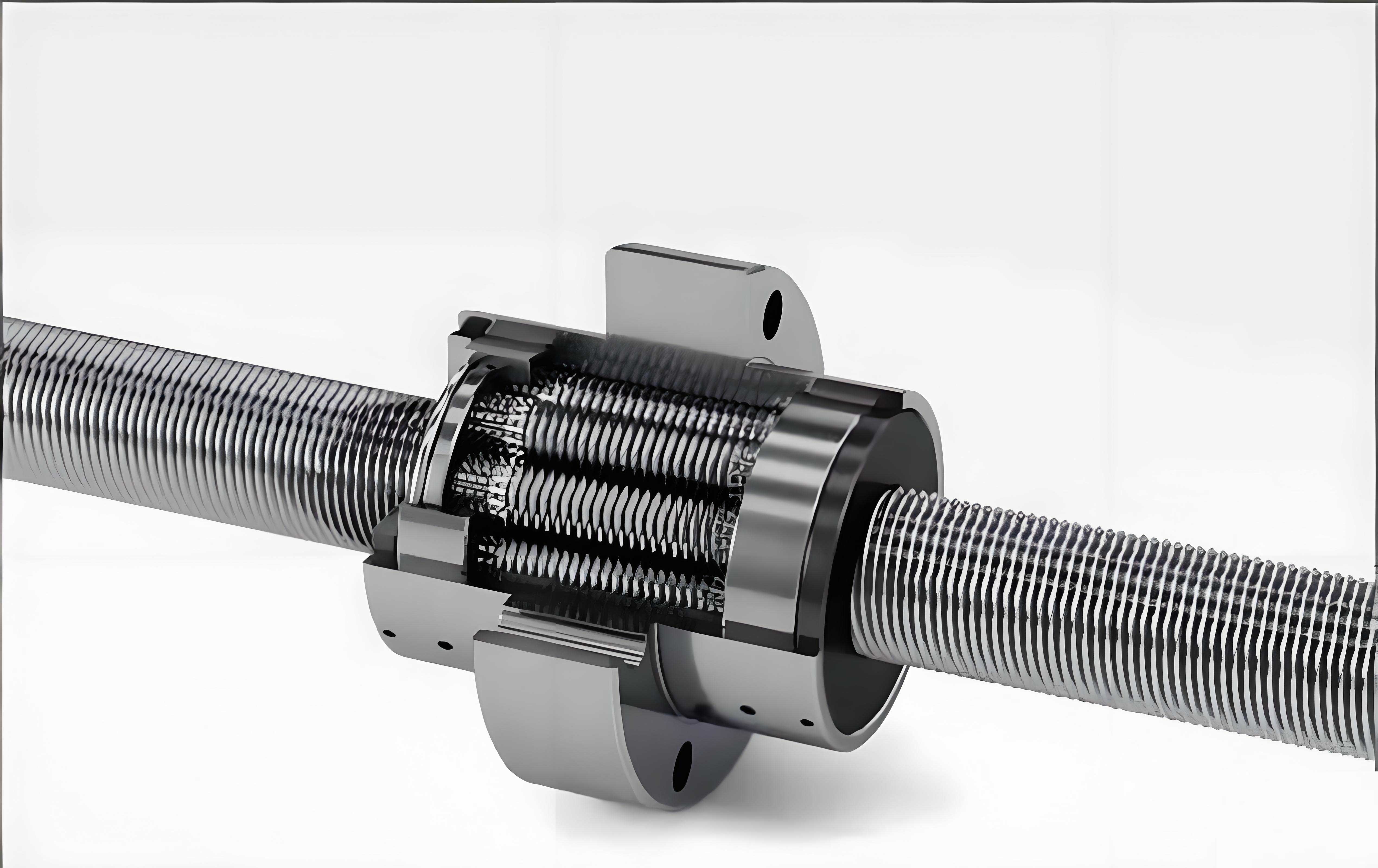
A thorough kinematic analysis is fundamental to understanding the motion relationships within the planetary roller screw assembly. The system can be effectively modeled as a planetary gear train. Let us define the following symbols: the screw rotates with an angular velocity $$ω_s$$, the nut translates with a linear velocity $$v_n$$, the carrier (and thus the roller orbit) rotates with angular velocity $$ω_c$$, and an individual roller spins about its own axis with angular velocity $$ω_r$$. The pitch diameters of the screw, nut, and roller are denoted as $$d_s$$, $$d_n$$, and $$d_r$$, respectively. The orbital diameter of the roller centers is $$d_c$$. The screw and nut have a lead $$L$$ (for a single-start thread, $$L$$ equals the pitch $$p$$).
In a typical configuration where the screw is rotating and the nut is constrained from rotating (only allowed to translate), a velocity analysis reveals the relationship between the orbital speed and the screw speed. Considering the instant center of rotation between the screw and roller, the orbital angular velocity can be derived as:
$$ω_c = \pm \frac{d_s}{2d_c} ω_s = \pm \frac{(d_n – 2d_r)}{2(d_n – d_r)} ω_s$$
The sign (±) indicates the direction of rotation relative to the screw. Treating the carrier as the arm of a planetary system, the gear ratio between the screw (sun) and the roller (planet) when the carrier is fixed gives the roller’s absolute spin velocity:
$$i^{H}_{sr} = \frac{ω_s – ω_c}{ω_r – ω_c} = -\frac{d_r}{d_s}$$
Solving for the roller’s spin angular velocity $$ω_r$$ yields:
$$ω_r = \pm \left[ \left( \frac{d_s}{d_r} + 1 \right) ω_c – \frac{d_s}{d_r} ω_s \right]$$
Finally, the translational velocity of the nut, which is the primary output in many applications of the planetary roller screw assembly, is directly related to the relative motion between the screw and nut threads. For a screw with $$n$$ starts and a lead $$L = n \cdot p$$, the nut displacement $$S_n$$ and velocity $$v_n$$ relative to the screw are:
$$S_n = \pm \frac{n \cdot p \cdot ω_s \cdot t}{2π}$$
$$v_n = \pm \frac{n \cdot p \cdot ω_s}{2π}$$
The sign convention for translation follows the right-hand rule relative to the screw’s rotation. The kinematic parameters for a specific RPRSM design are summarized in the table below.
| Component | Quantity | Pitch (mm) | Starts | Handedness | Pitch Diameter (mm) |
|---|---|---|---|---|---|
| Screw | 1 | 1.0 | 1 | Right | 31.13 |
| Nut | 1 | 1.0 | 1 | Right | 44.14 |
| Roller | 12 | N/A (Grooved) | N/A | N/A | 6.63 |
To investigate the dynamic forces and transient behavior of the planetary roller screw assembly, a multi-body dynamics model was constructed. A three-dimensional CAD model of the RPRSM, incorporating a nut with a 60° non-threaded section, was imported into a dynamics simulation software (ADAMS). The virtual prototype was assembled with appropriate kinematic joints and force interactions to accurately represent the physical system. The screw was connected to the ground via a revolute joint and assigned a constant input angular velocity of $$ω_s = -4π \text{ rad/s}$$ (clockwise when viewed along the axis). The nut was connected to the ground with a translational joint, allowing only axial movement. A cylindrical joint was applied between the carrier and the screw, permitting both relative rotation and translation. The carrier and the cam ring (fixed to the nut) were connected by a revolute joint.
The most critical aspect of the dynamic model is the definition of contacts. Contacts were defined between all interacting threaded surfaces: screw-to-roller and roller-to-nut. Additionally, contacts were defined between the roller ends and the cam ring protrusions, and between the rollers and the carrier slots. The Impact function, a common method for modeling intermittent contact in multi-body dynamics, was used. The contact force $$F$$ is calculated as:
$$F = \max(0, K(q_0 – q)^e – C \cdot \frac{dq}{dt} \cdot STEP(q, q_0-d, 1, q_0, 0))$$
Here, $$K$$ is the contact stiffness, $$q$$ is the instantaneous distance between geometries, $$q_0$$ is the free length or reference distance, $$e$$ is the force exponent (typically >1 for non-linear stiffness), $$C$$ is the damping coefficient, and $$d$$ is the damping ramp-up penetration depth. The STEP function smoothly activates the damping. Friction was modeled using the Coulomb method. The material for all components was set to GCr15 bearing steel. The contact and friction parameters used in the simulation are listed below.
| Parameter | Value |
|---|---|
| Stiffness, K | 1.0 × 10^5 N/mm |
| Force Exponent, e | 1.5 |
| Damping, C | 50 N·s/mm |
| Penetration Depth, d | 0.2 mm |
| Static Friction Coefficient, μ_s | 0.30 |
| Dynamic Friction Coefficient, μ_d | 0.25 |
The simulation was first run for 1 second under a no-load condition (only the weight of components) to verify the basic kinematics. The results for key motion parameters were extracted and compared with the theoretical values derived from the kinematic equations. The screw rotated at a steady $$ω_s = -12.57 \text{ rad/s}$$. The average roller spin velocity in the threaded zone was found to be $$ω’_r = 28.28 \text{ rad/s}$$, and the average carrier orbital velocity was $$ω_c = -5.20 \text{ rad/s}$$. The nut achieved an average translational velocity of $$v_n = 1.98 \text{ mm/s}$$ over a total displacement of 2.00 mm. The comparison demonstrates excellent agreement, with all errors below 5%, validating the fidelity of the dynamic model of the planetary roller screw assembly.
| Motion Parameter | Theoretical Value | Simulation Value | Relative Error |
|---|---|---|---|
| Roller Spin, ω’_r (rad/s) | 29.43 | 28.28 | 3.91% |
| Carrier Orbit, ω_c (rad/s) | -5.19 | -5.20 | 0.19% |
| Nut Velocity, v_n (mm/s) | 2.00 | 1.98 | 1.00% |
A significant dynamic event was observed in the roller spin velocity profile: a sharp transient drop occurred periodically. This corresponds precisely to the moment when a roller enters the nut’s non-threaded section and its end face contacts the protrusion on the cam ring. During this recirculation phase, the roller disengages from the nut threads, loses its kinematic constraint, and slides against the cam ring, leading to the sudden change in angular speed. This phenomenon is a critical characteristic of the dynamic operation of this type of planetary roller screw assembly.
To analyze the force transmission and dynamic response under load, additional simulations were conducted with constant axial loads of 5 kN, 10 kN, and 15 kN applied to the nut, opposing its direction of motion. The contact forces between the screw and a representative roller, and between that roller and the nut, were examined. The force profiles exhibited a distinct sinusoidal-like pattern during normal operation in the threaded zone. This oscillatory behavior is attributed to the small clearance between the roller and the carrier slot. As the roller transmits force, it contacts one side of the carrier slot, is pushed, then separates and may contact the opposite side, creating a cyclic variation in the contact force between the meshing threads. The average values of the screw-roller and roller-nut contact forces for a given load were nearly identical, as expected from Newton’s Third Law, confirming the force equilibrium on the roller. As anticipated, the magnitude of these contact forces increased proportionally with the applied load on the planetary roller screw assembly.
The collision forces between the roller end and the cam ring protrusion during the recirculation phase were also analyzed. A key finding was that the peak magnitude of this collision force showed no consistent correlation with the external axial load. For instance, the maximum peak collision force recorded was approximately 114 N at 5 kN load, 32 N at 10 kN, and 54 N at 15 kN. The analysis of different rollers under the same load (10 kN) also showed a similar range of peak collision forces. This independence from load can be explained by the roller’s state during recirculation: it is disengaged from the nut threads and is essentially “floating,” with its motion dominated by its own inertia and the guiding action of the cam ring, rather than by the static load path through the threaded engagements of the planetary roller screw assembly.
In contrast, the collision torque between the roller and the carrier slot showed a clearer trend. The peak values of this interaction torque generally increased with higher external loads. This is because the tangential force required to drive the roller’s orbital motion, which is transmitted through the carrier-roller contact, is related to the larger meshing forces present under higher axial loads in the threaded zone. The presence of clearance in the carrier slot leads to an oscillatory torque as the roller rattles between the slot’s sides.
The comprehensive analysis presented here elucidates the complex interplay of kinematics and dynamics within a Recirculating Planetary Roller Screw Mechanism. The theoretical kinematic model accurately predicts the motion relationships between the screw, rollers, carrier, and nut. The dynamic simulation, validated against this theory, provides deep insight into the transient forces governing the operation of the planetary roller screw assembly. Key dynamic characteristics include the sinusoidal fluctuation of thread contact forces due to carrier clearance, the load-independent nature of the roller-cam ring impact force during recirculation, and the load-dependent trend of the roller-carrier collision torque. The most pronounced dynamic event is the abrupt change in roller angular velocity when it contacts the cam ring protrusion to execute the recirculation step. For designers, minimizing friction and optimizing the profile of this cam interface are crucial for enhancing the smoothness and precision of the planetary roller screw assembly. Furthermore, controlling tolerances on the carrier slot to minimize clearance can reduce force oscillations and improve dynamic performance. This work establishes a foundational framework for modeling and analyzing RPRSMs, contributing to the ongoing development of high-performance actuation systems.