
In modern mechanical transmission systems, spiral bevel gears play a critical role due to their high load-carrying capacity, smooth operation, and low noise characteristics. These gears are extensively used in industries such as aerospace, automotive, and marine engineering. With the advancement of high-performance manufacturing technologies, the demand for improved quality and longevity of spiral bevel gears has intensified. One key factor influencing the performance and fatigue life of these gears is the residual stress induced during machining processes. Residual stresses on the machined surface can significantly affect gear durability, leading to premature failure if not properly controlled. Therefore, understanding the formation and distribution of residual stresses in spiral bevel gears is essential for optimizing machining parameters and enhancing gear reliability.
Traditionally, spiral bevel gears are manufactured using methods like form cutting and generation cutting. Form cutting is often employed for machining large spiral bevel gears, where the gear tooth profile matches the cutting tool’s shape. During this process, the cutter rotates while the gear blank remains stationary, and feed motion is applied along the cutter axis. This method involves complex three-dimensional cutting dynamics, which cannot be accurately represented by simple orthogonal cutting models. Instead, oblique cutting models are more appropriate as they account for varying tool angles and cutting directions. In this study, I focus on the form cutting process for spiral bevel gears and develop a three-dimensional oblique cutting finite element model to simulate residual stress generation. By analyzing the effects of cutting parameters, I aim to provide insights into minimizing detrimental residual stresses and improving the surface integrity of spiral bevel gears.
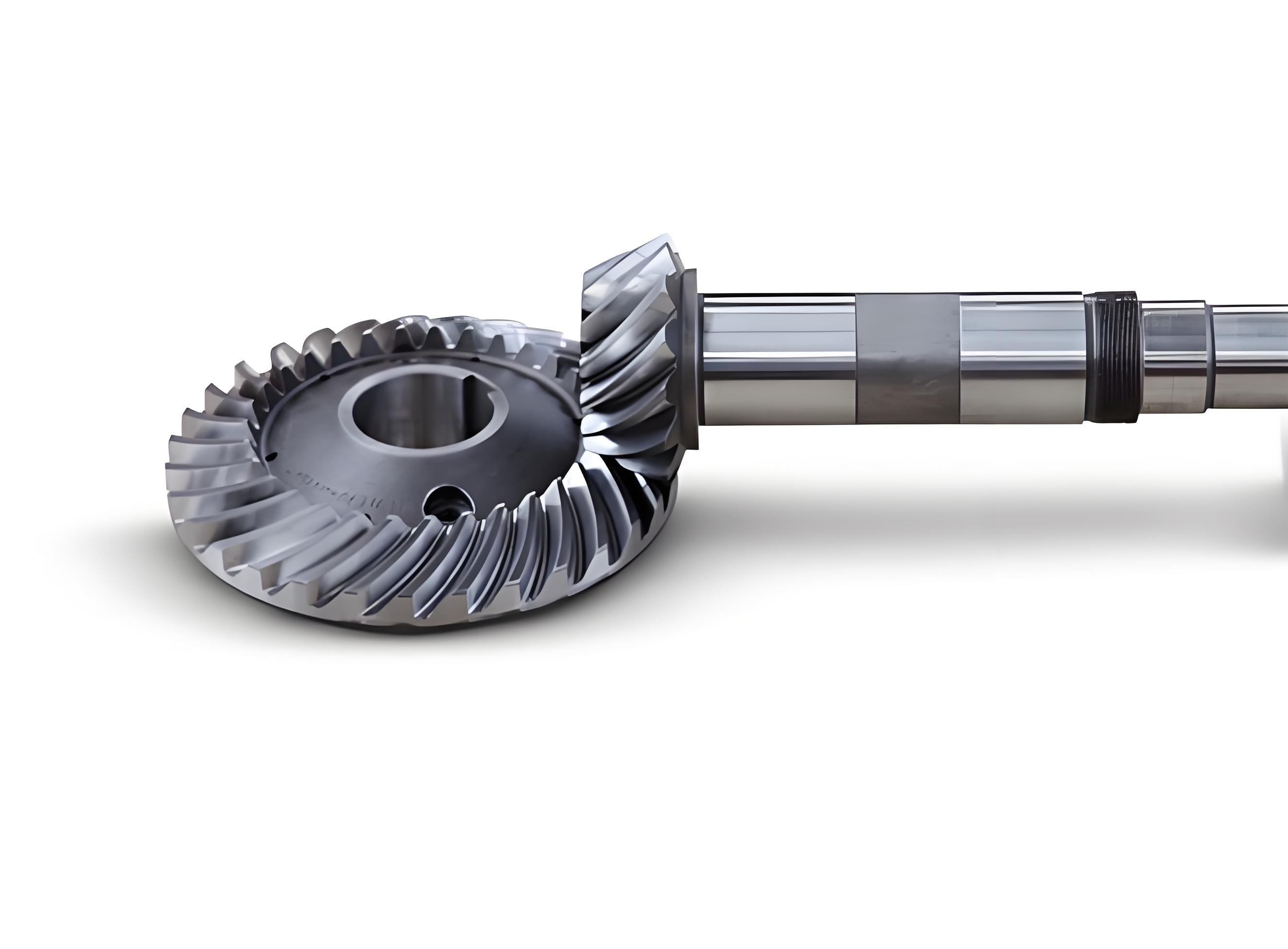
The oblique cutting process for spiral bevel gears involves a cutting velocity vector that is not perpendicular to the cutting edge, resulting in a three-dimensional stress state. This complexity necessitates advanced simulation techniques to capture the thermomechanical interactions during machining. I utilize the AdvantEdge finite element software, which is specialized for metal cutting simulations, to model the oblique cutting of spiral bevel gears. The workpiece material is selected as 20CrNiMo, a commonly used alloy steel in gear manufacturing due to its good machinability and mechanical properties. The material behavior is described using the Johnson-Cook constitutive model, which accounts for strain hardening, strain rate sensitivity, and thermal softening effects. The Johnson-Cook equation is expressed as:
$$ \sigma = \left( A + B \varepsilon^n \right) \left[ 1 + C \ln \left( \frac{\dot{\varepsilon}}{\dot{\varepsilon}_0} \right) \right] \left[ 1 – \left( \frac{T – T_0}{T_m – T_0} \right)^m \right] $$
where $\sigma$ is the equivalent stress, $A$ is the yield stress, $B$ is the hardening modulus, $\varepsilon$ is the equivalent plastic strain, $n$ is the strain hardening exponent, $C$ is the strain rate sensitivity coefficient, $\dot{\varepsilon}$ is the plastic strain rate, $\dot{\varepsilon}_0$ is the reference strain rate, $T$ is the current temperature, $T_0$ is the room temperature, and $T_m$ is the melting temperature. The material parameters for 20CrNiMo are listed in Table 1.
| Parameter | Value |
|---|---|
| A (MPa) | 303 |
| B (MPa) | 192 |
| n | 0.5 |
| C | 0.1 |
| m | 0.9 |
| $\dot{\varepsilon}_0$ (s⁻¹) | 1.0 |
| $T_m$ (°C) | 1460 |
| $T_0$ (°C) | 20 |
For chip separation and failure criteria, the Johnson-Cook shear failure model is implemented. This model defines the equivalent plastic strain at failure as:
$$ \varepsilon_f = \left[ D_1 + D_2 \exp \left( D_3 \frac{p}{q} \right) \right] \left[ 1 + D_4 \ln \left( \frac{\dot{\varepsilon}}{\dot{\varepsilon}_0} \right) \right] \left[ 1 + D_5 \left( \frac{T – T_0}{T_m – T_0} \right) \right] $$
where $D_1$ to $D_5$ are material failure parameters, $p$ is the hydrostatic pressure, and $q$ is the Mises stress. The values for 20CrNiMo are provided in Table 2.
| Parameter | Value |
|---|---|
| D₁ | 1.508 |
| D₂ | 1.094 |
| D₃ | -1.4 |
| D₄ | 0.005 |
| D₅ | 0.94 |
The friction at the tool-workpiece interface is modeled using a combined sticking-sliding approach, with a constant friction coefficient of 0.3. The cutting tool is assumed to be rigid and made of carbide, with a rake angle of 20°, a relief angle of 5°, an oblique angle of 10°, and a cutting edge radius of 0.02 mm. These parameters are kept constant throughout the simulations to isolate the effects of cutting conditions on residual stresses in spiral bevel gears.
To investigate the influence of machining parameters, I design a single-factor simulation plan. The cutting parameters include cutting speed, feed rate, depth of cut, and the application of coolant. The levels for each factor are summarized in Table 3. The simulations are performed for the oblique cutting of spiral bevel gears, with residual stresses extracted from a fixed cross-section on the machined surface. Stress data are collected along the depth direction at intervals of 0.05 mm, and averages are computed for both tangential (x-direction) and axial (y-direction) stresses.
| Factor | Level 1 | Level 2 | Level 3 | Level 4 |
|---|---|---|---|---|
| Cutting Speed (m/min) | 80 | 100 | 120 | 140 |
| Feed Rate (mm/rev) | 0.15 | 0.20 | 0.25 | 0.30 |
| Depth of Cut (mm) | 2.0 | 2.5 | 3.0 | 3.5 |
| Coolant | Absent | Present | – | – |
The simulation results reveal that residual stresses in spiral bevel gears exhibit a characteristic “spoon-shaped” distribution along the depth. The surface layer is dominated by tensile residual stresses, which transition to compressive stresses in the subsurface region before diminishing to zero at greater depths. This pattern arises from the thermomechanical coupling during machining. The heat generated by friction and plastic deformation leads to thermal expansion and subsequent contraction, inducing tensile stresses on the surface. Meanwhile, mechanical loads from cutting forces cause plastic deformation, resulting in compressive stresses beneath the surface. The tangential residual stresses are generally higher than axial stresses due to the predominant cutting direction in oblique cutting of spiral bevel gears.
I now analyze the effects of individual cutting parameters on residual stresses in spiral bevel gears. The cutting speed is varied from 80 to 140 m/min while keeping the feed rate at 0.15 mm/rev and depth of cut at 2 mm. The surface residual tensile stresses increase with cutting speed, as shown in Table 4. Higher cutting speeds intensify frictional heating, elevating surface temperatures and enhancing thermal effects. The increased thermal energy causes greater tensile stresses, while the reduced cutting forces slightly decrease compressive stresses in the subsurface. The relationship between cutting speed and surface tensile stress can be approximated by a linear equation:
$$ \sigma_{\text{surface}} = k_v \cdot V + c_v $$
where $\sigma_{\text{surface}}$ is the surface residual tensile stress in MPa, $V$ is the cutting speed in m/min, and $k_v$ and $c_v$ are constants derived from simulation data.
| Cutting Speed (m/min) | Tangential Stress (MPa) | Axial Stress (MPa) |
|---|---|---|
| 80 | 320 | 280 |
| 100 | 350 | 310 |
| 120 | 380 | 340 |
| 140 | 410 | 370 |
Next, the feed rate is varied from 0.15 to 0.30 mm/rev with a constant cutting speed of 100 m/min and depth of cut of 2 mm. Feed rate has a more pronounced impact on residual stresses in spiral bevel gears. As feed increases, both surface tensile stresses and subsurface compressive stresses rise significantly, and the depth of the affected layer expands. This is attributed to increased metal removal rates, which amplify mechanical loads and heat generation. The enhanced plastic deformation and friction lead to higher stress magnitudes. The data are summarized in Table 5. The relationship can be expressed as:
$$ \sigma_{\text{surface}} = k_f \cdot f + c_f $$
where $f$ is the feed rate in mm/rev, and $k_f$ and $c_f$ are constants. The depth of residual stress layer $d$ also correlates with feed rate:
$$ d = \alpha \cdot f + \beta $$
with $\alpha$ and $\beta$ as fitting parameters.
| Feed Rate (mm/rev) | Surface Tensile Stress (MPa) | Max Compressive Stress (MPa) | Layer Depth (mm) |
|---|---|---|---|
| 0.15 | 350 | -450 | 0.25 |
| 0.20 | 400 | -500 | 0.30 |
| 0.25 | 450 | -550 | 0.35 |
| 0.30 | 500 | -600 | 0.40 |
The depth of cut is varied from 2.0 to 3.5 mm while maintaining a cutting speed of 100 m/min and feed rate of 0.15 mm/rev. Interestingly, depth of cut shows minimal influence on residual stress distribution in spiral bevel gears. As presented in Table 6, the stress values remain relatively constant across different depths. This is because increases in depth of cut proportionally increase tool engagement length, improving heat dissipation and keeping thermal and mechanical effects balanced. Thus, depth of cut is less critical for residual stress control in machining spiral bevel gears.
| Depth of Cut (mm) | Surface Tensile Stress (MPa) | Max Compressive Stress (MPa) |
|---|---|---|
| 2.0 | 350 | -450 |
| 2.5 | 355 | -455 |
| 3.0 | 360 | -460 |
| 3.5 | 365 | -465 |
The application of coolant is simulated to assess its effect on residual stresses in spiral bevel gears. Coolant reduces friction and heat, thereby lowering surface temperatures. As a result, surface tensile stresses decrease compared to dry cutting conditions. Table 7 compares residual stresses with and without coolant for selected parameter sets. The reduction in tensile stress can be quantified by a cooling efficiency factor $\eta_c$, defined as:
$$ \eta_c = \frac{\sigma_{\text{dry}} – \sigma_{\text{coolant}}}{\sigma_{\text{dry}}} \times 100\% $$
where $\sigma_{\text{dry}}$ and $\sigma_{\text{coolant}}$ are surface tensile stresses under dry and coolant conditions, respectively.
| Condition | Cutting Speed 100 m/min, Feed 0.15 mm/rev, Depth 2 mm | Cutting Speed 120 m/min, Feed 0.20 mm/rev, Depth 2.5 mm |
|---|---|---|
| Dry (MPa) | 350 | 420 |
| With Coolant (MPa) | 300 | 370 |
| Reduction (%) | 14.3 | 11.9 |
To further analyze the thermomechanical behavior, I derive a simplified analytical model for residual stress generation in spiral bevel gears. The total residual stress $\sigma_{\text{total}}$ is considered as a superposition of thermal stress $\sigma_{\text{thermal}}$ and mechanical stress $\sigma_{\text{mechanical}}$:
$$ \sigma_{\text{total}} = \sigma_{\text{thermal}} + \sigma_{\text{mechanical}} $$
The thermal component depends on the temperature gradient $\Delta T$ and thermal expansion coefficient $\alpha_T$:
$$ \sigma_{\text{thermal}} = E \cdot \alpha_T \cdot \Delta T $$
where $E$ is Young’s modulus. The mechanical component relates to plastic strain $\varepsilon_p$ and yield strength $\sigma_y$:
$$ \sigma_{\text{mechanical}} = \sigma_y \cdot f(\varepsilon_p) $$
In oblique cutting of spiral bevel gears, the cutting force $F_c$ can be estimated using the Merchant’s equation modified for oblique angles:
$$ F_c = \frac{\tau_s \cdot A_c}{\sin \phi \cos(\phi + \beta – \alpha)} $$
where $\tau_s$ is the shear strength, $A_c$ is the cross-sectional area of cut, $\phi$ is the shear angle, $\beta$ is the oblique angle, and $\alpha$ is the rake angle. This force contributes to mechanical stresses and heat generation, influencing residual stress profiles.
Based on the simulation results, I propose optimal machining parameters for spiral bevel gears to minimize detrimental residual stresses. A lower feed rate and moderate cutting speed are recommended to reduce surface tensile stresses. Depth of cut can be selected based on productivity requirements, as it has minimal impact. Coolant application is beneficial for lowering thermal effects. These guidelines aim to enhance the surface integrity and fatigue performance of spiral bevel gears in practical applications.
In conclusion, this study employs a three-dimensional oblique cutting finite element model to simulate residual stresses in spiral bevel gears machined by form cutting. The results indicate that residual stresses exhibit a spoon-shaped distribution, with surface tensile stresses and subsurface compressive stresses. Cutting parameters significantly influence these stresses: cutting speed and feed rate increase surface tensile stresses, with feed rate having the most substantial effect. Depth of cut shows negligible impact, while coolant application reduces tensile stresses. The findings provide a theoretical foundation for optimizing machining processes to improve the quality and durability of spiral bevel gears. Future work could explore the effects of tool geometry and material variations on residual stresses in spiral bevel gears, further advancing high-performance gear manufacturing.