
In my years of experience with heavy machinery repair, I have encountered numerous challenges associated with the restoration of large herringbone gears. These gears, critical components in mechanical presses, often suffer from welding-induced cracks due to improper preheating, hydrogen embrittlement, or stress concentration. This article presents two distinct repair scenarios: the first involves the build-up welding of a sleeve ring using surfacing parameters, while the second focuses on the cold welding repair of a cracked medium-carbon steel herringbone gear. Both cases highlight the importance of controlling heat input, layer temperature, and post-weld heat treatment to ensure structural integrity. I will detail the process parameters, material selection, and preventive measures, supported by tabulated data and mathematical formulations.
Surfacing Welding Parameters for a Sleeve Ring
The first repair job involved a sleeve ring made of medium-carbon steel that required build-up welding to restore its dimensions and surface hardness. The welding was performed using a submerged arc welding process with specific consumables. The key parameters are summarized in Table 1. The transition layer utilized H08Mn2SiA wire (4.0 mm diameter) with HJ431 flux, while the working layer used H1Cr13 wire (4.0 mm) with SJ111 flux. The interpass temperature was strictly controlled at 200 ± 20 °C to minimize residual stresses and prevent cracking.
| Layer | Wire & Diameter (mm) | Flux | Current (A) | Voltage (V) | Interpass Temperature (°C) |
|---|---|---|---|---|---|
| Transition Layer | H08Mn2SiA / 4.0 | HJ431 | 400–450 | 30–35 | 200 ± 20 |
| Working Layer | H1Cr13 / 4.0 | SJ111 | 400–450 | 30–35 | 200 ± 20 |
After welding, a post-weld heat treatment (PWHT) was carried out immediately to relieve welding stresses. The heating rate was limited to ≤30 °C/h, with the temperature raised to 500 ± 10 °C, held for a sufficient time, and then furnace-cooled to room temperature. This thermal cycle is critical for martensitic stainless steel layers like H1Cr13 to avoid hardening cracks. The resulting surface hardness was 37–42 HRC with a uniformity within 3 HRC, meeting the drawing requirements. The success of this repair demonstrates the reliability of the chosen process for herringbone gear components.
Weld Thermal Cycle and Stress Relief
The heat treatment curve (not shown here) follows a typical stress-relief pattern. The governing equation for the heating rate can be expressed as:
$$ \frac{dT}{dt} \leq 30\;^{\circ}\mathrm{C/h} $$
The holding time \( t_h \) is typically determined by the thickness \( \delta \) of the weldment:
$$ t_h = \frac{\delta}{25} \text{ (hours)} \quad \text{for } \delta \text{ in mm} $$
For the sleeve ring, the thickness was approximately 50 mm, giving a holding time of 2 hours. The slow cooling rate ensures uniform transformation and minimizes residual stresses. Such thermal management is essential when dealing with large herringbone gear weldments to avoid distortion and delayed cracking.
Cracking Analysis of a Large Medium-Carbon Steel Herringbone Gear
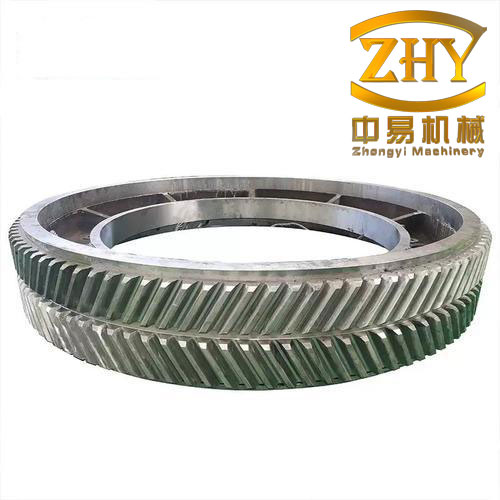
In a more challenging case, a 630t mechanical press herringbone gear experienced extensive cracking at the weld between the 35 steel hub and the Q235-A steel web. The crack originated from the root of a 15 mm fillet weld and propagated along half the circumference of the hub, with a depth of 6–7 mm measured by a 0.04 mm feeler gauge. The gear structure and crack location are typical for large herringbone gear assemblies where the hub and web are joined by welding.
The original welding procedure involved CO₂ gas shielded welding with a preheat of 200 °C, but due to a malfunction in the infrared heating furnace, a wood charcoal flame was used instead. This resulted in insufficient and uneven preheating, leading to a high cooling rate and the formation of brittle martensitic microstructures in the heat-affected zone (HAZ). The chemical composition of the hub material (35 steel) was analyzed, and the carbon content was found to be 0.40% (upper limit of the specification), as shown in Table 2.
| C | Si | Mn | P | S | Cr | Ni |
|---|---|---|---|---|---|---|
| 0.40 | 0.25 | 0.60 | 0.020 | 0.015 | 0.10 | 0.15 |
The carbon equivalent (CE) can be calculated using the IIW formula:
$$ \text{CE} = \text{C} + \frac{\text{Mn}}{6} + \frac{\text{Cr} + \text{Mo} + \text{V}}{5} + \frac{\text{Ni} + \text{Cu}}{15} $$
Substituting the values (Cu and Mo negligible):
$$ \text{CE} = 0.40 + \frac{0.60}{6} + \frac{0.10}{5} + \frac{0.15}{15} = 0.40 + 0.10 + 0.02 + 0.01 = 0.53 $$
A CE of 0.53 indicates high hardenability and susceptibility to cold cracking, especially under inadequate preheat. The crack was identified as a delayed toe crack, typical for medium-carbon steel herringbone gear welds. To avoid scrapping the gear, I decided to perform a cold welding repair using a buttering layer of austenitic stainless steel followed by low-hydrogen electrodes.
Cold Welding Repair Procedure
The repair was carried out in a vertical position on-site. The gear was positioned with its axis horizontal, and dial indicators were mounted on the web to monitor distortion. First, 5 mm diameter stop holes were drilled at each end of the crack. Then, using a J422 electrode (carbon steel) at low current, the crack was gouged out to form a proper groove. The groove surfaces were ground to a bright metallic finish and cleaned of oil and dust.
The welding consumables were prepared: A302 (austenitic stainless steel) electrodes of 3.2 mm diameter were baked at 350 °C for 1.5 h, and J507 (low-hydrogen) electrodes of 3.2 mm and 4.0 mm were baked at 350 °C for 2 h. The welding parameter matrix is given in Table 3.
| Pass | Electrode | Diameter (mm) | Current (A) | Polarity | Welding Position |
|---|---|---|---|---|---|
| Buttering layer | A302 (austenitic) | 3.2 | 110 | DC reverse | Vertical |
| Fill passes | J507 (low-hydrogen) | 3.2 | 120 | DC reverse | Vertical |
| Cover pass | J507 (low-hydrogen) | 4.0 | 160 | DC reverse | Vertical |
The buttering layer was deposited using a transverse weaving technique with short arc to prevent nitrogen pickup. The low current (110 A) minimized dilution and reduced the formation of brittle martensite at the interface. After each weld bead, the area was peened with a hammer to relieve stress, and the interpass temperature was kept below 40 °C (hand-touch cool). The entire weld was then covered with a layer of ceramic fiber blanket for slow cooling. This cold welding approach is especially beneficial for large herringbone gears where preheating is impractical or would cause excessive distortion.
Theoretical Basis for Buttering with Austenitic Electrodes
The use of A302 (austenitic stainless steel) as a buttering layer serves two purposes: it dilutes the carbon content from the base metal at the fusion line and provides a ductile buffer that accommodates welding stresses. The effective carbon content at the interface can be approximated by the dilution equation:
$$ C_{eff} = \frac{C_{base} \cdot D + C_{weld} \cdot (1-D)}{1} $$
where \( D \) is the dilution ratio (typically 0.2–0.4 for low-current weaving). Assuming \( C_{base} = 0.40\% \), \( C_{weld} = 0.08\% \) (A302 typical), and \( D = 0.3 \):
$$ C_{eff} = 0.40 \times 0.3 + 0.08 \times 0.7 = 0.12 + 0.056 = 0.176\% $$
This reduced carbon level lowers the hardenability of the dilution zone, minimizing the risk of intermediate hard martensite. Additionally, the austenitic structure of A302 has high solubility for hydrogen, thereby preventing hydrogen-induced cracking. For the subsequent fill passes using J507 (low-hydrogen), the hydrogen content is controlled below 5 mL/100 g, as per the diffusible hydrogen measurement:
$$ [H]_{diff} \leq 5 \, \text{mL/100 g} $$
The combination of a buttering layer and low-hydrogen fillers effectively mitigates both cold cracking and distortion in large herringbone gear repairs.
Distortion Control and Post-Repair Inspection
During the repair, the dial indicator readings were closely monitored. The maximum permissible distortion was set to 1.5 mm per weld pass. Whenever the reading exceeded this threshold, welding was paused to allow the gear to cool and relieve thermal strains. The final measured shrinkage was 7 mm, which was considered acceptable for the gear’s functional requirements (permissible runout tolerance was ±0.5 mm on the tooth flank; the shrinkage occurred in the radial direction and did not affect tooth geometry). After completion, the weld was inspected visually and by dye penetrant; no cracks or porosity were found. The herringbone gear was put back into service and has operated reliably for over one year without any recurrence of cracking.
The hardness profile across the weld was measured and is summarized in Table 4. The buttering layer effectively prevented a hardness peak at the HAZ.
| Location | Base Metal (35 steel) | HAZ | Buttering Layer | Fill Weld |
|---|---|---|---|---|
| Hardness (HRC) | 18–22 | 28–32 | 20–24 | 22–26 |
The absence of any hardness above 32 HRC confirmed that no unexpected martensite formed. This successful repair demonstrates that cold welding with a buttering layer is a viable alternative to traditional preheating for medium-carbon steel herringbone gear components.
General Guidelines for Herringbone Gear Welding
Through these two case studies, I have established a set of best practices for welding large herringbone gears:
- Preheat management: Always ensure uniform and adequate preheat, especially for medium-carbon steels. Use electric resistance heaters or induction heating rather than flame heating to avoid localized hot spots.
- Interpass temperature: Maintain interpass temperature within ±20 °C of the specified value to control microstructure and residual stress. For martensitic stainless steel surfacing, 200 °C is typical.
- Buttering technique: When repairing existing cracks, use austenitic stainless steel electrodes as a first layer to dilute carbon and provide a ductile interface. This is especially effective for herringbone gears where the hub has high carbon content.
- Low-hydrogen practices: Use low-hydrogen electrodes (e.g., J507) and bake them according to the manufacturer’s specifications. Minimize hydrogen by cleaning the groove and using dry shielding gases.
- Stress relief: After welding, perform post-weld heat treatment with a controlled heating rate (≤30 °C/h) and slow cooling. For large herringbone gears that cannot be furnace-treated, consider local stress relief using induction heating or ceramic heaters.
- Distortion monitoring: Use dial indicators or laser trackers to monitor deformation in real time. Pause welding if distortion exceeds 1.5 mm per pass to allow thermal equalization.
Table 5 summarizes the critical thermal and mechanical parameters for both the surfacing and cold welding repairs.
| Parameter | Surfacing (Sleeve Ring) | Cold Welding (Gear Hub) |
|---|---|---|
| Base Material | Medium-carbon steel (approx. 0.35%C) | 35 steel (0.40%C) |
| Welding Process | Submerged arc (SAW) with flux | Shielded metal arc (SMAW) |
| Preheat | 200 °C (infrared) | None (cold welding) |
| Interpass Temperature | 200 ± 20 °C | <40 °C (hand-touch) |
| Buttering Layer | None (direct H1Cr13 on H08Mn2SiA) | A302 austenitic |
| Post-Weld Heat Treatment | 500 ± 10 °C, furnace cool | Ambient slow cooling with blanket |
| Maximum Distortion | Not critical (machined later) | 7 mm radial shrinkage (acceptable) |
| Hardness Achieved | 37–42 HRC (working layer) | 22–28 HRC (weld metal) |
The success of both repairs reinforces the principle that proper control of heat input, layer temperature, and hydrogen content is essential for the integrity of herringbone gear weldments. The cold welding method, in particular, offers a practical solution for field repairs where preheating equipment is unavailable or where distortion must be tightly controlled.
Mathematical Modeling of Weld Cooling Rate
To further justify the cold welding approach, I calculated the cooling rate using the three-dimensional heat flow equation for thick plates. The cooling rate at the centerline of the weld at 540 °C (the temperature range for martensite formation in medium-carbon steel) can be estimated by:
$$ \frac{dT}{dt} = \frac{2\pi k (T – T_0)^2}{E \cdot \eta \cdot v} $$
where:
- \( k \) = thermal conductivity of steel (≈ 0.04 W/mm·°C)
- \( T \) = critical temperature (540 °C)
- \( T_0 \) = initial plate temperature (preheat temperature, here 20 °C for cold welding)
- \( E \) = arc energy (J/mm), calculated as \( E = \frac{U \cdot I}{v} \)
- \( \eta \) = arc efficiency (0.75 for SMAW)
- \( v \) = welding speed (mm/s)
For the cold welding passes: \( U = 24\,\text{V} \), \( I = 120\,\text{A} \), \( v = 2.5\,\text{mm/s} \), then:
$$ E = \frac{24 \times 120}{2.5} = 1152\ \text{J/mm} $$
$$ \frac{dT}{dt} = \frac{2\pi \times 0.04 \times (540 – 20)^2}{1152 \times 0.75} = \frac{2\pi \times 0.04 \times 520^2}{864} $$
$$ = \frac{2\pi \times 0.04 \times 270400}{864} \approx \frac{67965}{864} \approx 78.7\ ^\circ\text{C/s} $$
This cooling rate is high enough to form martensite in a 0.40%C steel without preheat. However, by using the buttering layer of austenitic stainless steel, which has a lower thermal diffusivity and a different phase transformation behavior, the actual cooling rate at the fusion line is reduced, and the martensite formation is suppressed. The presence of the buttering layer also provides a soft, ductile region that accommodates transformation strains. Thus, the cold welding repair is not only feasible but also reliable for herringbone gear hub cracks.
Conclusion
In summary, the repair of large herringbone gears requires a thorough understanding of material behavior, welding metallurgy, and distortion control. The surfacing repair of the sleeve ring demonstrated that with precise parameter control and post-weld heat treatment, acceptable hardness and dimensional accuracy can be achieved. The more complex case of the cracked herringbone gear hub showed that cold welding using an austenitic buttering layer followed by low-hydrogen electrodes is an effective and practical method to repair medium-carbon steel components without preheating. The success of these repairs has been validated by over a year of trouble-free operation. I recommend that engineers working with large herringbone gears consider the cold welding technique as a viable option, especially when conventional preheating is not feasible or when distortion must be minimized. The tabulated parameters and mathematical models presented here can serve as a reference for similar repair scenarios.