
In the manufacturing of automotive components, gear shaving is a critical finishing process that significantly impacts the precision, noise, and strength of gears during meshing. As a key player in this field, we have encountered a persistent issue: tooth surface distortion during the gear shaving process. This distortion leads to偏移 in meshing points and altered tooth profiles, adversely affecting gear performance. To address this, we embarked on a comprehensive study, employing a controlled single-variable experimental approach to identify influencing factors, developing a theoretical model based on gear shaving principles, and ultimately implementing an effective solution. This article details our journey, providing insights into the causes, analysis, and resolution of gear shaving-induced distortion.
Gear shaving is widely used for its efficiency in improving gear accuracy. However, we observed that post-shaving inspections often revealed a twisted tooth surface, where the gear’s cross-sections exhibited inconsistent profiles. This phenomenon, if unchecked, poses two major hazards: firstly, it causes偏移 in the meshing contact along the tooth width, leading to偏载 that compromises gear strength and lifespan; secondly, it alters the actual tooth profile, increasing啮合噪声. To illustrate, imagine a gear where the tooth surface is not uniform but扭曲, resembling a warped three-dimensional shape. This distortion is not merely cosmetic—it directly impacts functional integrity. Our goal was to systematically unravel the root causes and devise a corrective strategy.
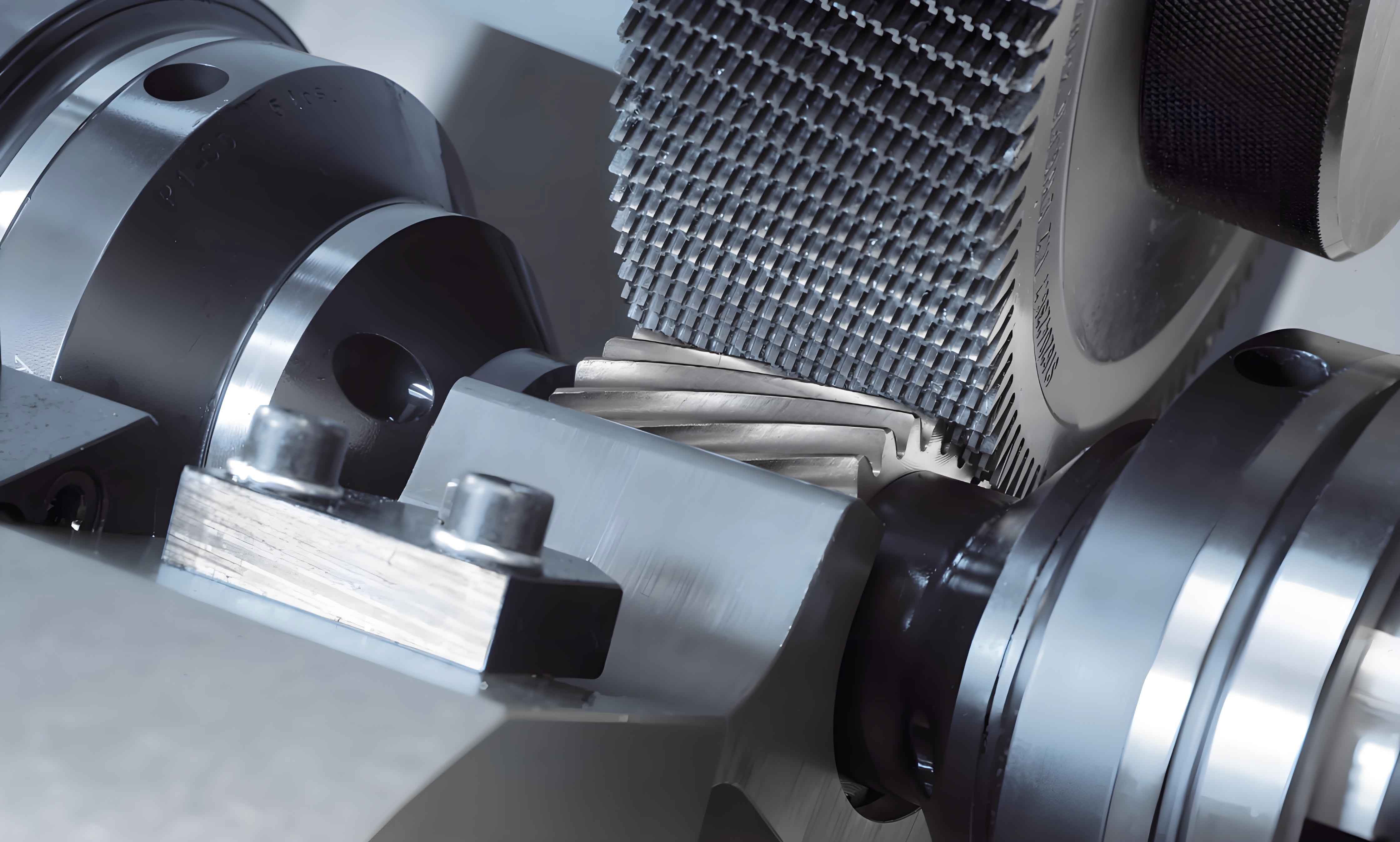
The gear shaving process involves the interaction between a shaving cutter and a gear workpiece. As shown in the image, it relies on the relative sliding motion between tooth surfaces during meshing. The cutter, designed with a helical angle differing from the gear’s, introduces an axial component to this slide, enabling material removal. However, this very mechanism can lead to distortion under certain conditions. We initiated our investigation by hypothesizing potential factors, ranging from cutter geometry to machine parameters, and structured a logical experimental sequence to test each variable independently.
Problem Description and Initial Observations
Upon detecting distortion in shaved gears, we conducted detailed measurements using three-section analysis. The results, when visualized, displayed a clear扭曲 pattern across the tooth width. For instance, the tooth profile at one end might exhibit a different pressure angle compared to the other end, indicating非均匀 material removal. This distortion manifests as a deviation in both tooth profile and tooth direction, akin to a twisted surface. The implications are severe: in啮合, such gears experience uneven contact stresses, leading to premature wear and increased noise emissions. Our initial assessment confirmed that this was not an isolated incident but a systematic issue in our gear shaving operations, necessitating a deeper dive into the process variables.
Experimental Investigation of Distortion Factors
We designed a series of experiments to isolate factors influencing gear shaving distortion. Adopting a single-variable control method, we varied one parameter at a time while keeping others constant, then measured the resultant distortion量 using precision gear analyzers. The factors considered included cutter geometry, machine type, shaving method, cutting parameters, and gear modification parameters. Below is a summary of our experimental logic and findings, presented in tables for clarity.
| Factor Category | Variable Tested | Experimental Condition | Distortion Observation |
|---|---|---|---|
| Cutter Geometry | Axis Cross Angle (β) | Same machine, same cutting parameters, different cutter spiral angles (10°, 12°, 15°) | Distortion increased with axis cross angle |
| Machine Type | Shaving Machine Principle | Same cutter, same parameters, different machines | No significant effect on distortion |
| Shaving Method | Axial vs. Radial Gear Shaving | Same machine, same cutter | Distortion only in radial gear shaving |
| Cutting Parameters | Speed and Feed Rate | Same machine, same cutter, varied speeds and feeds | No correlation with distortion |
| Gear Modification | Tooth Profile Crowning | Same setup, different profile crowning amounts | No effect on distortion |
| Gear Modification | Tooth Direction Crowning (c) | Same setup, different direction crowning amounts | Distortion increased with crowning amount |
The data clearly indicated that gear shaving distortion is primarily influenced by two factors: the axis cross angle of the shaving cutter and the tooth direction crowning amount of the gear. Notably, distortion only occurred in radial gear shaving, not in axial gear shaving. This led us to focus on the interplay between these variables in radial gear shaving operations.
Theoretical Model of Gear Shaving Distortion
Based on our experimental results and the principles of gear shaving, we developed a theoretical model to quantify distortion. The gear shaving process exploits the relative sliding motion between the cutter and gear tooth surfaces. When an axis cross angle β is present, this slide has an axial component, causing material removal to vary along the gear width. In radial gear shaving, the cutter often incorporates a concave tooth direction profile to achieve gear crowning. This concavity, combined with the axial slide, results in non-uniform cutting across different cross-sections, manifesting as distortion.
Let’s define key parameters:
- \( a \): axial slide distance during meshing
- \( s \): relative sliding length along the tooth surface
- \( P \): length of the line of action in meshing
- \( \beta \): axis cross angle between cutter and gear
- \( c \): tooth direction crowning amount of the gear (equivalent to cutter concavity over gear width)
- \( b \): gear face width
- \( d \): maximum distortion量 across the gear tooth surface
- \( r \): radius of the circular arc describing the cutter’s tooth direction concavity
From gear meshing theory, the sliding length \( s \) equals the line of action length \( P \):
$$ s = P $$
The axial slide \( a \) is related to \( s \) and \( \beta \):
$$ a = s \cdot \tan \beta = P \cdot \tan \beta $$
Considering the cutter’s concave profile, as shown in geometric analysis, the distortion \( d \) can be derived. The relationship is given by:
$$ (r – c + d)^2 + \left( \frac{b}{2} \right)^2 = r^2 $$
and
$$ \left( \frac{b}{2} \right)^2 + (r – c)^2 = r^2 $$
Solving these equations, we obtain the distortion formula:
$$ d = \frac{c}{2} \left( \sqrt{c^2 – \frac{b^2}{4}} + \sqrt{ \left( c^2 – \frac{b^2}{4} \right)^2 – 4 \left[ c^2 \left( P b \tan \beta – P \tan \beta – \frac{b^2}{2} \right) \right] } \right) $$
This model shows that distortion \( d \) is positively correlated with both the crowning amount \( c \) and the axis cross angle \( \beta \). Importantly, it allows us to predict distortion for given gear and cutter designs, enabling proactive adjustments in the gear shaving process.
| Parameter | Symbol | Effect on Distortion |
|---|---|---|
| Tooth Direction Crowning Amount | \( c \) | Positive correlation: increase in \( c \) raises distortion |
| Axis Cross Angle | \( \beta \) | Positive correlation: larger \( \beta \) increases distortion |
| Gear Face Width | \( b \) | Complex relationship, but wider gears may exacerbate distortion |
| Line of Action Length | \( P \) | Influences distortion via axial slide; fixed by design |
Solution Development and Implementation
Armed with our theoretical model, we evaluated potential solutions to mitigate gear shaving distortion. Options included switching to axial gear shaving, eliminating gear crowning, reducing the axis cross angle, or applying a compensatory反扭曲 grind to the shaving cutter. After权衡, we opted for the latter, as it preserves the efficiency of radial gear shaving while addressing distortion directly.
The implementation involved modifying the cutter grinding process. On a gear shaving cutter grinder, which simulates gear meshing, we introduced a controlled基圆滚筒偏心 during the磨削 of the cutter’s tooth surface. This偏心 alters the relative motion between the grinding wheel and cutter, inducing a反向扭曲 that counteracts the expected distortion from gear shaving. Mathematically, we adjusted the linear axis of the grinder to create a non-uniform磨削 profile along the cutter’s axial length. The required反向扭曲 amount is calculated using our distortion formula, setting \( d \) to the desired compensation value. For instance, if a gear is predicted to have a distortion of 25 μm, we grind the cutter with a反向扭曲 of -25 μm to neutralize it.
Post-implementation, we验证 the solution by measuring both the ground cutters and the shaved gears. The results showed a significant reduction in distortion, with gear profiles meeting specification limits. This approach has been integrated into our standard gear shaving workflow, enhancing product quality without compromising productivity.
Conclusion and Broader Implications
Our study demonstrates that gear shaving distortion is a controllable phenomenon rooted in the interaction between cutter geometry and gear design. Through meticulous experimentation, we identified the key factors—axis cross angle and tooth direction crowning—and derived a predictive theoretical model. The successful application of a反扭曲 grinding solution underscores the value of combining empirical data with fundamental principles in manufacturing problem-solving. This work not only resolves a specific issue in our gear shaving operations but also contributes to the broader understanding of precision gear finishing. Future directions may explore real-time monitoring or adaptive control in gear shaving to further optimize distortion management. Ultimately, by mastering these nuances, we can ensure higher-quality gears for automotive applications, reducing noise and improving durability in transmission systems.
In summary, gear shaving remains a vital process in gear manufacturing, and addressing its challenges like distortion is essential for advancing automotive technology. Our journey from problem identification to solution highlights the importance of systematic analysis and innovation in industrial practices.