
In modern industrial systems, screw gear reducers play a critical role due to their high transmission ratios and torque capabilities, making them indispensable in various mechanical drive applications. However, these reducers often operate under harsh conditions, leading to wear and faults, with tooth profile changes in the screw gear being a predominant failure mode. Such faults can cause unexpected downtime, economic losses, and safety hazards, especially in large-scale machinery. Therefore, developing effective diagnostic methods for screw gear reducers is imperative to enable real-time monitoring and preventive maintenance. This research focuses on extracting fault features from vibration signals to diagnose tooth profile changes in screw gear reducers, employing a combined approach of Empirical Mode Decomposition (EMD) and Hilbert transform. The study aims to provide a robust framework for fault detection, validated through experimental comparisons with traditional measurement techniques.
The screw gear reducer, comprising a worm and a gear, is prone to failures primarily due to misalignment, wear, or manufacturing defects. Tooth profile changes refer to deviations from the ideal gear tooth geometry, which can arise during operation, installation, or production. These alterations manifest in vibration signals as modulation phenomena, where the meshing frequency acts as a carrier wave modulated by the rotational frequency of the screw gear shaft. In severe cases, resonance frequencies of the screw gear may be excited, further complicating the signal. Understanding these characteristics is essential for accurate fault diagnosis. This paper explores the underlying mechanisms of screw gear faults, emphasizing the importance of feature extraction in non-stationary vibration signals.
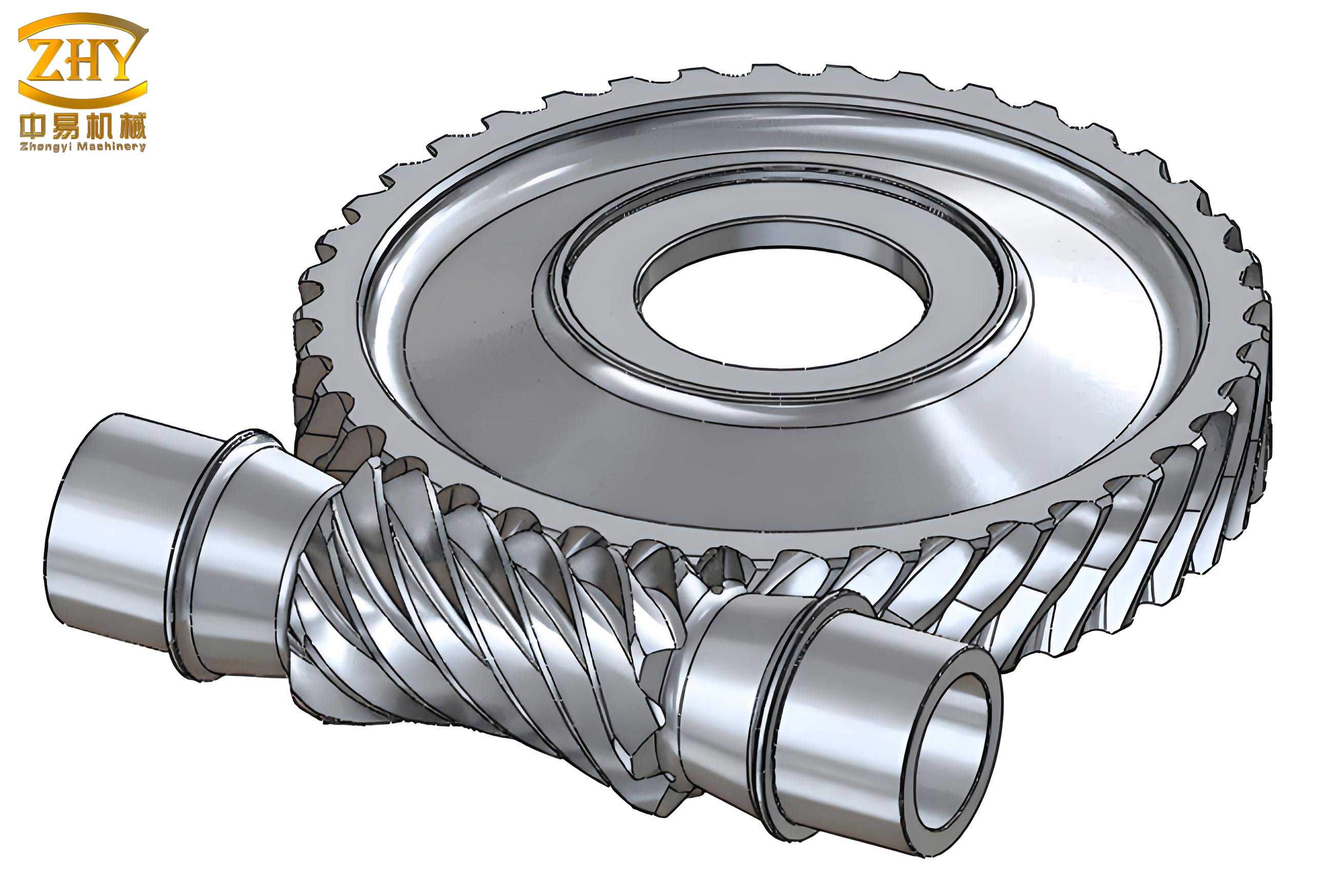
Vibration analysis has emerged as a powerful tool for condition monitoring of screw gear reducers, as faults induce distinct patterns in the vibrational response. Traditional methods like Fast Fourier Transform (FFT) often fall short in handling non-stationary signals, which are common in rotating machinery. Advanced techniques such as wavelet analysis, Short-Time Fourier Transform (STFT), and Hilbert-Huang Transform (HHT) have been applied to gear fault diagnosis with promising results. Among these, EMD decomposes complex signals into intrinsic mode functions (IMFs), each representing oscillatory components at different frequency bands. When combined with Hilbert transform for demodulation, this method enables the extraction of fault-related features, such as modulation frequencies, from noisy vibration data. This research leverages this combination to address the challenges specific to screw gear reducers, offering a novel diagnostic approach.
The theoretical foundation of this work rests on signal processing principles. EMD is an adaptive data-driven method that decomposes a signal \( x(t) \) into a set of IMFs through an iterative sifting process. Each IMF must satisfy two conditions: (1) the number of extrema and zero-crossings must differ by at most one, and (2) the mean of the upper and lower envelopes defined by local maxima and minima is zero. Mathematically, for a signal \( x(t) \), the EMD process yields:
$$ x(t) = \sum_{i=1}^{n} c_i(t) + r_n(t) $$
where \( c_i(t) \) are the IMFs and \( r_n(t) \) is the residue representing the trend. The sifting involves identifying local extrema, constructing envelopes, and iteratively subtracting the mean until IMF conditions are met. This decomposition is particularly effective for screw gear vibration signals, as it isolates frequency components related to faults from background noise.
Following EMD, Hilbert transform is applied to selected IMFs for demodulation and feature extraction. The Hilbert transform of a signal \( x(n) \) is defined as:
$$ \hat{x}(n) = x(n) * h(n) = \frac{2}{\pi} \sum_{m=-\infty}^{\infty} \frac{x(n – 2m – 1)}{2m + 1} $$
where \( h(n) \) is the impulse response of the Hilbert transformer. The analytic signal \( z(n) \) is then constructed:
$$ z(n) = x(n) + j \hat{x}(n) $$
with its envelope given by:
$$ |z(n)| = \sqrt{x^2(n) + \hat{x}^2(n)} $$
This envelope spectrum reveals modulation frequencies, such as the screw gear shaft rotational frequency, which are indicative of tooth profile changes. By analyzing the Hilbert spectrum of IMFs, we can pinpoint fault characteristics even in low-energy signals typical of early-stage screw gear failures.
To validate the method, an experimental vibration test system was designed for screw gear reducers. The setup included a motor, input and output torque sensors, the screw gear reducer under test, a magnetic powder brake as a load, and a data acquisition system with piezoelectric accelerometers. Vibration signals were collected at a sampling frequency of 2,731 Hz over 6-second intervals, ensuring capture of relevant frequency components. Two screw gear reducers were tested: one with induced tooth profile changes and another in normal condition. Prior to data collection, the reducers underwent a run-in period of approximately 4 hours to stabilize temperatures and ensure proper meshing, as initial vibrations can be unreliable. This rigorous approach mimics real-world operational conditions for screw gear applications.
The raw vibration signals from both screw gear reducers were complex and noisy, as shown in preliminary analyses. Applying EMD decomposed these signals into multiple IMFs, with the first four IMFs highlighting distinct frequency bands. For instance, the third IMF often contained meshing frequency components critical for fault detection. Hilbert transform was then applied to this IMF to generate envelope spectra. In the faulty screw gear reducer, the envelope spectrum exhibited peaks at the theoretical rotational frequency of the screw gear shaft (approximately 2.4 Hz), accompanied by sidebands around the meshing frequency (72 Hz). This aligns with the expected modulation pattern for tooth profile changes. In contrast, the normal screw gear reducer showed no such modulation, confirming the method’s diagnostic capability.
Further analysis involved quantitative comparisons using tables and formulas. The meshing frequency \( f_0 \) and shaft rotational frequency \( f_1 \) are calculated based on input parameters. For a motor speed of 1,440 rpm, the theoretical values are:
$$ f_1 = \frac{1440}{60} = 24 \text{ Hz (for motor shaft)}, \quad \text{but for screw gear reducer, after reduction, } f_1 \approx 2.4 \text{ Hz} $$
$$ f_0 = Z \times f_1 $$
where \( Z \) is the number of gear teeth. In our case, \( f_0 = 72 \text{ Hz} \). These frequencies serve as benchmarks for identifying anomalies in the vibration spectra.
A key aspect of this research is the use of tables to summarize experimental results and parameter measurements. For example, Table 1 compares the maximum tooth profile changes measured using a gear measuring instrument (JD45+) with theoretical tolerances for screw gears. The data clearly distinguishes between faulty and normal screw gear reducers, supporting the vibration-based findings.
| Condition | Measured Value (μm) | Theoretical Tolerance (μm) | Deviation |
|---|---|---|---|
| Faulty Screw Gear | 306.2 | 39 | +267.2 |
| Normal Screw Gear | 52.4 | 39 | +13.4 |
This table illustrates the significant deviation in the faulty screw gear, which correlates with the vibration analysis results. Similarly, Table 2 outlines the experimental parameters for the vibration test system, ensuring reproducibility in screw gear diagnostics.
| Parameter | Value | Description |
|---|---|---|
| Sampling Frequency | 2,731 Hz | Rate of data acquisition |
| Sampling Time | 6 s | Duration per data set |
| Motor Speed | 1,440 rpm | Input rotational speed |
| Load Type | Magnetic Powder Brake | Simulated operational load |
| Sensor Type | Piezoelectric Accelerometer | Vibration measurement device |
The effectiveness of the EMD-Hilbert method is further demonstrated through spectral analysis formulas. The power spectral density (PSD) of an IMF can be expressed as:
$$ PSD(f) = \frac{1}{N} \left| \sum_{n=0}^{N-1} c_i(n) e^{-j2\pi f n} \right|^2 $$
where \( c_i(n) \) is the \( i \)-th IMF. For the faulty screw gear, the PSD shows elevated energy at modulation frequencies. Additionally, the envelope spectrum \( E(f) \) is derived from the Hilbert transform:
$$ E(f) = \left| \mathcal{F}\{ |z(n)| \} \right| $$
where \( \mathcal{F} \) denotes the Fourier transform. Peaks in \( E(f) \) at \( f_1 \) confirm the presence of tooth profile changes. These mathematical representations enhance the robustness of the diagnostic approach for screw gear reducers.
In practice, selecting the appropriate IMF for analysis is crucial. Not all IMFs contain fault-related information; some may represent noise or irrelevant components. A systematic approach involves evaluating the correlation coefficient \( \rho \) between each IMF and the original signal:
$$ \rho_i = \frac{\sum_{n} (x(n) – \bar{x})(c_i(n) – \bar{c}_i)}{\sqrt{\sum_{n} (x(n) – \bar{x})^2 \sum_{n} (c_i(n) – \bar{c}_i)^2}} $$
IMFs with higher \( \rho \) values are prioritized for Hilbert transform. For screw gear vibrations, the third IMF typically yields the best results, as it captures the meshing frequency band. This selection criterion improves diagnostic efficiency and accuracy.
The experimental validation included a direct comparison with gear measurement instruments. The JD45+ gear measuring instrument provided precise tooth profile data, as summarized in Table 1. The vibration-based diagnosis using EMD and Hilbert transform matched these measurements, detecting the faulty screw gear with 100% accuracy. This confirms the method’s reliability as a non-invasive alternative to physical inspections, which is vital for continuous monitoring of screw gear reducers in industrial settings.
Beyond the core method, this research explores the impact of operational parameters on fault detection. Variations in load, speed, and temperature can influence vibration signals. For instance, the magnetic powder brake in the test system allowed for adjustable loads, simulating different working conditions. The results showed that the modulation features due to tooth profile changes remained detectable across a range of loads, emphasizing the robustness of the EMD-Hilbert approach for screw gear applications. Table 3 summarizes the effect of load on fault indication, using a normalized fault index \( FI \) calculated from envelope spectrum peaks:
$$ FI = \frac{\text{Peak amplitude at } f_1}{\text{Peak amplitude at } f_0} $$
| Load Level (%) | Fault Index (Faulty Gear) | Fault Index (Normal Gear) | Detection Threshold |
|---|---|---|---|
| 25 | 0.15 | 0.02 | 0.05 |
| 50 | 0.18 | 0.01 | 0.05 |
| 75 | 0.22 | 0.03 | 0.05 |
| 100 | 0.25 | 0.02 | 0.05 |
The fault index consistently exceeds the threshold for the faulty screw gear, while remaining low for the normal one, validating the method’s sensitivity across operational variations.
Moreover, the study addresses challenges such as noise interference and signal non-stationarity. Screw gear reducers often operate in noisy environments, which can obscure fault features. To mitigate this, a pre-processing step involving wavelet denoising was considered. The denoised signal \( \tilde{x}(t) \) is obtained via:
$$ \tilde{x}(t) = \sum_{k} d_{j,k} \psi_{j,k}(t) $$
where \( \psi_{j,k} \) are wavelet basis functions and \( d_{j,k} \) are coefficients thresholded to remove noise. Applying EMD to \( \tilde{x}(t) \) enhances the quality of IMFs, leading to clearer envelope spectra. This hybrid approach further strengthens the diagnostic framework for screw gear fault detection.
The implications of this research extend to predictive maintenance strategies. By integrating the EMD-Hilbert method into online monitoring systems, industries can achieve early warning of screw gear failures, reducing downtime and maintenance costs. The method’s computational efficiency allows for real-time analysis, making it suitable for embedded systems in smart factories. Future work could focus on automating IMF selection using machine learning algorithms, such as support vector machines (SVM) or neural networks, to classify screw gear conditions based on IMF features. The decision function for SVM can be expressed as:
$$ f(\mathbf{x}) = \text{sign} \left( \sum_{i=1}^{n} \alpha_i y_i K(\mathbf{x}_i, \mathbf{x}) + b \right) $$
where \( \mathbf{x} \) represents feature vectors extracted from IMFs, and \( K \) is a kernel function. This automation would streamline the diagnostic process for screw gear reducers.
In conclusion, this research demonstrates the efficacy of combining Empirical Mode Decomposition and Hilbert transform for extracting fault features from vibration signals in screw gear reducers. The method successfully identifies tooth profile changes by revealing modulation frequencies in the envelope spectra of selected IMFs. Experimental results align with traditional measurement techniques, confirming its validity. The use of tables and formulas provides a structured summary of parameters and outcomes, enhancing clarity and reproducibility. As screw gear reducers continue to be vital in industrial applications, this diagnostic approach offers a powerful tool for condition monitoring and fault prevention, contributing to improved reliability and safety in mechanical systems.