
In my extensive investigation into high-performance materials for aerospace applications, I have focused on the heat treatment of gear shafts made from C250 steel. This material, a maraging steel with exceptional strength and toughness, presents unique challenges during manufacturing, particularly concerning dimensional stability after aging. Through this study, I aim to elucidate the mechanisms behind deformation in C250 steel gear shafts and propose a robust solution to ensure precision in final dimensions. The gear shaft, a critical component in aviation transmissions, demands utmost reliability, and understanding its response to heat treatment is paramount.
C250 steel is a nickel-cobalt based maraging steel characterized by its ultra-high strength achieved through precipitation hardening rather than carbon content. Its composition is meticulously balanced to promote the formation of a lath martensite matrix upon air cooling from the solution treatment temperature, which is then strengthened by intermetallic precipitates during aging. Below, I present a detailed table summarizing its chemical composition, which is fundamental to its behavior.
| Element | Content (wt.%) | Role in Microstructure |
|---|---|---|
| C | ≤ 0.03 | Minimized to reduce carbide formation, enhancing toughness. |
| Si | ≤ 0.12 | Deoxidizer, typically kept low. |
| Mn | ≤ 0.20 | Stabilizes austenite, but content is low. |
| Ni | 17.5 – 18.5 | Promotes austenite formation at high temperature and ensures full martensite transformation on cooling, providing ductility. |
| Co | 7.00 – 8.00 | Reduces the solubility of Mo in austenite, enhancing precipitation hardening response. |
| Mo | 4.75 – 5.25 | Primary hardening element; forms intermetallic precipitates with Ni and Ti. |
| Ti | 0.30 – 0.50 | Forms coherent (Ni,Fe)₃(Ti,Al) precipitates during aging, key to strengthening. |
| Al | ≤ 0.15 | Contributes to precipitation hardening and deoxidation. |
| S | ≤ 0.01 | Impurity, kept minimal to avoid hot shortness. |
| P | ≤ 0.01 | Impurity, kept minimal to prevent embrittlement. |
The mechanical properties of C250 steel are extraordinary, offering a combination of strength and toughness rarely found in other alloys. After proper aging, this steel achieves tensile strengths exceeding 1750 MPa while maintaining significant ductility and fracture toughness. The following table outlines its typical mechanical properties, which are critical for a gear shaft subjected to high cyclic loads.
| Property | Value | Significance for Gear Shaft |
|---|---|---|
| Tensile Strength (σₓ) | ≥ 1758 MPa | Ensures the gear shaft can withstand high operational stresses without yielding. |
| Yield Strength (σ₀.₂) | ≥ 1724 MPa | Indicates high resistance to plastic deformation. |
| Elongation (δ₅) | ≥ 6% | Provides a margin of ductility, preventing brittle fracture. |
| Reduction of Area (ψ) | ≥ 45% | Reflects good material toughness. |
| Fracture Toughness (KIC) | ≥ 78 MPa√m | Critical for flaw tolerance in the gear shaft under dynamic loading. |
| Impact Energy (Longitudinal, AKV) | ≥ 33 J | Indicates resistance to shock loads, important for aerospace gear shafts. |
The heat treatment sequence for manufacturing a precision gear shaft from C250 steel is a delicate balance between machinability and final properties. My adopted process route begins with rough machining of the forged or rolled bar stock to a shape approximating the final gear shaft but with ample allowance. This is followed by solution treatment, where the component is heated to 820 ± 14 °C, held for 1.5 to 2 hours to dissolve alloying elements into a homogeneous austenitic phase, and then air-cooled. The resulting microstructure is soft, low-carbon lath martensite with a hardness not exceeding 34 HRC, which is amenable to machining.
Subsequent machining brings the gear shaft close to its final dimensions. However, the crucial step is the aging treatment, which precipitates fine intermetallic compounds within the martensite matrix, dramatically increasing strength and hardness to above 48 HRC. I performed this aging in a vacuum furnace (pressure < 1.3 × 10⁻¹ Pa) at 480 ± 5 °C for 4 hours, followed by rapid cooling to 200 °C under an argon atmosphere and final air cooling. This minimizes surface oxidation, which is vital for a finished gear shaft.
Early in my research, I encountered a significant issue: after aging, the first prototype gear shaft exhibited uniform dimensional shrinkage. Critical features like diameters and the overall length contracted, with total length reduction measured at 0.35 mm, rendering the part unusable for assembly. This was puzzling because maraging steels like C250 are often advertised as having minimal distortion during aging. To diagnose this, I conducted a systematic analysis, considering three primary factors: phase transformation-induced volume change, relief of internal stresses, and elastic strain recovery.
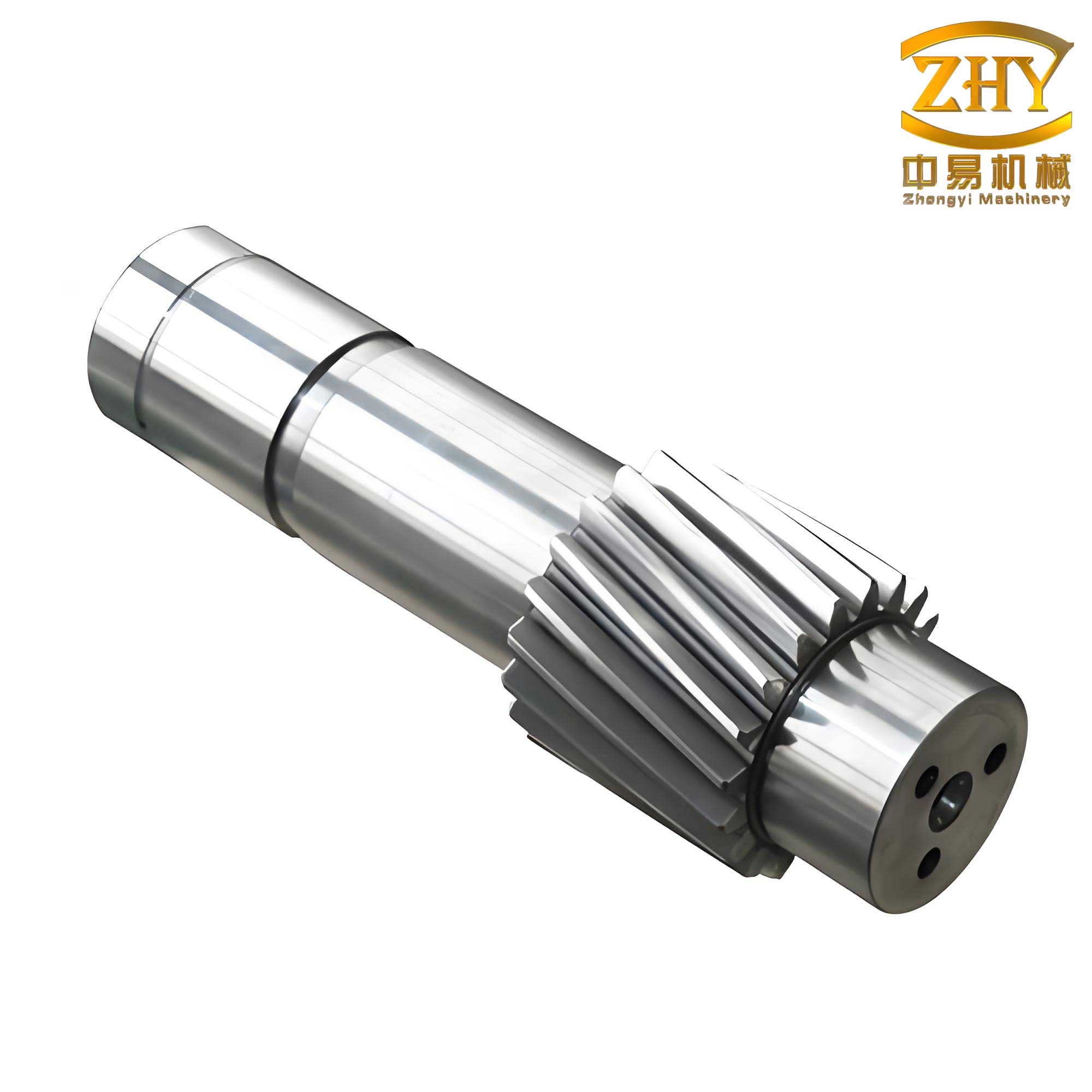
Through controlled experiments on test coupons, I isolated the cause. The shrinkage was intrinsically linked to the precipitation hardening mechanism itself. During aging, the supersaturated martensite decomposes, forming coherent (Ni,Fe)₃(Ti,Al) precipitates. This precipitation event alters the crystal lattice parameters of the martensitic matrix. The cumulative effect on a macroscopic scale is a slight but consistent volumetric contraction. The strain associated with this lattice mismatch can be modeled. For a simplified uniaxial case, the linear strain (ε) due to precipitation can be related to the volume fraction of precipitates (f) and the misfit parameter (δ):
$$ \epsilon \approx \frac{1}{3} f \delta $$
Where δ is defined as (ap – am)/am, with ap and am being the lattice parameters of the precipitate and matrix, respectively. For the C250 system, the precipitates have a different lattice constant than the martensite, leading to a net contraction. The total dimensional change (ΔL) in a gear shaft feature of initial length L₀ can be expressed as:
$$ \Delta L = \alpha_{eff} \cdot L_0 $$
Here, αeff is an effective linear contraction coefficient specific to the aging treatment. From my data and literature, this coefficient for C250 steel falls in the range of 0.03% to 0.05%. For a gear shaft with a nominal length of 700 mm, this translates to a potential shrinkage of 0.21 mm to 0.35 mm, aligning perfectly with my observed defect.
Having identified the root cause, I developed a compensatory strategy integrated into the manufacturing process flow. The solution was to intentionally leave a specific amount of excess material on the gear shaft after the final machining step prior to aging. This allowance would be consumed during the aging-induced shrinkage, resulting in a part that meets dimensional specifications post-treatment. The required allowance (A) per side (for diameters) or per end (for length) can be calculated based on the predicted shrinkage factor (S, taken as 0.04% as a conservative median) and the critical dimension (D):
$$ A = S \cdot D $$
For critical diameters and lengths on the gear shaft, I applied this formula. To account for machining tolerances and ensure complete compensation, I standardized a unilateral allowance of 0.4 mm for all major dimensions. This value was derived from the maximum expected shrinkage plus a safety margin for machining. The revised process flow is outlined below:
- Rough Machining: Gear shaft shaped from blank with large allowances.
- Solution Treatment: 820°C/1.5-2h, air cool. Achieves soft martensite (≤34 HRC).
- Semi-Finish Machining: Machine to dimensions that are 0.8 mm oversize on diameters and length relative to final drawing (providing the 0.4 mm per side allowance).
- Aging Treatment: Vacuum furnace at 480°C/4h, argon cool. Material hardens to ≥48 HRC and shrinks.
- Final Precision Machining/Grinding: Remove the remaining tenths of a millimeter to achieve the exact final dimensions and surface finish required for the gear shaft.
This method proved highly successful. In subsequent production runs of three gear shafts, the post-aging dimensions were consistently within the tight tolerances required for aerospace components. The problem of unpredictable shrinkage was eliminated.
To further generalize the findings, I analyzed the thermodynamics of precipitation in C250 steel. The driving force for precipitate formation is the reduction in Gibbs free energy. The change in free energy (ΔG) during aging has contributions from the chemical driving force (ΔGchem), the strain energy due to coherency (ΔGstrain), and the interface energy (ΔGinterface):
$$ \Delta G = -V_f \Delta G_{chem} + V_f \Delta G_{strain} + A_f \gamma $$
Here, Vf is the volume of precipitates, Af is their total surface area, and γ is the interfacial energy. The strain energy term (ΔGstrain) is directly responsible for the macroscopic dimensional change in the gear shaft. It arises from the elastic accommodation of the lattice mismatch around each precipitate. The total macroscopic strain (εtotal) can be integrated from the strain fields of all precipitates (N) distributed in the volume (V) of the gear shaft component:
$$ \epsilon_{total} = \frac{1}{V} \sum_{i=1}^{N} \int_{V_i} \epsilon(\vec{r}) dV $$
Where ε(r) is the local strain field around the i-th precipitate. For a homogeneous distribution, this simplifies to the product of the number density of precipitates and their average constrained strain. This theoretical framework explains why the shrinkage is uniform and predictable, allowing for compensation.
The performance of the finished C250 steel gear shaft is exceptional. Its high fatigue strength, governed by parameters like the stress intensity factor range (ΔK), ensures longevity under cyclic loading typical in aviation gearboxes. The endurance limit can be correlated to its ultimate tensile strength via empirical relationships, but the high toughness of C250 provides an added safety factor against catastrophic failure.
In conclusion, my research into the heat treatment of C250 steel for gear shafts has yielded a clear understanding of the precipitation-induced shrinkage phenomenon. By incorporating a calculated machining allowance prior to the final aging treatment, I have developed a reliable and repeatable manufacturing process. This approach effectively neutralizes the dimensional instability, ensuring that the high-strength gear shaft meets all geometric and performance specifications. The success of this method underscores the importance of a deep, mechanistic understanding of material behavior in precision engineering. Future work could involve fine-tuning the allowance via more precise modeling of the shrinkage coefficient as a function of specific aging parameters or gear shaft geometry, further optimizing the process for even more complex components.