
The quest for higher power density, compactness, and reliability in power transmission systems for marine and aerospace applications has led to the increasing adoption of advanced gear train architectures. Among these, multi-branch split-torque transmission systems represent a significant evolution from traditional parallel-axis or planetary configurations. This article delves into the critical design considerations, particularly the stringent tooth matching conditions, required for the successful implementation of a specific and highly efficient variant: the coaxial six-branch split-torque transmission system employing herringbone gears.
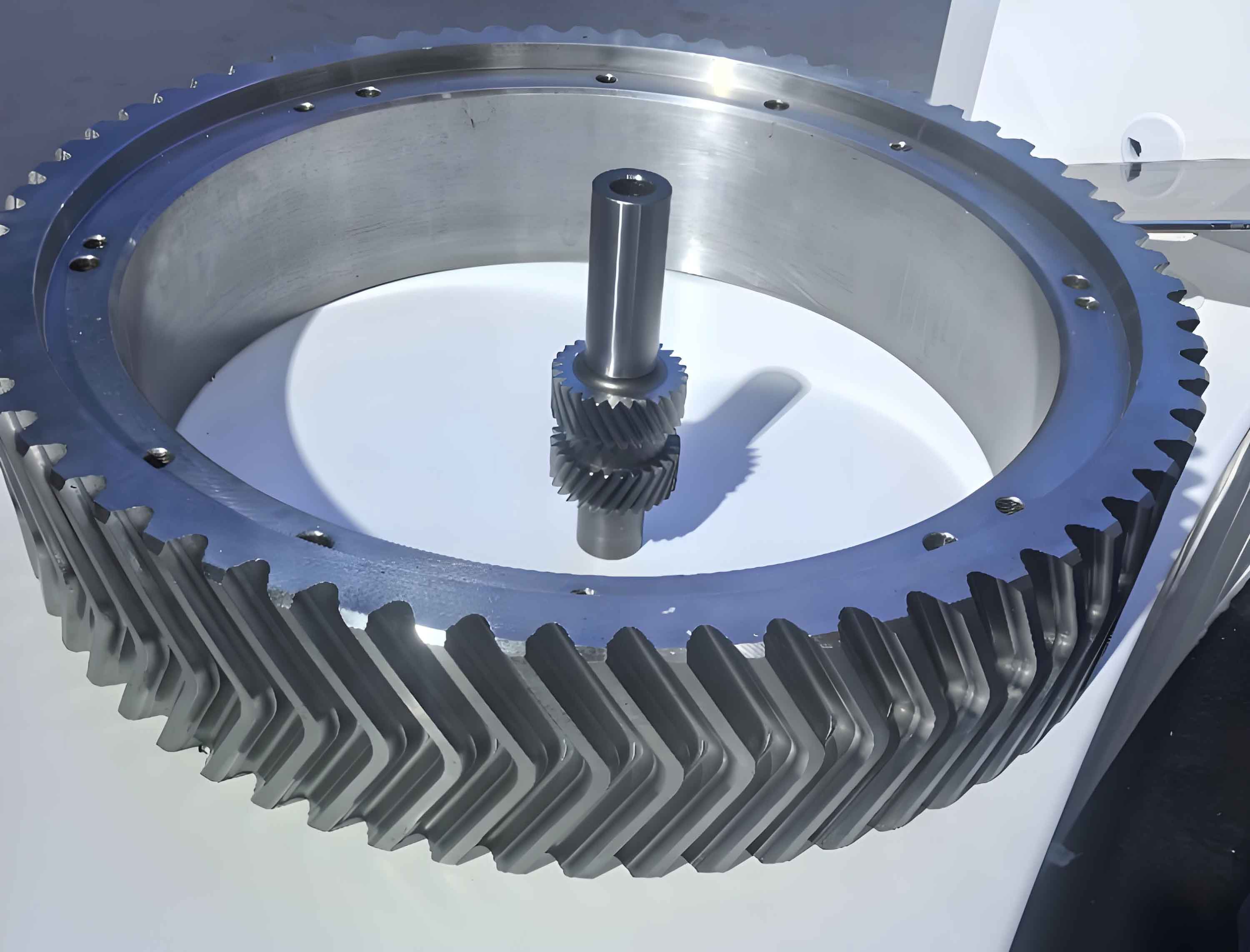
The fundamental advantage of a multi-branch system lies in its ability to divide the input power and torque across several parallel meshing paths. This power splitting reduces the load on individual gear teeth, allowing for higher overall power transmission within a smaller envelope compared to a single-path system. When configured coaxially—where the input and output shafts are aligned—the system achieves exceptional compactness. The use of herringbone gears, also known as double-helical gears, is crucial in such high-power applications. Their opposing helical angles cancel out axial thrust forces inherently, eliminating the need for complex thrust bearings and enabling smoother, higher-load-capacity operation than single helical gears.
However, the very feature that grants these systems their advantages—multiple, parallel power paths—also introduces a paramount design challenge: meshing synchronization. Unlike a simple gear pair, a multi-branch system is an over-constrained mechanism. For power to be transmitted smoothly and efficiently, and for loads to be shared equally among branches, the gears in every parallel path must mesh correctly and simultaneously with their respective partners. An error in the geometric configuration can lead to mismatched phasing, causing severe internal interference, unequal load distribution, excessive vibration, noise, and premature failure. Therefore, establishing a rigorous set of tooth matching conditions is not merely an optimization step but a fundamental requirement for the system’s viability. This research focuses on formulating and solving these conditions for a coaxial six-branch layout utilizing herringbone gears.
System Architecture and Design Challenges
The specific system under analysis is a four-stage, coaxial six-branch split-torque transmission. Its architecture is designed for high reduction ratios and massive torque transmission.
Power Flow and Stages:
1. Stage I (Input & First Split): A single input pinion (Gear 1) meshes simultaneously with three idler gears (Gears 2_i, i=1,2,3), arranged at 120° intervals. This achieves the initial triplex power split.
2. Stage II (First Reduction): Each idler Gear 2_i drives a larger gear (Gear 3_i), which is part of a compound (or “double-helical”) gear. This stage provides the primary speed reduction.
3. Stage III (Second Split): The other side of each compound gear (now designated Gear 4_i) drives two output-stage pinions (Gears 5_j). Each compound gear thus creates a second, duplex split, leading to a total of six power paths (3×2).
4. Stage IV (Output & Recombination): All six of the Gears 5_j mesh concurrently with a single, large output gear (Gear 6). This recombines the six power streams into a single coaxial output.
The entire system is populated with herringbone gears to handle the high torques and cancel axial loads. The primary challenge in designing such a system is selecting the number of teeth for each gear ($z_1, z_2, z_3, z_4, z_5, z_6$) and determining their precise angular positions to ensure synchronous meshing across all six paths, while also meeting basic gear design rules.
Foundational Tooth Matching Conditions
Before addressing synchronization, several classic gear train conditions must be satisfied.
Transmission Ratio Condition
The overall speed reduction ratio $i_{total}$ is determined by the product of the ratios of each stage. For the described system:
$$
i_{total} = i_{I} \cdot i_{II} \cdot i_{III} \cdot i_{IV} = \left(\frac{z_2}{z_1}\right) \cdot \left(\frac{z_3}{z_2}\right) \cdot \left(\frac{z_5}{z_4}\right) \cdot \left(\frac{z_6}{z_5}\right) = \frac{z_2 \cdot z_3 \cdot z_5 \cdot z_6}{z_1 \cdot z_2 \cdot z_4 \cdot z_5}
$$
Simplifying, we get the fundamental ratio condition:
$$
i_{total} = \frac{z_3 \cdot z_6}{z_1 \cdot z_4}
$$
Given a design target ratio $i_d$, the actual ratio calculated from the chosen integers $z_i$ will have a small error $\Delta i$. This error must be kept within an allowable limit $[\Delta i]$, typically 3-5%:
$$
\Delta i = \frac{|i_d – i_{total}|}{i_d} \leq [\Delta i]
$$
Concentricity Condition
This condition ensures that the centers of the compound gears (Gear 3_i/4_i) and the six output pinions (Gear 5_j) align correctly on their respective fixed axes. Considering one branch involving Gear 4_1, Gears 5_1 & 5_2, and the output Gear 6, their centers form a quadrilateral. For the assembly to be concentric, the geometry must satisfy the relationship derived from the law of sines and the fact that the center distances between meshing herringbone gears are fixed by their tooth numbers and module. For standard gears with equal normal module $m_n$ and helix angle $\beta$, the transverse module $m_t = m_n / \cos\beta$ is equal for all meshing pairs. The concentricity condition for one branch becomes:
$$
\left(\frac{z_5 + z_4}{2}\right) \frac{\sin(\theta_3/2)}{\sin(\theta_1/2)} = \left(\frac{z_5 + z_6}{2}\right)
$$
Where $\theta_1$ and $\theta_3$ are position angles within the quadrilateral. This equation must hold true for the physical layout to be possible.
Adjacency Condition
This condition prevents physical interference between the non-meshing components of the system, specifically between the tip circles of gears that are in close proximity. Two critical checks are necessary:
1. Between Output Pinions: The tip circles of two adjacent output pinions (e.g., Gear 5_1 and Gear 5_2) driven by the same compound gear must not touch. Their center distance is fixed by the geometry with Gear 4_1. The condition is:
$$
d_{a5} < D_{O_{51}O_{52}} \leq (d_5 + d_4)
$$
where $d_{a5}$ is the tip diameter of Gear 5, $D_{O_{51}O_{52}}$ is the center distance between the two pinions, and $d_4, d_5$ are their standard pitch diameters.
2. Between Compound Gear and Output Gear: The tip circle of the compound gear (Gear 4_1) must clear the tip circle of the large output gear (Gear 6). This imposes a constraint on their minimum center distance relative to the output pinion placement.
$$
\frac{d_{a6}}{2} + \frac{d_{a4}}{2} < D_{O_{41}O_{6}} \leq H
$$
Here, $H$ is a geometric limit derived from the positions of Gears 5_1, 5_2, and 6.
The Core Synchronous Meshing Condition
Meeting the above conditions ensures a geometrically feasible static assembly. The synchronous meshing condition ensures the dynamic kinematic compatibility of all parallel paths. For power to flow smoothly through all six branches, the meshing events at the final recombination stage (all six Gears 5_j with Gear 6) must occur in perfect synchrony. If one Gear 5_j is out of phase, it will be “late” or “early” to mesh with Gear 6, causing it to bear an impact load or not share load at all, leading to catastrophic uneven loading.
The analysis focuses on one of the three identical duplex branches. We define a quadrilateral formed by the centers of Gear 4_1 ($A$), Gear 5_1 ($B$), Gear 6 ($C$), and Gear 5_2 ($D$), with internal angles $\theta_1$, $\theta_2$, $\theta_3$, and $\theta_4$. The synchronous meshing problem can be framed by considering the sequence of engagement of teeth along the path from Gear 4_1 to Gear 6 via the two pinions.
By analyzing the number of tooth pitches between key engagement points on Gears 5_1, 5_2, and 6 around the quadrilateral, a fundamental synchronization equation is derived. This equation states that for the teeth of Gears 5_1 and 5_2 to contact Gear 6 at the same precise meshing phase, the following relationship must hold true as an integer multiple of the angular pitch:
$$
\theta_1 \cdot z_4 – \theta_2 \cdot z_5 + \theta_3 \cdot z_6 – \theta_4 \cdot z_5 = 2\pi \cdot M
$$
Where:
– $\theta_1, \theta_2, \theta_3, \theta_4$ are the position angles (in radians) of the quadrilateral.
– $z_4, z_5, z_6$ are the tooth counts of the compound gear side, output pinion, and output gear, respectively.
– $M$ is an integer (positive, negative, or zero). This integer is the key to finding viable solutions.
This equation is the master synchronization constraint. It is governed purely by tooth counts and geometry; the module or helix angle of the herringbone gears cancels out. The angles themselves are not free but are related through the geometry of the quadrilateral. The sum of angles is fixed:
$$
\theta_1 + \theta_2 + \theta_3 + \theta_4 = 2\pi
$$
Furthermore, applying the law of cosines to the two diagonals of the quadrilateral gives two more equations that link the angles to the tooth counts, since side lengths are proportional to $(z_i + z_j)$:
$$
\begin{aligned}
&(z_5 + z_4)^2 + (z_5 + z_4)^2 – 2(z_5 + z_4)^2\cos\theta_1 = \\
&(z_5 + z_6)^2 + (z_5 + z_6)^2 – 2(z_5 + z_6)^2\cos\theta_3 \\[1em]
&(z_5 + z_6)^2 + (z_5 + z_4)^2 – 2(z_5 + z_6)(z_5 + z_4)\cos\theta_2 = \\
&(z_5 + z_6)^2 + (z_5 + z_4)^2 – 2(z_5 + z_6)(z_5 + z_4)\cos\theta_4
\end{aligned}
$$
Assuming symmetry in the layout of the two output pinions around the compound gear ($\theta_2 = \theta_4$), we have a system of four equations with four unknowns ($\theta_1, \theta_2, \theta_3, M$) for given $z_4, z_5, z_6$.
Tooth Matching Calculation Methodology
The design process becomes an iterative search for integer tooth counts that satisfy all conditions simultaneously. The following algorithm outlines the procedure:
Step 1: Preliminary Design. Start with initial tooth counts ($Z_1, Z_2, Z_3, Z_4, Z_5, Z_6$) based on desired ratio, strength requirements, and gear design guidelines for herringbone gears.
Step 2: Solve Synchronization for Final Stage. Focus first on the final recombination stage (Gears 4, 5, 6). For a trial set ($z_4, z_5, z_6$) and an chosen integer $M$, combine the synchronization equation and geometric cosine rules. This reduces to solving a transcendental equation for $\theta_1$:
$$
\theta_1 z_4 – 2 z_5 \left[2\pi – \theta_1 – 2\cos^{-1}\left( \frac{(z_5+z_4)^2 \cos\theta_1 – (z_5+z_4)^2 + (z_5+z_6)^2}{(z_5+z_6)^2} \right) \right] + z_6 \cdot 2\cos^{-1}\left( \frac{(z_5+z_4)^2 \cos\theta_1 – (z_5+z_4)^2 + (z_5+z_6)^2}{(z_5+z_6)^2} \right) = 2\pi M
$$
The integer $M$ acts as a solution selector. Different values of $M$ shift the solution curve vertically, yielding different sets of viable angles $(\theta_1, \theta_2, \theta_3, \theta_4)$ for the same tooth counts.
Step 3: Check Final Stage Conditions. For the angles obtained from Step 2, verify:
1. Adjacency conditions for Gears 5_1/5_2 and Gear 4_1/Gear 6.
2. Concentricity condition.
If any check fails, iterate by adjusting $z_4, z_5, z_6$ or trying a different integer $M$.
Step 4: Solve First Stage. With the final stage geometry fixed, the center distance for the first stage (Gear 1, 2_i, 3_i) is determined. Determine the position angles for the first-stage idler layout, ensuring its adjacency condition (tip clearance between Gear 1 and Gear 3_i) is met.
Step 5: Verify Overall Ratio. Calculate the final transmission ratio $i_{total}$ and ensure the error $\Delta i$ is within the acceptable limit.
The process is summarized in the following algorithm flowchart:
| Step | Action | Key Checks & Outputs |
|---|---|---|
| 1. Initiate | Start with preliminary tooth counts based on ratio and strength. | Initial set: $z_1, z_2, z_3, z_4, z_5, z_6$. |
| 2. Final Stage Sync | For chosen $M$, solve transcendental equation for $z_4, z_5, z_6$. | Obtain position angles $\theta_1, \theta_2, \theta_3, \theta_4$. |
| 3. Validate Final Stage | Check adjacency and concentricity for Gears 4, 5, 6. | If FAIL: Adjust $z_4, z_5, z_6$ or $M$ and loop to Step 2. |
| 4. Design First Stage | Determine layout for Gears 1, 2_i, 3_i based on fixed centers. | Obtain first-stage angles; check Gear 1/Gear 3_i adjacency. |
| 5. Final Verification | Calculate overall transmission ratio error $\Delta i$. | If $\Delta i > [\Delta i]$: Loop to Step 1 or 2. If PASS: VIABLE DESIGN. |
Computational Example and Validation
Consider a marine propulsion system requiring a coaxial six-branch herringbone gear reducer. A preliminary design yielded the following tooth set which did not satisfy synchronization.
| Gear | Normal Module, $m_n$ (mm) | Teeth, $z$ | Helix Angle, $\beta$ |
|---|---|---|---|
| 1 (Input) | 6 | 50 | 28° |
| 2_i (Idler) | 6 | 69 | 28° |
| 3_i (Compound, 1st part) | 6 | 225 | 28° |
| 4_i (Compound, 2nd part) | 8 | 42 | 29° |
| 5_j (Output Pinion) | 8 | 81 | 29° |
| 6 (Output) | 8 | 209 | 29° |
Applying the synchronization methodology, we search for valid integer $M$ values. The table below shows the resulting position angles $\theta_1$ for the final stage for a range of $M$ values.
| Integer $M$ | -168 | -75 | -60 | 16 | 30 | 45 |
|---|---|---|---|---|---|---|
| $\theta_1$ (degrees) | 0 | 55.25 | 115.25 | 180.00 | 204.75 | 360 |
| Status | Interference | Risk of pinion clash | Risk of pinion clash | Feasible | Risk of gear clash | Interference |
Analysis reveals that extreme $M$ values lead to geometric interference (e.g., $M=-168, 45$). Values like $M=-75$ or $M=30$ yield configurations where the output pinions or the compound gear are too close, posing a high risk of contact under manufacturing tolerances. The solution for $M=16$, however, yields a symmetric and robust layout with $\theta_1=180°$, providing ample clearance.
Guided by this, the tooth counts are adjusted to satisfy all conditions simultaneously with $M=16$. The final, synchronized design is as follows:
| Gear | Normal Module, $m_n$ (mm) | Teeth, $z$ | Helix Angle, $\beta$ | Key Angle |
|---|---|---|---|---|
| 1 (Input) | 6 | 52 | 28° | — |
| 2_i (Idler) | 6 | 70 | 28° | — |
| 3_i (Compound, 1st part) | 6 | 221 | 28° | — |
| 4_i (Compound, 2nd part) | 8 | 44 | 29° | $\theta_1 = 180.0°$ |
| 5_j (Output Pinion) | 8 | 84 | 29° | $\theta_2 = \theta_4 = 63.9°$ |
| 6 (Output) | 8 | 207 | 29° | $\theta_3 = 52.2°$ |
This set meets the transmission ratio, adjacency, concentricity, and, most importantly, the synchronous meshing condition. Three-dimensional modeling and virtual assembly of this design confirm that all six branches mesh simultaneously without interference, validating the proposed tooth matching method. The process underscores that successful design of coaxial multi-branch systems using herringbone gears hinges on solving the integer-based synchronization equation within the framework of classical gear constraints.
Conclusion
The design of coaxial multi-branch split-torque transmission systems presents a unique set of challenges that extend far beyond basic gear sizing. This research has systematically detailed the critical tooth matching conditions essential for the functional viability of such systems, with a focus on a six-branch configuration employing herringbone gears. We have demonstrated that in addition to standard transmission ratio, concentricity, and adjacency conditions, a synchronous meshing condition is paramount. This condition ensures kinematic compatibility across all parallel power paths and is expressed by a diophantine-type equation involving gear tooth counts, position angles, and an integer parameter $M$.
The proposed solution methodology transforms the design problem into an iterative search for integer tooth counts that satisfy a system of geometric and trigonometric equations. The integer $M$ serves as a key selector among different geometric configurations for the same tooth set. A practical computational example for a marine gearbox illustrated the process, showing how an initial, non-synchronized design was methodically adjusted to achieve a feasible, synchronized configuration.
The principles and the mathematical framework established here for six-branch systems with herringbone gears are fundamentally scalable and adaptable. They provide a foundational approach for the design of other coaxial multi-branch configurations, such as four-branch or eight-branch systems, as well as for systems incorporating idler gears in different arrangements. Mastery of these synchronization principles is therefore indispensable for engineers developing next-generation, high-power-density gear drives for the most demanding applications in naval and aerospace propulsion.