
In the field of power transmission systems, especially in aerospace applications, spiral bevel gears play a critical role due to their ability to transmit motion between intersecting shafts with high efficiency and load capacity. The point-contact characteristics of spiral bevel gears are paramount for ensuring smooth operation, minimal vibration, and reduced noise. However, designing tooth surfaces that achieve predetermined meshing performance, such as specific contact patterns and transmission error curves, remains a complex challenge. Traditional methods often involve intricate adjustments of pinion machining parameters, which can be tedious and prone to errors. In this article, we propose a novel approach to tooth surface design for spiral bevel gears based on curvature correction. This method focuses on modifying the gear tooth surface rather than the pinion, simplifying the process and enabling precise control over meshing behavior. By constructing a conjugate gear surface relative to the pinion and applying curvature corrections, we can generate a target gear surface that meets desired transmission performance. This approach is particularly advantageous for applications like precision forging of spiral bevel gears, where minimizing secondary calculations for pinion adjustments is essential.
The design of spiral bevel gears often involves local synthesis at reference points, but this may not adequately control contact characteristics across the entire tooth surface. To address this, we employ a methodology that leverages predetermined transmission relationships and curvature modifications. The core idea is to start with a conjugate gear surface derived from the pinion’s machining parameters, then apply a curvature-based ease-off modification to achieve point contact with specific contact paths and transmission error profiles. This article details the mathematical modeling, discrete tooth contact analysis (DTCA), and experimental validation of this approach. We will use numerous formulas and tables to summarize key parameters and steps, ensuring a comprehensive understanding of the design process for spiral bevel gears.
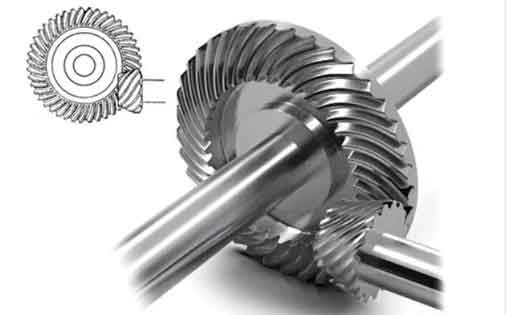
To begin, let us consider the pinion tooth surface, denoted as Σ1, which is generated using a duplex milling method. The mathematical model for Σ1 can be expressed in terms of surface parameters up and θp. The position vector r1 and normal vector n1 are given by:
$$ \mathbf{r}_1 = \mathbf{r}(u_p, \theta_p), \quad \mathbf{n}_1 = \mathbf{n}(u_p, \theta_p). $$
These equations form the basis for constructing the conjugate gear surface. The transmission relationship between the pinion and gear is predefined to include higher-order terms for controlling transmission error. For spiral bevel gears, this relationship can be written as:
$$ \phi_2 = \phi_2^0 + m_{12} (\phi_1 – \phi_1^0) + \Delta \phi_2, $$
where φ1 and φ2 are the rotation angles of the pinion and gear, respectively, m12 is the theoretical gear ratio (equal to the pinion-to-gear tooth number ratio), and Δφ2 represents the transmission error function. Typically, Δφ2 is expressed as a polynomial to achieve desired error profiles, such as parabolic or quartic forms. For example, a quartic transmission error function can be defined as:
$$ \Delta \phi_2 = \sum_{i=0}^{n} a_i (\phi_1 – \phi_1^0)^i, \quad i=0,1,\ldots,n, $$
where ai are coefficients that shape the error curve. By differentiating this relationship, we obtain the relative angular velocity ω01 between the mating surfaces. Using the principles of gear meshing, the conjugate gear surface Σ0 can be derived through coordinate transformations and the equation of meshing. The position vector r0 for Σ0 is given by:
$$ \mathbf{r}_0(u_p, \theta_p, \phi_1) = \mathbf{M}_{01} \mathbf{r}_1(u_p, \theta_p), $$
subject to the meshing condition:
$$ \mathbf{n}_1 \cdot \mathbf{V}_{01} = 0, $$
where M01 is the coordinate transformation matrix from the pinion to the gear, and V01 is the relative velocity vector at the contact point. This results in a line-contact conjugate surface, which is not ideal for point-contact applications due to potential edge loading and sensitivity to misalignment. Therefore, we introduce curvature corrections to transform this into a point-contact surface.
The curvature correction process involves defining a ease-off surface that modifies the conjugate gear surface. First, we project the conjugate surface Σ0 onto a plane aligned with the gear axis, with the X-direction along the pitch cone generatrix and the origin at the tooth surface midpoint. In this projection plane, we define a contact path L as a straight line passing through a design point M at an angle Γ to the X-axis. This line corresponds to a spatial curve Lc on Σ0. The goal is to apply curvature corrections such that along Lc, the correction is zero (to maintain contact), while in other directions, corrections are positive to avoid interference. The curvature correction amounts are derived from the relative normal curvatures between the pinion and gear surfaces. Let Δkc be the curvature correction along the contact path direction c, and Δkp be the correction along the contact line direction p, which is tangent to the instantaneous contact line on the pinion surface. From meshing theory, we have:
$$ \Delta k_p = \frac{8\delta}{a^2} > 0, $$
where δ is a small deformation constant (typically 0.00635 mm), and a is the semi-major axis length of the contact ellipse. The direction p can be calculated using the pinion surface geometry and relative motion:
$$ \mathbf{p} = k_{1v} \mathbf{V}_{01} + \tau_{1v} \mathbf{n}_1 \times \mathbf{V}_{01} + \boldsymbol{\omega}_{01} \times \mathbf{n}_1, $$
where k1v and τ1v are the curvature and torsion of the pinion surface along the relative velocity direction, respectively. The angle α between the contact path direction c and the contact line direction p is given by:
$$ \cos \alpha = \frac{\mathbf{c} \cdot \mathbf{p}}{|\mathbf{c}| |\mathbf{p}|}. $$
Using Euler’s formula for surface curvature, the maximum curvature correction Δkt in the direction t perpendicular to c is:
$$ \Delta k_t = \frac{\Delta k_p}{\sin^2 \alpha}. $$
This ensures that the ease-off surface, denoted as Π, has principal directions c and t with corresponding curvature corrections (0, Δkt). The ease-off surface Π is represented as a quadratic parabolic cylinder in the projection plane:
$$ \delta_{ij} = w \left[ (X – x_0) \sin \Gamma + (Y – y_0) \cos \Gamma \right]^2, $$
where w is a coefficient related to the contact ellipse size, and (x0, y0) are the coordinates of point M. Expanding this, we get:
$$ \delta_{ij} = a_1 X^2 + a_2 Y^2 + a_3 X Y + a_4 X + a_5 Y + a_6, $$
with coefficients a1 to a6 determined from the design parameters. The target gear surface Σ2 is then obtained by superimposing the ease-off surface onto the conjugate surface:
$$ \mathbf{r}_2 = \mathbf{r}_0 + \delta \mathbf{n}_0, $$
where n0 is the unit normal vector of Σ0. This results in a point-contact tooth surface with controlled contact patterns and transmission error for spiral bevel gears.
To validate the design, we perform discrete tooth contact analysis (DTCA) on the target gear surface and the pinion surface. DTCA involves discretizing both surfaces into grid points, typically with a spacing of 0.02 mm, and simulating the meshing process under the predetermined transmission relationship. The steps for DTCA are as follows:
- Initial Meshing Point Determination: Transform the gear and pinion surfaces into a common mesh coordinate system Sh. Set the initial gear rotation angle φ20 = 0, and compute the corresponding pinion angle φ10 using the meshing equation.
- Approximate Meshing Point Selection: For each incremental rotation step Δφ1 (e.g., 0.02 rad), compute the gear rotation Δφ2 = m12 Δφ1. Calculate the distances between corresponding points on Σ2 and Σ1, and select the point pair with the minimum distance as the approximate contact point.
- Precise Meshing Point Solution: Around the approximate point, define local patches of both surfaces. Use a critical interference approach to determine the exact contact point by iteratively adjusting the gear rotation until the maximum angle between the difference vector and the pinion surface normal reaches 90°, indicating critical contact.
This DTCA method provides accurate predictions of contact patterns and transmission error curves without relying on continuous surface equations, making it suitable for evaluating spiral bevel gears with complex ease-off modifications.
Now, let us consider a numerical example to illustrate the application of this design methodology for spiral bevel gears. The gear pair parameters are summarized in Table 1, and the pinion machining settings are given in Table 2. These parameters are typical for aerospace-grade spiral bevel gears.
| Parameter | Pinion | Gear |
|---|---|---|
| Number of Teeth | 8 | 31 |
| Shaft Angle (°) | 90 | |
| Module (mm) | 5.53 | |
| Pressure Angle (°) | 20 | |
| Spiral Angle (°) | 35 | |
| Hand of Spiral | Left | Right |
| Outer Cone Distance (mm) | 88.523 | 88.523 |
| Face Width (mm) | 26.7 | 26.7 |
| Pitch Cone Angle (°) | 14.47029 | 75.52971 |
| Root Cone Angle (°) | 12.08075 | 70.50307 |
| Face Cone Angle (°) | 19.49693 | 77.91925 |
| Parameter | Value |
|---|---|
| Pressure Angle (°) | 18.75 |
| Cutter Tip Radius (mm) | 149.1769 |
| Radial Setting (mm) | 66.48386 |
| Angular Setting (°) | 69.39847 |
| Root Cone Angle (°) | 12.08075 |
| Vertical Offset (mm) | 0.2948677 |
| Horizontal Offset (mm) | -2.942198 |
| Machine Center to Back (mm) | 0.616 |
| Ratio of Roll | 3.78497 |
For this example, we prescribe a quartic transmission error function with the same amplitude as a parabolic function to reduce sensitivity to misalignment. The transmission error functions are:
$$ \Delta \phi_2 = -0.000348 (\phi_1 – \phi_1^0)^2 \quad \text{(parabolic)}, $$
$$ \Delta \phi_2 = -0.00085 (\phi_1 – \phi_1^0)^4 \quad \text{(quartic)}. $$
We set the contact path angle Γ = 20° on the gear convex side and the contact ellipse semi-major axis length a = 8 mm. From these, we compute the curvature corrections: Δkp = 0.00079 and Δkt = 0.00251. The coefficients of the ease-off surface Π are calculated and listed in Table 3.
| Coefficient | Value (×10-3) |
|---|---|
| a1 | 0.147 |
| a2 | 1.11 |
| a3 | 0.81 |
| a4 | 0.165 |
| a5 | 0.454 |
| a6 | 0.047 |
The ease-off surface Π represents the modification applied to the conjugate gear surface, as shown in the topological plot. It ensures no curvature interference while aligning the contact path with the designed direction. Next, we perform DTCA on the target gear surface Σ2 and the pinion surface Σ1. The results indicate that the contact patterns are concentrated along the intended path, and the transmission error curves match the prescribed functions. Specifically, the quartic transmission error yields a flatter top and steeper ends, with an amplitude of 4.15 arcseconds at the transition points, which is lower than that of the parabolic error. This contributes to smoother meshing and reduced vibration for spiral bevel gears.
The DTCA simulation also generates the contact pattern over a full mesh cycle. Without load, the contact spots spread from the toe to the heel of the tooth, confirming the point-contact design. To validate experimentally, we manufactured the gear using a CNC milling machine with a ball-end cutter. The rolling test results show that the contact pattern location and path direction align well with the design objectives for spiral bevel gears. This demonstrates the effectiveness of the curvature correction approach in achieving predetermined meshing performance.
In summary, this article presents a comprehensive methodology for designing tooth surfaces of spiral bevel gears based on curvature correction. By constructing a conjugate gear surface from the pinion and applying ease-off modifications, we can control contact patterns and transmission error without complex adjustments to pinion machining parameters. The use of discrete tooth contact analysis provides accurate verification of meshing behavior. This approach is particularly beneficial for applications like precision forging, where the target gear surface can serve as a standard, simplifying the manufacturing process for spiral bevel gears. Future work could explore higher-order ease-off surfaces or dynamic loading conditions to further optimize the performance of spiral bevel gears in aerospace and other high-precision industries.
The mathematical framework developed here relies heavily on differential geometry and gear meshing theory. For instance, the curvature properties of spiral bevel gears can be analyzed using the fundamental forms of surfaces. The first fundamental form I and the second fundamental form II for a surface Σ(u,v) are given by:
$$ I = E du^2 + 2F du dv + G dv^2, \quad II = L du^2 + 2M du dv + N dv^2, $$
where E, F, G and L, M, N are coefficients derived from the surface parametrization. The normal curvature kn in a direction defined by du/dv is:
$$ k_n = \frac{L du^2 + 2M du dv + N dv^2}{E du^2 + 2F du dv + G dv^2}. $$
This formula is essential for computing the relative curvatures between mating surfaces of spiral bevel gears. Additionally, the equation of meshing can be expressed in terms of the relative velocity and normal vectors. For two surfaces Σ1 and Σ2 in contact, the condition is:
$$ \mathbf{n}_1 \cdot (\boldsymbol{\omega}_1 \times \mathbf{r}_1 – \boldsymbol{\omega}_2 \times \mathbf{r}_2) = 0, $$
where ω1 and ω2 are the angular velocity vectors. These equations form the backbone of the conjugate surface construction for spiral bevel gears.
To further illustrate the design process, we can derive the ease-off surface coefficients explicitly. Given the design point M (x0, y0) and angle Γ, the parabolic cylinder equation δ = w [ (X – x0) sin Γ + (Y – y0) cos Γ ]2 can be expanded to match the quadratic form. The coefficients are related to the curvature corrections as follows:
$$ a_1 = w \sin^2 \Gamma, \quad a_2 = w \cos^2 \Gamma, \quad a_3 = 2w \sin \Gamma \cos \Gamma, $$
$$ a_4 = -2w (x_0 \sin^2 \Gamma + y_0 \sin \Gamma \cos \Gamma), \quad a_5 = -2w (x_0 \sin \Gamma \cos \Gamma + y_0 \cos^2 \Gamma), $$
$$ a_6 = w (x_0 \sin \Gamma + y_0 \cos \Gamma)^2. $$
The coefficient w is determined from the maximum curvature correction Δkt and the surface geometry. For the discrete grid points on the gear surface, the modification δij is added along the normal direction, ensuring a smooth transition and controlled contact behavior for spiral bevel gears.
In practice, the design of spiral bevel gears must also consider manufacturing constraints. For example, the ease-off surface should be within the limits of the machining equipment. CNC machines for spiral bevel gears typically have multiple axes of motion, allowing for flexible tool path generation. The target gear surface Σ2 can be approximated by a series of tool positions and orientations, which can be derived via inverse kinematics. This enables direct manufacturing of the gear without secondary corrections, streamlining the production of spiral bevel gears.
The advantages of this curvature correction method are manifold. First, it decouples the design of the pinion and gear, allowing for independent optimization. Second, it facilitates the use of advanced transmission error functions to improve dynamic performance. Third, it reduces the computational burden in gear design by focusing modifications on the gear side. These benefits make it a valuable tool for engineers working with spiral bevel gears in demanding applications.
In conclusion, the curvature correction-based design offers a robust and efficient approach to achieving high-quality meshing in spiral bevel gears. By leveraging mathematical modeling, discrete analysis, and practical validation, we can ensure that spiral bevel gears meet the stringent requirements of modern power transmission systems. As technology advances, further integration with simulation software and additive manufacturing could open new frontiers for customizing spiral bevel gears for specific applications.