
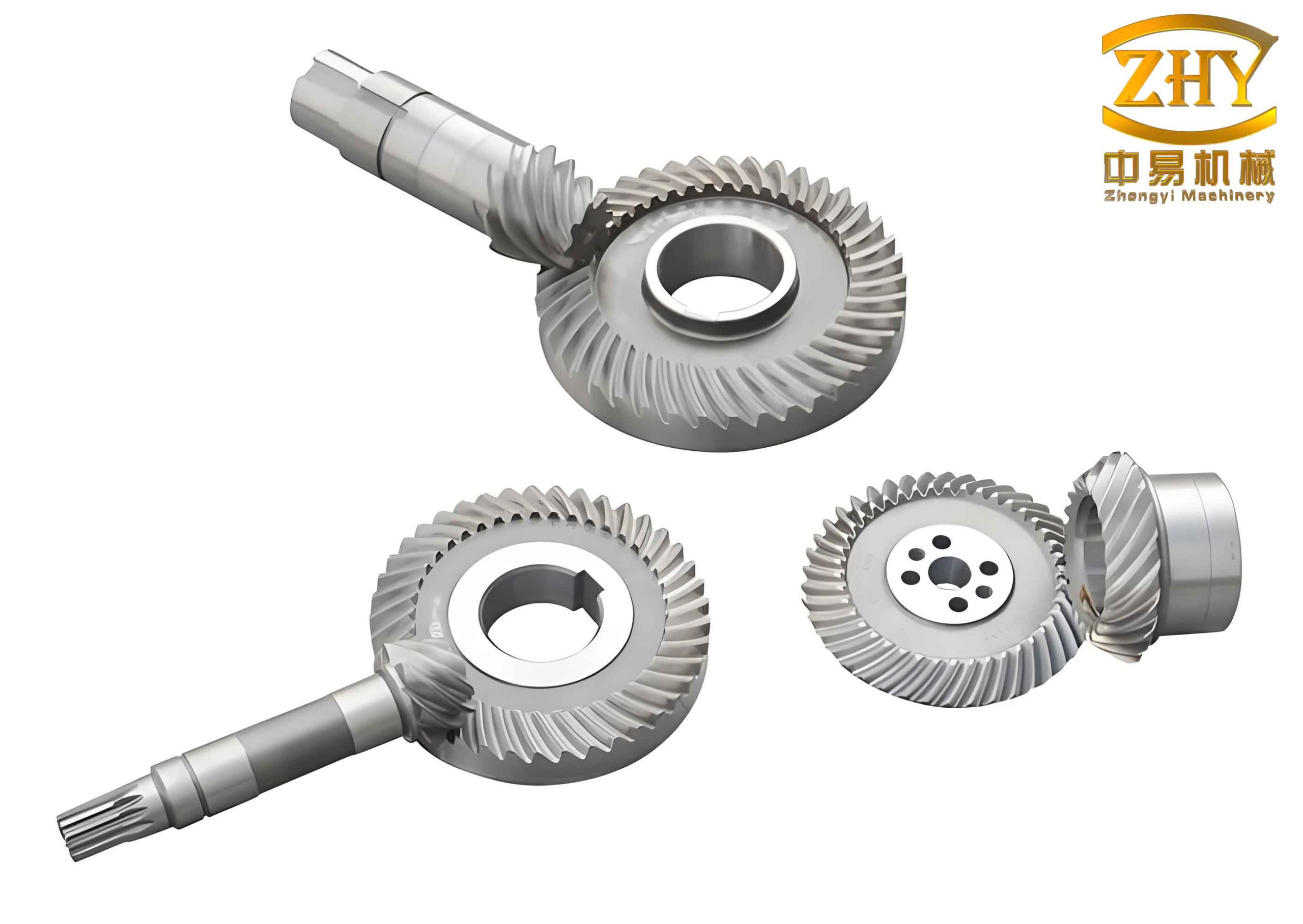
The design and performance prediction of advanced gear systems, such as hyperboloidal gears, are fundamentally rooted in classical spatial gearing theory. This body of work provides the essential mathematical framework for defining conjugate tooth surfaces, analyzing their contact conditions, and predicting their functional behavior under load. Recent advancements in tooth surface modification, including topological flank corrections and ease-off methodologies, all build upon this foundational theory of conjugate surfaces. This article delves into the core of this theory by explicitly defining and exploring two fundamental eigenfunctions and their associated vectors. These mathematical constructs elegantly capture the first and second-order differential characteristics of meshing surfaces. Their application provides a powerful and unified framework for analyzing key kinematic and geometric parameters that govern the performance of gear pairs. We will apply this eigenfunction-based approach to conduct a detailed investigation into the meshing characteristics of hyperboloidal gears, with a particular focus on quantifying the influence of the cutter head radius—a critical manufacturing parameter—on essential performance metrics like entrainment velocity, slide-to-roll ratio, and the effective radius of curvature at the contact point. Understanding these relationships is paramount for the optimal topological design and performance control of modern gear drives.
1. Fundamental Eigenfunctions of Conjugate Surfaces
The meshing of two gear tooth surfaces, denoted as $\Sigma^{(1)}$ and $\Sigma^{(2)}$, is governed by the fundamental equation of contact, which states that the relative velocity at a potential contact point must lie in the common tangent plane. This is expressed as $\mathbf{n} \cdot \mathbf{v}^{(12)} = 0$, where $\mathbf{n}$ is the common unit normal vector and $\mathbf{v}^{(12)}$ is the relative velocity of surface $\Sigma^{(1)}$ with respect to $\Sigma^{(2)}$. By differentiating this condition along the path of contact and performing necessary transformations, one can derive expressions that reveal the underlying differential structure of the conjugate pair.
1.1 Definition of Eigenfunctions and Eigenvectors
Starting from the differentiated contact condition and considering the motion trajectory $d\mathbf{r}_1 = d^1\mathbf{r}_1$, we arrive at the following relationship:
$$ \mathbf{n} \cdot \left[ \boldsymbol{\omega}^{(12)} \times (\boldsymbol{\omega}_1 \times \mathbf{r}_1) – \boldsymbol{\omega}_1 \times \mathbf{v}^{(12)} \right] = -\frac{d^1\mathbf{r}_1}{dt} \cdot \left[ \mathbf{n} \times \boldsymbol{\omega}^{(12)} + \mathbf{v}^{(12)} \frac{d^1\mathbf{n}}{ds} \right] $$
where $\boldsymbol{\omega}_1$ is the angular velocity of gear 1, $\boldsymbol{\omega}^{(12)} = \boldsymbol{\omega}_1 – \boldsymbol{\omega}_2$, and $d^1()/ds$ denotes differentiation with respect to the arc length on $\Sigma^{(1)}$.
We now define two pivotal vectors:
$$ \mathbf{q} = \boldsymbol{\omega}^{(12)} \times (\boldsymbol{\omega}_1 \times \mathbf{r}_1) – \boldsymbol{\omega}_1 \times \mathbf{v}^{(12)} $$
$$ \mathbf{p} = (\boldsymbol{\omega}^{(12)} \times \mathbf{n}) – \mathbf{v}^{(12)} \frac{d^1\mathbf{n}}{ds} $$
The vector $\mathbf{q}$ is termed the first-order eigenvector, and $\mathbf{p}$ is termed the second-order eigenvector. Using these definitions, we can compactly express two scalar functions:
$$ \Phi_I(u, v, t) = \frac{d^1\mathbf{r}_1}{dt} \cdot \mathbf{p} = \mathbf{n} \cdot \mathbf{q} $$
$$ \Phi_{II}(u, v, t) = \frac{d^2\mathbf{r}_2}{dt} \cdot \mathbf{p} = \mathbf{n} \cdot \mathbf{q} + \mathbf{p} \cdot \mathbf{v}^{(12)} $$
Here, $\Phi_I$ and $\Phi_{II}$ are the first-order and second-order eigenfunctions, respectively. They encapsulate the first and second-order differential properties of the conjugate surfaces and are central to analyzing their meshing behavior.
1.2 Physical Significance of the First-Order Eigenfunction $\Phi_I$
The first-order eigenvector $\mathbf{q}$ can be reformulated to highlight its geometric meaning:
$$ \mathbf{q} = (\boldsymbol{\omega}_1 \times \boldsymbol{\omega}_2) \times \mathbf{r}_1 – (\boldsymbol{\omega}_2 \cdot \boldsymbol{\omega}_1) \mathbf{a} $$
where $\mathbf{a}$ is the center distance vector. This form shows that $\mathbf{q}$ represents a screw motion of the contact point about the axis $\mathbf{a}$, independent of the local surface geometry. The eigenfunction $\Phi_I = \mathbf{n} \cdot \mathbf{q}$ is the projection of this motion onto the surface normal.
The condition $\Phi_I = 0$ defines the meshing limit (or first-order boundary) on surface $\Sigma^{(1)}$. At this limit, the velocity of the contact point along $\Sigma^{(1)}$ vanishes ($d^1\mathbf{r}_1/dt = 0$), while on $\Sigma^{(2)}$ it equals the relative velocity ($d^2\mathbf{r}_2/dt = \mathbf{v}^{(12)}$). This boundary separates the active meshing zone from the non-active zone on $\Sigma^{(1)}$ and is related to the envelope of consecutive contact lines. The corresponding limit normal $\mathbf{n}_0$ is perpendicular to both $\mathbf{q}$ and $\mathbf{v}^{(12)}$:
$$ \mathbf{n}_0 = \frac{\mathbf{v}^{(12)} \times \mathbf{q}}{\|\mathbf{v}^{(12)} \times \mathbf{q}\|} $$
Thus, $\Phi_I$ fundamentally determines the extent of the working area on the driving gear surface.
1.3 Physical Significance of the Second-Order Eigenfunction $\Phi_{II}$
The second-order eigenfunction and vector are intimately connected to the surface curvature. The vector $\mathbf{p}$ can be expressed in terms of the normal curvature $k_v^{(1)}$ and geodesic torsion $\tau_v^{(1)}$ of $\Sigma^{(1)}$ in the direction of $\mathbf{v}^{(12)}$:
$$ \mathbf{p} = \boldsymbol{\omega}^{(12)} \times \mathbf{n} + k_v^{(1)} \mathbf{v}^{(12)} + \tau_v^{(1)} (\mathbf{n} \times \mathbf{v}^{(12)}) $$
Alternatively, using principal curvatures $(k_e, k_f)$ and directions $(\mathbf{e}, \mathbf{f})$:
$$ \mathbf{p} = \boldsymbol{\omega}^{(12)} \times \mathbf{n} + \|\mathbf{v}^{(12)}\| (k_e \cos\varphi_v \mathbf{e} + k_f \sin\varphi_v \mathbf{f}) $$
where $\varphi_v$ is the angle between $\mathbf{v}^{(12)}$ and the principal direction $\mathbf{e}$.
The condition $\Phi_{II} = 0$ defines the curvature interference limit (or second-order boundary) on the generated surface $\Sigma^{(2)}$. This limit signifies the onset of undercutting. Furthermore, $\Phi_{II}$ and $\mathbf{p}$ directly yield the principal induced normal curvature $K_{II}$ between the surfaces:
$$ K_{II} = \frac{\|\mathbf{p}\|^2}{\Phi_{II}} $$
The other principal curvature $K_I$ is zero, corresponding to the direction tangential to the instantaneous contact line. Therefore, $\Phi_{II}$ governs phenomena related to second-order geometry, such as undercutting, contact ellipse size, and contact stress magnitude via the effective curvature.
1.4 Unified Expression of Kinematic Parameters via Eigenfunctions
The eigenfunctions provide a remarkably concise way to express critical kinematic parameters for contact and lubrication analysis:
- Contact Point Velocities: The components of the contact point velocities on $\Sigma^{(1)}$ and $\Sigma^{(2)}$ normal to the contact line are:
$$ u_1 = -\frac{\Phi_I}{\|\mathbf{p}\|}, \quad u_2 = -\frac{\Phi_{II}}{\|\mathbf{p}\|} $$ - Entrainment Velocity: The mean surface velocity responsible for generating a lubricant film in elastohydrodynamic lubrication (EHL) is:
$$ u_e = \frac{u_1 + u_2}{2} = -\frac{\Phi_I + \Phi_{II}}{2\|\mathbf{p}\|} $$ - Sliding Velocity: The component of the relative velocity normal to the contact line, which causes shearing, is:
$$ u_s = \mathbf{v}^{(12)} \cdot \frac{\mathbf{p}}{\|\mathbf{p}\|} = \frac{\Phi_{II} – \Phi_I}{\|\mathbf{p}\|} $$ - Slide-to-Roll Ratio (SRR): A key parameter in tribological analysis is:
$$ SRR = \frac{u_s}{u_e} = \frac{\Phi_{II} – \Phi_I}{(\Phi_I + \Phi_{II})/2} = 2\frac{\Phi_{II} – \Phi_I}{\Phi_I + \Phi_{II}} $$ - Effective Radius of Curvature: The combined radius governing Hertzian contact pressure is the inverse of the induced curvature:
$$ R_{eff} = \frac{1}{K_{II}} = \frac{\Phi_{II}}{\|\mathbf{p}\|^2} $$
This unified formulation demonstrates the power of the eigenfunction approach, linking fundamental differential geometry directly to practical performance metrics for gears like hyperboloidal gears.
2. Geometric and Kinematic Model of Hyperboloidal Gears
Hyperboloidal gears, or hypoid gears, are characterized by offset axes and complex curvatures. Their design relies on the simulation of a generating process, typically using a face-mill cutter. The choice of the cutter head radius ($r_0$) is a critical design variable, influencing the basic gear geometry and, consequently, its meshing performance.
2.1 Influence of Cutter Radius on Basic Gear Geometry
In the standard design process for hyperboloidal gears, the first-order eigenfunction condition $\Phi_I = 0$ is used to determine limiting parameters, such as the limiting pressure angle, to avoid meshing boundaries and lubrication dead points (where entrainment direction aligns with the contact line). The cutter radius is iteratively selected to satisfy convergence criteria related to this limit curvature. To illustrate its impact, consider a gear pair with the following fixed parameters: ratio 6/39, pitch diameter 230.0 mm, offset 35.0 mm. Calculations are performed for three different cutter sizes.
| Parameter | 6-inch Cutter (r₀ = 76.2 mm) | 7.5-inch Cutter (r₀ = 95.25 mm) | 9-inch Cutter (r₀ = 114.3 mm) |
|---|---|---|---|
| Pinion Face Width (mm) | 47.365 | 47.403 | 47.423 |
| Pressure Angle – Drive/Coast (°) | 15.940 / -22.060 | 14.841 / -23.159 | 14.106 / -23.894 |
| Pinion Pitch Angle (°) | 12.493 | 10.441 | 9.075 |
| Pinion Spiral Angle (°) | 76.650 | 78.833 | 80.289 |
| Gear Spiral Angle (°) | 8.774 | 8.76 | 8.754 |
| Gear Pitch Angle (°) | 70.906 | 72.901 | 74.333 |
The table clearly shows that a smaller cutter radius results in a larger pressure angle, a smaller pinion pitch angle, and a slightly reduced spiral angle for the gear member. These changes in basic geometry will inherently affect the kinematic characteristics derived from the eigenfunctions.
2.2 Mathematical Description of the Gear Tooth Surface
The tooth surface of the generated gear (member 2) is derived from the cutter surface. In the cutter coordinate system $O_c-i_c-j_c-k_c$, the cutter surface and its unit normal are given by:
$$ \mathbf{r}_c = \begin{bmatrix} r_u \cos\theta \\ r_u \sin\theta \\ u \cos\alpha \end{bmatrix}, \quad \mathbf{n}_c = \begin{bmatrix} -\cos\alpha \cos\theta \\ \cos\alpha \sin\theta \\ \sin\alpha \end{bmatrix} $$
where $r_u = r_0 – u \sin\alpha$, $r_0$ is the point radius of the cutter, $\alpha$ is the blade pressure angle, and $(u, \theta)$ are surface parameters.
This surface is then transformed into a coordinate system defined at the pitch point $P$ ($\mathbf{i}-\mathbf{j}-\mathbf{k}$ system, where $\mathbf{j}$ is along the relative velocity direction at $P$) and subsequently rotated about the gear axis $\mathbf{g}$ through the generating angle $\phi$ to produce the final gear tooth surface $\mathbf{r}_m^{(2)}$ and its normal $\mathbf{n}_m^{(2)}$. The generation angle $\phi$ is determined by solving the meshing equation $f(\theta, u, \phi) = \mathbf{n}_m^{(2)} \cdot \mathbf{v}^{(21)} = 0$.
2.3 Curvature and Motion Parameters
The principal curvatures of the cutter surface at the contact point are:
$$ k_e = \frac{\cos\alpha}{r_u}, \quad k_f = 0 $$
The normal curvature and geodesic torsion of the gear surface in the direction of the relative velocity $\mathbf{v}^{(21)}$ are found using Euler’s and Bertrand’s formulas:
$$ k_v^{(2)} = H + Q\cos 2\varphi_v, \quad \tau_v^{(2)} = -Q\sin 2\varphi_v $$
where $H=(k_e+k_f)/2$, $Q=(k_e-k_f)/2$, and $\varphi_v$ is the angle between $\mathbf{v}^{(21)}$ and the principal direction corresponding to $k_e$.
The angular velocity vectors of the gear and pinion in the pitch-point coordinate system are:
$$ \boldsymbol{\omega}^{(2)} = |\omega_2| \begin{bmatrix} -\cos\delta_2 \sin\beta_2 \\ \cos\delta_2 \cos\beta_2 \\ -\sin\delta_2 \end{bmatrix}, \quad \boldsymbol{\omega}^{(1)} = |\omega_1| \begin{bmatrix} \cos\delta_1 \sin\beta_1 \\ -\cos\delta_1 \cos\beta_1 \\ -\sin\delta_1 \end{bmatrix} $$
The relative velocity at any point on the surface during meshing is:
$$ \mathbf{v}^{(21)} = \mathbf{v}_0^{(21)} + \boldsymbol{\omega}^{(21)} \times \mathbf{r}_m^{(2)} $$
With these definitions, all components needed to compute the eigenfunctions $\Phi_I$, $\Phi_{II}$, and the vectors $\mathbf{q}$, $\mathbf{p}$ for the hyperboloidal gear pair are established.
3. Meshing Characteristic Analysis of Hyperboloidal Gears
Applying the eigenfunction framework, we can now systematically analyze the meshing behavior of the example hyperboloidal gear pair. The slide-to-roll ratio (SRR) and the effective radius of curvature ($R_{eff}$) are critical for assessing contact fatigue risk and elastohydrodynamic lubrication (EHL) film thickness, respectively.
3.1 Baseline Analysis with 7.5-inch Cutter
Using the geometric parameters from the 7.5-inch cutter design (Table 1) and setting the pinion speed to 1 (non-dimensional), we compute the kinematic fields across the tooth surface. The computational procedure is:
- Compute the gear surface geometry $\mathbf{r}_m^{(2)}, \mathbf{n}_m^{(2)}$.
- Compute curvature parameters $k_v^{(2)}, \tau_v^{(2)}$.
- Compute relative velocity $\mathbf{v}^{(21)}$ and its direction angle $\varphi_v$.
- Solve the meshing equation for the generating angle $\phi$.
- Compute eigenfunctions and vectors: $\Phi_I$, $\mathbf{q}$, $\Phi_{II}$, $\mathbf{p}$.
- Derive performance metrics: $u_s$, $u_e$, $SRR$, $R_{eff}$.
The results confirm that the designed surface is free of meshing limits ($\Phi_I \neq 0$) and curvature interference limits ($\Phi_{II} \neq 0$). The sliding velocity field is predominantly longitudinal and relatively uniform. A significant angle exists between the contact lines and the relative velocity vector, generating substantial entrainment velocity ($u_e$). The SRR remains below 0.7, and the effective radius of curvature shows a favorable distribution. These conditions suggest good potential for effective EHL.
| Metric | Symbol | Typical Value (Range) | Implication |
|---|---|---|---|
| Sliding Velocity | $u_s$ | Moderate, Uniform | Governs friction losses and heat generation. |
| Entrainment Velocity | $u_e$ | High | Promotes formation of a protective lubricant film. |
| Slide-to-Roll Ratio | $SRR$ | < 0.7 | Indicates a favorable mix of rolling and sliding for wear and EHL. |
| Effective Radius | $R_{eff}$ | Varies across face | Directly influences contact stress ($\sigma_H \propto 1/\sqrt{R_{eff}}$). |
3.2 Influence of Cutter Head Radius on Meshing Performance
To isolate the effect of the cutter radius, we compare the key performance metrics—entrainment velocity $u_e$, slide-to-roll ratio $SRR$, and effective radius $R_{eff}$—for the three design variants (6″, 7.5″, and 9″ cutters). The analysis follows the same procedure, keeping all non-cutter-related design intents constant.
The results reveal consistent trends:
- Entrainment Velocity ($u_e$): The smaller 6-inch cutter generates a notably higher entrainment velocity across the tooth face compared to the larger 9-inch cutter. Higher $u_e$ is universally beneficial for EHL film formation, reducing the risk of metallic contact and surface distress.
- Slide-to-Roll Ratio ($SRR$): The gear pair generated with the smaller cutter exhibits a lower slide-to-roll ratio. A lower SRR generally correlates with reduced friction and wear, as the contact involves a greater proportion of rolling motion.
- Effective Radius of Curvature ($R_{eff}$): The influence is most pronounced here. The smaller cutter radius produces a significantly larger effective radius of curvature at the contact point. Since Hertzian contact pressure is inversely proportional to the square root of $R_{eff}$ ($p_{max} \propto 1/\sqrt{R_{eff}}$), a larger $R_{eff}$ directly leads to lower contact stresses, enhancing the surface durability and resistance to pitting fatigue.
| Performance Metric | Trend with Decreasing Cutter Radius | Mechanical & Tribological Benefit |
|---|---|---|
| Entrainment Velocity ($u_e$) | Increases | Improves lubricant film thickness, reduces wear. |
| Slide-to-Roll Ratio ($SRR$) | Decreases | Reduces friction losses and heat generation. |
| Effective Contact Radius ($R_{eff}$) | Increases significantly | Lowers Hertzian contact stress, improves pitting resistance. |
| Overall EHL & Contact Condition | Markedly Improved | Favors higher load capacity and longer service life. |
The underlying mechanism is geometric: a smaller cutter radius increases the local curvature of the generating tool. This change propagates through the generation process, altering the second-order properties (captured by $\mathbf{p}$ and $\Phi_{II}$) of the final hyperboloidal gear tooth surface in a way that favorably increases $R_{eff}$. Simultaneously, it modifies the first-order kinematic relationship (captured by $\mathbf{q}$ and $\Phi_I$) to improve the velocity conditions ($u_e$ and SRR). While a smaller cutter may have practical limitations in terms of cutting efficiency (fewer blade groups), the analysis conclusively shows its superior performance from a contact mechanics and lubrication standpoint for hyperboloidal gears.
4. Conclusion
This exploration reaffirms the power and elegance of classical spatial gearing theory when framed through the lens of eigenfunction analysis. The explicit definition of the first and second-order eigenfunctions, $\Phi_I$ and $\Phi_{II}$, along with their associated eigenvectors $\mathbf{q}$ and $\mathbf{p}$, provides a profound and unified methodology for dissecting the meshing behavior of conjugate surfaces. These functions seamlessly integrate geometric and kinematic properties, offering direct pathways to compute critical parameters such as meshing boundaries, induced curvature, contact point velocities, entrainment velocity, sliding velocity, and the slide-to-roll ratio.
The application of this framework to hyperboloidal gears has yielded clear and actionable insights. The systematic study on the influence of the generating cutter head radius demonstrates that this fundamental manufacturing parameter has a decisive impact on final gear performance. Specifically, the analysis proves that selecting a smaller cutter radius leads to:
- An increased effective radius of curvature, which lowers Hertzian contact stress and improves resistance to contact fatigue.
- An increased entrainment velocity, which promotes the formation of a thicker elastohydrodynamic lubrication film.
- A reduced slide-to-roll ratio, which favors lower friction and wear.
These combined effects significantly enhance the potential contact and lubrication performance of the hyperboloidal gear pair. Therefore, the eigenfunction-based analysis not only provides a deep theoretical understanding but also serves as a practical guide for performance-driven design optimization. It establishes a rigorous foundation for the subsequent topological modification and precise control of meshing performance in high-performance gear systems, ensuring their reliability and efficiency in demanding applications.